
Gino D’Acampo’s estimated net worth in 2026 sits between £8 million and £10 million — up from roughly £3.5 million in the early stages of his television career. That growth has come despite two significant restaurant failures: the 2022 liquidation of his My Pasta Bar chain, which left £5 million in unpaid debts, and the 2025 administration of his premium dining group. In both cases, his personal holding companies remained legally separate and financially unaffected.
D’Acampo consistently maintained that My Pasta Bar was a standalone business, entirely separate from his premium assets — and the corporate filings bear that out. The closure accelerated a shift that was already underway: away from owning and operating restaurants, and toward licensing his name and recipes to partners who bear the property and staffing risk. By 2026, his income reaches audiences through television repeats, supermarket shelves, and hotel dining rooms — none of which require him to employ a single chef directly.
Born Gennaro D’Acampo on 17 July 1976 in Torre del Greco, near Naples, he moved to London at 18 to pursue a culinary career, initially working at The Orchard Restaurant in Hampstead. His grandfather Giovanni was a professional cook — the family connection to Italian food that D’Acampo would later turn into a television career and a portfolio of food businesses.
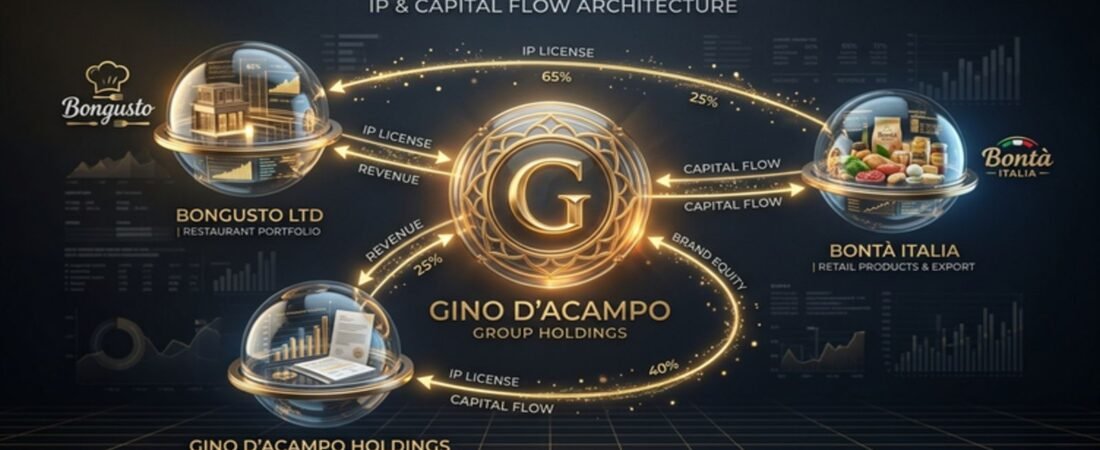
At the centre of D’Acampo’s business structure sits Bongusto Limited, the company that holds and manages his brand rights. It operates alongside Bontà Italia Ltd — his Italian ingredient supply business — and Gino D’Acampo Holdings Ltd, which reported accumulated profits of £4,893,220 in its most recent Companies House filings.
The D’Acampo Arc 2009 – 2026
From primetime victory to an £8M–£10M business portfolio — and the restructuring crisis that tested it.
I’m a Celebrity — Winner
Wins ITV’s I’m a Celebrity…Get Me Out of Here!, transforming from a regular This Morning chef into a primetime household name overnight. The win made him one of ITV’s most recognisable food presenters for the following decade.
My Pasta Bar & My Restaurant Chains Launch
Enters the high-street hospitality market with My Pasta Bar (fast-casual) and the premium My Restaurant concept. The two formats aimed at different markets — quick-service and premium dining — but the fast-casual arm carried high fixed costs that would prove unsustainable during the pandemic.
Meliá Partnership Signed; Upmarket Directorship Exit
Signs a licensing agreement with Spain’s Meliá Hotels International — the hotel group covers property costs, fit-out, and staffing, while D’Acampo earns licensing and menu direction fees. He simultaneously steps back as a person with significant control of Upmarket Leisure, creating legal separation between his personal holding companies and the restaurant operation.
My Pasta Bar Liquidated — Asda Range Goes Live
January 2022: My Pasta Bar enters liquidation with £5 million in debts — £4.9M to trade creditors, £113,975 to HMRC, and £37,887 in staff wages. D’Acampo attributes the collapse to Covid-19 trading damage. Simultaneously: the Asda partnership goes live with 60+ products across chilled ready meals and Italian store-cupboard essentials — replacing volume hospitality revenue with higher-margin retail licensing income.
Upmarket Leisure Rebrand
The premium restaurant operating entity — previously trading as Gino D’Acampo Hotels and Leisure — rebrands to Upmarket Leisure Ltd, creating clearer legal separation between D’Acampo’s personal holding companies and the restaurant operation — a structural change that would matter considerably when financial pressure arrived two years later.
ITV Allegations Investigation — Programming Pulled
ITV News publishes an investigation on 6 February 2025 citing dozens of former colleagues alleging bullying, intimidation, and sexually inappropriate behaviour spanning more than a decade. ITV begins pulling repeats the following day. D’Acampo, through his legal team, has firmly and consistently denied all allegations. Companies House filings confirm net assets at Gino D’Acampo Ltd dropped significantly in the financial year ending April 2025, with earnings slumping by over £150,000 following ITV’s withdrawal.
Administration, £5M Pre-Pack Sale — Production Resumes
April 2025: Upmarket Leisure Ltd enters administration with total liabilities exceeding £11 million — including approximately £4.2 million owed to HMRC and £3 million to unsecured trade creditors.
Pre-pack sale: The five premium restaurant sites (London, Leeds, Liverpool, Manchester, Newcastle) are acquired for £5 million by Upmarket Hotels & Leisure, preserving all 400 jobs and maintaining trading. D’Acampo’s personal IP entities — Bongusto Limited, Gino D’Acampo Holdings Ltd — are legally unaffected.
Production resumes: Spaghetti Wars and An Italian in Malta broadcast in 2025, demonstrating continued international commissioning appetite for D’Acampo content outside the ITV relationship.
Second HMRC Winding-Up Petition — Personal Entities Unaffected
July 30, 2026: HMRC files a second winding-up petition at the High Court against Upmarket Hotels & Leisure — the same entity that acquired the restaurants out of the 2025 administration. The petition signals ongoing financial instability in the operational restaurant business.
Personal IP insulated: Gino D’Acampo Holdings Ltd, Bongusto Limited, and Bontà Italia Ltd remain separate legal entities and are unaffected by the petition. The £4.89 million in accumulated profits held by Holdings Ltd remains the most significant cash reserve within D’Acampo’s personal business structure.
Sources: Companies House (Gino D’Acampo Ltd #08024736; Upmarket Leisure Ltd); The Caterer; ITV News; High Court public records; Elites Mindset editorial research.
His wife, Jessica Stellina Morrison, is a named director across the key holding entities — Gino D’Acampo Holdings Ltd and Gino D’Acampo Ltd — giving the business structure continuity and keeping control within the family. Where Gordon Ramsay has built his wealth through owned restaurants, Michelin recognition, and international expansion, D’Acampo’s model is built around his public persona: retail partnerships, television, and licensed hospitality concepts that generate recurring income without significant upfront capital.
The Bongusto Portfolio: How D’Acampo’s Business Structure Generates Income Beyond Television
D’Acampo’s wealth does not depend on his restaurants turning a profit. His television back-catalogue — including five series of Gordon, Gino and Fred: Road Trip and the long-running Gino’s Italian Escape franchise — continues to generate licensing income through international distribution and streaming repeats, independent of whatever is happening in his dining rooms.
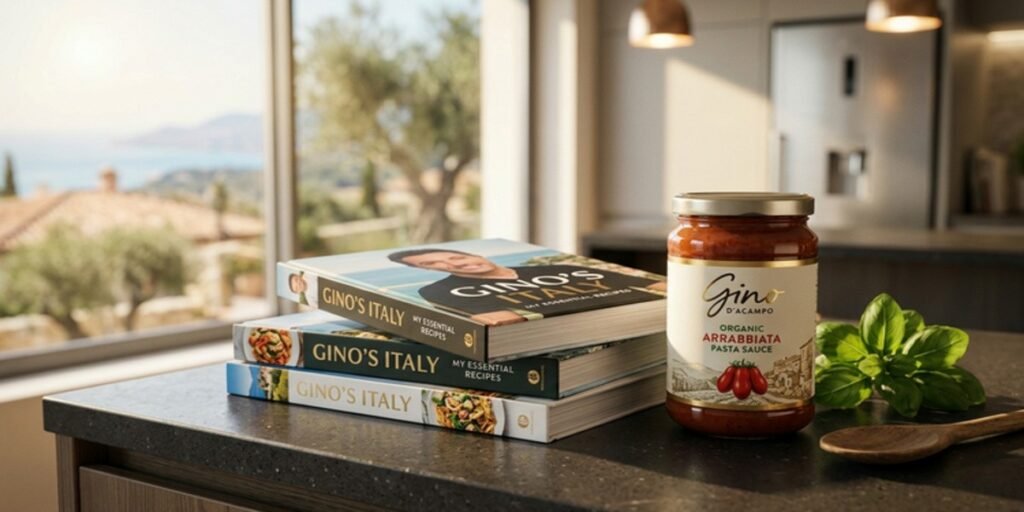
His publishing output — more than 20 cookbooks, including Gino’s Italy: Like Mamma Used to Make and Gino’s Italian Family Adventure, both published by Bloomsbury — adds a further income layer that benefits directly from television exposure. Each new series drives sales of existing titles without additional marketing spend: the programmes are, in effect, extended advertisements for books already in print. Gino’s Italian Family Adventure was specifically noted as contributing to Bloomsbury’s profit upgrades.
The underlying corporate structure keeps these income streams separate and clearly documented. Gino D’Acampo Ltd — the primary trading company he co-owns with Jessica — reported accumulated profits of £417,097 in recent filings. His talent management company, MEMS Agency Limited, added a further £408,197 in profits in 2024. Combined with the £4.89 million held in Gino D’Acampo Holdings Ltd, these entities generate meaningful cash flow that has nothing to do with whether his restaurants are full.
When his restaurant group entered administration in 2025, these holding-company reserves were untouched. Bongusto Limited and Bontà Italia Ltd are legally separate from the operational restaurant businesses, which means his cookbook royalties, television residuals, and brand licensing fees continued regardless of what was happening in the dining rooms.
He also holds six Guinness World Records — all set on his cookery programmes — a piece of brand trivia that reinforces his entertainment-first positioning within the culinary space.
His retail food development career predates the Asda partnership: D’Acampo’s collaboration with Tesco’s Finest range was an earlier version of the same idea — putting his name and recipes into mainstream supermarket products.
The Asda partnership, signed in 2021, took that model further — launching over 60 products across chilled ready meals, organic store-cupboard essentials, and frozen Italian classics inspired by his Nonna Flora.
The Asda deal went beyond a simple name-licensing arrangement — it was a product-development collaboration that placed his recipes into the weekly shop of millions of British families. Supermarket retail generates far better margins than restaurant service, and the shelf presence quietly advertises his premium hospitality brands at no additional cost.
By 2026, D’Acampo’s content is distributed across streaming platforms, international syndication, and retail simultaneously. An Italian in Malta broadcast in 2025, adding to a growing international content slate outside the ITV relationship.
Family Ownership Structure:
D’Acampo and Jessica Stellina Morrison have been married since 2002, and Jessica is an active director across Gino D’Acampo Holdings Ltd, Gino D’Acampo Ltd, and MEMS Agency Limited. That continuity of control matters: several high-profile celebrity chef divorces have forced rushed asset sales or triggered brand complications. D’Acampo has spoken publicly about the couple’s approach to their relationship, and the shared directorship structure means the business remains under family control. The couple have three children — Luciano, Rocco, and Mia.
From High Street to Licensing: The Restaurant Strategy Shift
D’Acampo’s financial position in 2026 is, in part, a consequence of what he no longer owns. The January 2022 liquidation of My Pasta Bar — which he attributed to the impact of the Covid-19 pandemic — removed £5 million in liabilities from his portfolio. The May 2025 administration of Upmarket Leisure went further: the group entered administration with total liabilities exceeding £11 million, including roughly £4.2 million owed to HMRC and approximately £3 million to unsecured trade creditors. The business was sold in a pre-pack deal and the brand survived, but the debt did not follow D’Acampo personally. The practical result is a shift from running pasta bars with high fixed costs to licensing his name to Meliá Hotels, which bears the property and staffing risk entirely.
2026 Update: The restructured entity, now operating as Upmarket Hotels & Leisure, was served with a second HMRC winding-up petition on 30 July 2026 — filed at the High Court against the same Manchester-registered company and directors that acquired the restaurants out of the 2025 administration. The petition signals continued financial instability in the operational restaurant business. D’Acampo’s personal holding entities (Gino D’Acampo Holdings Ltd, Bongusto Limited) are separate and unaffected by this action. The 2026 Asset Matrix “Stable / Growth” outlook for the Hospitality row should be read with this caveat.
Digital Reach as a Commercial Asset:
With 2.5 million Instagram followers as of early 2026, and a combined cross-platform audience exceeding five million across Facebook, TikTok, and Twitter, D’Acampo maintains a direct line to his audience that operates entirely outside broadcast television. That audience drives cookbook sales, supports restaurant bookings, and gives him genuine negotiating weight when renewing brand endorsements — without relying on a broadcaster to schedule his content. When ITV ended its relationship with him in 2025, that direct audience connection went from being a nice-to-have to something his business actually depends on.
| Feature | D’Acampo | Ramsay | Oliver |
|---|---|---|---|
| Primary wealth vehicle | Holding company IP | Global restaurant group | Media + Naked Group |
| Restaurant model | Licensed (Meliá) | Owned/franchised | Multiple failures (2019) |
| Cookbook output | 20+ titles | 20+ titles | 30+ titles |
| Supermarket presence | Asda (60+ products) | Various | Sainsbury’s (extensive) |
| Broadcaster | ITV (disrupted 2025) | Global/Netflix | Channel 4 |
| Risk profile | Moderate–High | High (capital-intensive) | High (post-administration) |
Gino D’Acampo (Personal)
├── Gino D’Acampo Holdings Ltd [IP holding; £4.89M profits]
├── Bongusto Limited [Brand IP management]
├── Bontà Italia Ltd [Italian ingredient supply]
├── Gino D’Acampo Ltd [Primary trading vehicle; with Jessica]
└── MEMS Agency Limited [Talent management; £408K profits 2024]
Separate / arm’s-length:
└── Upmarket Hotels & Leisure (formerly Upmarket Leisure)
[Restaurant operator; NOT D’Acampo-controlled since 2021]
The Meliá Partnership: Why D’Acampo Stopped Owning Restaurants
The clearest shift in D’Acampo’s business model over the past five years is his exit from restaurant ownership and his move toward licensing. The Meliá partnership is the most visible example: the hotel group owns the sites, employs the staff, and carries the property risk, while D’Acampo provides the brand and menu direction.
D’Acampo was clear publicly that My Pasta Bar was legally and financially separate from his premium operations — “sometimes you win and sometimes you lose,” as he put it. The fast-casual format was always exposed to the same pressures that have damaged similar chains: thin margins, high fixed rents, and labour costs that don’t flex easily when trade falls. The Meliá model sidesteps all of those.
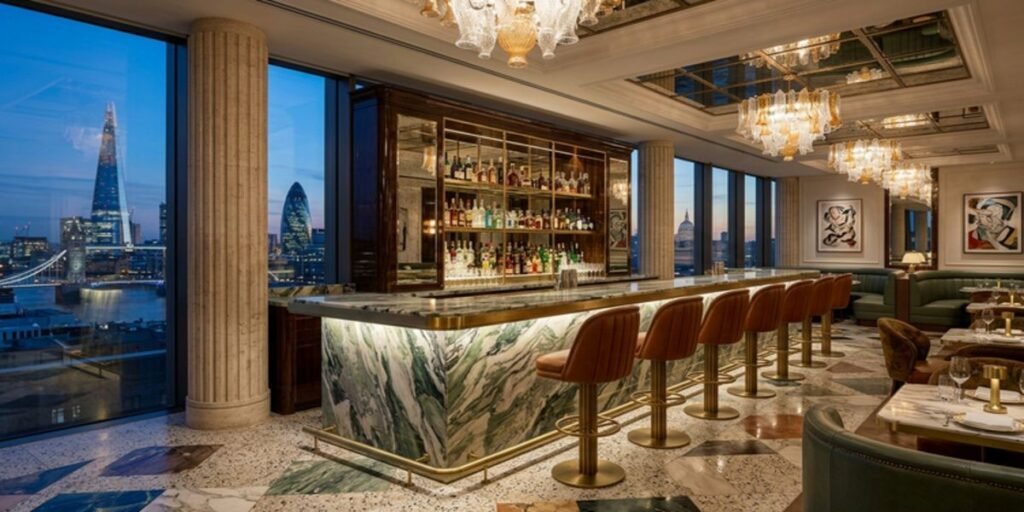
The partnership with Meliá Hotels International, signed in 2021, works simply: Meliá provides the venues, staff, and infrastructure; D’Acampo provides the brand name and culinary direction in exchange for licensing fees. He takes a smaller cut than he would as an owner, but he also carries none of the downside risk if a site underperforms. Given what happened to his owned restaurants, that trade-off looks well-judged.
This framework has produced Luciano by Gino D’Acampo—named after his eldest son and positioned as a higher-end Italian destination at the ME London hotel on The Strand—alongside Gino D’Acampo 360 Sky Bar on the 18th floor of INNSiDE by Meliá in Liverpool, offering panoramic Mersey views and premium cicchetti. Additional INNSiDE by Meliá partnerships operate in Manchester and Newcastle.
In May 2025, Upmarket Leisure Ltd — formerly trading as Gino D’Acampo Hotels and Leisure before its 2023 rebrand — entered administration with total liabilities exceeding £11 million, including approximately £4.2 million owed to HMRC. The brand was considered sufficiently viable that a buyer emerged quickly: a £5 million pre-pack sale preserved all 400 jobs and kept all five sites — London, Leeds, Liverpool, Manchester, and Newcastle — trading through the transition.
The group reported turnover of £20 million, which helps explain why a buyer was willing to pay £5 million for the assets rather than let them be wound down. D’Acampo had stepped back as a person with significant control in 2021; the business was majority owned by Steven Walker and former JD Sports CEO Peter Cowgill. His exact residual stake, if any, is not publicly disclosed. The Meliá-branded sites continue to operate under his name, and the licensing fees flow to his personal holding companies regardless of who owns the dining rooms.
Television Career: How Fifteen Years on ITV Built — and Then Complicated — His Business Model
Before his television career took hold, D’Acampo was convicted of burglary in 1998 and served a prison sentence — a biographical detail he has spoken about publicly and which sits in stark contrast to the aspirational brand he subsequently built. The arc from conviction to primetime television host is itself a commercial asset: his story is one of genuine reinvention.
For fifteen years, D’Acampo appeared regularly on ITV’s This Morning — a presence consolidated by his I’m a Celebrity win in 2009, though he had featured on the programme before that victory. That sustained free-to-air exposure drove cookbook sales, restaurant bookings, and brand deals without any marketing spend on his part. Unlike chefs whose commercial value depends on Michelin recognition, D’Acampo’s appeal was always built on accessibility: he made Italian cooking feel straightforward, which made him a natural fit for supermarket partnerships like the 2021 Asda range. At his peak, he was estimated to earn around £2 million annually from television and related media, with individual brand endorsements reaching six-figure fees.
Beyond This Morning, D’Acampo fronted ITV’s revived Family Fortunes from 2020 to 2023, taking over the format five years after Vernon Kay’s celebrity edition ended. The role demonstrated his range beyond food programming and gave ITV another reason to keep him on the payroll across multiple prime-time slots.
ITV began pulling repeats of D’Acampo’s programming on 7 February 2025 — one day after an ITV News investigation cited dozens of former colleagues alleging bullying, intimidation, and sexually inappropriate behaviour spanning more than a decade. ITV ended its relationship with D’Acampo entirely. Through his legal team, D’Acampo has firmly and consistently denied all allegations. The financial impact was real regardless of how the allegations are ultimately resolved: Companies House filings show net assets at Gino D’Acampo Ltd dropped significantly in the year ending April 2025, with overall earnings falling by more than £150,000 following ITV’s withdrawal.
His back-catalogue has provided a degree of cushion: repeats of Gordon, Gino and Fred continue to air internationally, his cookbooks remain in print through Bloomsbury and other publishers, and he resumed active production in 2025 with Spaghetti Wars and An Italian in Malta. Chefs whose income depends entirely on active service contracts have no equivalent buffer. D’Acampo’s fifteen years of broadcast output created a library that generates discovery and sales long after original transmission — something a restaurant booking cannot replicate.
In late 2025, D’Acampo expanded further internationally — filming An Italian in Canada, serving as a guest judge on MasterChef Malta, and appearing at the Taste of Abu Dhabi food festival in November 2025. The diversification away from ITV is already underway.
| Asset Class | Revenue Stream | Risk Profile | 2026 Outlook |
|---|---|---|---|
| Media IP | TV Contracts & Book Royalties | Low | Stable / Growth |
| Hospitality | Luciano & Meliá Partnerships | Medium–High | Under Review |
| Retail | Brand Endorsements (Asda/Bongusto) | Low | Recurring Income |
| Real Estate | Personal & Commercial Property | Low | Appreciating |
Risk Register — D’Acampo Portfolio (2026)
🔴 Reputational risk: ITV allegations (denied) remain unresolved and have already caused material revenue impact.
🔴 Hospitality instability: Second HMRC winding-up petition (July 2026) against Upmarket Hotels & Leisure — the same entity that bought the restaurants out of 2025 administration.
🟠 Broadcaster diversification pressure: ITV has confirmed it has no plans to work with D’Acampo again. His 2025–2026 output relies on international commissions and non-ITV platforms — a revenue stream that is growing but not yet proven to replace ITV-era income levels.
🟠 Brand licensing dependency: Core Bongusto value depends on D’Acampo’s personal reputation remaining commercially viable.
🟢 Holdings Ltd insulation: Gino D’Acampo Holdings Ltd cash (£4.89M) is legally ring-fenced from operational hospitality entities.
Gino D’Acampo Net Worth 2026: Summary
As of 2026, Gino D’Acampo’s estimated net worth sits between £8 million and £10 million. That figure is grounded in his television back-catalogue, publishing royalties, retail partnerships, and the Meliá hotel licensing agreements. Despite two significant restaurant failures — the 2022 My Pasta Bar liquidation and the 2025 Upmarket Leisure administration — his core holding companies have remained untouched, which is the clearest validation of the legal separation he put in place.
Companies House filings for Gino D’Acampo Limited (Company No. 08024736) show Gino D’Acampo Holdings Ltd carrying accumulated profits of £4.89 million. A publishing catalogue of more than 20 cookbooks provides a further income base that is not dependent on broadcast schedules, and his content has moved increasingly into international streaming and syndication following the ITV withdrawal.
Frequently Asked Questions
Is Gino D’Acampo a billionaire?
No. D’Acampo’s estimated fortune of between £8 million and £10 million puts him firmly in high-net-worth territory, well below the billionaire threshold. His holding companies carry £4.89 million in accumulated profits, and his income from publishing and retail licensing is not tied to whether his restaurants are trading. That gives him a more stable financial base than chefs whose wealth is concentrated in owned restaurant operations.
Who owns Gino D’Acampo’s restaurants?
The premium restaurant sites — including Luciano — are operated by Upmarket Hotels & Leisure Ltd, the entity that acquired the assets out of the 2025 administration for £5 million. D’Acampo stepped back as a person with significant control of the restaurant operating company in 2021; the business was majority owned by Steven Walker and former JD Sports CEO Peter Cowgill. His exact residual stake, if any, is not publicly disclosed. His brand IP sits in entirely separate holding companies — Gino D’Acampo Holdings Ltd and Bongusto Limited — which are unaffected by whatever happens to the restaurant operator.
How did the 2025 ITV separation affect his wealth?
ITV ended its relationship with D’Acampo over the course of 2025, following allegations he has firmly and consistently denied through his legal team. Companies House filings show his personal trading company took a hit — assets down significantly, with earnings falling by more than £150,000. The income from his holding companies, publishing royalties, and retail licensing is not ITV-dependent, and he has continued producing content for international distribution — including An Italian in Malta and An Italian in Canada. His 20+ cookbooks and global television repeats provide income that does not rely on any single broadcaster.
What does the Bongusto business structure actually do?
Bongusto Limited is the company that holds and manages D’Acampo’s brand rights. Working alongside Bontà Italia Ltd — his Italian ingredient supply business — it covers his supermarket licensing arrangements (including the 60+ product range with Asda), his publishing rights, and ingredient supply chains. Revenue comes through licensing fees rather than the operational costs of running kitchens and dining rooms, which is why its margins are higher and its exposure to the kind of trading disruption that hit his restaurant group is much lower.
How much does he make per TV appearance?
Specific rates are not publicly disclosed, but industry benchmarks suggest D’Acampo commanded six-figure fees for primetime franchises and major brand endorsements. At his peak, his combined media and talent management earnings — the latter handled through MEMS Agency Ltd — reached approximately £2 million annually. His 2025 disruption has affected that figure, but his international profile — built over fifteen years of broadcast television across multiple formats — means he continues to be booked for international projects, live events, and brand work.