
This article was written by Javed Ahmad (IT Specialist & FinTech Contributor) and independently reviewed for factual accuracy by Shamima Khatoon (Elites Mindset editorial team).
The 2026 regulatory environment has fundamentally altered the cost of inaccuracy. For Ultra High Net Worth (UHNW) entities, family offices, and private investment vehicles, the transition to SEC Inline XBRL (iXBRL) mandates is not merely a formatting upgrade — it is a fundamental change in how financial data must be structured, traced, and made machine-readable from the moment it leaves the ledger.
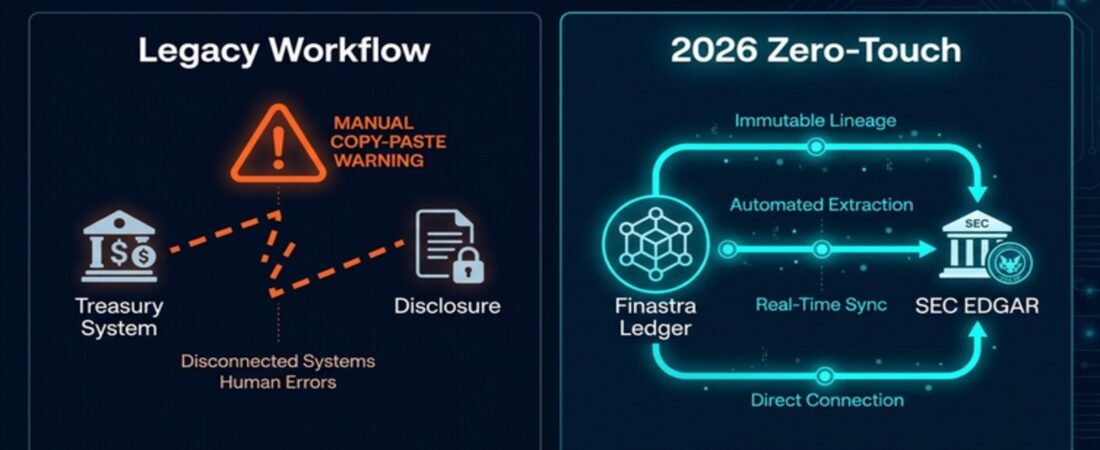
At the center of this transformation lies the “Original Quote Gap”: the precise moment when source data from treasury systems is manually extracted, copied, and pasted into disclosure documents, severing the digital audit trail.
A note on scope: not all UHNW structures are SEC filers. Single-family offices managing only family assets are generally exempt from SEC registration under the Investment Advisers Act. Multi-family offices, fund structures with outside investors, and entities that have issued publicly registered securities do fall within the SEC’s jurisdiction. The iXBRL and disclosure automation requirements discussed here apply to registered entities — but the underlying data lineage principles are equally relevant to any UHNW structure subject to investor reporting obligations, regardless of regulatory status.

In 2026, this gap represents a material weakness. When an auditor cannot trace a reported figure back to its originating system without encountering a human intermediary and a static spreadsheet, the filing entity faces heightened scrutiny, potential restatement risk, and the erosion of audit defensibility. The SEC’s 2026 validation protocols now enforce semantic consistency across filings, meaning a value tagged in one context cannot diverge in another without triggering EDGAR validation errors, potential filing rejection, or SEC staff comment letters requesting correction or restatement.
The architecture to close this gap has matured. Forward-looking UHNW entities are moving away from the “Analyst-in-the-Middle” model…toward what compliance technology vendors describe as a “Zero-Touch Filing” approach — a fully automated pipeline in which no human manually transcribes data between systems. This approach treats the disclosure document not as a destination for manually assembled data, but as a live, synchronized endpoint fed directly by the general ledger. The result is immutable data lineage: every number in a 10-K, 10-Q, or private stakeholder report carries a digital birth certificate that traces directly to the source system, timestamped, version-controlled, and free from manual transcription errors.
Intelligence Brief: The 2026 Disclosure Stack
Regulatory Horizon: Domestic operating company filers submitting Form 10-K, 10-Q, and certain registration statements must include cover page, financial statement, footnote, and auditor information in Inline XBRL format. Family offices and private investment vehicles that are not SEC registrants are not directly subject to this mandate — but those that are registered, or whose funds are, should treat iXBRL compliance as a baseline rather than an advanced requirement. The SEC’s 2026 EDGAR validation suite now checks for semantic consistency at the instance level—meaning identical facts must carry identical values across all tagged locations.
Forensic Threshold: Manual copy-paste workflows between treasury systems and disclosure platforms are a recognized risk factor under SOX Section 404 internal control assessments — and where compensating controls are absent or insufficient, they can rise to the level of a reportable control deficiency or material weakness. KPMG’s 2024 material weakness study found that IT, software, security, and access control issues have been a steadily growing driver of material weakness disclosures every year from 2021 to 2024 — now ranking among the top five causes across all filers.
Am I Required to File in iXBRL?
A five-step decision tree for UHNW entities, family offices, registered funds and their compliance officers — 2026 filing year
Is the entity registered with the SEC — or does it advise or issue securities that are?
Registration status is the gateway test. Everything downstream depends on it.
Is it a domestic operating company — rather than a Foreign Private Issuer?
Domicile and issuer classification determine which rule set and which taxonomy govern your filing.
Does it file Form 10-K or 10-Q — or a registration statement containing financial statements?
The mandate attaches to the form, not to the entity. This is the question most often got wrong.
What is your filer status — Large Accelerated, Accelerated, or Non-Accelerated?
Status is set by public float and reporting history under Exchange Act Rule 12b-2. It changes your deadline, not whether you tag.
✓ iXBRL Tagging Required — Full Scope
Cover page data, primary financial statements, all footnotes, and auditor identification must be tagged in Inline XBRL. Block tagging plus detailed footnote tagging applies. Annual 10-K deadlines by filer status:
Which taxonomy applies to your entity type?
Taxonomy selection drives element choice. Using the wrong release year is itself a common source of validation errors.
FASB US-GAAP Financial Reporting Taxonomy
The default for domestic operating companies. Released annually by FASB and accepted by EDGAR for a defined window — filing against a superseded release triggers validation errors. Current releases at xbrl.fasb.org.
IFRS Accounting Taxonomy
Applies to foreign private issuers reporting under IFRS as issued by the IASB. Maintained by the IFRS Foundation. Rarely relevant to domestic UHNW structures, but decisive where a cross-border holding company is the registrant.
This flowchart is an orientation tool, not legal advice. Filer status, form scope and taxonomy acceptance windows change. Confirm current obligations with qualified securities counsel before filing.
2026 Disclosure Architecture
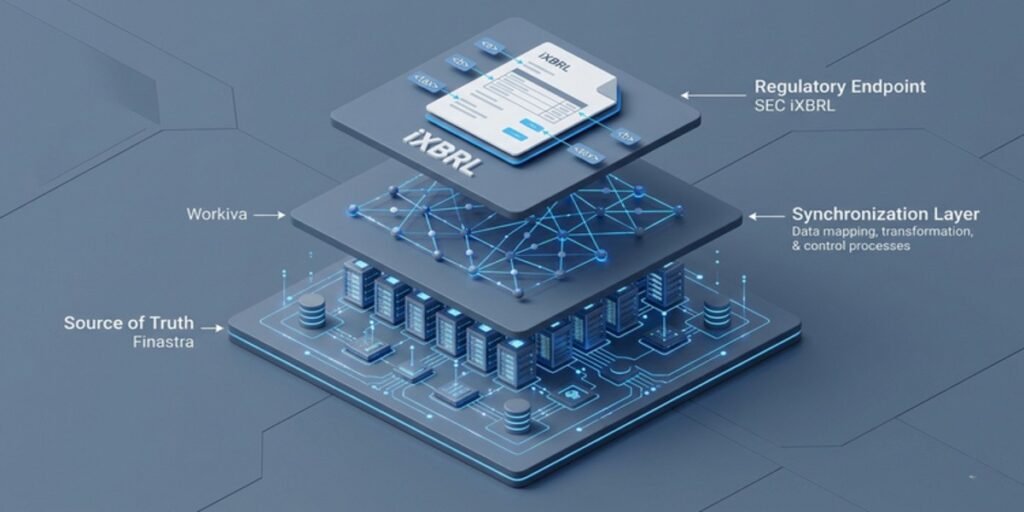
API-led connectivity eliminates the Original Quote Gap by maintaining a persistent, queryable link between the ledger cell and the tagged disclosure fact, ensuring data lineage is preserved from origin to submission.
Bridging the Original Quote Gap: The Workiva Wdesk Integration Logic
The Workiva platform functions as the connective tissue between source financial data and SEC-mandated disclosure outputs. Its core technical mechanism—live linking—operates at the cell level. When a treasury datum originates in Finastra’s general ledger and flows into Workiva’s Wdesk environment, it is not imported as a static value. Instead, Workiva establishes a persistent formulaic link between the source dataset and every downstream instance of that data across the reporting ecosystem. A change in a single treasury cell—whether driven by a late-adjusting journal entry, a foreign exchange revaluation, or an intercompany elimination—automatically cascades to every mention across the 10-K, 10-Q, 8-K, proxy statement, and private investor reports.
This linking architecture extends beyond quantitative data points. Narrative disclosures, directional language, and forward-looking statements that reference specific financial thresholds are also bound to the underlying dataset. When the source changes, the narrative updates in parallel, ensuring that qualitative disclosures remain synchronized with quantitative facts. For UHNW entities managing complex multi-entity structures, this eliminates the revision fatigue that traditionally accompanies quarter-end reporting: the “roll forward” process that once consumed days of manual reconciliation is compressed to a single publish action that pushes updated figures to all impacted files simultaneously.
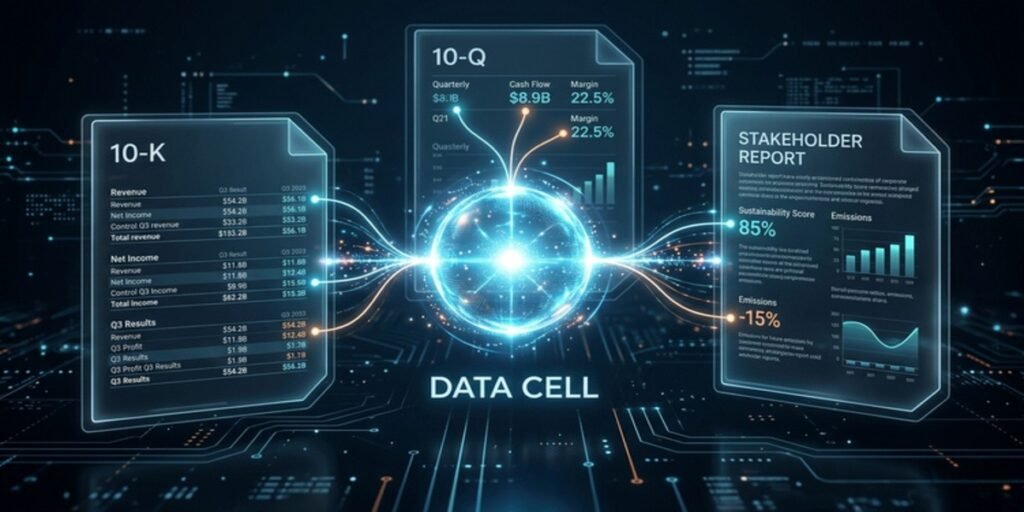
Workiva’s SEC reporting capabilities are further hardened by built-in XBRL and iXBRL tagging infrastructure. The platform incorporates the Arelle open-source validation engine — widely used across the industry and referenced by the SEC’s EDGAR filing community as a standard pre-submission validation tool—plus an additional layer of business-logic checks that examine tagging choices from an accounting perspective. This dual-validation approach reduces the “Tagging Error Risk” that previously plagued private wealth disclosures, where incorrect taxonomy selection or inconsistent fact properties could trigger SEC comment letters or filing suspensions. According to Workiva’s published product documentation, the platform closes the original quote gap end-to-end: from the moment data enters the environment, it is linked, tagged, versioned, and audit-trailed through to EDGAR submission.
Workiva is the market leader in cloud-native disclosure management, but it is not the only option. Toppan Merrill Bridge™ and Certent (now part of insightsoftware) serve overlapping use cases with different integration and pricing models. The right choice for any given UHNW entity depends on its existing treasury stack, the number of jurisdictions it files in, and whether it needs a purpose-built disclosure platform or a broader financial reporting suite.
Entities that rely on traditional ERP modules for disclosure management are forced into manual export-import cycles that break data lineage. Workiva’s cloud-native architecture, by contrast, maintains an unbroken chain of custody. Every modification is logged with user attribution, timestamp, and before/after values. External auditors and stakeholders can be granted role-based access to review filings in real time, with tied supporting documents clearly labeled for reference. This transparency transforms the audit from a retrospective forensic reconstruction into a continuous, observable process.
The Finastra Synergy: Feeding the SEC Reporting Engine
For entities whose treasury operations already run on Finastra’s Summit or Fusion Opics platforms, this pairing is a natural fit — though family offices built on other treasury infrastructure (Murex, Calypso, or in-house systems) can achieve equivalent API-led connectivity to Workiva or its competitors, provided the underlying platform exposes a comparable open API layer. These systems manage multi-currency positions, cross-border settlements, derivatives valuations, and intercompany balances across jurisdictions. In the 2026 compliance landscape, the integrity of the disclosure is only as strong as the integrity of the ledger that feeds it.
The technical flow from Finastra to Workiva is API-led connectivity in its most rigorous form. Rather than relying on batch-exported CSV files or spreadsheet extracts that must be manually formatted, modern implementations utilize Finastra’s open API architecture to stream structured data directly into Workiva’s datasets. This integration eliminates the need for manual exports entirely. Treasury data—cash positions, investment valuations, liability schedules, and contingent obligation calculations—flows as structured feeds into Workiva, where it is automatically mapped to the appropriate disclosure line items.
For automated SEC filings for family offices, this architecture is transformative. Family offices traditionally operate with lean operational teams where a single controller or CFO may be responsible for consolidating data from multiple custodians, private investment vehicles, and operating companies. The Finastra-to-Workiva pipeline automates the aggregation layer: data from multiple external systems is consolidated within Finastra’s unified ledger, validated for internal consistency, and then synchronized to Workiva as a single source of trusted data. The result: every figure in the SEC filing matches the treasury system exactly — timestamped and matched to the penny.
Real-time treasury reporting further compresses the disclosure timeline. Finastra’s Summit platform now incorporates real-time accounting and AI-powered pre-settlement matching, reducing the lag between transaction execution and ledger recognition. When combined with Workiva’s live linking, this means that a transaction executed on a Thursday can be reflected in a draft 10-Q by Friday, with full audit trail and iXBRL tagging intact. For entities facing accelerated filing deadlines, this compression matters.
Eliminating Revision Fatigue: Version Control in Multi-Entity Audits
UHNW wealth structures are rarely monolithic. They comprise siloed assets across multiple jurisdictions—private operating companies, real estate holding vehicles, investment partnerships, trust structures, and philanthropic entities—each with its own chart of accounts, functional currency, and local regulatory requirements. The challenge of multi-entity compliance technology is not merely aggregating these disparate datasets, but maintaining a unified audit trail that satisfies both SEC auditors and local regulators simultaneously.
Workiva addresses this through hierarchical dataset architecture. Each entity’s financial data resides in its own secured dataset within the platform, with granular permissions controlled down to the cell level. Intercompany eliminations, consolidation entries, and currency translation adjustments are applied as documented transformation layers—each with its own lineage record. When an auditor requests evidence of how a consolidated figure was derived, the platform can expose the complete path: from the subsidiary’s local ledger, through the elimination schedule, through the translation matrix, to the final tagged fact in the iXBRL instance.
This UHNW audit trail automation capability is critical under the SEC’s 2026 scrutiny regime. The EDGAR XBRL Guide explicitly requires semantic consistency: a fact reported as “$10 million” in one location cannot appear as “$11 million” in another within the same submission. In multi-entity environments, such inconsistencies historically arose when different analysts updated different sections of a filing using different versions of a spreadsheet. Workiva’s version control and blackline comparison tools eliminate this risk by enforcing a single, platform-wide source of truth. When a dataset is updated, all linked instances are simultaneously refreshed; when a revision is made, the full history is preserved and comparable across versions.
Version control for SEC filings extends to the XBRL taxonomy itself. Workiva’s historical data roll-forward capability automatically updates prior-period tagged data across files, ensuring that comparative financial statements maintain consistent tagging from quarter to quarter. For UHNW entities with long-dated investment horizons and complex equity structures, this consistency reduces the risk of restatement and the associated legal friction.
Forensic Compliance: Why “Manual” is a 2026 Liability
The SEC’s enforcement posture in 2026 has shifted from forgiving “clerical errors” to treating manual data migration as a presumptive control failure. The Commission’s Inline XBRL mandate was designed specifically to improve data quality and accessibility by embedding machine-readable tags directly into human-readable HTML filings. The underlying premise is that structured data reduces ambiguity—but this benefit is negated when the data feeding the structure has been manually transcribed.
Under SEC data lineage requirements, an auditor must be able to trace any reported figure back to its originating system without encountering undocumented human intervention. When a valuation specialist copies a private equity NAV from a PDF capital account statement into an Excel workbook, then pastes that workbook value into a Word document, then converts that document to HTML for EDGAR submission, the lineage is broken at three distinct points. Each manual transfer introduces the risk of transposition, rounding error, or deliberate manipulation. In 2026, if an auditor cannot trace a figure back to its Original Quote—the first system-of-record instance of that datum—without seeing evidence of human copy-paste intervention, the entity faces a material weakness forensic audit finding.
In practice, an SEC comment letter triggers a formal response obligation — typically within 10 business days — requiring the filer to either justify the flagged disclosure or amend it. For UHNW entities without dedicated SEC reporting staff, a single comment letter can consume weeks of legal, accounting, and management time. Repeated comments on the same issue, or failure to respond within the required window, can escalate to SEC staff referral to the Division of Enforcement. The cost is not the fine; it is the process.
What an SEC Comment Letter Actually Costs
The real sequence from EDGAR submission to potential enforcement referral — with estimated internal staff-hour burden at each stage
The Comment Letter Lifecycle — Stage by Stage
Filing Submitted to EDGAR
The 10-K or 10-Q is transmitted. EDGAR runs automated structural and iXBRL validation on receipt. Structural failures bounce immediately; semantic and judgement issues do not surface here.
SEC Staff Review Window
Division of Corporation Finance staff screen the filing. Tagging inconsistencies, unexplained period-on-period movements and thin disclosure around judgement areas are the usual triggers for escalation to a formal comment.
Comment Letter Issued
A formal letter lands, identifying specific disclosures and requesting explanation or amendment. Internal triage starts the same day: counsel reads the comment, finance locates the underlying workpapers, and someone has to reconstruct how the figure was derived.
Response DeadlinePeak cost
Roughly ten business days to respond or request an extension. The response must either defend the original treatment with evidence or concede and commit to amendment. Legal drafting, technical accounting analysis and executive sign-off all compress into this window.
Amendment, Second Round, or Close
If the response satisfies staff, the file is closed and the correspondence is published on EDGAR. If not, an amended filing is required — with fresh tagging, fresh validation, and the possibility of a second comment round on the same issue.
Escalation Path — Where Staff-Hours Stop Being the Problem
Missing the response window, or drawing repeat comments on the same disclosure across consecutive filing cycles, can lead to referral from Corporation Finance to the Division of Enforcement. At that point the cost is no longer measured in internal hours — it is measured in external counsel fees, restatement exposure, auditor re-scoping and the reputational consequence of published correspondence. Comment letters are a matter of public record on EDGAR once the review closes.
Staff-hour figures are illustrative practitioner estimates, not SEC-published data. Actual burden varies with filer size, number of consolidated entities, complexity of the flagged disclosure, and the strength of existing internal controls. Response timing conventions can vary by review; verify against the specific letter received. Not legal advice.

A Bloomberg Tax survey of more than 400 corporate tax professionals found that 76% still rely on Excel for calculations in workpapers and 63% manually gather ERP/GL data — a pattern that translates directly into the version control fragmentation and lineage gaps that SEC auditors increasingly flag as control deficiencies. These manual processes create version control issues, disconnected research tools, and fragmented citation tracking that become acute vulnerabilities under audit scrutiny. The IRS has publicly expanded its use of AI in compliance and enforcement workflows, with machine learning tools being deployed to identify inconsistencies and anomalies in filed data — a development that raises the detection risk for manual transcription errors that leave no audit trail. The SEC’s enforcement posture has broadened elsewhere too: the Cyber and Emerging Technologies Unit (CETU), announced on February 20, 2025 and comprising approximately 30 fraud specialists and attorneys, focuses on cyber-related misconduct and fraud involving AI, blockchain, and emerging technologies — replacing the former Crypto Assets and Cyber Unit — a different priority area from general financial-disclosure accuracy, but indicative of a broader institutional shift toward technology-driven enforcement across the Commission.
2026 compliance audit technology demands that UHNW entities treat their disclosure infrastructure with the same rigor as their trading infrastructure. Just as straight-through processing (STP) eliminated manual settlement risk in capital markets, Zero-Touch Filing eliminates manual disclosure risk. Finastra reports STP rates of up to 90% for settlement workflows in its own published materials; the same discipline must now be applied to regulatory reporting. When data moves from Finastra to Workiva to EDGAR without human transcription, the entity can demonstrate not merely that the numbers are correct, but that they could not have been otherwise.
The “Zero-Touch” Premium: Audit Defensibility as Asset Protection
In a 2026 forensic audit, having a complete audit trail for every figure in a filing — a timestamped, attributable record of where it originated, who touched it, when it changed, and how it was tagged — reduces the scope, duration, and adversarial intensity of regulatory inquiry. Entities that can produce instant traceability avoid the “fishing expedition” phase of audits, where investigators probe for control weaknesses.
This defensibility premium extends to litigation contexts. When a shareholder derivative action or regulatory enforcement proceeding questions the accuracy of a disclosure, the entity with immutable data lineage can demonstrate that its reported figures were not the product of judgment or manipulation, but of synchronized, validated, system-generated data. The Workiva-Finastra stack provides this evidentiary foundation by design.
AI-Assisted iXBRL Tagging: How It Works
The final layer of 2026 disclosure automation is AI-assisted iXBRL tagging. Workiva’s platform incorporates machine learning models that predict the correct SEC taxonomy element for a given disclosure, drawing on historical tagging patterns and peer-filing analysis. These models do not replace human judgment—particularly for novel or complex UHNW transactions—but they dramatically reduce the “Tagging Error Risk” that arises from manual taxonomy selection.
The AI engine validates generated tags against the full SEC taxonomy, identifies outliers compared to peer filings in the same industry classification, and flags potential inconsistencies before submission. For UHNW entities with unique asset classes—such as fine art investment vehicles, aircraft leasing structures, or cryptocurrency holdings—this predictive capability ensures that disclosures are tagged with the most granular and accurate available concepts, reducing the likelihood of SEC comment letters requesting additional detail or reclassification.
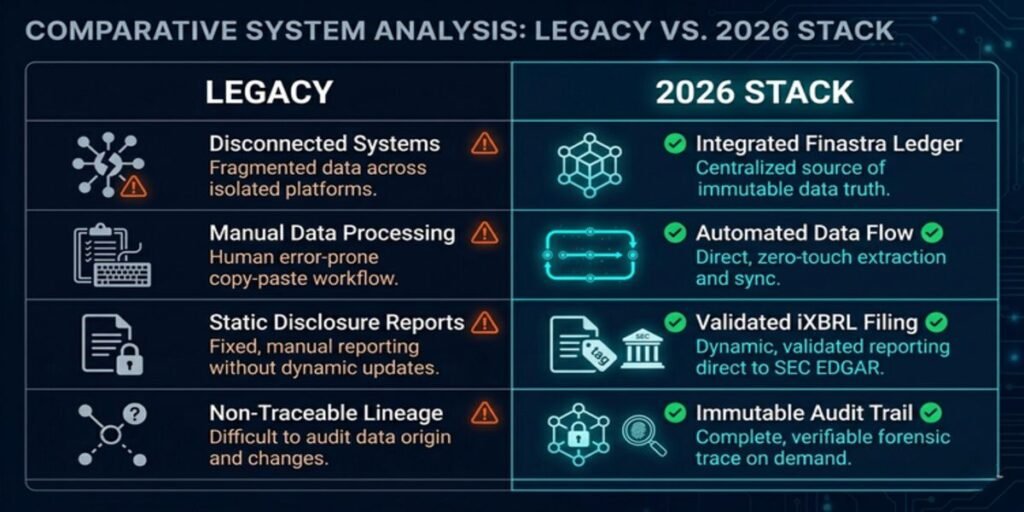
Visual Data Benchmarking: Legacy vs. 2026 Automated Stack
Legacy Manual Stack vs. Automated Disclosure Platform
Process-by-process breakdown with estimated staff-hours per quarterly 10-Q filing cycle
| Process Step | Legacy Manual Approach | Automated Platform Approach | Manual Staff-Hours | Automated Staff-Hours | Reduction |
|---|---|---|---|---|---|
| 01Data Collection & ERP/GL Aggregation | Figures pulled by hand from multiple ERP and custodian systems, re-keyed into Excel workpapers. No machine-readable record of what came from where.Version drift | API connectors pull structured figures from source systems straight into the disclosure environment. No re-entry, and every value retains a pointer to its origin.Full lineage | 40–80hrs / cycle | 3–6hrs / cycle | ~90% |
| 02iXBRL Tagging & Taxonomy Mapping | Elements mapped manually against the US-GAAP taxonomy. Custom extensions are error-prone, and any late disclosure edit forces re-tagging under deadline pressure.Rejection risk | Prior-period tags roll forward automatically. Machine-assisted element suggestions are checked against peer filings, so only genuinely novel disclosures need manual judgement.Auto roll-forward | 30–60hrs / cycle | 2–5hrs / cycle | ~92% |
| 03Cross-Document Consistency Checks | A senior accountant manually compares figures across MD&A, statements, footnotes and the earnings release. One late adjustment means sweeping the whole document set again.Comment trigger | Linked data propagates a single change to every instance across every document. Automated tie-out surfaces mismatches as they occur rather than at review.No propagation error | 20–40hrs / cycle | 1–2hrs / cycle | ~95% |
| 04Pre-Submission Validation | Validation run late, as a discrete step, using standalone tools. Errors surface close to the deadline — sometimes on submission day itself.Late-stage failure | EDGAR and XBRL validation runs continuously through drafting. Document health checks flag defects while there is still time to fix them properly.Continuous checks | 8–16hrs / cycle | 0.5–1hrs / cycle | ~94% |
| 05Version Control & Change History | Versioning by filename and email chain — the Final_v7_REAL_FINAL.xlsx problem. No central change log, so audit evidence has to be reconstructed after the fact.SOX 404 exposure | Timestamped, user-attributed change history at cell and tag level. Auditors get permissioned read access instead of emailed spreadsheets.Audit-ready trail | 16–32hrs / cycle | 0–1hrs / cycle | ~97% |
| 06Audit Support & Evidence Retrieval | Answering an auditor or SEC staff query means hunting for the right file version across drives, inboxes and local copies. Each request becomes its own small project.Auditor friction | Evidence is already linked to source data and timestamped. Queries are answered from the platform in minutes rather than assembled over days.Instant traceability | 12–20hrs / cycle | 2–4hrs / cycle | ~82% |
| TOTAL — Per 10-Q Cycle | Six manual process areas compounding into fragmentation, version drift and broken lineage every single quarter. | One linked environment: automated tagging, continuous validation, centralised change history. | 126–248hrs / cycle | 8.5–19hrs / cycle | 85–93% lower |
Vendor note: Workiva is the category leader in cloud-native disclosure management, but not the only option — Toppan Merrill Bridge™, Certent (part of insightsoftware) and DFIN ActiveDisclosure serve overlapping use cases on different integration and pricing models. Elites Mindset has no commercial, advertising or affiliate relationship with any vendor named here.
References: SEC Inline XBRL · SEC EDGAR · PCAOB AS2201 · Arelle
Frequently Asked Questions about SEC Disclosure Technology
Q1:Why do UHNW entities prefer Workiva over traditional ERP modules?
Traditional ERPs focus on operational accounting rather than regulatory narrative — this is the category gap that disclosure-management platforms are built to close. Workiva is the market leader in this space, though competitors including Certent (part of insightsoftware) and Toppan Merrill Bridge™ offer overlapping capabilities with different pricing and integration models. For complex UHNW structures spanning multiple jurisdictions, the core requirement is a unified, audit-trailed environment — the specific vendor choice should be driven by existing ERP/treasury stack compatibility and cost, not treated as a foregone conclusion.
Q2:How does Finastra automate 2026 regulatory compliance?
Finastra’s platforms (Summit/Fusion Opics) serve as the authoritative ledger for complex financial operations. Through open API architecture, Finastra streams structured data directly into Workiva, eliminating manual import cycles that introduce latency. This means data recognized in the ledger is available for disclosure tagging within minutes, with the full transformation logic preserved. Finastra also continuously updates its modules to reflect evolving SEC, EMIR, and MiFIR requirements, ensuring data is compliance-validated at the source.
Is Workiva the only platform that can do this?
No. Workiva is the market leader in cloud-native SEC disclosure management, but the category includes several mature alternatives. Toppan Merrill Bridge™ is built specifically for capital markets regulatory disclosure and SEC filing workflows. Certent, now part of insightsoftware, serves overlapping use cases with a focus on integration with mid-market ERP stacks. DFIN ActiveDisclosure offers end-to-end SEC filing with iXBRL tagging. The right platform depends on your existing treasury infrastructure, the number of entities you consolidate, your filing frequency, and your internal technical capacity. Arelle (open-source) is also widely used as a standalone pre-submission iXBRL validation tool and is free to use regardless of which disclosure platform you select.
Editorial Notice Methodology, Scope & Legal Disclaimer
Scope of Applicability
This article addresses SEC-registered entities — domestic operating companies filing Form 10-K or 10-Q, registered multi-family offices, and fund structures with outside investors. Single-family offices managing only family assets are generally exempt from SEC registration under the Investment Advisers Act and are not directly subject to the iXBRL mandates discussed here. The data lineage principles apply broadly; the regulatory obligations do not.
Staff-Hour Estimates
All staff-hour figures in the E-2 Comment Letter Timeline and E-3 Comparison Table are illustrative practitioner estimates, not SEC-published data, not audited benchmarks, and not guaranteed to reflect any specific organisation’s experience. They are built around the relative effort weighting of each process step and framed accordingly. Do not cite them as empirical data in client-facing documents without independent verification.
Decision Flowchart
The iXBRL filing requirement flowchart (E-1) is an orientation tool designed to help readers identify the right questions to ask. It is not legal advice. Filer status definitions, form-specific requirements, and taxonomy acceptance windows change. Confirm all filing obligations with qualified securities counsel before submitting to SEC EDGAR.
Vendor References
Workiva, Finastra, Toppan Merrill Bridge™, Certent (insightsoftware), DFIN ActiveDisclosure, and Arelle are referenced as illustrative examples of a category of compliance and disclosure technology. Elites Mindset has no commercial, advertising, or affiliate relationship with any vendor named in this article. References do not constitute endorsements. Vendor capabilities, pricing, and product names may change — verify current specifications directly with each vendor.
Authored & Reviewed
Written by Javed Ahmad (IT Specialist & FinTech Contributor). Independently reviewed for factual accuracy by Shamima Khatoon (Elites Mindset editorial team). Regulatory sources: SEC Inline XBRL guidance · PCAOB AS2201 · Arelle · Exchange Act Rule 12b-2 · Investment Advisers Act family office exemption.