

The family office technology stack has changed fundamentally over the past five years. What began as a migration from Excel-based reporting to cloud-based dashboards has produced a different kind of architecture — one where every custodial feed, private equity capital call, and digital asset wallet converges into a single, interconnected data layer. In 2026, the question is no longer which software a family office should purchase, but whether its architecture can reconcile illiquid alternatives alongside liquid public markets in real time—without manual intervention.
Legacy Excel-based reporting, once tolerated as an operational inconvenience, is now recognised as a serious operational liability: a single formula error in a consolidated net-worth statement can cascade through entity structures, producing tax miscalculations that attract regulatory scrutiny across multiple jurisdictions. A well-built family office stack does not just aggregate data — it ensures every number is traceable to its source API and that data ownership stays with the family.
While 2024 was defined by the adoption of AI-assistants, 2026 is defined by Autonomous Data Engines—systems that don’t just summarize data but proactively identify tax-loss harvesting opportunities across global borders without human prompt. The modern stack is no longer a set of standalone tools. The aggregation layer feeds the intelligence layer, which feeds reporting, which feeds governance. Each layer must communicate via open REST APIs, because in 2026, a platform’s value is now determined more by the quality of its API documentation than by its feature set. If a tool cannot natively speak to the tax reporting engine, the legal document vault, and the risk analytics module, it is technical debt, not infrastructure.
Family Office Intelligence: 2026 Stack Matrix
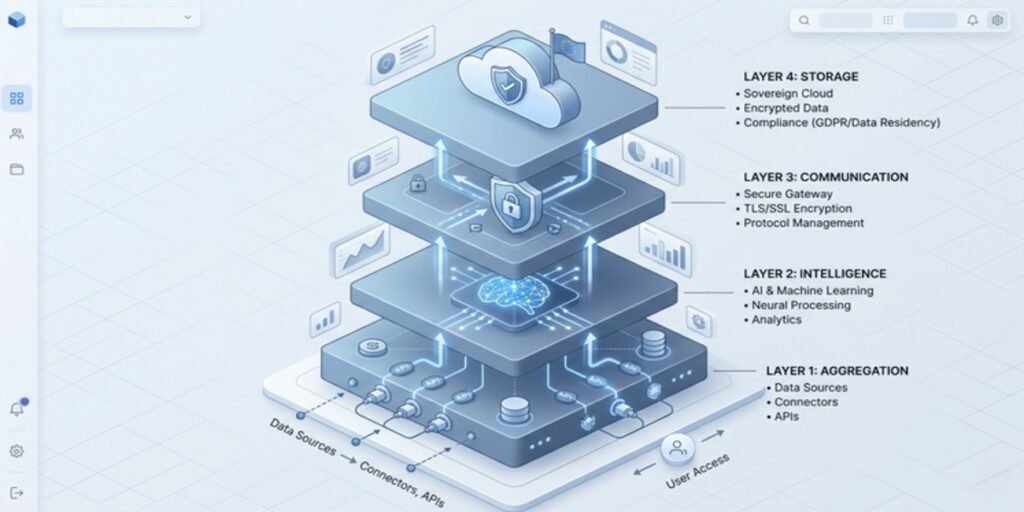
The Data Aggregation Core: Auditing Real-Time Multi-Custodial Reconciliation
In 2026, data aggregation is no longer a back-office function — it is the layer everything else depends on. The modern family office manages assets across dozens of custodians, multiple jurisdictions, and a growing allocation to illiquid alternatives that lack standardized reporting formats. The ability to achieve real-time wealth reporting across this fragmented landscape separates institutional-grade offices from those still reconciling month-end statements in spreadsheets. Addepar and Masttro both function as open-architecture aggregation platforms, but they take different approaches — and the differences matter for procurement decisions.
Addepar positions itself as an enterprise-grade analytics and reporting stack built around what it terms the “Financial Graph“—an ownership structure hierarchy that maps households, legal entities, accounts, and investments into a unified model. As of Q1 2026, the platform supports over $9 trillion in client assets across more than 1,500 firms in approximately 60 countries, making it the largest independent wealth management data platform by AUM coverage. This architecture allows a family office to pivot analytical perspectives—viewing the same portfolio through the lens of an individual beneficiary, a trust, or a holding company—without restructuring the underlying data.
For offices managing trusts, LLCs, and partnerships across generations, this ownership model is a prerequisite for accurate look-through exposure analysis — not a convenience feature. Addepar’s open REST APIs and Integration Center enable it to function as the aggregation hub within a broader best-of-breed ecosystem, pushing normalized data into tax engines, CRMs, and custom portals. Addepar maintains SOC 2 Type II certification and publishes a SOC 3 summary report, giving procurement teams the audit artifacts needed for institutional due diligence.
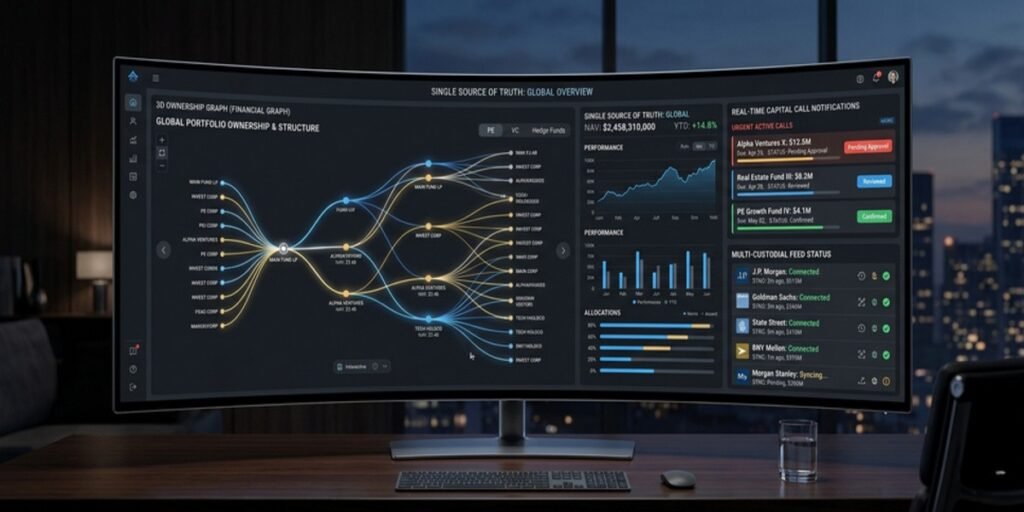
Masttro, by contrast, emphasizes direct custodial connectivity and total-wealth visibility as its core value proposition, claiming 650+ direct custodian connections and processing high volumes of daily transactions across its client base. Its architecture is built for a principal-first view — consolidating liquid markets, private equity, real estate, and passion assets in a single dashboard.
One structural difference: Masttro rejects AUM-based pricing, offering fixed annual costs that do not scale with portfolio growth—a structural advantage for ultra-high-net-worth families where asset values can fluctuate by hundreds of millions in a quarter. The platform’s AI-powered document automation addresses a persistent operational bottleneck: extracting data from capital calls, distribution notices, and K-1 statements and getting it into structured reporting formats without manual re-keying.
FundCount is a third contender worth noting — a fund-accounting and portfolio-management platform that combines general-ledger functionality with multi-currency reporting, filling a gap neither Addepar nor Masttro explicitly targets. For offices that need integrated partnership accounting alongside portfolio analytics, it represents a distinct architectural choice.
The critical audit criterion for 2026, however, is not which platform aggregates more custodians, but whether the aggregation layer can reconcile illiquid private equity valuations alongside liquid market positions in a single pane of glass without manual intervention. The practical test: how long does it take from a capital call notification arriving to that call appearing in the family’s consolidated net-worth statement? If an alternatives transaction requires a human to re-key data into a spreadsheet before it appears in the Principal’s quarterly report, the stack has failed. In 2026, any manual data entry in the reconciliation chain is treated as a failure — a gap in data lineage that compromises both accuracy and auditability.
The Interoperability Premium
The biggest shift in family office tech procurement is that API quality now matters more than UI design or feature lists. The efficiency gain from seamless data flow between systems now exceeds what any single application delivers on its own. A tax reporting engine that cannot automatically ingest cost-basis data from the aggregation layer, or a legal document vault that cannot trigger workflow alerts when entity ownership percentages change, creates friction that compounds exponentially across the stack. In 2026, if a tool cannot natively speak to the rest of the architecture via well-documented, version-controlled APIs, it is not merely suboptimal; it is a legacy liability that will require expensive middleware or manual bridging within eighteen months. The CTO’s job is to audit API endpoints, rate limits, webhook reliability, and data schema consistency with the same rigour applied to investment due diligence.
The Intelligence Layer: Moving from Passive Reporting to Autonomous Risk Mitigation
The intelligence layer has moved beyond summarising historical performance. The emergence of AI in wealth management has progressed from generative assistants that answer natural-language queries to Agentic AI systems that autonomously monitor portfolio health, identify threats, and surface optimization opportunities without waiting for human prompts. These systems represent the most significant architectural upgrade since the shift from client-server to cloud-native platforms.
The 2026 intelligence layer performs three functions that were impossible at scale just two years ago. First, predictive risk analytics continuously stress-test portfolios against geopolitical shocks, currency crises, and regulatory discontinuities using Monte Carlo simulations fed by real-time market data and alternative data sources. Second, autonomous tax optimization engines scan cross-border positions to identify harvesting opportunities, treaty arbitrage, and entity restructuring possibilities—executing preliminary calculations and flagging them for human approval rather than requiring an analyst to initiate the inquiry. Third, scenario modeling integrates private markets cash-flow forecasting with public market volatility assumptions, allowing family offices to model liquidity events, generational transfer timing, and concentrated position de-risking strategies within a unified framework.

The 2026 regulatory environment makes this intelligence layer essential, not optional. In the United Kingdom, the abolition of the non-dom regime from April 2025 and the introduction of the residence-based Foreign Income & Gains regime has fundamentally altered the tax calculus for internationally mobile families. The April 2026 cap on business and agricultural property relief — originally announced at £1 million in the October 2024 Autumn Budget, then raised to £2.5 million per individual in December 2025 — means only 50% relief applies above that threshold. The anticipated inclusion of pension death benefits within inheritance tax from April 2027 adds further pressure, and together these changes demand predictive modelling capabilities that legacy reporting tools simply cannot provide. A family office managing UK-connected wealth in 2026 cannot afford to discover the tax implications of these changes during annual compliance season; the intelligence layer must model them continuously.
Across the Atlantic, the federal picture has clarified. The One Big Beautiful Bill Act, signed on 4 July 2025, permanently increased the federal estate, gift and generation-skipping transfer tax exemption to $15 million per individual ($30 million for married couples) from 1 January 2026 — eliminating the TCJA sunset that had threatened to halve the threshold. But state-level exposure remains acute. New York’s 2026 exemption stands at $7.35 million per individual — less than half the federal figure — and the state does not recognise federal spousal portability. More dangerously, New York’s “cliff” provision means that estates exceeding 105% of the exemption ($7,717,500) lose the exemption entirely and face NYC Mayor Zohran Mamdani proposed reducing the New York exemption further tax on the full estate from the first dollar. In March 2026, NYC Mayor Zohran Mamdani proposed reducing the New York exemption further — to $750,000 — and raising the top rate from 16% to 50%. The proposal has not been enacted, but it signals the direction of political pressure. The intelligence layer must track enacted legislation, proposed bills, regulatory comment periods, and court decisions across every jurisdiction where the family holds assets or structures — and surface alerts before draft legislation becomes law.
The Rise of the Shadow Stack
[SOP: Eliminating Shadow Infrastructure]
A growing threat to architectural integrity in 2026 is the proliferation of the “Shadow Stack”—fragmented tools, applications, and communication channels adopted by individual family members outside the centralized technology governance framework. A Principal’s spouse may use a personal budgeting app that scrapes account data; the next generation may maintain cryptocurrency wallets on consumer exchanges; individual trustees may store sensitive documents in personal cloud drives. Each of these shadow tools creates data silos, security vulnerabilities, and compliance gaps that undermine the single source of truth.
The 2026 audit must therefore extend beyond the officially sanctioned technology stack to identify and eliminate shadow infrastructure. Central oversight is not merely an operational preference but a governance requirement: the Family Office Principal must maintain ultimate data sovereignty, with visibility into every tool touching the family’s financial data, and policies that prohibit the use of unsanctioned consumer-grade applications for wealth-related activities.
Cybersecurity Sovereignty: The “Zero-Trust” Perimeter for UHNW Personal Data
The 2026 threat landscape for ultra-high-net-worth families has rendered consumer-grade communication tools an unacceptable liability. Using WhatsApp, standard email, or unencrypted messaging for wealth-related communication is now treated as an institutional security failure by any serious cybersecurity framework. The modern family office must operate within a zero-trust wealth tech architecture where no user, device, or connection is implicitly trusted, and every data access request is authenticated, authorized, and encrypted.

This defensive posture begins with the migration from public cloud dependency to sovereign cloud or on-premises hybrid infrastructure. For families managing wealth across jurisdictions with conflicting data privacy regimes—such as the European Union’s GDPR, Switzerland’s FINMA guidelines, and emerging US state-level privacy laws—data residency is not merely a compliance checkbox but a strategic asset. Masttro positions its Swiss Tier 4 data centre infrastructure and client-owned encryption keys as core differentiators — the platform provider itself cannot access client data. This directly addresses the principal’s core concern: that a vendor breach, subpoena, or insider threat could expose generations of financial data.
The zero-trust perimeter extends to communication architecture. Encrypted communication vaults—specialized platforms designed for financial services—replace email and messaging apps with secure, auditable channels that maintain end-to-end encryption, message retention policies, and granular access controls. These tools eliminate the phishing vectors inherent in consumer email and ensure that sensitive discussions about entity restructuring, succession planning, or litigation strategy remain within a controlled environment. In 2026, institutional best practice assumes that any communication touching wealth data will eventually be subject to discovery, regulatory examination, or family dispute resolution; the communication layer must therefore produce immutable audit trails by design.
Post-Quantum Readiness: The Long-Term Encryption Imperative
NIST finalized its first post-quantum cryptographic standards in August 2024, including ML-DSA (FIPS 204) for digital signatures — replacing the RSA and ECDSA schemes that most financial infrastructure still relies on — and ML-KEM (FIPS 203) for key encapsulation. Regulatory frameworks mandating quantum-resistant upgrades for financial institutions are now in development.
For family offices, the post-quantum threat is particularly acute because estate documents and trust structures are designed to persist for decades—well within the window when cryptographically relevant quantum computers may become operational. A digitally stored will, trust deed, or power of attorney encrypted with today’s standards could be retroactively decrypted by a future quantum adversary if the underlying cryptographic scheme is broken.
The 2026 audit must therefore assess not only current encryption protocols but the organization’s capacity for crypto-agility: the ability to rotate cryptographic algorithms, update certificate hierarchies, and re-encrypt archival documents without disrupting operational workflows. Forward-thinking family offices are already implementing hybrid classical-quantum certificate chains and conducting pilot migrations of their most sensitive long-term documents to post-quantum standards, treating this not as a 2030 problem but as a 2026 architectural requirement.
Conclusion: The Architectural Integrity Mandate
The 2026 family office tech stack is not a procurement list—it is an architectural philosophy. The offices that will preserve and compound multi-generational wealth are those that treat technology infrastructure with the same rigor applied to investment due diligence. This means demanding API documentation before user interface demos, auditing data lineage before report aesthetics, and stress-testing cybersecurity before feature checklists. It means recognizing that manual data entry is a forensic failure, that consumer communication tools are institutional liabilities, and that post-quantum encryption is a present-tense requirement for long-term document security.
A unified, API-first data architecture is the baseline. Anything less is legacy infrastructure accumulating risk.
Informational Purpose Only: This technical audit is provided by Elites Mindset for educational and illustrative purposes regarding 2026 technology trends. It does not constitute financial, legal, tax, or investment advice. The mention of specific platforms — including but not limited to Addepar, Masttro, or FundCount — does not imply a formal endorsement or a commercial partnership unless explicitly stated.
Forensic Accuracy: While Javed Ahmad and our editorial team strive for forensic accuracy in technology specifications and regulatory references (such as UK IHT changes or US state-level tax proposals), readers are advised that the software landscape and jurisdictional laws are subject to rapid change.
Independent Due Diligence: Family Office Principals and CIOs should conduct independent due diligence and consult with qualified legal and technical counsel before implementing any structural changes to their wealth technology architecture or data residency protocols. Elites Mindset assumes no liability for operational failures, data breaches, or tax consequences resulting from the application of the frameworks discussed herein.