

Elin Nordegren‘s Florida real estate portfolio is one of the clearest examples of how a divorce settlement can be turned into long-term property wealth. Following the highly publicized 2010 divorce from Tiger Woods, finalized with a reported $100 million payout, Nordegren did not simply park the money in bonds or index funds. Instead, she treated the settlement as starting capital for a hands-on real estate strategy.
Between 2011 and 2020, her strategy was straightforward but high-risk: buy undervalued oceanfront land, demolish the outdated house, and build a new estate designed for the top end of the Palm Beach luxury market. This was not lifestyle spending dressed up as investing — it was a genuine ground-up build using her own money.
The payoff came in September 2020. In a single transaction, Nordegren sold her custom-built Seminole Landing estate for a recorded $28.641 million, turning nine years of building and holding costs into cash. The exit did not signal retreat from real estate, however.
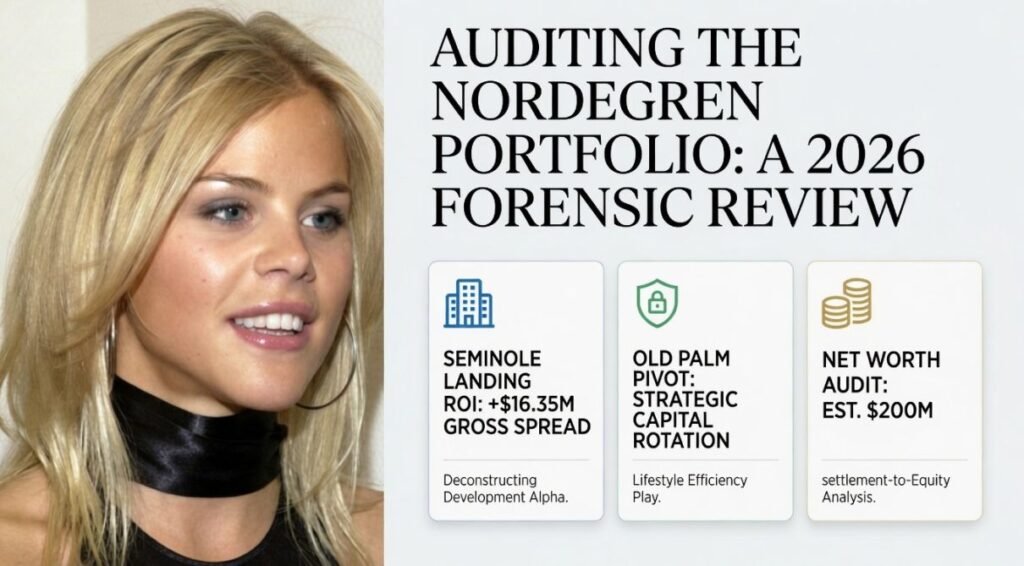
Four days later, acquisition documents recorded a $9.9 million purchase in Palm Beach Gardens’ Old Palm Golf Club a transaction that reveals a deliberate shift from a high-maintenance oceanfront showpiece to a more private, lower-upkeep inland estate. The 2020 sequence—simultaneous liquidation and consolidation—demonstrates how someone at this level of wealth rebalances a property portfolio — trading size and prestige for lower running costs and better privacy.
Estate Audit: The Elin Nordegren Portfolio
Who Is Elin Nordegren?
Elin Maria Pernilla Nordegren was born on 1 January 1980 in Stockholm, Sweden, to journalist Thomas Nordegren and politician Barbro Holmberg. She has a twin sister, Josefin, and a brother, Axel. Before meeting Tiger Woods, she worked as a model and as a nanny for the family of Swedish golfer Jesper Parnevik. She married Woods in October 2004 at Sandy Lane in Barbados; they divorced in August 2010. She has two children with Woods — daughter Sam Alexis (b. 2007) and son Charlie Axel (b. 2009). Since 2017, she has been in a relationship with retired NFL tight end Jordan Cameron; their relationship became public in 2019 when she was expecting their first child. They have three children together: Arthur (b. 2019), Zeta, and Freya. Cameron also has a son, Tristan, from a previous relationship, making their household a blended family of six children.
After the divorce, Nordegren enrolled at Rollins College‘s Hamilton Holt School in Winter Park, Florida. She graduated in May 2014 with a bachelor’s degree in psychology, a 3.96 GPA, and the Outstanding Graduating Senior Award. She later earned a master’s degree from Nova Southeastern University with a focus on mental health counseling. She is a registered mental health counselor in Florida.
The Demolition Strategy: Converting a $12.25M Acquisition into a $28.6M Liquidity Event
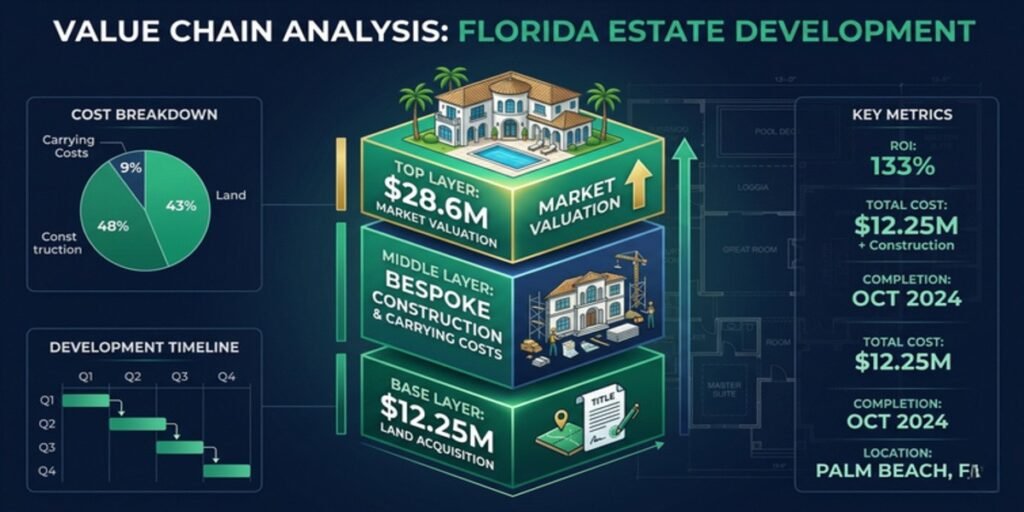
The foundation of Nordegren’s real estate ROI thesis was established in 2011 with the $12.25 million acquisition of a 1.4-acre oceanfront parcel at 12520 Seminole Beach Road in North Palm Beach. The property, situated within the gated Seminole Landing community, carried a significant liability: a 1930s-era structure (built circa 1932) that had become functionally obsolete for contemporary UHNW living. Rather than renovate, Nordegren opted for complete demolition. Before the wrecking crew arrived in December 2011, she gave Habitat for Humanity four weeks to salvage anything of value from the interior — fixtures, appliances, and furnishings were auctioned at a Habitat warehouse. The decision attracted significant media attention but was, according to her architect, the only practical path — the original structure could not be brought up to current hurricane safety codes without costs exceeding a full rebuild.
The existing residence, while historically substantial with six bedrooms, eight bathrooms, and a 4,000-square-foot basement — unusual for Florida’s high water table, represented a depreciation liability. Its bones, systems, and layout were incompatible with what buyers spending $20M+ in Palm Beach County now expect: hurricane-rated construction, smart-home integration, and seamless indoor-outdoor living.
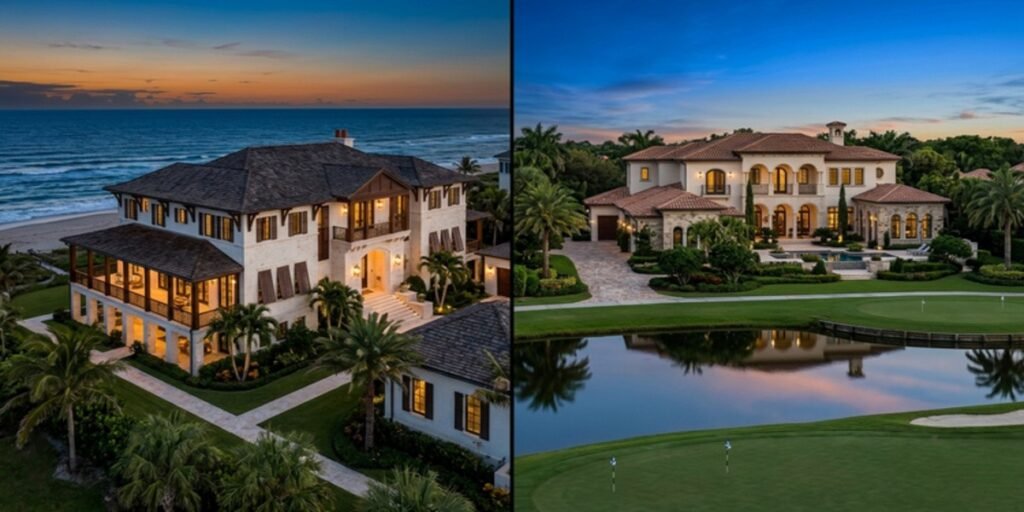
By razing the structure and beginning from zero, Nordegren controlled the entire value chain. The replacement residence, completed in 2014, was engineered as a British West Indies-inspired fortress spanning approximately 25,878 square feet with 11 bedrooms, 15 full bathrooms, and three half bathrooms. The design prioritised hurricane resistance — increasingly important in Florida as insurance costs and storm risks have risen — while making the most of the 200 feet of direct Atlantic frontage.
This was not passive appreciation. The $16.35 million gross difference between her $12.25 million purchase price and the $28.6 million sale cannot be explained by rising land prices alone. By absorbing what industry observers estimate was $8–12 million or more in construction, carrying costs, and architectural fees (exact figures were never publicly disclosed), Nordegren effectively de-risked the parcel for the UHNW market, ultimately commanding a $28.6M liquidity event during a period of high demand for ‘fortress’ coastal assets.
Instead, it reflects the profit earned by taking on the risk and cost of a full rebuild: carrying demolition costs, construction debt, architectural oversight, and illiquidity for nearly a decade. When analyzing custom estate appreciation rates, the Nordegren case demonstrates that in trophy markets, bespoke construction by a principal-occupant can outperform passive land holding by 200% or more, provided the finished product matches what ultra-wealthy buyers in Palm Beach County expect.
The eventual buyer, Russell Weiner — the billionaire founder of Rockstar Energy, which he sold to PepsiCo in 2020 for over $4 billion —, acquired the property through a revocable trust, confirming that the asset had been engineered to the exacting standards of the self-made ultra-wealthy. The listing history—originally listed at $49.5 million in March 2018, reduced to $44.5 million in 2019, and ultimately sold in September 2020 at $28.6 million—indicates Nordegren and her advisors understood the asset’s ceiling but ultimately prioritised a quick sale and redeployment of capital over holding out for the highest possible price.
Weiner’s purchase was in fact a two-property transaction: alongside the $28.641 million Seminole Landing estate, he also acquired a second, non-waterfront Nordegren property across the street at 12395 Banyan Road for approximately $4.25 million, bringing his combined outlay to roughly $32.9 million. Weiner then sold the oceanfront estate for $41.8 million and the Banyan Road house for $6.4 million — a combined $48.2 million, representing a 46% gain in roughly five weeks. The buyer was later identified as billionaire Robert F. Smith.
The Old Palm Pivot: Strategic Portfolio Rebalancing in Palm Beach Gardens
Four days after the Seminole Landing sale closed, Nordegren’s Northern Lights Trust executed a second transaction that revealed the true sophistication of her 2020 strategy: the $9.9 million acquisition (recorded as $9.926 million in deed filings) of a six-bedroom estate at 12251 Tillinghast Circle in Palm Beach Gardens’ Old Palm Golf Club. This was not merely downsizing; it was a deliberate move away from an exposed, high-maintenance coastline property toward a secured, lower-cost inland compound.
The home had previously belonged to billionaire developer Donald Soffer (founder of Turnberry Associates); it was bought from Soffer in 2018 for $6.2 million by an entity managed by Larry Ross, who then sold it to Nordegren two years later at $9.9 million.
The Old Palm property, built in 2010 and situated on two acres overlooking a golf-course pond, offered approximately 13,500 square feet of living space within a total 16,841-square-foot envelope (per property records). The strategic logic becomes apparent when you compare the running costs of the two properties. The North Palm Beach estate required management of 200 linear feet of saltwater coastline, an 11-bedroom interior, extensive groundskeeping for oceanfront vegetation, and the structural depreciation inherent in 26,000 square feet of coastal glass and timber.
By contrast, the Old Palm estate leverages the community’s homeowners association for common-area infrastructure, shared security protocols, and golf-course maintenance, while the reduced bedroom count and inland positioning dramatically lower staffing, insurance, and climate-resilience expenditures.
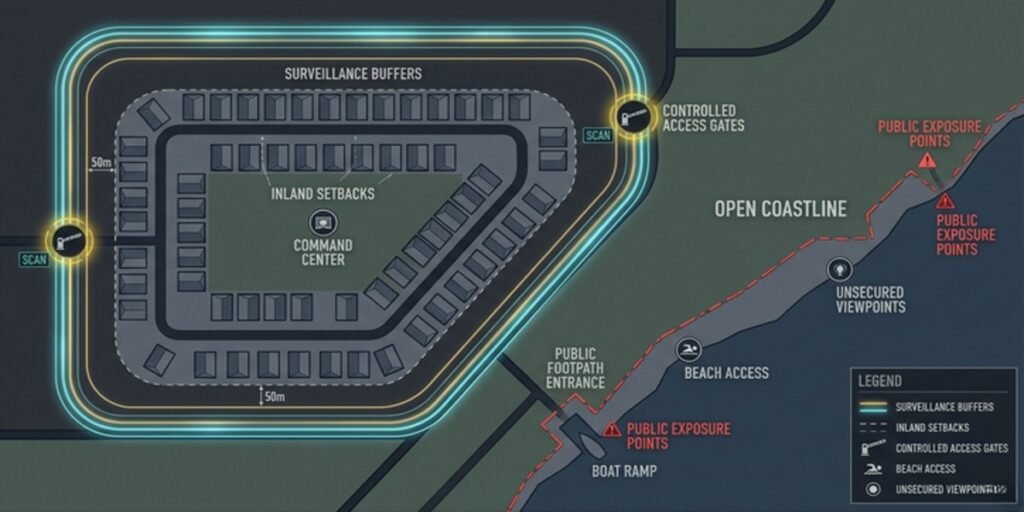
This pivot illuminates a broader trend in UHNW real estate downsizing strategy that Nordegren executed with disciplined precision. While figures like Jeff Bezos represent the expansion of land-heavy coastal holdings—acquiring vast, high-visibility waterfront compounds that function as public-facing status monuments—Elin Nordegren took the opposite path — selling the high-maintenance oceanfront estate and moving inland to a gated community with lower running costs and stronger privacy. The privacy argument is equally strong.
Coastal trophy properties, particularly those with oceanfront exposure, are inherently visible. Aerial photography, boat traffic, and paparazzi with beach access make coastal properties difficult to secure, no matter how high the hedges. The Old Palm Golf Club, by contrast, offers privacy by design: a gated perimeter with controlled vehicular access, no public waterfront sightlines, and a community design that prioritizes golfer and resident privacy over architectural spectacle.
For someone with Nordegren’s public profile and young family, the shift from Seminole Beach Road to Tillinghast Circle represents a move from a property designed to signal wealth publicly to one designed to protect her family’s privacy, keep operating costs manageable, and preserve long-term capital value. In the current threat landscape for high-profile individuals, this shift from exposed coastal compounds to gated inland communities is increasingly common among high-profile individuals and their advisors.
Architectural Specifications: The Real Value of Custom Amenities
To understand why the property sold for $28.6 million, it helps to look at what Nordegren actually built. The 25,878-square-foot floor plan was not merely large; it was packed with high-specification features that are difficult and expensive to replicate in Florida’s luxury market. Most notable was the fully realized lower level, an architectural rarity in a state where the high water table and porous limestone substrate typically preclude sub-grade construction.
A 1930s-era structure (built circa 1932) had contained a 4,000-square-foot basement — unusual for Florida construction. Nordegren’s new build retained this sub-grade space, housing a temperature-controlled wine cellar, a catering kitchen, a fitness center, and a dedicated home theater below grade. In Florida coastal construction, this sub-basement configuration functions as a hurricane-safe core while delivering the kind of dedicated entertainment and wellness infrastructure that separates $10M properties from $25M+ properties.
Above grade, the residence featured walls of retractable glass designed for indoor-outdoor flow, dual kitchens for residential and event use, a three-story Swarovski crystal chandelier as a vertical anchor piece, and a rooftop deck with Atlantic sightlines. The exterior program included a cabana house with its own kitchen, bar, and billiards table; a resort-style pool with waterslide; a putting green; a firepit; and a basketball and pickleball sport court. These were not decorative additions but functional assets that allowed the property to operate as a self-contained resort, eliminating the need for off-site leisure expenditure and increasing the home’s utility for multigenerational or guest-heavy occupancy.
The Elin Nordegren house floor plan at Old Palm, by contrast, reflects a different architectural value proposition. While the 13,504-square-foot interior abandons the sheer scale of Seminole Landing, it puts money into fewer but higher-quality features: a glass-enclosed refrigerated wine room with capacity for 500+ bottles, a club-grade media room, a dedicated gym, and a home office scaled for executive use.
The shift from 15 bathrooms to 8.5, and from 11 bedrooms to 6, reflects a practical reality: beyond a certain size, extra bedrooms and bathrooms add cost — staffing, cleaning, climate control, ongoing furnishing — without adding proportional resale value. The Old Palm residence is sized for someone who travels frequently, entertains selectively, and values practicality over sheer scale.
Elin Nordegren Net Worth 2026
Elin Nordegren’s estimated net worth in 2026 ranges from $100 million to $200 million, depending on the source. Celebrity Net Worth places her at $200 million; CelebsMoney estimates $120 million; other trackers anchor their figures to the original $100 million settlement. The higher end assumes strong real estate appreciation and disciplined investment since 2010.
Nordegren Portfolio FAQ
How much did Elin Nordegren sell her house for?
Elin Nordegren sold her custom North Palm Beach estate in Seminole Landing for a recorded $28.641 million in September 2020. The buyer was billionaire Russell Weiner, founder of Rockstar Energy Drink. The sale reflects a deliberate decision to take a good price quickly and redeploy the cash, rather than hold out for a higher offer.
Where does Elin Nordegren live now?
As of 2026, Nordegren resides in the Old Palm Golf Club, Palm Beach Gardens. She acquired the approximately 13,500 sq ft estate for $9.9 million in 2020. The move reflects a shift toward a lower-maintenance, more private property with significantly reduced running costs.
How did she fund her real estate portfolio?
The foundation was an estimated $100M settlement from her 2010 divorce. Nordegren used the Northern Lights Trust as her purchasing entity and took a straightforward approach: demolish the outdated home, build a better one, and sell it to a buyer who could afford something exceptional.
What is Elin Nordegren’s estimated net worth in 2026?
Current estimates place Nordegren’s net worth at approximately $200 million. The higher estimates reflect the gains from her Florida property strategy and assumed investment returns since the 2010 settlement.
For more information on high-profile portfolio audits, visit the Elites Mindset
● Disclaimer
Financial Disclaimer: The analysis provided by Elites Mindset regarding Elin Nordegren’s real estate portfolio and net worth is based on publicly recorded deed filings, county property records, and real estate market data current to October 2026. All figures, including ROI estimates and architectural valuations, are for educational and informational purposes only.
This content does not constitute professional investment, legal, or tax advice. Real estate markets are subject to volatility, and past development performance is not indicative of future returns. Elites Mindset is an independent editorial publication and is not affiliated with Elin Nordegren, the Northern Lights Trust, Russell Weiner, or Robert F. Smith.