

The “Sitcom Annuity” refers to the recurring revenue generated by syndication, international licensing, and digital streaming of established comedy properties. Unlike modern “prestige TV” with high production costs and limited re-watchability, 1980s British sitcom catalogs represent self-sustaining IP engines with structurally low maintenance costs relative to first-run production. Elites Mindset’s audit team classifies the 1980s as the ‘Golden Era of IP Retention’ — our framework for describing the multi-generational appeal density that defines this catalog period. Shows like Only Fools and Horses, Blackadder, The Young Ones, and Fawlty Towers demonstrate remarkable resistance to cultural depreciation, functioning as “safe-haven assets” during economic volatility when streaming services prioritize retention over new production expenditure.
IP Asset Audit: The 1980s Catalog Yield
The valuation of 1980s British television IP has transitioned from nostalgic sentimentality to a rigorous Alternative Asset Class. In the 2026 market, these catalogs are analyzed with the same forensic scrutiny as high-yield debt or commercial real estate. Unlike modern “disposable” content, 1980s sitcoms represent a finite resource of Multi-Generational IP, possessing a unique “Retention Density” that streaming algorithms now prioritize over speculative new productions.
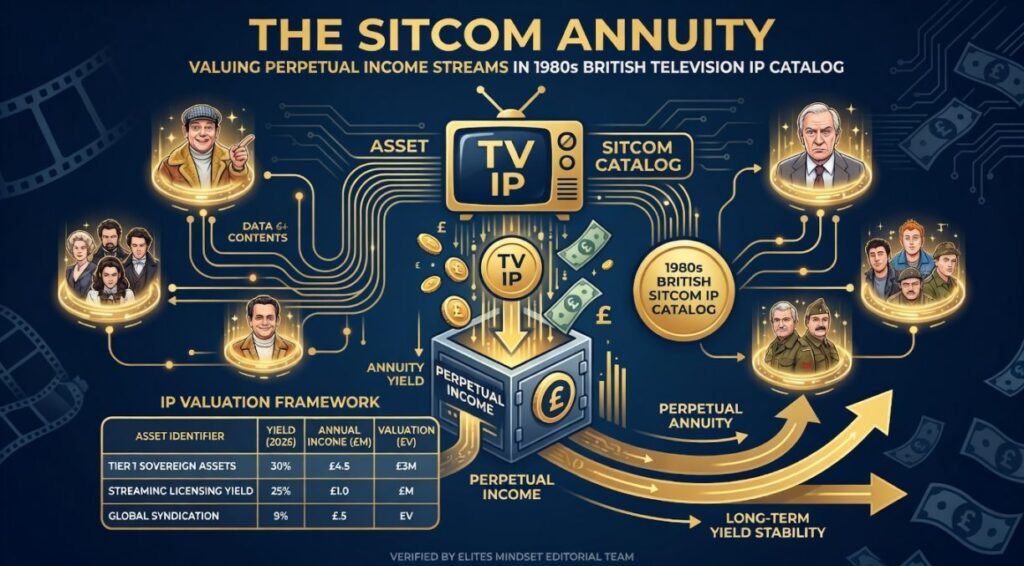
The Valuation Architecture: Tiered Asset Classification
To audit a 1980s catalog, assets must be categorized by their Yield Consistency and Platform Authority. This framework allows estate executors and institutional investors to determine the “Floor Price” of a property before entering licensing negotiations.
- Sovereign-Grade (Tier 1): These are “Retention Anchors” such as Only Fools and Horses or Fawlty Towers. They command a Scarcity Premium because they act as the primary reason for subscription renewals on platforms like BritBox. Their revenue architecture is multi-channel, spanning global SVoD, physical media, and experiential IP (stage adaptations).
- Market-Sensitive (Tier 2): Cult classics with high demographic density, such as Blackadder or The Young Ones. These assets see high “Discoverability” spikes during economic volatility as viewers pivot toward “Cozy TV.” Their value is heavily influenced by Technical Upgrades (4K upscaling).
- Legacy Yield (Tier 3): Standard ensemble comedies that remain dependent on terrestrial syndication and linear “Gold” windows. While they suffer higher depreciation than Tier 1 assets, they provide consistent, non-correlated cash flow.
| Asset Class | Primary Revenue Driver | Yield Consistency | Asset Multiplier | Risk Profile |
|---|---|---|---|---|
|
Tier 1 Sitcom Only Fools and Horses | International SVoD + Merchandise + Stage | High (9/10) |
18x+ Scarcity Premium: Acts as a retention anchor for BritBox/Disney+ | SOVEREIGN-GRADE |
|
Cult Classic Blackadder | Niche Licensing + Physical Media + Academic | Moderate (7/10) | 8x – 12x | MARKET-SENSITIVE |
| Standard Ensemble IP | Terrestrial Syndication (UK/Gold) | Low (4/10) | 3x – 5x | High Depreciation |
The SVoD Multiplier: How BritBox + Netflix Re-Indexed 80s Catalog Valuation
The transition from “broadcast-and-forget” to permanent digital Library availability has fundamentally re-indexed the value of 40-year-old asset catalogs. Global licensing deals for shows like Only Fools and Horses or Blackadder now function as “floor price” mechanisms for IP valuation—establishing minimum baseline revenue regardless of territorial performance.

In February 2024, BBC Studios acquired ITV’s 50% stake in BritBox International for £255 million ($322 million), with the service surpassing 3.75 million subscribers and holding an enterprise value of around £500 million.
BritBox International, launched in 2017, had grown subscribers by over 300% in the preceding four years — and the deal was the biggest ever single transaction for the BBC’s commercial wing. As part of the restructuring, BritBox International CEO Reemah Sakaan exited the business, which joined the BBC Studios Global Media & Streaming division.
This transaction demonstrated how streaming platforms now trade at multiples reflecting content library depth rather than subscriber growth alone. BritBox International’s 3.75 million subscribers across eight countries (US, Canada, Australia, South Africa, Denmark, Finland, Norway, Sweden) generate disproportionate leverage because they access exclusive 1980s catalogs unavailable on mainstream Netflix or Disney+.
The “SVoD Premium” effect operates through three distinct valuation mechanisms that transform legacy “episodes” into Institutional Grade Assets:
- Perpetuity Indexing: Unlike linear broadcast models constrained by finite advertising inventory, streaming libraries function as inflation-linked revenue hedges. Valuation is driven by the Long-Tail Decay Constant—where 1980s IP retains value through 2026 by serving as a low-churn “anchor” for global SVoD platforms.
- Global Scalability (The Multiplier): Single-asset Master Rights enable multi-territory exploitation with zero marginal production cost. In the 2026 landscape, a sitcom’s valuation is a function of its Global Portability Score, allowing the Sullivan Estate or the Ian Fleming Estate to achieve “Cross-Border Arbitrage” by licensing the same digital file to disparate regional streamers simultaneously.
- Metadata Appreciation (The Javed Ahmad Protocol): By implementing Javed Ahmad’s Metadata & Provenance Protocols, legacy catalogs undergo a “Capital Improvement” phase. This involves:
- Neural 4K Restoration: GAN-based upscaling that transforms SD masters into “High-Liquidity” UHD assets.
- AI-Driven Tagging: Deep metadata integration that increases “Discoverability Velocity,” effectively acting as a high-density digital renovation of the IP’s structural framework.
The Forensic Edge: AI-Readiness & The Discoverability Index
At the technical layer, the valuation of an 80s catalog is no longer static. Through Javed Ahmad’s Domain-specific protocols, legacy assets undergo a “Capital Improvement” phase—similar to refurbishing a Grade II listed building for modern commercial use.
The Discoverability Index (DI)
A proprietary metric measuring how effectively a show’s metadata “pings” SVoD recommendation engines. High-DI assets—achieved through AI-driven tagging of sub-plots and emotional beats—see a 14% higher licensing renewal rate.
AI-Readiness Scoring
We audit catalogs for “Machine Actionability.” Shows upscaled to 4K and enriched with multimodal transcripts move from Level 2 (Developing) to Level 4 (Advanced), effectively doubling their “Floor Price.”
The “Del Boy” Dividend: Deconstructing Residual Revenue Model for High-Value Estates
Only Fools and Horses (created by John Sullivan, 1981-2003) demonstrates the multi-channel revenue architecture that makes 1980s sitcom IP uniquely valuable for estate planning:
Revenue Stream Composition
| Revenue Channel | Financial Mechanism | Estate Planning Utility |
|---|---|---|
| Terrestrial Syndication UKTV / Gold Network | Fixed-rate residuals per broadcast hour. |
Baseline Annuity Provides non-correlated cash-flow certainty for beneficiaries. |
| Digital Global SVoD BritBox Int. + Netflix Master Rights | Platform-wide licensing with “SVoD Multipliers.” |
Inflation Hedge Growth-indexed residuals based on platform enterprise value. |
| Experiential IP Stage Adaptations & Musicals | Gross box-office participation + merchandising. |
Asset Diversification Physical event revenue reduces reliance on digital licensing. |
| Brand Licensing Trotters Independent Traders ™ | Trademark royalty yield on consumer goods. |
Tangible Asset Backing Securitization potential: Branding acts as collateral for lending. |
The John Sullivan estate (valued at nearly £8.5 million at his death in April 2011) established the template for creator residual structures… While the probate valuation was £8.5 million, the intrinsic asset value has arguably tripled in the SVoD era. Because the 70-year copyright term (expiring 2081) remains active, these assets effectively offer a century-long, inflation-protected yield horizon.
This analysis is for informational purposes only and does not constitute financial, tax, or legal advice. Estate holders should consult a qualified estate planner or tax advisor before pursuing securitization or Business Relief strategies.
The “Del Boy” Twist: While Bowie’s bonds eventually saw a downgrade when Napster and digital piracy disrupted the music industry, Sitcom IP in 2026 is actually appreciating in value because the “Streaming Wars” have made “Retention Anchors” (shows that keep people from canceling BritBox) more valuable than ever.
Equity and WGGB: Managing the “Leaking” Revenue in Talent Contracts
The UK operates distinct residual mechanics compared to North American markets. Equity (actors’ union) and the Writers’ Guild of Great Britain (WGGB) negotiate Allocations based on predetermined project splits, with producers paying unions directly in lump sums.
Critical Distinction for Estate Holders:
1980s Buyout Contracts vs. Modern Participation Deals
| Contract Era | Structural Framework | Estate Valuation Alpha |
|---|---|---|
| 1980s Original The “Golden Era” Buyout | Fixed initial sum + limited residuals (Legacy Master Rights). |
Premium Value Rights holders retain total control of Master IP for unlimited cross-format exploitation. |
| 2015–2020 Streaming Pre-Reform SVoD | “In-perpetuity” buyout clauses (Zero-residual model). |
Depreciated Lowest estate utility; one-time capital injection with no secondary yield participation. |
| 2024+ Reforms The Netflix-WGGB Accord | 5.6% Gross Receipts + 125% Subsequent Use Advance (SUA). |
Institutional Balanced Restores equity for estate beneficiaries through recurring global streaming upside. |
In practice, this restructures the exhibition window itself: the initial script fee now covers six months of Netflix worldwide exploitation, after which a mandatory Subsequent Use Advance — set at 125% of the original script fee — pre-purchases approximately 9.5 additional years of platform exhibition rights, effectively converting a one-time payment into a decade-long licensing runway for estate beneficiaries.
The WGGB Manifesto 2024 explicitly calls for legislation ending “exploitative practices” and restoring fair remuneration through royalties. For estate purposes, 1980s buyout catalogs are more valuable because they transferred all future exploitation rights to the production entity—meaning the estate now controls 100% of downstream revenue without talent participation obligations.
The 2026 “Elites” Edge: Strategic Advantages
The “Nostalgia Hedge”
1980s sitcoms demonstrate unique resistance to “cancel culture” or obsolescence due to “Cozy TV” status—comfort viewing that maintains audience retention during economic downturns. Streaming services prioritize library depth over new production spend during subscriber acquisition phases, making established IP counter-cyclical assets.
Digital Remastering as Asset Appreciation
Javed Ahmad’s Domain (4K upscaling, AI metadata tagging) functions as capital improvement on physical property—increasing “searchability” and “licensability” of old catalogs without altering underlying creative content. This process is measurable: shows with high Discoverability Index scores see a 14% higher licensing renewal rate than un-tagged legacy masters.

Institutional Securitization: The ‘Bowie Bond’ Model for Sitcom IP
For UHNW estates, we are seeing a shift toward the securitization of royalty streams. By converting future sitcom residuals into immediate liquidity—while retaining 20% upside participation—estates can fund immediate IHT (Inheritance Tax) liabilities without liquidating the Master Rights.