

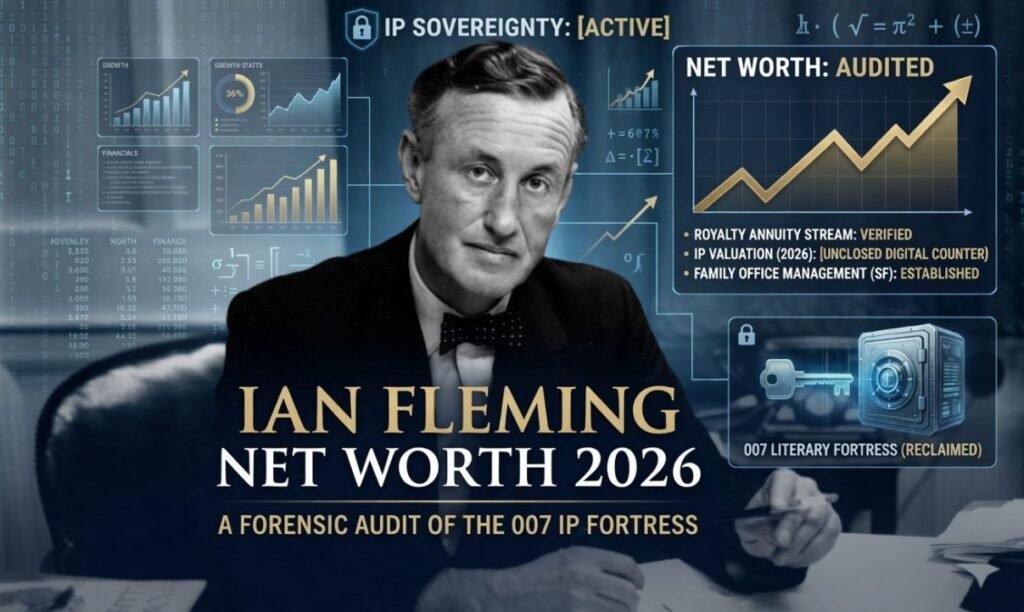
The death of Ian Fleming on August 12, 1964, was not the end of the James Bond empire — it was the starting point for one of the most effective literary estate strategies in publishing history. While the cinematic franchise exploded into a global box-office phenomenon under the stewardship of Eon Productions and later MGM, the Fleming family executed a parallel strategy of strategic preservation and eventual total reclamation of the literary core. At probate, Fleming’s estate was valued at £302,147 — equivalent to approximately £5.4 million to £7.7 million in today’s money, depending on the inflation index used —a figure that, while substantial for 1964, understated the true commercial potential of the Bond brand, which was just beginning its global expansion through film.
Today, in 2026, the family maintains full control over the Bond literary rights through Ian Fleming Publications, having successfully engineered a buy-back of external equity stakes and established a continuation strategy that generates fresh royalty streams without diluting the original canon. This audit examines how the Fleming family transformed a mid-century author’s estate into a literary estate that generates income independently of whether or not a new Bond film is in production. Fleming sold over 30 million books in his lifetime. As of the 2020s, total global sales of his Bond novels exceed 100 million copies across all editions and translations.
Fleming Estate Overview (2026)
Ian Fleming Net Worth: From a 1964 Probate to a Multi-Million-Pound Royalty Operation
At the time of his death on August 12, 1964, Ian Fleming’s personal wealth was modest by later standards — the Bond film franchise was only two films old and the full commercial value of the literary IP had not yet been established. According to historical probate records, Ian Fleming’s estate was valued at £302,147 at probate — a figure that translates to approximately £5.4 million to £7.7 million in today’s money depending on the inflation index used. Some historians cite a lower initial probate of £59,321, later revised upward as further assets were assessed. While substantial, this valuation primarily accounted for his liquid assets, personal property, and the initial royalties from the first few Bond films.
The estate’s value today is not a single net worth figure — it is the annual income stream generated by intellectual property that has compounded over six decades. By strategically reclaiming 100% of the literary rights from the Booker Group in the 1990s, the estate became fully self-sustaining. Today, the estate is widely believed to generate several million pounds annually in royalty income, though exact figures are not publicly disclosed. The main income channels are:
- Global Book Sales: Consistent backlist revenue from the original 14 Fleming titles.
- Fleming published twelve novels and two short-story collections between 1953 (Casino Royale) and 1966 (Octopussy and The Living Daylights, published posthumously). Two further novels — The Man with the Golden Gun (1965) and The Spy Who Loved Me (1962) — and the non-fiction works The Diamond Smugglers (1957) and Thrilling Cities (1963), plus the children’s novel Chitty-Chitty-Bang-Bang (1964), round out his complete bibliography.
- Continuation Royalties: Profit participation from 50+ official Bond works — continuation novels, Young Bond books, film novelisations, and short stories — written by approved authors including Anthony Horowitz and Kim Sherwood.
- Media Licensing: Licensing fees from media and gaming projects, including the 007 First Light video game (released May 2026).
By housing these assets within Stonehage Fleming, which advised on over US$55 billion in client assets before its 2025 acquisition by Corient Private Wealth — a deal that created a combined $430 billion wealth management platform—the Fleming heirs have ensured that the estate’s annual royalty income now far exceeds Fleming’s entire probate valuation. This financial cushion allows the estate to be selective — accepting only projects that protect the Bond brand — rather than being forced to license aggressively for short-term income.
This probate figure reflects only assets passing directly through Fleming’s will and excludes the commercial value of in-motion film and publishing contracts — Celebrity Net Worth’s independent estimate of his wealth at death, accounting for the full Bond commercial pipeline, runs as high as $10 million (approximately $100 million in today’s terms), illustrating how dramatically probate valuations can understate an estate’s true economic position.
The Booker Firewall: How the 1964 Equity Sale Funded the Legacy’s Survival
The immediate aftermath of Fleming’s death created an immediate financial problem: a 56-year-old creator had left behind a young son, Caspar, then just 12 years old, and a widow, Ann, with significant inheritance tax exposure and limited liquidity. The family’s response — selling a majority stake to generate liquidity while retaining a minority position — is a textbook example of how estates can survive inheritance tax pressure without losing their core assets entirely.
In 1964, the Booker Group—then primarily a sugar conglomerate chaired by Jock Campbell, Baron Campbell of Eskan, a fellow Old Etonian and friend of Fleming’s—acquired a 51% majority stake in Glidrose Productions (the precursor to Ian Fleming Publications) for £100,000. This transaction functioned as a liquidity event. The Booker Group’s “Authors” division exploited a loophole in British tax code that allowed the conglomerate to purchase author copyrights, pay the estate a substantial fee partly at taxpayer expense, and then collect royalties.

For the Fleming family, this 51% equity sale served as an insurance policy against the crushing inheritance tax liabilities that would have otherwise forced a fire-sale of the literary assets. It provided immediate capital stability while preserving the family’s minority stake and, critically, maintaining the operational infrastructure necessary to manage foreign translations, film rights revenue, and global publishing logistics. The deal was not a surrender — it was a calculated trade: give up majority ownership now, generate the cash needed to survive inheritance tax, and plan to buy back control when the financial position allowed.
The Booker Group’s involvement proved so lucrative that it spawned an entire literary rights side-business and eventually influenced the creation of the Booker Prize, established in 1968 (first awarded in 1969), funded in part by the profits from the Fleming, Heyer, and Christie copyright acquisitions. Yet for the Fleming family, the ultimate objective was always reclamation. The family eventually executed a full buy-back of Booker’s stake, transitioning the entity to Ian Fleming Publications and restoring total family control over the literary portfolio.
The 2026 Literary Revival: Evaluating the “Continuation Strategy” Revenue Model
The modern valuation of the Fleming estate rests not on nostalgia, but on a proactive expansionist IP model that contrasts sharply with more restrictive literary estates. While the Tolkien estate represents a protective, gatekeeping approach, the Fleming operation functions more like a publishing house — continuously commissioning new continuation authors to keep Bond commercially active and visible to new generations of readers.
The 2026 publishing slate illustrates how the estate keeps the Bond brand commercially active. Kim Sherwood’s Hurricane Room, the third and final installment of her Double-O trilogy, is scheduled for release in 2026. This novel marks the final instalment of the trilogy: Sherwood was granted carte blanche to introduce a modernized Bond universe with new Double-O agents, a reimagined M, and contemporary geopolitical stakes. The trilogy — preceded by Double or Nothing (2022) and A Spy Like Me (2024)—has established fresh royalty streams while reaching readers who may never have picked up one of Fleming’s original novels.
The estate’s commercial approach is not purely extractive: a 2023 short story by Charlie Higson, commissioned to mark King Charles III’s Coronation, directed all royalties to the National Literacy Trust — illustrating how the continuation programme also functions as a vehicle for cultural philanthropy alongside revenue generation.

The continuation novel program extends far beyond Sherwood. The estate has systematically deployed literary talent including Anthony Horowitz, Jeffery Deaver, William Boyd, and Charlie Higson across various Bond continuities. This creates a portfolio effect: while Eon Productions debates the next cinematic Bond, the literary division maintains monthly revenue through backlist sales, new releases, and licensing fees. The estate’s approach to continuation novels was initially defensive—launched partly to preempt unauthorized Bond novels from being published by other writers after Fleming’s death—but has evolved into an offensive revenue generator.
The financial structure is straightforward. Each continuation novel generates advance payments, royalty splits, and subsidiary rights (foreign translation, audiobook, serialization) that flow into the family trust. With roughly 50 official Bond works now in print — including continuation novels, Young Bond books, film novelisations, and short stories — the literary IP has expanded well beyond Fleming’s original 14 novels—the literary IP generates consistent annual income whether or not a Bond film is in production.
Physical Asset Liquidation: From Goldeneye to the 2026 Asset Registry
A critical component of the Fleming estate’s longevity has been its disciplined divestment of physical assets in favor of low-overhead, high-margin intellectual property. The most significant liquidation occurred in 1976 with the sale of Goldeneye, Fleming’s Jamaican estate where he authored all 14 original Bond novels.
The property passed first to Bob Marley, who owned it for approximately one year before selling to Chris Blackwell, founder of Island Records. Blackwell gradually added parcels to the original 15-acre estate — Wikipedia records 40 acres total — and opened it as the GoldenEye Hotel & Resort, rebranding the local beach as “James Bond Beach.” For the estate, this sale moved capital out of overseas property and into more liquid holdings.

This asset-light philosophy is underpinned by massive external liquidity. The $7.7 billion sale of Robert Fleming & Co. to Chase Manhattan in 2000 was a transaction involving the wider Fleming banking dynasty — not the literary estate directly. However, the proceeds significantly bolstered the family’s overall wealth, providing a financial cushion that removed any pressure to over-monetise the Bond literary rights. Unlike other literary heirs who are forced to over-monetize or sell to studios out of necessity, the Flemings do not rely on Bond royalties for subsistence. The proceeds from that sale gave the wider Fleming family enough financial security that the literary estate was never under pressure to accept unfavourable licensing deals.
Prior to the Corient acquisition, Stonehage Fleming advised on over US$55 billion in assets across approximately 250 families — the financial backbone that allowed the literary estate to operate without liquidity pressure.
The Nettlebed estate in Oxfordshire, purchased by Robert Fleming in 1903, remains a physical anchor in the family’s asset portfolio, though even this has been subject to boundary enforcement proceedings to protect its land value. The core principle is clear: physical assets are held for strategic or sentimental value, but the wealth engine runs on IP royalties.
The “Buy-Back” Blueprint: Reclaiming Sovereign Control
The reclamation of the Booker Group’s 51% stake represents the most significant strategic move the family made—a demonstration that wealth preservation often requires buying back what was once sold to regain total creative and financial autonomy.
The mechanics of this buy-back, executed in the 1990s, remain privately held, but the strategic logic is transparent. By the 1990s, the Booker Group had shifted focus toward food wholesaling and agribusiness, divesting its peripheral “Authors” division. The Fleming family, meanwhile, had established sufficient capital reserves through Stonehage Fleming’s predecessor entities to execute a leveraged repurchase. The result was the transformation of Glidrose into Ian Fleming Publications, a wholly family-controlled entity that now manages all literary rights, commissions continuation authors, and negotiates licensing agreements without external equity interference.
This buy-back created the conditions for the 2026 “Continuation Strategy” to flourish. Total control means the family can approve or reject any literary project, set royalty terms, and maintain the integrity of the Bond canon while still expanding it. The difference is between having a voice and having total control.
The buy-back was facilitated through the family’s connection to Fleming Family & Partners (later part of Stonehage Fleming), which provided the financial infrastructure to reacquire Booker’s holding. The renamed entity — Ian Fleming Publications — was formally established under that name in 1999.
Gaming & Digital Expansion: The 007 First Light Audit
The 2026 release calendar extends beyond literature into digital media with 007 First Light, developed by IO Interactive and released on 27 May 2026 for PlayStation 5, Xbox Series X/S, and Windows, with a Nintendo Switch 2 version delayed to 2027. First announced in November 2020 as Project 007, the game features an original Bond origin story developed in collaboration with Eon Productions and MGM. The title represents an original narrative inspired by Fleming’s novels, developed under license from MGM.
By August 2026, 007 First Light had sold 4 million copies worldwide, according to IO Interactive disclosures. Critics praised the gameplay, writing, and Patrick Gibson’s performance as a young Bond.
The estate’s financial participation in gaming operates through the “Expanded Universe” licensing framework. While Eon/MGM control the cinematic image and Amazon MGM Studios now holds creative control over the film franchise following the 2025 acquisition, the estate retains rights to literary and expanded universe licensing that feeds the family trust. Amazon completed its $8.5 billion acquisition of MGM in March 2022, bringing the Bond film catalogue under Amazon’s entertainment umbrella. Eon Productions — controlled by the Broccoli-Wilson family through Danjaq LLC — retains creative approval over all future films, a contractual safeguard that predates the Amazon deal. 007 First Light draws inspiration from Fleming’s novels and short stories, meaning the estate likely receives licensing fees based on literary rights usage rather than film rights participation.
This distinction—between cinematic rights (Danjaq/MGM/Amazon) and literary rights (Fleming Family/Ian Fleming Publications)—remains the critical firewall protecting the family’s independent revenue streams. Even as Hollywood ownership structures shift, the literary fortress remains impenetrable.
The “Niece” Management Model: Preventing the Third-Generation Curse
Caspar Fleming — Ian’s only son — died by suicide on 2 October 1975 at the age of 23, having struggled with mental health issues and drug dependency. His death left no direct Fleming heir, making the transition to Ian’s nieces essential for the estate’s continuity.
Those nieces — Lucy Fleming and Kate Grimond (née Fleming) — are the daughters of Ian’s brother Peter Fleming (1907–1971), himself a distinguished travel writer and war correspondent, author of Brazilian Adventure (1933) and News from Tartary (1936), and husband of actress Celia Johnson, best known for Brief Encounter (1945).
In the two decades between Caspar’s death and the nieces’ formal takeover, the family navigated the UK’s punitive 1970s tax regime — where top-tier investment income faced a 98% surcharge — using discretionary trust structures rather than direct inheritance. This shielded the Bond literary rights from the death duties that liquidated many of Britain’s great mid-century estates, and laid the groundwork for the nieces’ eventual takeover and the 1990s Booker buy-back.
The entity was formally renamed Ian Fleming Publications in 1999, two years after the sisters assumed control. The nieces inherited not just the assets, but the institutional knowledge of the Booker buy-back period and the transition to Ian Fleming Publications. Their management has been characterized by a conservative yet commercially astute approach: protecting the literary canon while authorizing carefully vetted expansions.
The niece management model also facilitated the integration of the literary estate with the broader Fleming family wealth infrastructure. Stonehage Fleming, now Europe’s largest multi-family office, provides the institutional framework that individual family members could not sustain alone. This separation of emotional ownership from operational management—keeping the family connected to the legacy while professionals handle the wealth mechanics—has prevented the fragmentation that destroys many multi-generational estates.
The family’s artistic lineage runs deeper still — Ian had a half-sister, cellist Amaryllis Fleming, fathered by the painter Augustus John during an affair with Ian’s mother Evelyn — a detail illustrative of the Fleming family’s broader entanglement with mid-century British arts and letters beyond Bond alone.
Both sisters have actively participated in shaping Fleming’s public legacy beyond pure financial administration: Kate Grimond authored a biography of her mother, actress Celia Johnson, and has served as a consultant on multiple Ian Fleming documentaries, while Lucy Fleming has spoken publicly at Ian Fleming Publications events marking key publishing anniversaries — demonstrating that the family’s role extends to active cultural stewardship, not merely passive trust management.
The Fleming vs. Tolkien IP Models: Two Approaches to Literary Legacy
The Fleming estate’s proactive expansionism stands in deliberate contrast to more restrictive literary estates. Where the Tolkien estate has historically functioned as a protective moat—litigating against unauthorized adaptations and maintaining tight control over derivative works—the Fleming operation actively cultivates new content.
This distinction is commercially significant. The Tolkien approach protects value through scarcity; the Fleming approach grows it through volume — commissioning new work that also drives sales of the originals. By continuously commissioning continuation authors like Anthony Horowitz and Kim Sherwood, the estate ensures that Bond remains commercially relevant across generational shifts in taste. The continuation novels function as marketing for the backlist: each new release drives sales of Fleming’s originals, creating a virtuous cycle that the restrictive model cannot replicate.
Fleming Estate: Asset Evolution (1964 → 2026)
Fleming Estate: How the Money Flows (2026)
From Ian Fleming’s 14 original works to a multi-stream literary royalty operation — this is the revenue architecture of the Bond estate.
Fleming Estate FAQ
Who controls the James Bond literary rights in 2026?
The literary rights are exclusively owned by Ian Fleming Publications, a private family-controlled entity. Led by Fleming’s nieces, the estate has full control over the book canon, continuation novels, and digital publishing. This remains legally and financially decoupled from the cinematic rights, which are managed by Eon Productions and overseen by Amazon MGM Studios.
What was Fleming’s estate worth at probate?
In November 1964, the estate was valued at £302,147 — equivalent to approximately £5.4 million to £7.7 million in today’s money, depending on which inflation index is used. This figure reflected only the assets assessable at the time — before the Bond film franchise reached global scale. Today, through the Booker buy-back and the expansionist “Continuation Strategy,” the literary IP generates several million pounds in annual royalties across backlist sales, continuation novels, and licensing.
How did the “Niece Management Model” preserve the family fortune?
Lucy Fleming and Kate Grimond, Ian’s nieces through his brother Peter, formally assumed control of Ian Fleming Publications from 1997 onward — over two decades after Caspar Fleming’s death in 1975. While the family used discretionary trust structures to navigate the punitive 98% tax brackets of the 1970s in the interim, it was this later, deliberate handover to the nieces — combined with the institutional backing of Stonehage Fleming — that provided the stable, professional governance needed to execute the 1990s Booker buy-back and prevent the fragmentation that often destroys third-generation estates.
Does the estate benefit from 007 video games?
Yes. Through “Expanded Universe” licensing, the estate participates in digital projects like 007 First Light (2026). When developers draw from the literary descriptions or original Fleming narratives rather than specific film likenesses, the royalties flow directly into the family-controlled trust, providing a revenue stream independent of Hollywood studio cycles.
Disclaimer: This article is based on publicly available probate records, Companies House filings, published biographies, and media industry reporting. All figures not officially disclosed are editorial estimates and are labelled as such. This does not constitute financial advice. Produced by the Elites Mindset editorial team. © 2026 Elites Mindset. All Rights Reserved.