
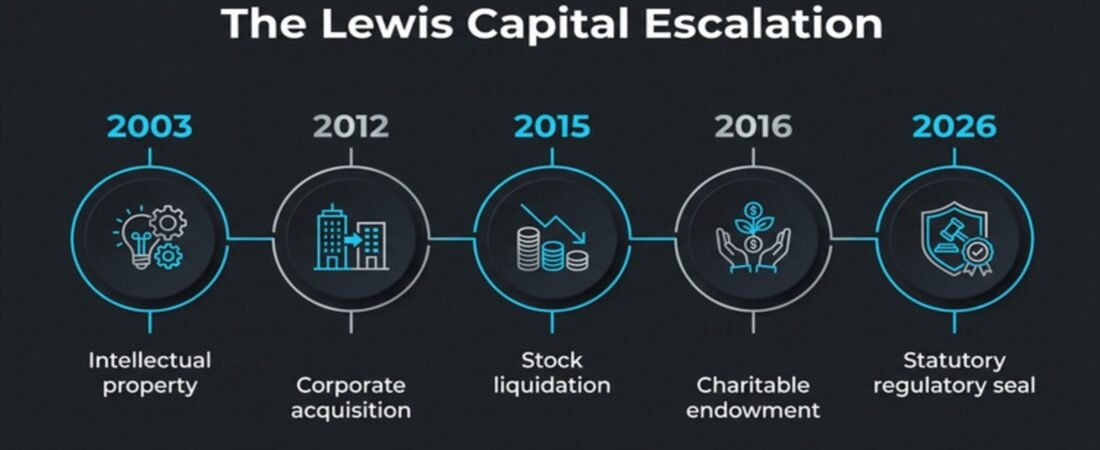

In February 2003, Martin Lewis CBE — financial journalist, broadcaster, and consumer rights advocate, appointed OBE in 2014 and CBE in 2022 — launched MoneySavingExpert.com from his living room with a reported initial outlay of £80–£100 (sources vary between the web design fee specifically and total startup costs)—an amount that would ultimately yield confirmed personal proceeds exceeding £79 million within twelve years, with no external capital raised at any stage. What began as a bootstrapped consumer advice platform, architected around hyper-focused search intent and zero external venture capital, escalated into a high-margin media powerhouse commanding an enterprise valuation of up to £87 million within nine years.
The significance of the MSE case extends beyond the return on capital. Lewis built a site whose traffic depended on user trust, then protected that trust through a binding editorial code written into the acquisition contract — preventing the post-sale erosion common in private equity media buyouts.
The Sunday Times Rich List historically benchmarks Lewis’s baseline net worth at £123 million. While this figure serves as a static historical benchmark rather than an active live valuation, it reflects a financial position built on realized liquidity events, diversified asset holdings, and disciplined philanthropic giving. Unlike standard internet entrepreneurs who scale via aggressive venture capital injections that dilute equity early, Martin Lewis represents the organic, bootstrapped operational model—converting hyper-focused search intent into a high-margin consumer media powerhouse. His trajectory demonstrates how a media asset can scale from zero capital to a nine-figure exit without external funding and without losing the editorial trust that underpinned its traffic.
The Wealth Timeline: From £100 to £123 Million
The £87M Exit Structure: Dissecting the Moneysupermarket.com Acquisition Model
The acquisition of MoneySavingExpert.com by Moneysupermarket.com Group PLC (now MONY Group), announced in June 2012 and legally completed on 21 September 2012, represents a structured deal combining immediate liquidity with long-term upside. MoneySavingExpert.com derived approximately 59 percent of its revenue from Moneysupermarket.com’s comparison products, making the acquirer both the largest commercial partner and the logical buyer. In the year to October 2011, MSE attracted 39 million unique visitors and generated revenues of £15.7 million — the underlying commercial foundation for the £87 million acquisition price. Lewis was the sole 100% shareholder at the time of sale — there were no co-founders, investors, or diluted equity positions. The transaction was not a simple cash purchase but a three-part structure — cash, shares, and performance-linked deferred payments — designed to align Lewis’s continued operational input with the parent group’s performance metrics.
At closing, Lewis received £35 million in upfront cash, approximately 22.1 million MML shares valued at prevailing market rates, and deferred consideration of up to £27 million contingent on earn-out performance and operational milestones — of which £19.2 million was ultimately confirmed as payable to Lewis when the earn-out matured — as detailed in the official RNS acquisition announcement.
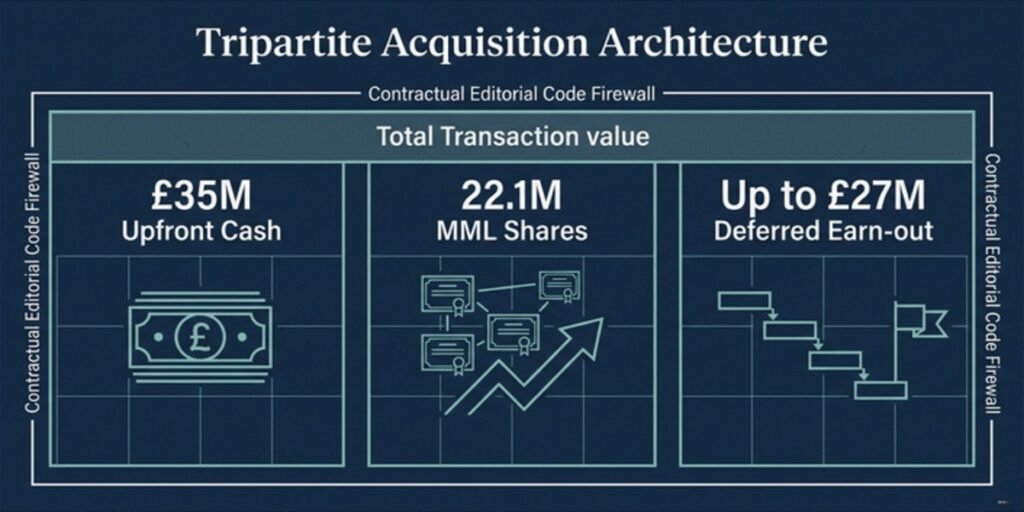
This equity-heavy structure served dual strategic functions. For Moneysupermarket.com, the issuance of 22.1 million shares acted as a retention mechanism, ensuring Lewis remained tethered to the asset’s editorial and commercial trajectory. For Lewis, the share component preserved upside mobility, allowing him to participate in the parent group’s market capitalization growth without surrendering all equity in his own creation. The deferred consideration—reportedly subject to traffic and revenue benchmarks—functioned as a classic earn-out security mechanism, protecting the acquirer from overpayment while Lewis preserved the underlying trust architecture that had driven MSE to approximately 16 million monthly users at its peak.
Critically, Lewis did not exit operationally. He retained the role of Editor-in-Chief under a binding editorial code that guaranteed MSE’s editorial independence from commercial interference. This was not a ceremonial title; it was a contractual guarantee that prevented Moneysupermarket.com from redirecting MSE’s high-intent consumer traffic toward its own comparison products in ways that would degrade user trust. The preservation of this editorial moat is central to understanding why MSE’s traffic engine did not suffer the typical post-acquisition decay seen when media brands are absorbed into larger corporate entities. The site maintained its organic search dominance because the underlying content architecture remained user-centric rather than commercially co-opted.
📋 Deal Arithmetic: The MoneySavingExpert Exit

  Initial outlay (2003):         ~£100
  Upfront cash (Sept 2012):      £35,000,000
  MML shares received (2012):    22.1 million shares
  Earn-out received (Oct 2015):  £19,200,000
  Share sale (July 2015):        £25,200,000 (9M shares @ £2.80)
  ─────────────────────────────────────────
  Total confirmed personal proceeds: ~£79.4M+
  (Excludes retained shares and dividend income)

📋 The Martin Lewis Charity Fund — Key Disbursements (as of February 2026)

  Total fund:                      ~£25 million
  Citizens Advice UK:              £2,000,000 (two £1M tranches: 2012, 2015)
  Trussell Trust:                  £650,000
  PFEG / Young Enterprise:         £500,000
  Mind:                            £100,000
  MMHPI founding endowment:        £2,000,000+
  Fund managed via:                Charities Aid Foundation (CAF)
The 2015 Share Liquidation and Present Financial Asset Portfolio
In July 2015, Lewis executed a strategic secondary market placement, liquidating 9 million MML shares—representing just over half of his remaining post-acquisition shareholding—for £25.2 million in cash. The block sale, conducted through institutional placement, represented a decisive diversification maneuver, converting concentrated public equity exposure into liquid capital capable of deployment across conservative UK wealth management systems, high-end real estate holdings, and treasury balances.
The timing of the 2015 liquidation merits forensic attention. Lewis had already received his £35 million upfront cash payment in 2012, and by mid-2015 the deferred consideration mechanisms had largely matured. The July share sale therefore represented a deliberate portfolio rebalancing—locking in gains from MML’s market performance while reducing single-stock concentration risk. Notably, Lewis did not liquidate his entire position; he retained a significant minority stake, allowing continued participation in dividend flows and share price appreciation while insulating his personal balance sheet from sector-specific volatility in the UK price-comparison market.
Following the 2015 sale, Lewis’s remaining stake in Moneysupermarket.com fell to under 3%, a figure that would decline further to around 1.5% in subsequent years as additional shares — including some donated to the Charities Aid Foundation — were sold down.
Post-2015, Lewis’s consolidated wealth trajectory stabilized into a diversified holdings structure. According to the Sunday Times Rich List, his net worth stands at £123 million—a figure reflecting not active entrepreneurial risk but the compounding of realized liquidity events, conservative investment returns, and strategic asset allocation. His present portfolio is understood to include substantial London residential property, managed fund exposures through UK private wealth institutions, and liquid treasury reserves. The operational income from his ITV presenting work — including The Martin Lewis Money Show and regular appearances on Good Morning Britain — provides additional cash-flow layering alongside journalism and writing income, though these represent marginal contributions relative to the capital base established through the MSE exit.
The Philanthropic Carve-Out: Institutionalizing Wealth Distribution
Parallel to his wealth accumulation, Lewis committed publicly and in detail to a structured charitable giving programme running parallel to the sale proceeds. In June 2012, concurrent with the MSE sale announcement, he pledged £10 million to charitable causes—a commitment that has since escalated through gift-aid amplification, share appreciation, and additional pledges to approximately £25 million in total charitable capital, as confirmed in Lewis’s February 2026 charity fund update. The fund is administered through the Charities Aid Foundation, a structure Lewis deliberately chose to publicize as a model for high-net-worth giving, retaining control over disbursement while ensuring all distributions flow exclusively to registered charities.
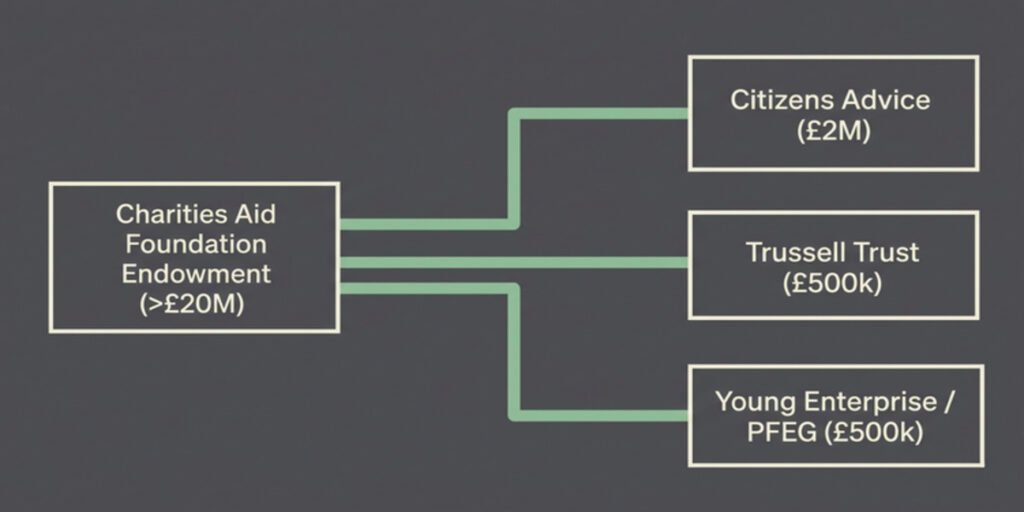
The forensic flow of capital reveals a strategic targeting of underfunded institutional infrastructure. Citizens Advice received £2 million across two major tranches: an initial £1 million in 2012, split proportionally across England and Wales, Scotland, and Northern Ireland — and a subsequent £1 million in 2015 following the share liquidation. This targeting was deliberate—Lewis explicitly directed capital toward Citizens Advice at a moment when government austerity measures had severed debt-counselling funding, using his private wealth to expose public-sector funding gaps.
The Trussell Trust received a total of £650,000, and the Personal Finance Education Group (now a Young Enterprise sub-brand) received £500,000. The Trussell Trust allocation funded the rollout of financial triage services across UK food banks, building on a successful £100,000 pilot that demonstrated measurable outcomes in debt reduction and service uptake. The PFEG endowment funded financial education programming in schools at a critical juncture when many donors assumed curriculum inclusion had eliminated the need for supplemental charitable support. Additional disbursements included £100,000 to Mind for mental health work and smaller allocations to the Royal National Institute of Blind People and Winston’s Wish.
The “Trust Premium” Valuation: Editorial Independence as Enterprise Value
Most digital media acquisitions see traffic drop 15–30 percent within eighteen months as editorial integrity gets compromised by commercial priorities. The MSE case defied this pattern. By negotiating a binding editorial code that guaranteed absolute independence from Moneysupermarket.com’s commercial operations, Lewis preserved the underlying trust architecture that had generated MSE’s search-engine dominance and 16-million-monthly-user ecosystem at its peak.
This “trust premium” functioned as a hidden valuation multiplier. While not explicitly priced into the 2012 transaction, it protected the acquirer’s return on investment by preventing the typical post-acquisition traffic collapse. MSE’s editorial code—ensuring no commercial interference in content decisions, no preferential placement of Moneysupermarket.com products, and no dilution of consumer-revenge journalism—maintained the site’s high-intent user base. The traffic engine, built on template-letter downloads, PPI reclaim guides, and energy-switching tools, continued to generate organic engagement because users recognized that the editorial product had not been captured by its corporate parent. For wealth auditors, this represents a critical lesson: in consumer media, editorial independence is not merely an ethical stance but a balance-sheet asset that preserves enterprise value post-liquidity.
The Super-Complainant Status Asset: Systemic Influence as Competitive Moat
In February 2026, The Financial Services (Designated Consumer Body and Designated Representative Body) Order 2026, designated by HM Treasury, awarded the Money and Mental Health Policy Institute expanded super-complainant status, with powers over the FCA and PSR taking effect in March 2026. This milestone granted the charity fast-track powers to lodge complaints directly with the Financial Conduct Authority (FCA) and the Payment Systems Regulator (PSR).
Super-complainant designation transforms MMHPI from a standard advocacy charity into a systemic policy actor with statutory leverage over UK financial regulation. The Treasury’s designation instrument explicitly recognizes the institute’s capacity to identify market-wide consumer harms—particularly at the intersection of mental health vulnerability and predatory financial practices—and compel regulatory investigation without the procedural friction faced by standard complainants. Crucially, as outlined by MoneySavingExpert’s Official Announcement, this expansion builds upon MMHPI’s initial super-complainant status awarded via the Department for Business and Trade in 2025, granting it power to lodge complaints with the Competition and Markets Authority (CMA). Once a super-complaint is lodged, the regulator must publish a formal response within 90 days — a response that can trigger investigation, enforcement action, or recommendations for legislative change. As a result, the charity now operates uniquely across the entirety of the UK’s tripartite regulatory architecture: competition, financial conduct, and payment systems.
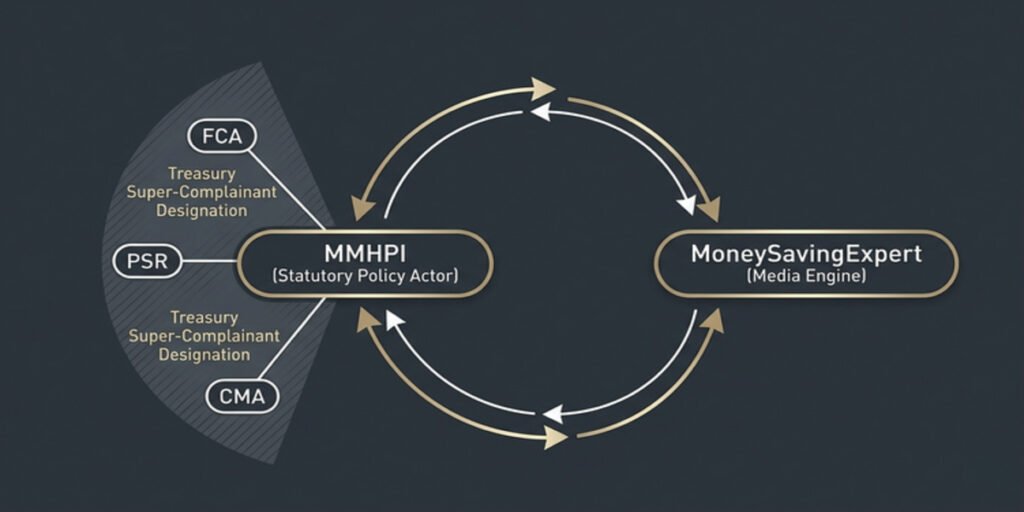
For the Lewis corporate ecosystem, this status functions as a competitive advantage that reinforces the core MSE brand’s systemic influence — though it’s worth noting MMHPI is one of only four organizations holding this tripartite status across the CMA, FCA, and PSR, alongside Which?, Citizens Advice, and the Consumer Council for Northern Ireland. It is a genuinely rare designation, but not a unique one. This symbiotic structure creates a self-reinforcing influence loop that extends Lewis’s consumer champion positioning from media into statutory governance.
Frequently Asked Questions
Q: How much did Martin Lewis sell MoneySavingExpert for?
Martin Lewis sold MoneySavingExpert.com to Moneysupermarket.com Group in a deal completed in September 2012. The transaction was structured around an upfront consideration of £60 million (comprising £35 million in upfront cash and 22.1 million MML shares) plus performance-linked deferred targets capped at a maximum of £27 million. Upon maturity of the earn-out period in October 2015, the final performance-linked deferred payment yielded £19.2 million paid directly to Lewis, bringing his total confirmed personal cash proceeds to approximately £79.4 million — comprising £35 million upfront cash, £19.2 million earn-out, and £25.2 million from the 2015 share sale — excluding retained shares and dividend income.
Q: What is Martin Lewis’s net worth according to the Sunday Times Rich List?
The Sunday Times Rich List historically established Martin Lewis’s net worth baseline at £123 million. While this specific valuation originates from index calculations carried forward as a static benchmark rather than a live 2026 asset sheet, it remains the authoritative public profile standard. This valuation reflects the crystallization of his 2012 enterprise sale, subsequent 2015 public equity liquidations, premium UK real estate holdings, and structured investment cash flows, balanced against extensive philanthropic distributions.
Q: Does Martin Lewis still own MSE?
No, Martin Lewis does not own MoneySavingExpert.com. The platform is entirely owned by MONY Group PLC (formerly Moneysupermarket.com Group), which acquired the asset in 2012. However, Lewis maintains strict operational and strategic influence as Executive Chair—a permanent governance role he assumed in September 2015 after stepping down as Editor-in-Chief. This operational positioning guarantees that the brand’s legally binding editorial code remains fiercely independent from the corporate parent’s direct commercial operations.
Q: Why is the Money and Mental Health Policy Institute’s super-complainant status considered an enterprise “moat”?
Super-complainant status transforms MMHPI (the charity Lewis founded and chairs) from a passive research body into a statutory regulatory actor. Following initial status via the CMA, the 2026 expansion grants the institute legal power to compel fast-track, 90-day response investigations directly from the FCA and PSR. For the broader Lewis ecosystem, this forms a genuinely rare — though not unique — competitive advantage, shared with only three other UK consumer bodies; the institute’s high-level systemic policy intelligence feeds an authoritative content pipeline that structurally underpins the ‘trust premium’ of the MSE platform.
Q: How exactly was the initial capital outlay structured in 2003?
Forensic records from the asset’s genesis point to a total initial setup budget of £100. Of this total, £80 went to commission a web designer in Uzbekistan to build the original site template. A total outlay of £100 — yielding confirmed personal proceeds exceeding £79 million — represents one of the most documented return profiles in UK bootstrapped media history.
📋 Source Verification Key
Deal structure: MSE official announcement (June 2012); Citywire (Oct 2015)
Net worth: Sunday Times Rich List (£123M — historical benchmark, confirmed 2024)
Charitable total: Martin Lewis Charity Fund blog (Feb 2026 — £25M confirmed)
Super-complainant: MMHPI official press release (12 Feb 2026); legislation.gov.uk (SI 2026/124)
CMA status: Department for Business and Trade recommendation (2025); Credit Connect
MSE user figures: Frome Town Council / MSE site description (16 million monthly users)
Editor step-down: Citywire (Sep 2015 announcement); Mabumbe/Wikipedia (2016 formal completion)
Disclaimer & Editorial Notes
This profile functions strictly as an independent forensic corporate case study and public asset audit. All financial data, transaction milestones, and net worth indexing are compiled exclusively from high-authority public records, statutory regulatory filings, and historical media indexes. Elites Mindset operates with absolute editorial independence and maintains no corporate affiliation, endorsement, or commercial relationship with Martin Lewis, MoneySavingExpert.com, or MONY Group PLC. The insights provided herein are for educational and analytical purposes only and do not constitute financial, legal, or investment advice.