
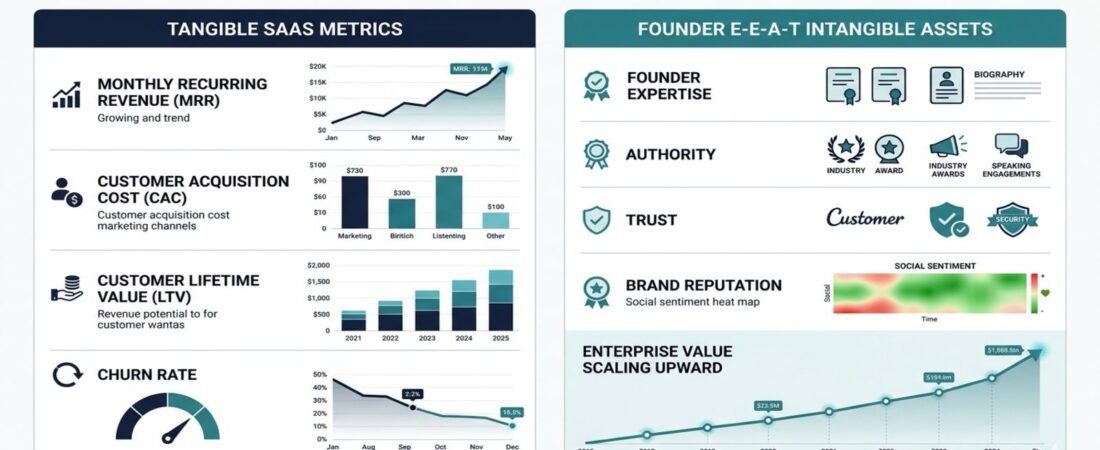

In 2026, the personal brand of a UK tech founder is no longer a peripheral marketing accessory—it is a quantifiable intangible asset that sits squarely on the corporate balance sheet. Enterprise buyers, institutional investors, and elite talent do not merely evaluate your SaaS metrics, cap table, or technical architecture in isolation. They execute deep background reconnaissance on the humans behind the entity. A founder’s digital footprint—comprising verified author entities, high-signal editorial citations, and algorithmically favoured first-person expertise—functions as the primary trust mechanism in a market where 41% of B2B buyers already have a preferred vendor in mind before formal procurement begins.
When a founder’s searchable presence demonstrates demonstrable experience, expertise, authoritativeness, and trustworthiness (E-E-A-T) across Google’s Knowledge Graph and LinkedIn’s professional graph, the enterprise effectively purchases a reduction in perceived vendor risk. That risk reduction translates directly into lower customer acquisition costs, compressed sales cycles, and premium pricing power—outcomes that map directly onto standard enterprise value metrics: lower CAC, shorter sales cycles, and premium pricing.
AI-ASSISTED EXECUTIVE SUMMARY (CLICK TO HIDE/SHOW)
Institutional Core: The personal brand of a 2026 UK tech founder has transitioned from a peripheral marketing accessory into a quantifiable intangible asset that sits directly on the corporate balance sheet to decrease perceived vendor risk.
The Algorithmic Pivot: Superficial posting schedules face aggressive suppression. The 2026 landscape is governed by LinkedIn’s three-phase Depth Score and Google’s March 2026 Core Update, both of which algorithmically penalize generic AI content while favoring verified, first-person knowledge entities.
Asset Class Architecture:
- The Three-Tier Framework: Executive insight is systematically scaled across an integrated network of Owned Authority (centralized Person Schema markup), High-Signal Social (high-intent LinkedIn pipeline assets), and Earned Authority (global editorial validation).
- Technical Anchoring: Technical trust is secured via semantic code-to-entity mapping and the Cross-Border Validation Multiplier, building defensive SERP real estate optimized for Generative Engine Optimization (GEO).
The Corporate Firewall: To insulate enterprise equity from key-person risk contagion, founders must structurally and legally partition personal brand IP from company assets within employment contracts and separation protocols.
Commercial Liquidity: Operating a leveraged content engine converts one raw hour of monthly founder insight into a multi-channel pipeline driver, compressing enterprise B2B sales cycles and securing premium pricing power.
The Sovereign Blueprint: True market dominance in 2026 separates genuine business acumen from ephemeral social media noise by treating the digital entity with the strict operational and legal rigour required of core corporate infrastructure.
The competitive landscape for UK tech and venture-backed CEOs has shifted dramatically. The post-2025 macroeconomic environment—characterised by cautious institutional capital, elongated B2B sales cycles, and stringent GDPR-compliant data practices—means that generic visibility no longer converts. Founders must now architect what we term the Founder Premium: a deliberate, structurally sound personal brand that operates as a parallel corporate asset, insulated from operational risk yet intrinsically linked to enterprise equity.
This blueprint moves beyond superficial posting schedules and engagement farming. It is a rigorous system for converting raw executive insight into verifiable corporate trust, leveraging the 2026 algorithmic realities of both Google and LinkedIn to dominate high-intent UK corporate positioning and personal SEO queries.
Founder Brand Architecture: The 2026 Framework

Entity Verification
Schema-optimised author profiles, Person markup, and Knowledge Graph anchoring that make the founder a recognisable entity to Google’s semantic systems.
Signal Density
Domain-specific, metric-driven storytelling that satisfies LinkedIn’s 2026 Depth Score and Google’s information gain requirements.
Distribution Leverage
A systematic content engine that transforms one hour of raw founder insight into multi-channel, high-intent pipeline assets.
Corporate Firewalling
IP boundaries, governance protocols, and exit-ready brand equity structures that protect the enterprise from founder-risk contagion.
The Algorithm Shift: Why Generic Thought Leadership Fails the 2026 UK B2B Landscape
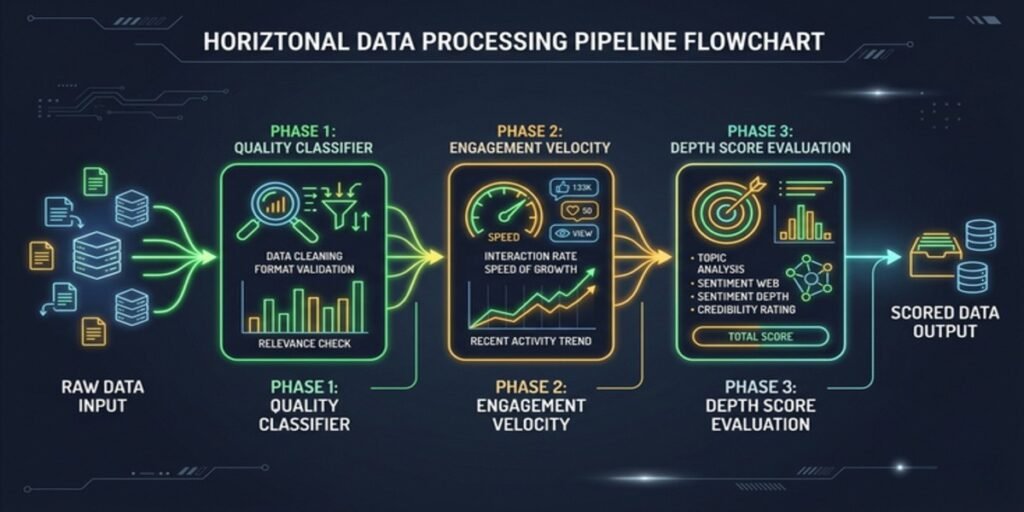
The era of low-effort personal branding is definitively over. In 2026, the LinkedIn algorithm operates through a three-phase sequential evaluation that penalises the very tactics many founders adopted during the 2023-2024 engagement boom. First, a quality classifier assesses content within minutes of publication, examining substance, formatting signals, and author credibility. Second, early engagement patterns within the first 30 minutes determine initial distribution scope. Third—and this is the structural change that kills generic content—the Depth Score accumulates over 24-48 hours and can either expand or contract distribution based on how deeply the audience actually engages. Posts that generate superficial likes but lack meaningful comment threads, save rates, or professional follow-up actions see their reach throttled. Conversely, content that sparks substantive professional dialogue receives compounding algorithmic amplification.
What this means for UK tech CEOs is brutal in its simplicity: generic AI-generated copy, empty engagement farming, and reaction polling are now actively suppressed. The algorithm evaluates semantic density and knowledge-rich signals rather than raw engagement volume. Native document carousels and multi-image posts average approximately 24.42% engagement compared to roughly 4.10% for standard text posts, not merely because of dwell time but because the format structurally demands genuine content depth. The platform has also rebalanced feed allocation dramatically: industry analysis of 2026 platform behavior indicates company pages now receive approximately 5% of user feed visibility while personal profiles command around 65% — figures LinkedIn has not officially confirmed but which are consistently reported across independent SEO research. This is not a temporary fluctuation but a structural realignment that makes employee advocacy and executive thought leadership the primary organic growth channel for B2B brands.
For the UK founder, the strategic imperative is to transition from “content creator” to “domain-specific knowledge anchor.” The posts that build authority most reliably are those that could only have been written by someone with your specific operational experience: counterintuitive lessons from funding rounds, specific patterns observed across enterprise SaaS implementations, honest breakdowns of what failed and why, and proprietary frameworks developed from doing the actual work. The algorithm in 2026 is demonstrably better at detecting authenticity than ever before, which creates asymmetric opportunity for founders with genuine expertise. Three to four high-signal posts per week, structured with 1,000–1,300 characters, strong line-break readability (LinkedIn truncates at approximately 210 characters — your hook must land before the “See More” break), and a discussion prompt at the conclusion, consistently outperform daily posting of diluted material. The goal is sustainable cadence with irreplaceable specificity—not maximum volume.
In contrast, sophisticated asset architecture prioritizes entity-first positioning—systematically transforming a principal’s reputational capital into a verifiable, ring-fenced corporate asset that lowers systemic enterprise risk.
The UHNW founder who approaches digital networks not as social media platforms, but as components of a dynamic professional knowledge graph, commands the immediate validation of institutional allocators and private equity firms conducting pre-acquisition due diligence. In high-value liquidity events, an unoptimized or fragmented digital footprint is no longer just an administrative oversight; it operates as a silent deal-killer that penalizes asset valuation and quietly disqualifies the enterprise before formal M&A negotiations ever commence.
Building the Digital Moat: Navigating Google E-E-A-T and Author Entity Realignment
Off-social anchoring is where the 2026 founder brand battle is truly won or lost. While LinkedIn dominates the nurturing phase, Google controls the discovery and validation phase. Enterprise buyers, venture partners, and prospective employees do not stop at LinkedIn—they execute branded search queries, evaluate Knowledge Panel presence, and scrutinise author entity consistency across the indexed web. The March 2026 Core Update marked a major shift in how Google evaluates content quality, doubling down on E-E-A-T signals by heavily penalizing sites with anonymous or unverified author profiles while rewarding deep, firsthand expertise over scaled, generic content. For founders, this means anonymity is algorithmically penalised and verified authorship is rewarded with preferential ranking, Knowledge Panel inclusion, and AI Overview citation eligibility.
The technical foundation begins with Person Schema markup. Every founder must maintain a centralised, schema-optimised author profile page on their personal website or primary owned media domain. This markup must include: name, jobTitle, worksFor (linked to the corporate entity via Organization Schema), sameAs properties connecting to verified social profiles and authoritative presences, knowsAbout declaring specific topic areas, and alumniOf where relevant. Consistency is non-negotiable—one name, one professional headshot, one concise bio deployed across every platform where the founder publishes. Inconsistency fragments entity recognition and dilutes the Author Vector that Google constructs to evaluate trust and topical authority.
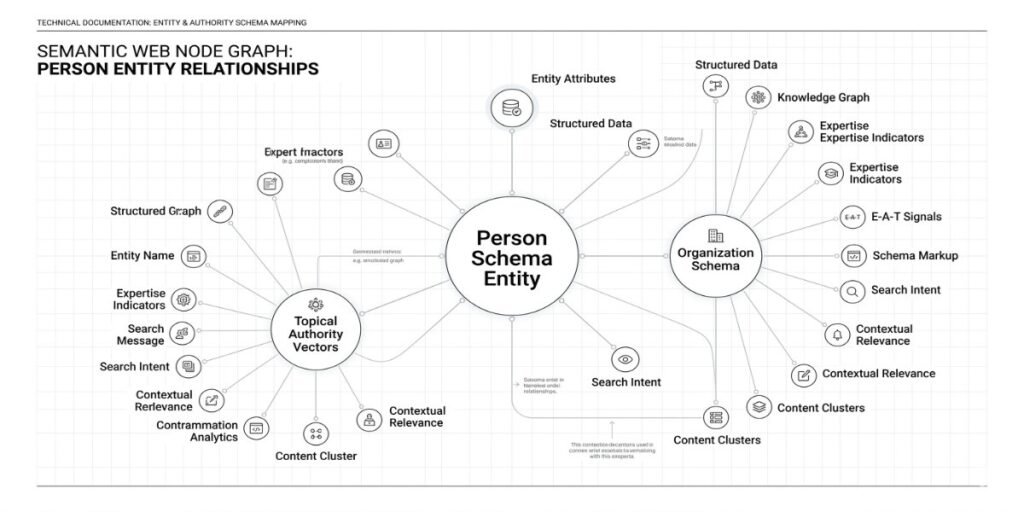
Beyond schema, founders must systematically build what SEO practitioners now term the “author entity moat.” This involves publishing consistently within defined topic clusters for a minimum 18-month horizon to establish pattern recognition in Google’s systems. A founder who publishes about B2B SaaS pricing psychology, enterprise sales cycle compression, and UK venture capital dynamics creates a coherent vector. If that same founder suddenly pivots to generic productivity advice, the vector weakens and algorithmic preference degrades. The content must demonstrate first-hand experience through original data, proprietary case studies, documented client outcomes, and specific operational details that generic AI content cannot replicate.
Critical to this architecture is the deliberate cultivation of high-authority media citations. Google’s Knowledge Graph feeds on verifiable third-party signals. When a founder is quoted in established business press, featured on recognised industry podcasts, or referenced in authoritative editorial contexts, these citations function as off-page entity validation. The Cross-Border Validation Multiplier is particularly potent for UK founders: by securing editorial features that bridge UK market expertise with international business press—South Asian financial publications, North American tech outlets, European innovation journals—founders rapidly construct a robust global entity profile. This international citation layer ranks prominently in branded search, creates defensive SERP real estate that suppresses negative or irrelevant results, and signals to Google’s systems that the author is a recognised authority across multiple geographic and topical markets.
The final component is AI citability. With Google’s AI Overviews and third-party answer engines now capturing significant query volume, founder content must be structured for extraction. Clear descriptive headings that match high-intent queries, concise fact-dense paragraphs that function as standalone answers, original statistics that AI systems want to cite, and FAQ Schema implementation all increase the probability that a founder’s insights are surfaced in zero-click environments. This is not traditional SEO—it is Generative Engine Optimisation (GEO) that builds brand visibility even when the user never clicks through to the website.
The Distribution Playbook: From Fragmented Content to High-Intent Pipeline Scaling
The primary objection founders raise—”I do not have time to be a full-time content creator”—is valid but solvable through system architecture rather than willpower. The high-performing UK tech CEO in 2026 does not write posts from scratch every morning. Instead, they operate a production system that captures raw insight in real time, batches refinement into efficient workflows, and distributes through channels weighted by intent and reach.
The foundational unit of production is the Monthly Insight Download: a single 60-minute recorded session where the founder speaks candidly about recent board decisions, market observations, customer conversations, and strategic pivots. This raw audio or video asset is not published as-is. It is processed through a structured extraction pipeline: a transcription specialist identifies 4-6 discrete insights, a content strategist maps each insight to a specific channel and format, and an editorial layer structures the material into platform-native assets while preserving the founder’s authentic voice and first-person experience markers. AI assists in formatting and structural optimisation, but the insight, angle, and specific experience remain irreducibly human.
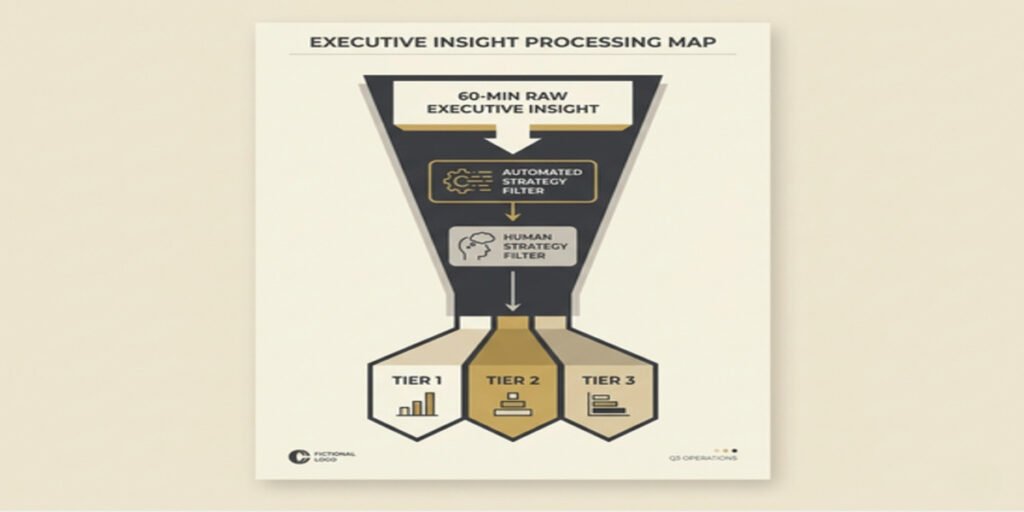
This single hour of raw material fuels a multi-channel distribution engine:
Executive Summary Matrix: Cross-Platform Asset Architecture at a Glance
| Tier | Asset | Core Purpose | Metric |
|---|---|---|---|
| Tier 1 Owned Authority | Personal Website & Schema-Optimized Author Profiles | Google Knowledge Graph & E-E-A-T Baseline | Branded Search Domination |
| Tier 2 High-Signal Social | LinkedIn / Industry Newsletters | Nurturing Enterprise Pipelines & Talent Acquisition | Inbound Lead Volume & Content Engagement Quality |
| Tier 3 Earned Authority | High-Tier Business Press & Podcast Features | Validation Multiplier & Off-Page SEO Signals | Domain Authority Boost & Referral Conversions |
The workflow must be calendar-driven rather than inspiration-dependent. The founder’s content calendar should align with corporate milestones: funding announcements, product launches, key hires, and market expansion. This ensures that personal brand momentum compounds with corporate news cycles, creating what we term “entity resonance”—where the founder’s individual authority and the company’s institutional credibility amplify each other. Scheduling tools that publish through LinkedIn’s official API handle timing automatically without introducing the reach suppression risk associated with third-party automation.
For UK founders specifically, GDPR compliance must be embedded into the distribution infrastructure. First-party data collection via owned properties, transparent cookie policies, and legitimate-interest-based outreach are non-negotiable. The lead generation technology stack should include UK-favoured tools like Cognism for GDPR-compliant prospecting, HubSpot or Salesforce for CRM enrichment, and LinkedIn Sales Navigator for social selling intelligence. When website visitor identification tools are deployed, they must operate on business-level data without cookies, using Article 6(1)(f) GDPR legitimate interest frameworks, with all data processed and stored on EU servers.
Corporate Governance & Legal Firewalls: Protecting the Enterprise from Founder Risk
A founder’s personal brand that is not legally and structurally firewalled from the corporate entity is a latent liability. When the founder’s digital identity becomes inseparable from the company’s market perception, any personal controversy, health event, or abrupt departure creates enterprise value contagion. The 2026 framework demands that founder branding be treated with the same governance rigour as intellectual property, employment contracts, and equity vesting schedules.
Intellectual Property Boundaries: Every UK employment contract and founder service agreement must explicitly define who owns the personal brand IP. Content created on company time, using company resources, or referencing proprietary customer data belongs to the corporate entity. Content created independently, outside operational hours, and based on general industry observation belongs to the founder. This distinction must be codified in writing before the brand achieves significant visibility. Social media account ownership—particularly LinkedIn profiles that accumulate substantial followings—should be addressed in separation agreements. The optimal structure treats the founder’s LinkedIn presence as a licensed corporate asset during tenure, with reversion or transition protocols clearly defined upon exit.
PR Crisis Containment: Founders must operate with a pre-approved crisis protocol. This includes designated spokesperson alternates, legal review workflows for politically sensitive or market-moving commentary, and rapid-response dark pages on the corporate website that can be activated if founder-related controversy threatens enterprise reputation. The governance framework should mandate a “cooling period” for posts addressing regulated industries, competitive disputes, or macroeconomic commentary that could affect share price or investor confidence. For venture-backed founders, this protocol should be reviewed and approved by the board as part of quarterly governance checkpoints.
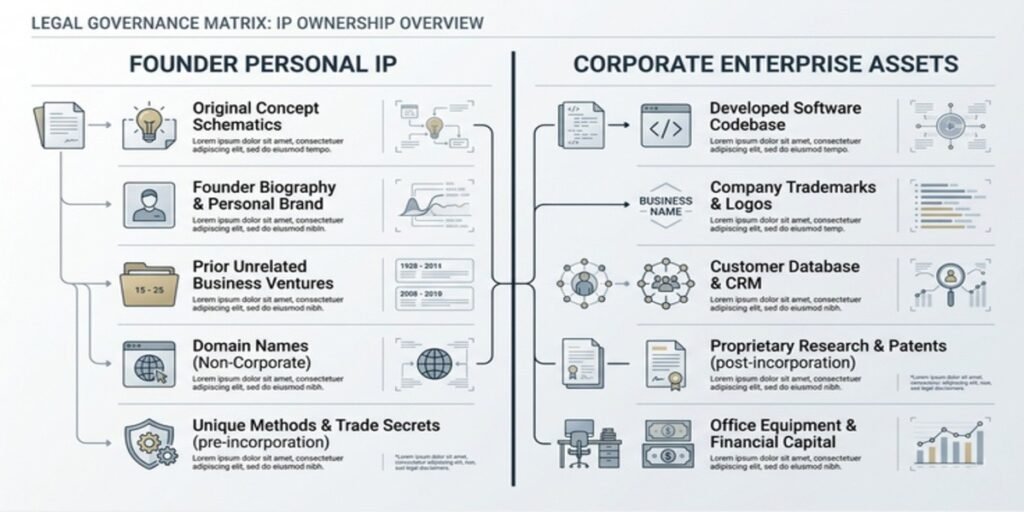
Exit-Ready Brand Equity: The ultimate test of a founder brand’s corporate value is whether it can survive the founder’s transition to chairperson, non-executive director, or complete exit. The brand architecture must therefore include “institutionalisation” mechanisms: a documented thought leadership methodology that can be transferred to successors, a ghostwriting and voice-capture system that preserves tonal consistency, and a content repository that remains owned by the enterprise regardless of founder departure. The goal is to ensure that the brand equity accumulated under the founder’s personal identity can be gracefully decoupled and either transitioned to a new CEO or absorbed into the corporate brand without catastrophic audience attrition.
For UK tech startups, these governance measures are particularly acute given the prevalence of founder-led sales in Seed to Series B stages. When the founder is the primary revenue engine, their personal brand is quite literally a revenue-generating asset. Investors and acquirers will conduct due diligence on this asset during any liquidity event. A founder who can demonstrate clean IP ownership, documented crisis protocols, and transferable brand equity will command higher valuations and cleaner term sheets than one whose personal brand is structurally entangled with corporate operations.
Frequently Asked Questions
Q.How much time should a UK founder spend on personal branding weekly?
The efficient founder brand engine requires approximately three to four hours per month of dedicated founder time, not per week. This comprises one 60-minute raw insight recording session and two 30-minute review and approval blocks for drafted content. The production, scheduling, and distribution infrastructure should be managed by a dedicated content operations resource—either in-house marketing or a specialised executive ghostwriting agency. The founder’s role is to provide irreplaceable insight; the system’s role is to convert that insight into platform-native assets. Any model requiring the founder to write daily social posts from scratch is structurally broken and will fail under the time pressures of actual executive leadership.
Q.How do you measure the ROI of a CEO’s personal brand?
ROI measurement must be bifurcated into leading indicators and lagging commercial outcomes. Leading indicators include: branded search volume for the founder’s name (tracked via Google Search Console and SEO monitoring tools), LinkedIn Social Selling Index (SSI) score movement, inbound DM and connection request quality from identifiable buyer personas, content save rates and substantive comment ratios, and share of voice within target industry conversations. Lagging commercial outcomes include: sales cycle length compression for deals where the buyer engaged with founder content prior to first meeting, customer acquisition cost reduction in channels attributed to founder-led demand generation, talent acquisition cost reduction for senior hires who cited founder visibility as a decision factor, and valuation premium during fundraising attributed to recognisable founder authority. The critical discipline is to track these metrics in a dedicated dashboard reviewed monthly by the CEO, CMO, and CFO—not as vanity metrics, but as components of enterprise intangible asset value.
Q.Should early-stage or venture-backed founders prioritise corporate branding or personal branding first?
For UK tech founders from Seed through Series B, personal branding must take precedence over corporate branding. The data is unambiguous: in 2026, content from personal LinkedIn profiles achieves 5-10x more organic reach than equivalent content from company pages, and company pages now receive approximately 5% of feed allocation versus 65% for personal profiles. Early-stage enterprises lack the brand recognition and content volume to compete algorithmically as institutional entities. The founder, however, has unique access to first-hand funding narratives, product origin stories, and customer implementation details that no corporate page can authentically replicate. The correct sequence is: founder brand builds initial trust and preference; corporate brand inherits that trust as the team scales; and institutional brand eventually supersedes personal brand at the Series C+ stage when the company has sufficient independent momentum. Attempting to build corporate brand visibility before founder brand authority is established is inefficient capital allocation that ignores the structural realities of 2026 platform algorithms.
Q.How do founders bypass the “AI-generated” algorithmic penalties on LinkedIn and Google in 2026?
Both platforms now heavily penalize LLM-synthesized prose that lacks Information Gain (Google’s metric for novel content) or triggers LinkedIn’s low-substance classifiers. To bypass these filters, your content architecture must rely on irreplaceable personal data anchors: proprietary internal metrics, unpolished screenshots of real system architectures, exact text from historical Slack messages during a crisis, or contrarian framework graphics. AI can be used to cleanly polish layout or format text, but the core thesis must rely on non-replicable operational friction that an AI model cannot hallucinate.
Q.Should UK tech founders diversify into video platforms like YouTube or short-form networks like X/Threads?
Monopolizing LinkedIn and Google search real estate yields the highest absolute enterprise ROI for B2B tech executives. Diversification should only occur if the company’s valuation model relies on high-volume developer relations (where X/Twitter and GitHub hold cultural capital) or technical product demos (where short-form vertical video scales). Unless you possess a dedicated media team capable of translating assets cross-platform natively, chasing multi-channel presence usually dilutes signal quality. Focus on owning the high-intent channels where enterprise procurement teams run background checks, rather than seeking vanity reach across disparate consumer feeds.
The 2026 “Elites” Edge
Strategic SummaryThe founders who will dominate UK B2B positioning in 2026 are those who recognise that their personal brand is not a vanity project but a core corporate infrastructure decision. While competitors continue to post generic AI-generated content and wonder why their pipeline remains thin, the disciplined minority will have built verified author entities, high-signal distribution systems, and legally firewalled brand architectures that compound in value quarter after quarter.
“The Founder Premium is not about being famous. It is about being findable, verifiable, and trustworthy at the exact moment when an enterprise buyer, institutional investor, or elite talent is running their final background check before committing.”
In a market where trust is the scarcest commodity, the founder who systematically invests in their digital entity will capture disproportionate returns—and they will do so with the operational rigour that separates genuine business acumen from ephemeral social media noise.