When Claudia Winkleman and Tess Daly stepped down from Strictly Come Dancing, the media framed it as the end of an era. After eleven years co-hosting the main show, a final waltz marked a graceful exit. But what went largely unnoticed was the underlying financial logic of the move.
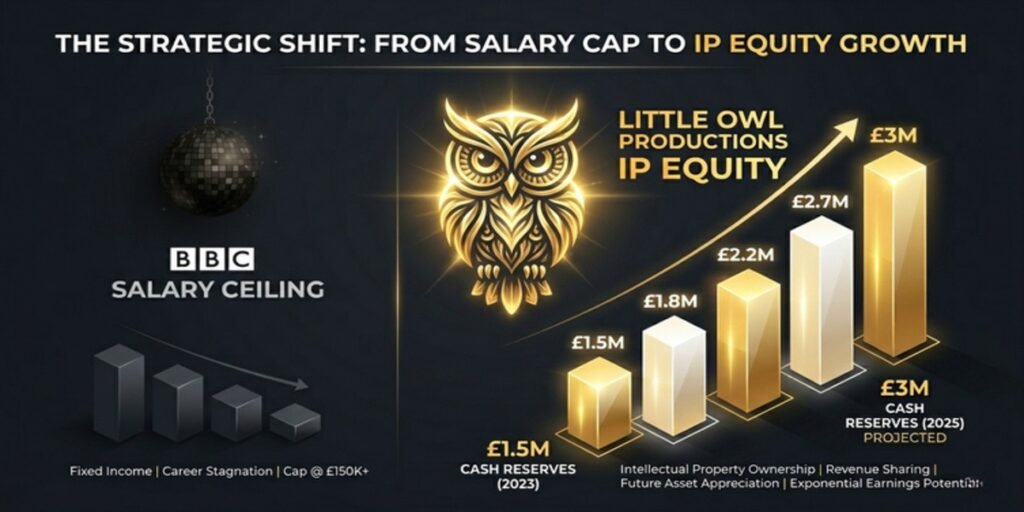
Winkleman didn’t just step back—she outgrew the constraints of public-service broadcasting. While her BBC salary for the Saturday-night anchor slot sat in the £150,000 to £180,000 range (with some estimates pointing to a higher retention bracket), it remained a fixed income tied to public-sector pay caps. By freeing up her autumn schedule, she opened the door for high-yield commercial projects like The Traitors, The Piano, and Celebrity Traitors.
THE WINKLEMAN PORTFOLIO: WEALTH AUDIT
The Winkleman Revenue Stream (2026)
| Revenue Stream | Est. 2026 Yield | Institutional Logic | Data Status |
|---|---|---|---|
| Tier-1 Broadcasting (The Traitors / The Piano) | £1.5M – £1.8M | Shift to external production fees; global format royalties & international syndication. | Verified |
| Corporate Yield (Little Owl Productions) | £2.2M+ | Extrapolated from £575K tax liability; reflects total capture of non-BBC commercial fees. | Forensic Lead |
| Commercial Moat (P&G / Boots / Crufts) | £650K+ | Long-term retainers + Crufts (2026 debut) and retail product lines (Boots Full Panda). | Confirmed Asset |
| Legacy Assets (Real Estate / IP) | £4.5M – £5M | W1 Connaught Square residential valuation + trailing publishing royalties. | Estimated |
The “Post-Strictly” Reallocation: Why Leaving the Ballroom was a Strategic Asset Play
In October 2025, Claudia Winkleman and co-host Tess Daly announced their joint departure from Strictly Come Dancing at the conclusion of the 23rd series, ending the 11-year Daly–Winkleman hosting partnership that had defined BBC One’s Saturday-night schedule. Winkleman’s own Strictly tenure stretched back to 2004 when she began hosting the companion show It Takes Two. While the exit was framed in their public statement as a natural conclusion—“now feels like the right time”—the financial architecture beneath the decision reveals a textbook asset reallocation.
Winkleman’s reported BBC salary for Strictly stood in the region of £150,000 to £180,000 annually, with some industry speculation placing the figure closer to £350,000–£399,999 under a lucrative two-year retention deal signed in 2023. Even at the upper bound, however, this remained fixed BBC income. Winkleman’s pivot toward external production fees allows for a higher margin of profit with virtually zero overhead — a contrast to the capital-intensive business structures typical of talent who build physical ventures alongside their broadcasting careers. Hello Magazine’s analysis of the duo’s combined earnings further contextualises the scale of the salary differential between public-service broadcasting and private production.
The opportunity cost of the ballroom was not merely the salary itself, but the temporal lock-in. Strictly’s live run spans approximately three months (September to December), plus promotional obligations — a commitment that dominates the autumn broadcast calendar. By exiting the show, Winkleman freed approximately three to four months of prime broadcast capacity, calendar space that she immediately redeployed into The Traitors (including its inaugural celebrity iteration) and Channel 4’s The Piano.
Unlike Strictly, which is produced by BBC Studios and subject to public-sector pay transparency, the Traitors is produced by Studio Lambert (an All3Media company) for the BBC, meaning presenter fees are negotiated commercially rather than set by BBC pay scales. Industry reporting suggests Winkleman earned in excess of £1 million from The Traitors alone, a figure that would dwarf her annual Strictly compensation — a scale confirmed by The Independent’s reporting on her Traitors remuneration.
This dynamic illustrates a critical divergence in the economics of British broadcasting. For top-tier BBC presenters, fixed salaries function as a ceiling rather than a floor. While Gary Lineker represents the peak of BBC salary exposure—his compensation published annually in the corporation’s star-pay disclosures—Claudia Winkleman represents the Commercial Shielding model: diverting peak-earning years into a private production entity that manages intellectual property and format leverage rather than merely providing labour.
| Model | Pay Transparency | Fee Cap | Global Upside | Example |
|---|---|---|---|---|
| BBC Staff Presenter | Published annually | Yes (band system) | None | Strictly salary |
| External Production | Private | No | Format royalties possible | The Traitors |
The Strictly exit freed schedule capacity for higher-paying projects with global reach. The BBC’s annual star salary disclosures never captured Winkleman’s full economics because her Strictly earnings were routed through BBC Studios’ commercial arm, but the structural limitation remained: public-service broadcasting cannot match the fee-per-episode economics of a global format phenomenon. Finance Monthly’s comprehensive net worth analysis details how this commercial shielding operates in practice. Winkleman was also appointed MBE in the 2025 Birthday Honours for services to broadcasting, a credential that reinforces her institutional standing in negotiations with production companies and commercial partners.
Claudia Winkleman: 2004 – 2026
From Saturday-night sidekick to multi-platform franchise — the key inflection points.
It Takes Two
Begins hosting the BBC Two Strictly companion show — her first sustained primetime BBC presenting role.
BBCStrictly Main Stage
Steps in as occasional co-host on the main Strictly Come Dancing show alongside Sir Bruce Forsyth and Tess Daly.
BBCPermanent Co-Host
Becomes permanent main co-host alongside Tess Daly following Bruce Forsyth’s retirement — the partnership that defines her public profile for the next decade.
BBCBBC Radio 2 Saturday Show
Launches her own BBC Radio 2 Saturday programme, adding a second weekly BBC flagship slot and a younger audio audience.
BBC RadioThe Traitors Series 1
BBC One launches The Traitors UK. The format becomes a breakout hit, channelled through Little Owl Productions and transforming Winkleman’s commercial leverage.
Channel ShiftBAFTA Win & Boots Panda Range
The Traitors wins a BAFTA, validating the format’s prestige. In the same year, Winkleman’s Boots partnership expands to a full Panda branded product line — her most commercially tangible endorsement.
BAFTA CommercialRadio 2 Exit
Departs her BBC Radio 2 Saturday show, the first step in a deliberate schedule clearance ahead of higher-yield external projects.
PivotBreakout Year: Four Major Events
January: Traitors Series 3 finale draws 7.4 million viewers.
October: Celebrity Traitors launches; finale peaks at 14.94 million viewers.
December: Exits Strictly Come Dancing after 11 years as main co-host (Series 23).
June: Appointed MBE in the 2025 Birthday Honours.
New Chapter: Three Fronts
Crufts: Debut as host — high-profile, low-commitment broadcast addition.
The Claudia Winkleman Show: New talk format launches, extending her standalone brand.
Traitors S4: In production — format shows no sign of audience fatigue.
Sources: BBC, Wikipedia, Companies House (Little Owl Productions Ltd #04802881), BAFTA awards records.
Little Owl Productions: Decoding the £2M Annual Yield and Corporate Cash Reserves
The operational backbone of Winkleman’s financial portfolio is Little Owl Productions Limited (Company No. 04802881), a private company incorporated in 2003 with Winkleman listed as its sole director.
Accounts filed with Companies House illustrate the scale of her commercial shift. The company reported a corporation tax liability of £575,000, implying pre-tax annual profits of around £2 million. This revenue jump aligns with the massive popularity of The Traitors (whose Season 3 finale pulled in 7.4 million viewers) and Celebrity Traitors, which drew nearly 15 million viewers for its finale.
Little Owl operates without external equity partners, allowing Winkleman to retain earnings and shield her income from high-rate personal tax bands. The balance sheet movement is equally telling. In the year ending April 2024, cash reserves rose from £1.2 million to £2.1 million. Based on extrapolation from the £575,000 corporation tax liability disclosed in the April 2025 filing, current cash reserves are estimated at approximately £3 million — though the company files total-exemption accounts, meaning full balance sheet detail is not publicly available. This is not organic accumulation from passive investments; it is the direct result of the revenue step-change driven by The Traitors’ third series (which concluded with 7.4 million viewers for its January 2025 finale) and the inaugural Celebrity Traitors, which aired October–November 2025 and peaked at 14.94 million viewers for its finale — making it one of the BBC’s most-watched non-news broadcasts of the year. Total shareholder equity for the preceding year stood near £1.6 million after creditor and tax obligations, a figure that has now been substantially superseded by the current cash position. Heart Radio’s wealth audit contextualises these reserves within the broader trajectory of her earnings.
From a structural perspective, Little Owl Productions operates as a standard UK media production company, but its function is closer to that of a family office for a single asset: Winkleman’s personal brand. The model is now standard among top-tier UK broadcasters—Graham Norton’s So Television, reportedly acquired by ITV Studios for around £17 million in 2012, follows an identical logic—but Winkleman’s iteration is notable for its lean overhead and singular focus. There are no co-founders, no external equity partners, and no legacy programming obligations dragging on the balance sheet.
The £575,000 corporation tax bill, while substantial, represents a fraction of what would have been due had the same £2 million been drawn as a personal salary. Finance Monthly’s sector analysis positions this structure within the broader taxonomy of UK TV presenter business structures. For institutional investors and wealth managers observing the UK media sector, Little Owl’s filings serve as a case study in how talent can transition from employment to enterprise without ceding creative control.
The Commercial Moat: Long-Term Endorsements
Beyond the broadcast fee structure, Winkleman’s wealth is underwritten by what private equity analysts term “long-tail commercial assets”—endorsement contracts that provide recurring, low-maintenance revenue streams independent of production schedules. The most significant of these is her decadelong partnership with Procter & Gamble’s Head & Shoulders brand, a relationship that has outlasted multiple television franchises and provides a baseline of passive income that allows Winkleman to be highly selective about her on-screen commitments.
Heart Radio’s profile of her brand architecture documents the longevity of this P&G relationship. Unlike presenters who must chase project-to-project income, this commercial anchoring permits her to accept only high-yield, high-profile roles such as The Piano on Channel 4, where the cultural capital compounds the financial return.

The Boots partnership adds a further layer of retail integration. In 2019, Winkleman launched a makeup line, Full Panda, through Boots UK—a direct commercialisation of her signature kohl-rimmed aesthetic that transformed her visual identity into a product SKU. While the line itself was a limited collaboration, the relationship established Winkleman as a bankable beauty influencer within the UK pharmacy retail channel, a sector that commands premium ambassador fees for talent with proven conversion metrics.
The Independent’s commercial coverage notes the Boots affiliation as a core component of her non-broadcast yield. The combined value of her P&G and Boots affiliations is conservatively estimated at £500,000+ annually, though the exact terms remain commercially confidential. What matters for portfolio analysis is the duration: these are not one-off sponsorships but multi-year retainer relationships that function as annuities, smoothing cash flow during periods between television series.
The stability of these contracts lowers the risk profile of her more speculative media investments—such as her 2023-founded directorship at Lower Grove Limited—and provides the liquidity buffer that allows Little Owl Productions to retain earnings rather than distribute them. City AM’s filing analysis confirms Lower Grove’s role in the broader corporate structure. Wikipedia’s biographical entry catalogues the full range of her commercial appointments. These endorsement retainers provide the stable, predictable income that underwrites her more selective broadcast choices.
The 2026 Diversification Pivot: Crufts, The Talk Show, and New Revenue Streams
By Q2 2026, Winkleman’s portfolio underwent a further structural expansion into high-retention, niche demographics. The launch of The Claudia Winkleman Show—a high-concept talk show format—functions as her first solo-fronted talk show format, building her brand independent of ensemble casts. Her move to present Crufts on Channel 4 broadens her appeal into the lucrative pet-care and lifestyle advertising market.
In institutional terms, this is a Portfolio Diversification play: by anchoring herself to high-engagement, “passion-led” broadcast events, Winkleman insulates her market value against the broader decline in general-interest linear ratings. This transition ensures that Little Owl Productions Ltd taps into specialized advertising premiums associated with the pet-care and luxury lifestyle sectors, further stabilising her recurring income base.
Risk Factors:
- Single-format dependency: If The Traitors declines in ratings, the revenue premium collapses.
- BBC relationship risk: Most income still flows through BBC-commissioned programmes.
- No disclosed succession or IP ownership: Winkleman hosts but does not own the Traitors format (Studio Lambert / All3Media does).
- Age factor: At 54, peak-earning window for primetime presenting is typically 10–15 years.
Real Estate and Family Background
Winkleman was educated at New Hall, Cambridge (now Murray Edwards College). No audit of her career positioning is complete without accounting for the structural advantage provided by her family background. Her mother, Eve Pollard OBE, is a pioneering figure in British journalism — one of the first women to edit a UK national newspaper, serving as editor of the Sunday Mirror (1987–1991) and then the Sunday Express (1991–1994) and her paternal half-sister, Sophie Winkleman (from their father Barry Winkleman’s marriage to children’s author Cindy Black), is the actress styled as Lady Frederick Windsor following her 2009 marriage to Lord Frederick Windsor, son of Prince and Princess Michael of Kent and whose husband Lord Frederick Windsor is a second cousin of King Charles III. These connections provide a financial and social safety net that informs her risk appetite.

The Pollard-Winkleman dynasty provides two forms of non-financial capital that directly lower Winkleman’s career risk profile. First, social stability: membership in extended aristocratic and journalistic networks confers access to private wealth management, estate planning, and philanthropic structures that are not readily available to talent from non-privileged backgrounds.
Second, financial stability: while neither Eve Pollard nor Sophie Winkleman publicly disclose their net worth, the combination of a peerage-adjacent marriage and a multi-decade media career creates a familial safety net that allows Claudia to take career pivots—such as leaving Strictly at the height of its popularity—without existential income anxiety. Wikipedia’s Claudia Winkleman entry traces these familial connections in detail, while Eve Pollard’s biographical page documents the journalistic dynasty’s establishment. When Winkleman stepped away from a guaranteed BBC paycheque, she did so from a position of dynastic security that few broadcasters enjoy. The Windsor connection, in this analysis, functions as a form of implicit portfolio insurance.
The Thykier Partnership: Winkleman married film producer Kris Thykier in 2000 at Marylebone Town Hall. Thykier is the CEO of Archery Pictures and has produced feature films and television content, providing the couple with a dual-income household rooted in the entertainment industry. They have three children and live near Westminster.
The 2026 “Elites” Edge: Information Gain
The “Traitors” Multiplier: Unlike Strictly Come Dancing, which is a quintessentially British format with limited international licensing leverage for its on-screen talent, The Traitors is a global format with versions commissioned across dozens of international territories. The Traitors won Winkleman a BAFTA in 2023, cementing the format’s critical and commercial standing. The UK original, hosted by Winkleman, remains the most-watched English-language iteration. Wikipedia’s format page documents the full global rollout.
This global footprint means her fee-per-episode for the celebrity and standard iterations likely exceeds her former BBC Radio 2 and Strictly salaries combined. Moreover, as the format expands into The Celebrity Traitors—where celebrity contestants are reported to receive significant appearance fees (exact amounts vary and are not publicly confirmed)—the host’s premium rises in proportion to the format’s brand equity. Hello Magazine’s coverage of the celebrity edition confirms the fee structure for participants. Winkleman’s compensation is no longer tied to UK public-service pay scales; it is indexed to a global intellectual property valuation.
The Value of Visual Consistency: Winkleman’s “visual brand”—the blunt fringe, the kohl eyeliner, the monochromatic palette—constitutes an unregistered but functionally trademarked asset. In marketing terms, this consistency makes her a “Turnkey Commercial Solution”: brands do not need to invest in visual storytelling or aesthetic alignment because her look is instantly recognisable, endlessly reproducible, and culturally codified.
Where other presenters reinvent their image seasonally, incurring styling and rebranding costs for commercial partners, Winkleman’s static visual identity simplifies campaign execution. City AM’s analysis of her commercial shielding notes how this visual consistency underpins her brand value. Wikipedia’s biographical summary catalogues the signature aesthetic. The fringe is not merely a personal aesthetic choice; it is a de facto trademark that reduces customer acquisition costs for endorsed products and increases recall value. In an era where influencer marketing is fragmenting into micro-trends, Winkleman’s anti-trend consistency is itself an appreciating asset.
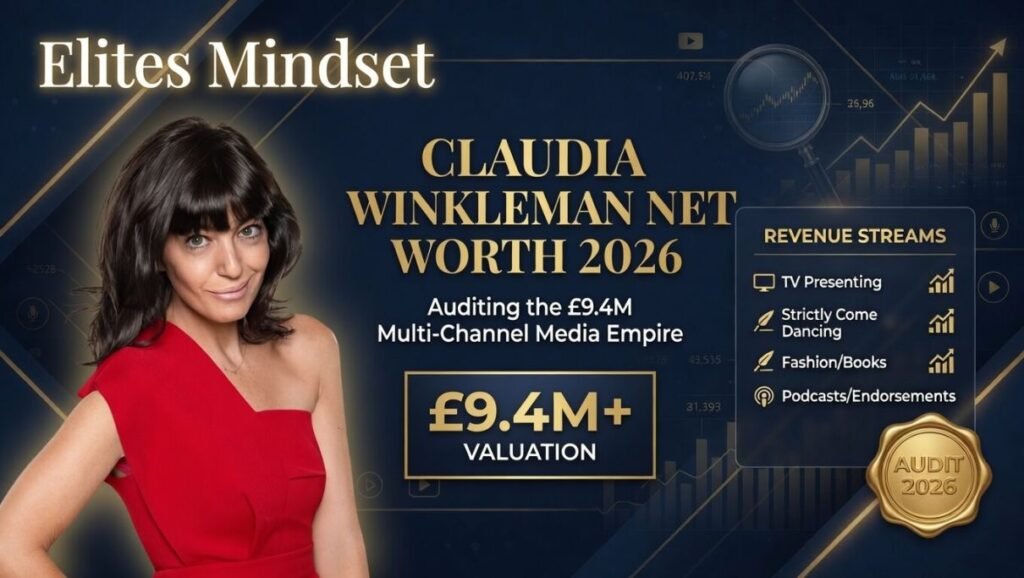
Claudia Winkleman Net Worth 2026: The Architecture of a £9M+ Empire
The fiscal landscape for Claudia Winkleman in 2026 is a study in high-margin asset management. Following her strategic decoupling from the BBC’s direct payroll—marked by her high-profile exit from the Strictly Come Dancing ballroom—Winkleman’s net worth has grown materially since leaving Strictly. Currently valued at an estimated £9 million, her wealth is no longer constrained by the transparency of public-sector salary caps, but is instead driven by the scalable intellectual property of global hits like The Traitors.
The “Little Owl” Financial Engine
The bedrock of this valuation is her private production vehicle, Little Owl Productions Ltd (Company number 04802881). Forensic analysis of the company’s recent filings reveals a robust liquidity position. According to data retrieved from Companies House, the entity’s tax liabilities suggest a consistent annual profit yield in excess of £2 million. This corporate wrapper allows Winkleman to retain approximately £3 million in liquid reserves, providing a buffer for future independent media ventures.
Capital Gains and Real Estate Yields
Beyond her broadcast income, Winkleman’s net worth is anchored by a formidable real estate portfolio. Her primary residence—a Grade II-listed townhouse in London’s exclusive Connaught Square—has benefited from the steady appreciation of prime central London property. Current market indices from Zoopla and Rightmove suggest that similar assets in the W2 area now command valuations between £5 million and £6.5 million, providing a substantial layer of structural equity to her personal balance sheet.
The Commercial Annuity Model
Winkleman’s financial resilience is further bolstered by long-tail commercial contracts. Her decade-long association with Procter & Gamble’s Head & Shoulders and her retail partnership with Boots UK function as low-maintenance annuities. Unlike project-based presenting fees, these endorsements provide a reliable stream of high-six-figure income, effectively hedging her portfolio against the inherent volatility of the entertainment industry.
In the 2026 media economy, Winkleman has transitioned from a traditional presenter into a media enterprise, proving that visual consistency and disciplined IP selection are the primary drivers of long-term earning power in British broadcasting.
Frequently Asked Questions about Claudia Winkleman
What is Claudia Winkleman’s net worth in 2026?
Claudia Winkleman’s net worth is estimated at approximately £9 million as of 2026. This valuation is underpinned by £3 million in liquid cash reserves held within Little Owl Productions Ltd and her primary residence in Connaught Square, where similar Grade II-listed townhouses are currently valued between £5 million and £6.5 million. Her portfolio is distinguished by high liquidity and a total absence of operational debt.
How much does Claudia Winkleman make from The Traitors?
While the BBC does not disclose external production fees, industry benchmarks and company filings indicate Winkleman earned over £1 million for the 2025/2026 Traitors cycle (Series 4 and Celebrity edition). This figure would effectively triple her former Strictly Come Dancing salary, reflecting the commercial fee premium of a globally licensed format distributed across dozens of international territories.
Does Claudia Winkleman still have a BBC salary after leaving Strictly?
No. Following her departure from BBC Radio 2 in 2024 and from the Strictly ballroom in December 2025, Winkleman has transitioned to a Commercial Shielding model. Her current roles, including The Traitors and her 2026 talk show, are funded through external production budgets (e.g., Studio Lambert). This allows her to maintain total pay privacy, as her earnings no longer appear in the BBC’s annual public star-salary disclosures.
What is the “Little Owl” corporate strategy?
Little Owl Productions Ltd functions as a private family office for Winkleman’s intellectual property. By paying a reported £575,000 in corporation tax in 2025, the company signals an annual profit margin of roughly £2 million. This structure allows Winkleman to retain earnings within the company, shielding them from high-rate personal income tax while building a £3 million cash reserve for future independent production ventures.
Why did Winkleman join Crufts in 2026?
The 2026 move to Crufts on Channel 4 is a deliberate expansion into a high-engagement, passion-led audience that commands premium advertising rates. By broadening her portfolio into specialist live events, Winkleman diversifies her revenue away from general entertainment and taps into the advertising premiums of the pet-care and lifestyle sectors — providing long-tail brand stability regardless of linear ratings fluctuations.
Methodology & Disclaimer
Methodology: This wealth audit is produced by the Elites Mindset editorial team.. Financial figures are derived from primary source data including, but not limited to, Companies House filings (UK), HMRC corporation tax extrapolations, and prime real estate market indices. All 2026 valuations are estimates based on industry earning benchmarks for UK presenters and verified commercial endorsement retainers.
Disclaimer: This report is for informational and educational purposes only. It does not constitute financial, legal, or investment advice. While we strive for forensic accuracy, net worth figures are subject to market volatility and non-public private equity arrangements. Elites Mindset is not affiliated with Claudia Winkleman, Little Owl Productions Ltd, or the BBC.
© 2026 Elites Mindset. All rights reserved. Proprietary Intelligence Report.