

Most retired athletes settle for punditry contracts or ambassadorial work. For a few elite performers, the years after playing have become more lucrative than the years on the pitch — a shift from earning wages to building equity. Rio Ferdinand is the clearest case study of this evolution. Where contemporaries have anchored their second acts to fixed-salary broadcasting contracts or capital-intensive hospitality ventures, Ferdinand has built something more valuable: a media business he owns outright, independent of traditional broadcasters.
His estimated 2026 net worth of £55 million to £80 million reflects the conversion of personal brand equity into scalable, ownership-driven assets. It is separate from the £80 million to £100 million he is estimated to have earned gross across his playing career. A pundit sells time. A founder sells distribution. Ferdinand, through FIVE and its allied ventures, has chosen the latter.
This audit examines Ferdinand’s portfolio as a diversified holding structure, not a celebrity wealth list. He has effectively retrained as a capital allocator. The architecture rests on four primary pillars: Media IP (the FIVE digital ecosystem and its production revenue), Broadcasting (the now-concluded TNT Sports anchor contract and global syndication potential), Real Estate (a multi-territory property strategy pivoting from operational hospitality to yield-focused physical assets), and Venture Capital (a growing allocation to fintech and digital infrastructure plays).
From Centre-Back to Capital Allocator
30 years of career milestones — playing, transitioning, and building equity
Turns Professional at West Ham United
Signs professional terms with West Ham aged 16. Makes first-team debut in May 1996 vs Sheffield Wednesday.
British Record £18M Transfer to Leeds United
Becomes the world’s most expensive defender. Establishes himself as a senior England international.
£29.1M Move to Manchester United
Breaks his own British transfer record. Begins a 12-year dynasty at Old Trafford: 6 Premier League titles, 1 Champions League.
Co-Founds Rosso Restaurant, Manchester
Takes 25% stake in the Italian restaurant alongside the Kamani family. Operates for 14 years in a Grade II-listed building on Spring Gardens.
Joins BT Sport as Pundit
Begins broadcasting career while still an active player. Contract later carried through TNT Sports rebrand.
Retires from Professional Football
Final season at Queens Park Rangers. Shifts full focus to broadcasting and early business ventures.
Boxing Licence Denied by BBBC
Announces professional boxing career but is refused a licence. Episode illustrates willingness to take unconventional risks.
Marries Kate Wright
Wedding in Turkey. Kate later becomes a key figure in the family’s public brand and Dubai relocation narrative.
Invests in Sokin (Fintech)
Early-stage investment in the multi-currency payments platform. Later validated by Morgan Stanley Expansion Capital in 2024.
Exits Rosso Restaurant
The “Venture Athlete” Model: Fintech, Digital Assets, and Equity Upside
Morgan Stanley Backs Sokin
Morgan Stanley Expansion Capital acquires strategic stake (July). Further £12M growth round follows in January 2025.
Leaves TNT Sports · Relocates to Dubai
Departs TNT Sports after decade of service. Signs with WME. Moves family to £6.5M Al Barari residence in UAE’s zero-tax jurisdiction.
Kent Mansion Listed · FIVE Hits 400M Views at World Cup
Lists Kent property for sale at £10.5M. Rio Ferdinand Presents passes 400M views during the 2026 World Cup, with 1.72M YouTube subscribers.
The Richest estimates his net worth at approximately $75 million (roughly £60 million), and Wales Online reports around £57 million. Our asset-by-asset estimate agrees at the low end but reaches £80 million at the top, because it values FIVE’s production equity and Ferdinand’s venture stakes at current market rates. What follows explains that gap and traces how a centre-back became an investor.
The Wealth Matrix: The Ferdinand Portfolio Audit
| Asset Class | Valuation / Yield | Primary Structural Driver & Strategy |
|---|---|---|
| Media IP (FIVE) | £18M–£25M | Digital equity in Rio Ferdinand Presents, Vibe with Five podcast network, and commercial production arm. High-growth asset with third-party streaming expansion. |
| Broadcasting | £5M–£7M/yr (income; excluded from valuation) | Former TNT Sports anchor contract (concluded 2025). Now transitioning to global syndication and US market entry via WME representation. |
| Real Estate | £17M–£20M | Multi-territory portfolio including London/Kent assets and Dubai luxury residential. Exited operational hospitality (Rosso) in 2023. |
| Venture & Tech | £8M–£15M | Fintech (Sokin, Yonder) and digital assets (Sorare). Speculative but high-upside allocation with institutional co-investors. |
Consolidated Portfolio Metrics (2026 Projections)
Methodology: Valuations are derived from public funding round disclosures, property listing data, revenue multiples typical of digital media businesses (5x–6x) and publicly reported contract benchmarks. Venture positions are marked at last known funding round valuations adjusted for standard dilution assumptions.
The FIVE Ecosystem: Why Independent Media Ownership is Ferdinand’s Primary Value Driver
Most athlete wealth reports treat all media income as ‘punditry.’ This conflates two different economic models: selling commentary as a service versus owning content distribution as equity. Ferdinand’s Rio Ferdinand Presents—operating under the FIVE brand umbrella and produced by New Era Global Productions—exemplifies the latter.
With over 1.72 million YouTube subscribers on Rio Ferdinand Presents and a growing podcast network that includes Vibe with Five, the platform has grown from a personal channel into a media company with two revenue streams. The first comes from its audience, through advertising and brand partnerships. The second comes from businesses, which pay FIVE to produce campaign content using Ferdinand’s access to active footballers.
The 2026 World Cup was the platform’s biggest test. Rio Ferdinand Presents hit over 400 million total views during the tournament, with Ferdinand releasing 30 original episodes between June 8 and July 20, including Rio Reacts match coverage and eight World Cup editions of Rio Meets featuring Kaká, Clarence Seedorf, and Thierry Henry. Crucially, 55% of the audience reached was aged 18-35 — the demographic most valued by brand partners.
The tournament also brought strong growth on other platforms, with the brand’s Instagram following growing 111.4%, TikTok 180.1%, and Threads 181.8%. Ferdinand himself stated: ‘Reaching 400 million views demonstrates the strength of the platform we have built.’ This is no longer a side project; it is a media company performing at scale during the world’s biggest sporting event.
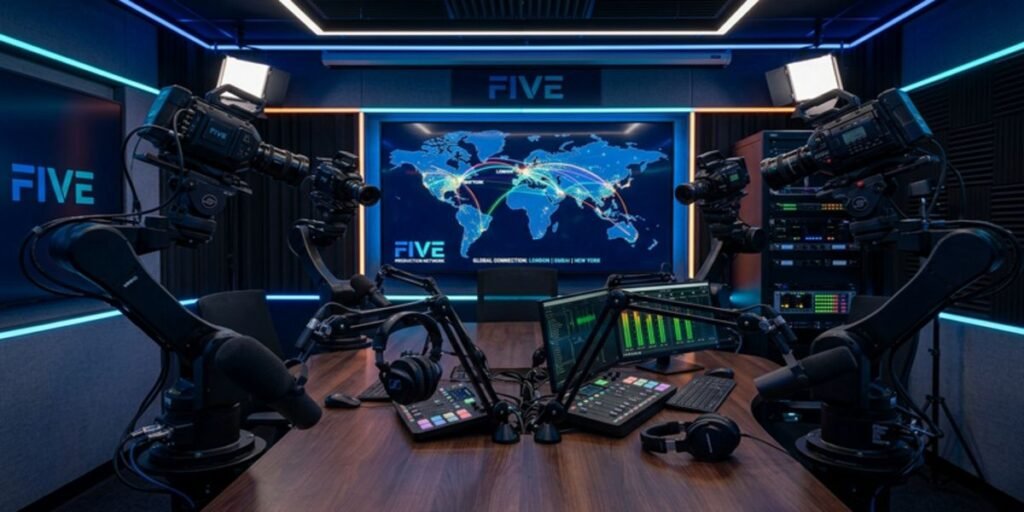
The valuation distinction here is structural. A traditional broadcasting contract pays for hours rendered. FIVE pays for intellectual property created. As Ferdinand articulated at the World Football Summit, his competitive advantage is not production quality or follower count—both replicable commodities—but “trust-based access” to current players that traditional rights holders cannot manufacture.
Broadcasters operate within the 90-minute match window; FIVE operates outside it, capturing long-form interviews with Cristiano Ronaldo, David Beckham, and Wayne Rooney in relaxed settings that traditional press conferences cannot replicate. This access has transformed FIVE into a production partner for brands seeking genuine player engagement rather than scripted endorsement, creating a revenue stream that scales without Ferdinand’s direct time involvement.
Ferdinand’s partnership with William Morris Endeavour (WME), the Hollywood talent agency, signals a plan to sell FIVE’s production work beyond YouTube to subscription streaming services. According to WME Sports’ own mandate, the agency exists to help clients build “first-of-its-kind media companies” and “maximise earnings and extend their influence beyond the field of play.” For Ferdinand, this represents the transition from content creator to media executive: licensing FIVE’s interview format, access protocols, and production infrastructure to global platforms while retaining equity.
A talent contract has no resale value; a media company with its own distribution and production capability does. If FIVE generates £3 million to £5 million in annual revenue (an estimate, since New Era Global Productions does not publish accounts), a 5x–6x revenue multiple would put its equity value at £18 million to £25 million. That value belongs to the business, not to Ferdinand’s hours on air.
The Broadcasting Anchor: Analyzing the TNT Sports & Global Syndication Contracts
For a decade, Ferdinand’s TNT Sports contract—originally signed with BT Sport in 2013 and carried through the TNT Sports rebrand—functioned as the defensive anchor of his post-playing income. Manchester Evening News reporting indicated that Ferdinand collected approximately £7 million annually from his aggregate media commitments, with the TNT contract and BBC World Cup coverage representing the bulk of this guaranteed income layer.
During his Manchester United playing career (2002-2014), he reportedly earned £6 million per season; the broadcasting transition thus maintained income parity while requiring materially fewer physical inputs. This is the “guaranteed income” thesis that underpins most athlete retirement planning: convert physical capital into commentary expertise, preserve lifestyle, minimize risk.
However, the Ferdinand audit reveals a deliberate exit from this model.
In May 2025, Ferdinand announced his departure from TNT Sports following his final broadcast at that year’s Champions League final. The exit was publicly framed as amicable — Ferdinand called it a ‘difficult decision’ and cited a desire to focus on ‘other business interests’ and family time, while TNT gave him a warm on-air send-off. However, multiple sources including Goal.com reported that sustained online criticism of his commentary, particularly regarding perceived Manchester United bias, was also a factor. Ferdinand separately indicated that TNT was not receptive to his ideas for evolving the format of their coverage, adding creative frustration to the business rationale. The underlying strategic logic is clear: rather than renewing a UK-exclusive broadcasting contract, Ferdinand chose to build out FIVE and pursue the WME-brokered global syndication path ahead of the 2026 World Cup. Most athletes cling to broadcasting security; Ferdinand discarded it.
The WME partnership explains the timing. The 2026 World Cup across the US, Canada, and Mexico was a chance for a British football voice with US agency representation to break into that market. Instead of accepting a UK-only renewal, Ferdinand used the tournament to showcase his own platform, and the 400 million views FIVE recorded suggest the bet paid off. None of the sources reviewed for this audit disclose any US broadcast deal, so that part of the plan remains unconfirmed.
The market benchmarking is instructive. Gary Neville—Ferdinand’s former Manchester United teammate and the co-founder of Hotel Football and the Stock Exchange Hotel—represents the alternative “Property and Hospitality” path. Neville’s broadcasting work with Sky Sports remains substantial, but his wealth architecture is weighted toward physical assets and development projects. Ferdinand, conversely, has chosen the “Sovereign Media” path: digitizing his personal brand to create a platform that functions independently of traditional networks.
While Neville builds rooms, Ferdinand builds reach. Both are valid, but the capital efficiency of Ferdinand’s model—requiring less leverage, less regulatory exposure, and less operational overhead—may prove superior in a media landscape where attention, not square footage, is the scarcest resource. The 2026 market rate for Tier 1 UK football pundits remains in the £5 million to £7 million annual range for exclusive contracts, but Ferdinand’s unbundled approach—selling appearances, production, and platform access separately—may extract more value from the same expertise.
The Defensive Anchor: Analyzing the £17M–£20M Multi-Territory Real Estate Portfolio
Ferdinand’s property strategy has undergone a deliberate rebalancing from operational hospitality to passive residential assets—a shift that mirrors the broader portfolio pivot from time-intensive to capital-intensive wealth preservation. The most visible manifestation of this transition was the September 2023 closure of Rosso, the Manchester Italian restaurant in which Ferdinand held a quarter ownership stake alongside the Kamani family since 2009. The ownership was split between Nurez Kamani (50%), Suleman Kamani (25%), and Ferdinand (25%) — meaning Ferdinand’s direct financial exposure to the restaurant was limited relative to his broader portfolio. Situated in the Grade II-listed former banking hall at 43-45 Spring Gardens, Rosso had become a celebrity institution, frequented by Wayne Rooney, Harry Styles, and Erling Haaland.
The closure statement—”it feels like the right time to go out at the height of our popularity and look ahead to new horizons”—was not spin. It was portfolio management. Operational restaurants consume management bandwidth, carry inventory risk, and expose owners to sector-specific volatility. By exiting Rosso after 14 years, Ferdinand removed a management-heavy, high-liability business from his holdings. The site was later taken over by the Cibo restaurant group, which spent nearly £3 million refurbishing it, a sign the location still draws investment. There is no public record that Ferdinand owned the building, so his exit is best read as closing a business rather than selling property.
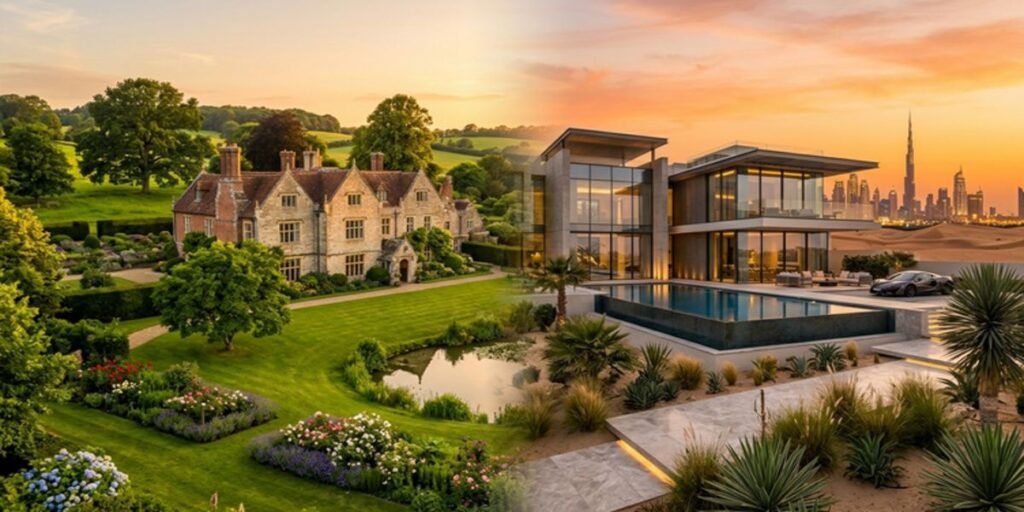
Ferdinand’s Kent mansion in the gated enclave of Farnborough Park, Orpington, listed for sale in April 2026 at £10.5 million, shows how much the property has grown in value. Bought in 2008 for approximately £2.7 million, the 12,500-square-foot home on 20 acres would, if it sells at the asking price, return nearly £8 million over 18 years: growth of roughly 7.8% a year.
The sale signals a definitive geographic pivot: Ferdinand, his wife Kate, and their children relocated to Dubai in August 2025, acquiring a 12,700-square-foot luxury residence in the Al Barari area valued at approximately £6.5 million. The Dubai move is not merely lifestyle-driven; the UAE’s zero income tax regime and strategic positioning as a content creator hub—evidenced by Ferdinand’s participation in the 1 Billion Followers Summit—create structural tax efficiency and networking synergies for his media ventures.
Ferdinand was publicly vocal about his motivation, criticizing UK tax rises and questioning whether public services justified the burden — a position that drew significant media attention and public debate.
Earlier property investments reveal both the evolution of his strategy and the hazards of speculative development. The Le Jardin de Fleur project in Saidia, Morocco—backed by Ferdinand and John Terry among others in the mid-2000s—exemplifies the risks of emerging-market hospitality development. The £200 million resort, featuring 1,342 planned properties and three golf courses, stalled after the 2008 financial crisis when funding parties collapsed, leaving the site abandoned for years.
Ferdinand had reportedly invested £2 million in a three-bedroom townhouse and three villas. That was a loss in value rather than a total loss, and it likely pushed him toward property in developed markets with clear legal frameworks and easier resale. The current portfolio (the Kent property at a £10.5 million asking price and the Dubai residence at about £6.5 million) points to a physical asset base of £17 million to £20 million before any mortgage debt; the upper figure allows for holdings that haven’t been disclosed. His former homes in Alderley Edge, Cheshire, and Bromley, London, are excluded. The direction is clear: away from running restaurants and speculative overseas developments, toward prime homes in established markets.
The “Venture Athlete” Model: Fintech, Digital Assets, and Equity Upside
The most sophisticated element of the Ferdinand portfolio—and the component most frequently omitted from celebrity net worth tabulations—is his venture capital allocation. Ferdinand has transitioned from passive endorsement deals to active equity participation in technology companies, functioning as what institutional investors term a “value-add angel”: a high-profile individual whose capital is accompanied by brand amplification, network access, and customer acquisition leverage.
His most significant holding is in Sokin, the UK-based payments fintech providing multi-currency IBAN and international transfer infrastructure for businesses. Ferdinand invested in Sokin’s early rounds in 2021, citing the company’s mission to remove “borders, barriers, and burdens associated with international payments.” The investment has since attracted institutional validation at the highest level: Morgan Stanley Expansion Capital acquired a strategic stake in July 2024 through a transaction that provided significant capital for growth, alongside prominent investors including former PayPal executives, followed by a further £12 million in growth funding in January 2025 (approximately $15 million) that enabled new office openings in London, New York, Toronto, and Dubai.
Sokin processes more than $2.5 billion in annual transactional volume as of mid-2024, with further rapid growth anticipated, supports Premier League football clubs among its client base, and has expanded through the acquisition of Norwegian fintech Settle Group. For Ferdinand, this represents not merely a financial return but a validation of his investment thesis: fintech infrastructure that serves the global sports and remittance economies he understands intimately.
Beyond fintech, Ferdinand is also a co-founder of Football Escapes, a luxury travel company offering football coaching holidays at high-end resorts. The business sits between hospitality and brand licensing, and most net worth estimates leave it out.

The fintech theme continues through Yonder, the rewards credit card platform co-founded by former ClearScore executives, which raised a £62.5 million Series A round in 2023 at a £70 million valuation. Ferdinand’s participation alongside institutional co-investors Northzone and RTP Global demonstrates his integration into serious venture ecosystems rather than celebrity vanity rounds. His earlier investment in Sorare, the digital trading card game valued at $4.3 billion in a 2021 SoftBank-led round at the peak of the NFT market, shows his appetite for small bets with large potential payoffs. That valuation has not been publicly re-tested since the digital-collectibles downturn. These positions collectively represent an £8 million to £15 million allocation within his portfolio, depending on mark-to-market assumptions and subsequent dilution.
Ferdinand’s growing credibility as a startup evaluator was underscored by his role as a judge for Alibaba.com’s CoCreate Pitch competition, where he helped distribute a $400,000 prize pool to innovative startups — positioning him not just as a passive investor but as an active dealflow participant in the global startup ecosystem.
Not all bets have succeeded. In March 2022, the Mirror reported that Ferdinand and other high-profile footballers, including Wayne Rooney, lost roughly £25 million after investing in Kingsbridge Asset Management, a Nottinghamshire-based firm that collapsed in 2010 having channelled client money into Florida holiday-home developments. City of London Police investigated the firm for fraud over a two-year period but closed the case in 2022, citing insufficient evidence to prosecute — meaning investors were left with confirmed losses but no finding of wrongdoing either way. The “Venture Athlete” model doesn’t depend on every bet working. It depends on portfolio construction: accepting that each early-stage investment could fail outright, and relying on the winners to cover the losses.
Brand Parity Audit: The Ferdinand Model vs. The Beckham Model
No wealth analysis of a former England international can avoid the David Beckham comparison. Yet the comparison reveals two divergent philosophies of post-career wealth architecture. Beckham’s model—anchored by Inter Miami CF MLS ownership, Studio 99 production, brand partnerships with Boss and Tudor, and Authentic Brands Group’s majority stake in his DB Ventures business—prioritizes traditional luxury, physical team ownership, and heritage brand alignment. It is capital-intensive, operationally complex, and dependent on long-dated asset appreciation.
Ferdinand’s model is the antithesis: digital-first, capital-light, and distribution-obsessed. Where Beckham invested in a stadium, Ferdinand invested in a content pipeline. Where Beckham’s brand equity is monetized through licensing and equity in physical ventures, Ferdinand’s is monetized through direct audience ownership and technology equity. Both carry merit on different timescales. Ferdinand’s model offers superior capital efficiency and faster liquidity cycles; Beckham’s MLS equity, however illiquid, may represent the larger absolute return if franchise valuations continue their current trajectory. A YouTube interview with Cristiano Ronaldo generates revenue within 48 hours of publication; an MLS expansion team generates revenue over a decade. The Beckham model requires hundreds of millions in committed capital; the Ferdinand model requires intellectual property and production infrastructure.
This divergence also reflects generational media consumption patterns. Beckham’s dominance was constructed during the peak broadcast era, where mass reach required network partnership. Ferdinand’s dominance is constructed during the platform era, where creators own their distribution. For athletes retiring in the 2020s, the Ferdinand model is more replicable. Not every former player can raise $300 million for a football franchise. Every former player with specialized knowledge and authentic relationships can build a niche media property.
Social Capital Liquidity: The CAC Shield
The most undervalued asset on Ferdinand’s balance sheet is his social media reach. With over 7 million Instagram followers as of mid-2026, combined with his YouTube subscriber base, Twitter/X audience, and podcast listenership, Ferdinand commands an aggregate reach exceeding 25 million across platforms. In venture capital and marketing economics, this functions as a Customer Acquisition Cost (CAC) Shield: the ability to launch new products, promote portfolio companies, and drive audience conversion without purchasing advertising inventory on the open market.
For Sokin, Yonder, or any future Ferdinand-backed venture, this distribution represents millions of pounds in avoided marketing spend. When Ferdinand promotes a portfolio company to his audience, he is not merely endorsing; he is delivering targeted, high-trust customer acquisition at zero marginal cost. This is why technology investors value athlete angels with authentic platform presence over those with mere name recognition. The social capital is convertible into economic capital through reduced CAC, higher conversion rates, and lower churn among acquired customers. In 2026, this “CAC Shield” is arguably Ferdinand’s most defensible competitive advantage—an asset that appreciates as platform algorithms evolve and attention becomes increasingly expensive to purchase.
The Ferdinand Wealth Architecture (2026 Projections)

| Asset Class | Asset Type | Primary Driver | 2026 Status | Estimated Value |
|---|---|---|---|---|
| Media IP (FIVE) | Digital Equity | Content Ownership & Production Licensing | Growth | £18M–£25M |
| Broadcasting | Service Contract | Global Syndication & US Market Entry | Transitioning | £5M–£7M/yr potential |
| Property | Physical Assets | London/Kent Appreciation & Dubai Yield | Appreciating | £20M+ |
| Tech VC | Private Equity | Fintech (Sokin, Yonder) & Digital Assets (Sorare) | Speculative / High Upside | £8M–£15M |
| Liquid Reserves | Cash & Equivalents | Career Earnings Retention & Dividends | Stable | £12M–£18M |
Frequently Asked Questions about Rio Ferdinand
What is Rio Ferdinand’s net worth in 2026?
Detailed analysis places Ferdinand’s 2026 net worth in the £55 million to £80 million range when illiquid assets are marked to market. More conservative estimates citing only liquid and established holdings place the figure closer to £57 million. The distinction matters: the lower figure reflects cash-realisable value; the upper bound captures FIVE’s production equity, institutional-validated venture stakes, and property at current market rates. The critical distinction is between career earnings — estimated at £80 million to £100 million gross — and current net worth, which reflects capital preservation and appreciation rather than mere accumulation.
How much does Rio Ferdinand earn from FIVE?
FIVE operates as a hybrid revenue entity. Direct YouTube advertising is not the main source of value. Third-party trackers estimated it at £1,400 to £9,400 a month before the 2026 World Cup, and the tournament’s view counts will have raised that temporarily. The material revenue flows from B2B brand partnerships, where companies pay FIVE’s production arm for authentic player access and campaign content, and from third-party production licensing as the WME partnership matures. While exact figures are private, industry benchmarking suggests a digital media property of FIVE’s scale, reach, and production capability could generate £3 million to £5 million annually. Ferdinand’s personal extraction from this revenue depends on his equity percentage within New Era Global Productions, but the asset’s enterprise value likely exceeds £20 million when production infrastructure and content library are included.
What happened to his Rosso restaurant investment?
Rosso, the Manchester Italian restaurant in which Ferdinand held a 25% ownership stake since 2009, closed permanently in September 2023 after 14 years of operation. The closure was strategic rather than distressed; the venue’s statement emphasised exiting “at the height of our popularity” to pursue “new horizons.” The Grade II-listed building on Spring Gardens was subsequently acquired by the Cibo restaurant group, which invested nearly £3 million in refurbishment and reopened the site in April 2024. For Ferdinand, the Rosso exit shows his move away from running restaurants, which demand a lot of management and carry high liability, toward passive property and digital media. Closing the business removed the operational risk.
Why did Ferdinand leave TNT Sports?
Ferdinand departed TNT Sports in May 2025 after 12 years with the broadcaster. The exit was voluntary and strategic, designed to concentrate on his business empire and facilitate a US market entry through WME representation ahead of the 2026 World Cup. Rather than remaining anchored to a UK-exclusive contract estimated at £5 million to £7 million annually, Ferdinand is pursuing an unbundled global syndication model that separates appearance fees, production rights, and platform licensing — potentially extracting greater total value from the same expertise across multiple territories and formats.
How does Ferdinand’s investment strategy compare to other footballers?
Ferdinand’s venture allocation distinguishes him from peers who concentrate on property or hospitality. His early backing of Sorare, which SoftBank later valued at $4.3 billion in 2021, shows a willingness to move early on technology bets. His Sokin position, now backed by Morgan Stanley Expansion Capital and further institutional growth funding, places him alongside institutional capital in regulated fintech infrastructure. While many athletes invest passively in restaurants or fashion labels, Ferdinand has constructed a technology-focused venture book with institutional co-investors, suggesting a deliberate strategy to drive wealth growth through equity upside rather than time-for-money income. A reported impairment from his investment in Kingsbridge Asset Management — a firm that collapsed in 2010, with a fraud investigation into the case only closing in 2022 — appears to have accelerated this pivot toward sectors where his social capital and network access provide genuine value beyond mere capital contribution.
Disclaimer: This article is for informational, educational, and analytical purposes only. Financial figures, net worth projections, and intellectual property valuations detailed in this audit are estimates calculated based on publicly available data, industry benchmarking models, and market multiples as of 2026. These numbers do not constitute official corporate financial statements or formal financial advice. External hyperlinks are provided to verify historical funding rounds, transaction histories, and corporate declarations from third-party sources; the accuracy and maintenance of external platforms remain the responsibility of their respective publishers.
Disclosure: This analysis relies on publicly available data. Ferdinand’s exact equity stakes in Sokin, Yonder, FIVE/New Era Global Productions, and other ventures are not publicly disclosed. Venture valuations use last-known funding round data and may not reflect current fair market value.