


Carl Hartley’s net worth was widely reported at £23 million in national press coverage of his January 2020 sentencing, a figure originally drawn from his 32nd-place ranking on the 2018 Sunday Times Under 30 Rich List — the most authoritative publicly attributed figure available, though not a court-disclosed asset valuation. Given supercar market appreciation since 2018, his current net worth is plausibly higher, though no updated figure has been formally disclosed. His wealth was built almost entirely through Tom Hartley Cars Ltd — one of the UK’s most exclusive off-market supercar dealerships.
Hartley began working in his father’s Derbyshire showroom as a child, reportedly leaving formal education at around the age of 12 and not attending secondary school — a trajectory later documented in the 2015 Channel 4 documentary First Cut — Supercars: the Million Pound Motors. The pattern echoed his father’s own start: Tom Hartley Sr sold his first car — a Range Rover — at the age of 12 in 1973, and set up his Derbyshire base in 1980. He was formally appointed co-director of Tom Hartley Cars Ltd on 29 October 2009, aged 22. That early start gave him nearly two decades of direct experience trading Ferrari, Bugatti, and McLaren assets through a private, appointment-only model that operates nothing like a conventional dealership.
What separates Tom Hartley Cars from conventional dealerships is the model itself. Where standard franchises rely on floorplan financing, advertising spend, and volume turnover, the Hartley operation runs on the opposite logic: a small, carefully curated inventory, no public listings, and direct relationships with a closed network of ultra-high-net-worth buyers built over decades. The family’s 40-acre Derbyshire estate — with its private helipad, gated entry, and appointment-only policy — is not just a showroom. It is the physical proof of that exclusivity.
What Is Carl Hartley’s Net Worth? Breaking Down the Business Portfolio
| Asset Class / Entity | Allocation / Ownership | Forensic Valuation Logic | Status |
|---|---|---|---|
| Tom Hartley Cars Ltd | 50% Direct Equity (Carl Hartley) / 50% Direct Equity (Tom Hartley Sr.) | Core trading enterprise built over four decades. In 2018, Carl was ranked #32 on The Sunday Times Under 30 Rich List. National press coverage from 2019–2020 cited his personal net worth at £23 million at that time — a figure drawn from the Sunday Times Rich List, not a court-disclosed valuation. Enterprise value has likely appreciated since then through supercar market growth, though no updated figure has been publicly disclosed. | ✓ Verified Corporate Filing |
| Showroom Inventory Pool | Co-Managed Portfolio | High-turnover ultra-rare assets (Ferrari Classiche-certified models, Bugatti Veyron chassis, McLaren F1 road cars, Lamborghini Miura, Porsche 918 Spyder). Inventory is held as balance-sheet collateral, not depreciating stock. | ⬡ Active Asset Class |
| Media & IP Joint Ventures | Co-Owner — Cars & Money podcast with Rob Moore | Top-of-funnel UHNW lead generation network via multimedia syndication. Functions as a reputation amplifier and client acquisition channel for private wealth individuals. | ⬡ Active Operation |
| Source: Companies House — Tom Hartley Cars Ltd (07061171) | All valuations indicative. No audited accounts publicly filed under small company exemption. | |||
| ✓ VERIFIED | ~ ESTIMATED |
|---|---|
| 50/50 equity split — Companies House PSC | Net worth £23M+ |
| Incorporated 29 October 2009 | Enterprise value £50M+ |
| Showroom cost £10M — Car Dealer Magazine | Inventory value £30M+ |
| Confirmation statement: 29 Oct 2025 | Current net worth (no 2026 disclosure) |
Two Companies, One Address: Companies House records show two active entities at 159 Moira Road, Overseal: Tom Hartley Limited (Company No. 01552637, incorporated 24 March 1981) — the original family trading company — and Tom Hartley Cars Ltd (Company No. 07061171, incorporated 29 October 2009), which is the vehicle through which Carl and Tom Sr hold their 50/50 equity. Both are active. This article refers exclusively to Tom Hartley Cars Ltd unless otherwise stated.
Carl Hartley and Tom Hartley Sr.: The 50/50 Business Partnership Explained
The strict 50/50 business partnership between Carl and Tom Hartley is not a familial formality—it is a highly defensive operational structure. Official registry records from UK Companies House confirm both men serve as active directors of Tom Hartley Cars Limited (Company Number 07061171), formalizing an equal split of corporate control since the firm’s incorporation in October 2009.
The 50/50 structure reflects a narrowing of family involvement rather than an original design: Carl’s older brother, Tom Hartley Jr, worked in the business before resigning as a director in October 2014 to launch his own eponymous classic car dealership. According to Motor Trade News, the split was described as “the most amicable separation you can imagine.” Tom Hartley Jr’s dealership — Tom Hartley Jnr Ltd — has since relocated to a purpose-built circa 42,500 sq ft facility in Hook Norton, Oxfordshire, operating as a separate and independent business. Their sister, Priscilla Hartley, remains involved as the company’s financial controller, though she does not hold an equity stake.
Their statutory Persons with Significant Control (PSC) registry confirms both men hold joint significant control over the company — a structure that, in practice, means no major inventory decision can be made without both partners’ agreement, reducing the risk of a single mispriced acquisition damaging the firm.

The 50/50 structure also matters to clients. As Carl told Car Dealer Magazine, buyers deal directly with both principals rather than a faceless entity — every transaction involves a Hartley. The 50/50 split ensures that both Hartleys are materially invested in every deal, every restoration decision, and every client relationship. It also creates a succession buffer: unlike founder-dependent dealerships where institutional knowledge evaporates upon exit, the Hartley model embeds redundancy. Both partners can price legacy assets like a classic Ferrari Daytona or a modern Bugatti Veyron Super Sport from memory, and both maintain direct relationships with the same global client list that has returned to buy repeatedly over decades.
This equity symmetry extends directly to risk absorption. While the Hartleys have publicly stated the business does not rely on traditional floorplan debt — with Tom Hartley Sr telling Car Dealer Magazine “I have never borrowed a penny” — Companies House records show two outstanding charges registered against Tom Hartley Cars Ltd, including a fixed and floating charge created in June 2014. The nature of these charges is not publicly detailed, but their existence means the “zero-debt” framing requires a caveat. Neither partner can lever the partnership into vulnerable, illiquid positions without total agreement—a discipline that has preserved the business through multiple market downturns, including the 2008 financial crisis and the post-2022 luxury correction. The 50/50 equity model functions as a risk-management instrument as much as an ownership distribution.
How Carl Hartley Makes Money: The Buy-Back and Resale Model
The financial velocity behind Carl Hartley’s liquid net worth derives from a mechanism that traditional automotive retail cannot replicate: the buy-back and resale of identical ultra-rare chassis to an elite global client list. Within the Hartley ecosystem, industry commentary and the firm’s own marketing describe a pattern where the same high-performance chassis can rotate back through the dealership multiple times over a multi-year horizon — though exact frequency figures are not independently verified. While some coverage frames this as selling the same vehicle “up to five times,” the operational reality is a continuous inventory rotation where the firm acts as both market maker and liquidity provider.
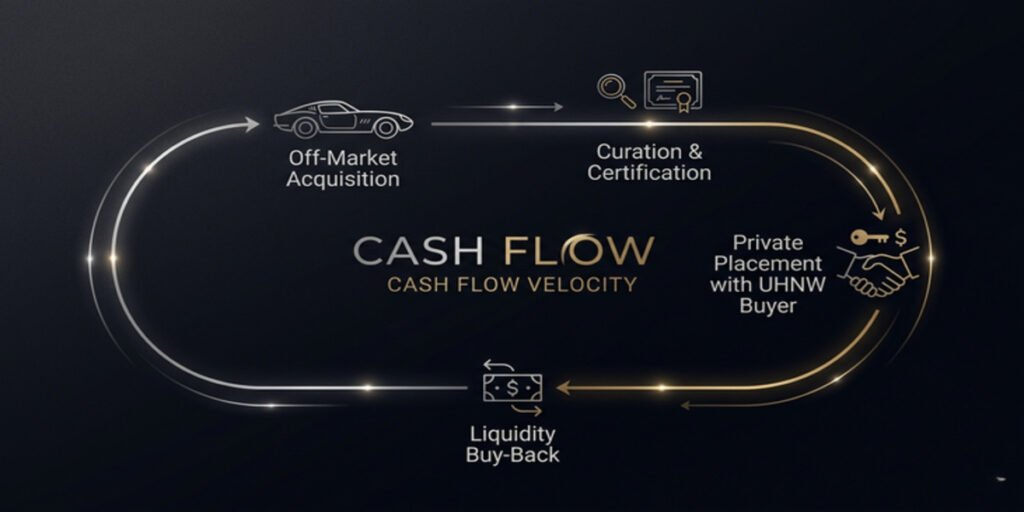
This luxury vehicle asset flipping model accelerates cash flow velocity without expanding physical overhead. Consider the mechanics: a Ferrari Classiche-certified F40 or a non-cat, non-adjust Rosso Corsa example is acquired off-market, often from an estate or a distressed seller. The vehicle undergoes a multi-thousand-pound paint correction, ceramic coating, and documentation audit. It is then placed with a client at a premium. Twelve to thirty-six months later, the same client—now seeking liquidity for a new acquisition—sells the car back to Hartley at a negotiated price. The firm then reconditions the asset and places it with a new principal, capturing margin not merely on the spread, but on the repeated origination fees embedded in each transaction.
The Tom Hartley Cars revenue model is therefore not dependent on new inventory origination. It is dependent on relationship density. The firm’s client roster functions as a captive market: because UHNW collectors rarely sell publicly (doing so signals distress and damages provenance value), they route disposals through Hartley, who can place the asset quietly with a vetted buyer. This creates a closed-loop transaction ecosystem where off-market hypercar transactions generate compound returns on the same underlying metal. The result is a capital efficiency ratio that dwarfs traditional dealerships: rather than turning inventory 4–6 times annually, Hartley turns relationships 4–6 times annually, with each rotation monetizing the same underlying asset class.
What Is Tom Hartley Cars Worth? Inventory, Estate, and Carrying Costs
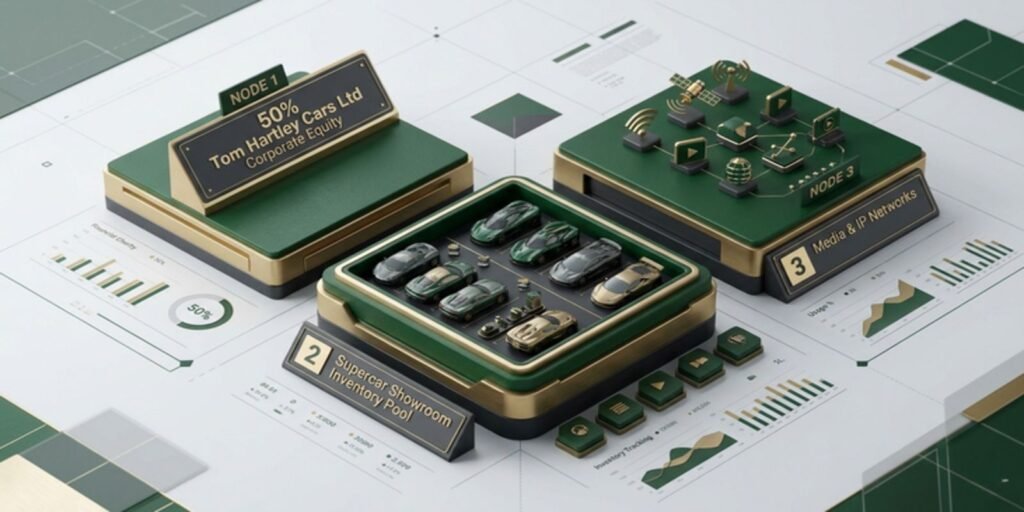
The historical Tom Hartley showroom portfolio routinely commands assets ranging from investment-grade modern Bugatti and Ferrari flagships to ultra-exclusive classic builds, typically listed under strict Price on Application (POA) parameters.
| Feature | Detail | Source |
|---|---|---|
| Estate size | 40 acres | Hacel / Car Dealer Magazine |
| Showroom area | 15,000 sq ft | Hacel Lighting project page |
| Showroom build cost | £10 million (reported) | Car Dealer Magazine |
| Showroom opened | March 2019 | Car Dealer Magazine |
| Access | Appointment only; helipad available | Tom Hartley Cars / Hacel |
Speaking to Car Dealer Magazine, Carl Hartley stated there is often more than £30m worth of metal on the estate, paid for with cash — a figure that, combined with the £10 million showroom build cost reported by the same outlet, puts a conservative floor on total on-site asset value well above £40 million before accounting for the land itself.
“Often more than £30m worth of metal on the estate, paid for with cash.” — Carl Hartley, speaking to Car Dealer Magazine
Tom Hartley Cars Ltd’s most recent confirmation statement is dated 29 October 2025, with the next due by 12 November 2026. As a small company, it is not required to file full audited accounts — meaning the £50M+ floor valuation cited here is an estimate, not a disclosed figure.
The financial implications of managing POA assets are substantial. First, there is the capital lock-up: a single Ferrari 250 GTO-class asset can tie up £30M–£40M in liquidity for months or years. Second, there is the maintenance overhead: Ferrari Classiche certification requires factory-standard parts and documented provenance; Bugatti Veyron acquisition cost is merely the entry fee—annual service contracts, specialized tire replacements, and transport logistics add six-figure carrying costs per annum. Third, there is the condition premium: the firm invests heavily in “research, preparation, and presentation,” including paint corrections that can exceed £25,000 for triple-layer Ferrari Rosso Corsa, ceramic coatings, and climate-controlled storage.
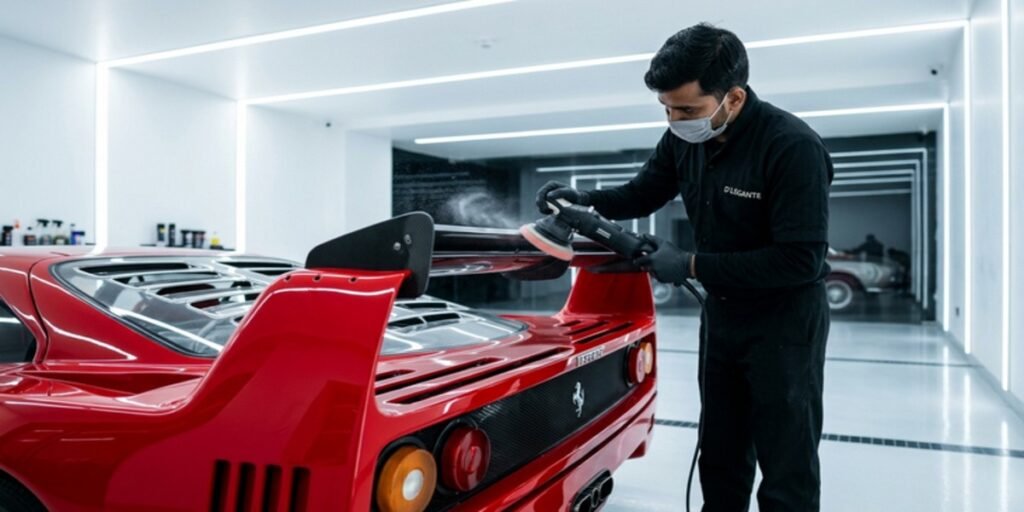
These costs are not expenses—they are margin preservation investments. In the classic car inventory valuation framework, a £25,000 paint correction on a £2.7M Pagani Huayra or a £1.25M McLaren P1 is not a 0.9% cost; it is the difference between a “good” example and a “best-in-class” example that commands a 15–20% premium at resale. The Hartley showroom itself — a three-storey, 15,000 sq ft glass pavilion built at a reported cost of £10 million and opened in March 2019 — functions as a physical credibility signal. When clients arrive by helicopter or chauffeur from any UK airport, the environment confirms the asset’s institutional-grade custody.
The Hartley model demonstrates that the real return isn’t in the initial purchase price, but in the curation premium — the difference between a raw market acquisition and a fully presented, Hartley-certified asset.
Carl Hartley in 2026: The Cars & Money Podcast and Media Income
How Carl Hartley’s Off-Market Pricing Advantage Works
Carl Hartley’s true financial advantage lies not in the metal, but in the information network. Because the firm trades largely off-market—facilitating transactions between principals without public listing, auction exposure, or price disclosure—their real transactional margins remain completely opaque to traditional automotive pricing indexes such as Hagerty, Classic.com, or auction house results. This grants them an information arbitrage edge: they know what a specific client paid, what they will pay again, and what the next principal in the queue will accept, all while the broader market operates on stale or synthetic data.

Carl Hartley has discussed the mechanics of selling to wealthy clients in media appearances, noting that the firm’s negotiation leverage derives from knowing the true market for a chassis before the seller does.
The Cars & Money Podcast: Reach, Guests, and Business Value
Launched in late 2025, the Cars & Money podcast represents a deliberate client-acquisition channel, not a side project. Co-hosting the Cars & Money podcast alongside entrepreneur Rob Moore, Hartley has positioned himself as the voice of elite automotive finance for a global audience. The podcast—syndicated across Apple Podcasts, Spotify, YouTube, and TikTok—features guests ranging from Gumball 3000 founder Maximillion Cooper to Wheeler Dealers icon Mike Brewer, and covers topics from £35M one-of-one Ferrari storage to the financial mechanics of supercar ownership. The podcast was announced in December 2025 and began releasing episodes in early 2026.
The strategic value is not advertising revenue; it is client acquisition at scale. Each episode functions as a credibility filter: by discussing £500,000 monthly fleet finance payments with collector Paul Bailey or the supercar gatekeeping controversy around Mat Armstrong’s salvage-title Bugatti Chiron rebuild, Hartley signals to UHNW listeners that he operates at their altitude. The podcast’s sponsorship structure—featuring Tom Hartley Cars as a primary sponsor alongside Rob Moore’s Money.School—creates a direct pipeline from content consumption to dealership inquiry. For a firm that operates by appointment only, media reach replaces traditional marketing spend with reputation leverage.
Legal Proceedings: 2019 Dangerous Driving Case
Carl Hartley admitted dangerous driving at Sheffield Crown Court in November 2019, following a collision in which he crashed his £180,000 Ferrari 458 Spider into a Porsche 718 Cayman GTS at the Tinsley roundabout in Sheffield on 20 May 2018. The other driver, Henry James Hibbs, suffered minor injuries. Both drivers initially fled the scene; Hartley later identified himself to police and claimed his brakes had failed — though investigators found no evidence of brake damage. Hibbs, who pleaded not guilty, was convicted following trial and given a ten-month sentence suspended for 24 months, 220 hours of unpaid work, a two-year driving ban, and ordered to pay £4,070 in costs.
At sentencing on 15 January 2020, Hartley received a nine-month prison sentence suspended for 24 months, was ordered to complete 200 hours’ unpaid work, banned from driving for two years, and ordered to pay £1,400 in costs. National press coverage at the time confirmed his net worth as £23 million. His business operations at Tom Hartley Cars continued throughout and following the proceedings.
How Tom Hartley Cars Vets Its Buyers
The firm’s operational protocols function as regulatory and reputational shields that preserve institutional premium. Strict anti-cash policies eliminate money-laundering risk and ensure transactional transparency; direct relationship-vetting—described by Carl Hartley as “blacklisting” volatile or unreliable buyers—maintains roster integrity. In a market where a single defaulted wire transfer or a client who “pops their clogs and doesn’t tell anybody” can freeze a £2M asset for months, these policies are not bureaucratic friction—they are liquidity protection mechanisms.
The blacklisting protocol is particularly significant. By refusing to transact with buyers who renege on deals, negotiate in bad faith, or fail to complete due diligence, the Hartleys ensure that their client network remains a closed syndicate of reliable principals. This exclusivity is itself a balance-sheet asset: it reduces default risk, accelerates transaction velocity, and allows the firm to price inventory with confidence that the counterparty will perform. In practice, that reputation is what allows the firm to hold £30 million of unfinanced inventory with confidence that every asset can be placed quickly.
Frequently Asked Questions
What is Carl Hartley’s estimated net worth?
Carl Hartley’s net worth was widely reported as £23 million in national press coverage of his January 2020 sentencing — a figure originally drawn from his 32nd-place ranking on the 2018 Sunday Times Under 30 Rich List. This is the most authoritative publicly attributed figure available, though it was not a court-disclosed asset valuation. His 2018 appearance on The Sunday Times Under 30 Rich List at position #32 confirmed his status among Britain’s wealthiest under-30s at that time. Given supercar market appreciation since 2019, his current net worth is plausibly higher, but no updated figure has been formally disclosed or independently verified.
Does Carl Hartley own 100% of the supercar dealership?
No. Carl Hartley holds a 50% direct equity stake in Tom Hartley Cars Ltd, with his father, Tom Hartley Sr., holding the remaining 50%. This equal partnership structure has been in place since October 2014, when Carl’s older brother Tom Hartley Jr resigned as director, leaving Carl and Tom Sr as the sole equal principals. Official data from the Companies House Director Registry confirms both men as active directors under their statutory Persons with Significant Control (PSC) filings.
What is the total enterprise value of Tom Hartley Cars?
No public accounts are required under UK small company filing rules, so exact revenue figures are not disclosed. However, the showroom regularly holds inventory including Ferrari F40s, Bugatti Veyrons, and McLaren F1 road cars — assets individually worth £1M–£20M+. The business operates from a 40-acre private estate in Derbyshire, with a purpose-built showroom opened in 2019. A conservative floor valuation based on typical inventory depth would place the enterprise well above £50M at any given time.