
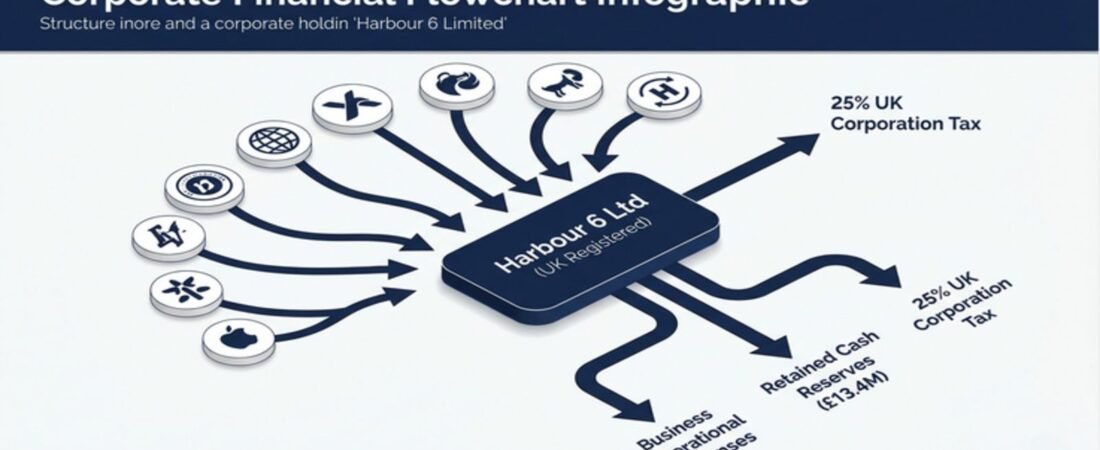

Emma Raducanu’s 2026 valuation is defined by a deliberate decoupling of income from athletic performance. While her on-court prize money stands at $6,562,478 per official WTA records, her corporate vehicle, Harbour 6 Limited (12472925), serves as a high-liquidity brand equity holding company. As of the May 2025 audited filings, the entity held £13.4 million in liquid cash. This cash-heavy balance sheet insulates Raducanu’s lifestyle from WTA ranking volatility.
The forensic distinction between these two revenue streams is stark. WTA Tour prize money is performance-contingent, subject to physical attrition, and taxed heavily at source across multiple jurisdictions. Corporate endorsement revenue, by contrast, is contractually fixed, geographically diversified, and optimized through corporate tax structures. As of the latest audited financial disclosures for Harbour 6 Limited, the vehicle held £13.5 million in total assets with £13.4 million in liquid cash as of 31 May 2025—a figure that represents the hard baseline for her 2026 valuation before accounting for active endorsement retention and new deal flows. This is not athlete wealth in the traditional sense; it is the balance sheet of a media and brand equity holding company that happens to be directed by a tennis player.
The Commercial Portfolio: Emma Raducanu Valuation Matrix

- 🟢 Verified Filing — Harbour 6 cash, assets, and charge disclosures confirmed via Companies House (12472925).
- 🟠 Estimated / Reported — Sponsorship annual retainers based on trade press reporting (SportsPro, City AM, Sportico).
- 🔵 Third-Party Source — Career prize money via WTA records; ranking via ATP/WTA official databases.
The Raducanu Revenue and Asset Structure Matrix (2026 Projections)
| Corporate / Asset Tier | Asset Type | Core Drivers | Audit Status |
|---|---|---|---|
| Corporate Vehicle (Harbour 6 Ltd) | Liquid Cash & Reserves | Corporate Endorsement Funnel |
Audited
Verified via Companies House |
| Luxury / Lifestyle Portfolio | Fixed Long-Term Retainers | Global Brand Equity & APAC Appeal |
Active
Dior, Tiffany & Co. (Verified) — Porsche: Ended 2024 (excluded) |
| Institutional Portfolio | Corporate Commercial Deals | Mass Market UK / Global Trust |
Active
HSBC, British Airways, Evian (Verified) |
| WTA Tour On-Court Earnings | Prize Money | Tournament Performance & Draws |
Volatile
Public WTA Records |
Inside Harbour 6 Limited: How Raducanu Institutionalized Her Tennis Earnings
Harbour 6 Limited serves as the primary funnel for Raducanu’s global endorsements (Tiffany & Co., Dior, HSBC, British Airways). By retaining profits within the company, Raducanu pays the 25% UK corporation tax rate rather than the 45% personal income tax rate applicable to earnings over £125,140. The structure also allows the company to offset legitimate operating costs — coaching, global travel, management fees — before tax is assessed, and to distribute retained profits as dividends at lower personal rates when extraction is required. Where a model like Andy Murray’s required decades of sustained ATP Top-10 consistency to justify corporate scale, Raducanu’s converted a single moment of global visibility into long-term, fixed-fee contracts that don’t depend on her ranking.
This represents a significant escalation from the prior filing year, which showed profits of £9.6 million on assets of £10.2 million including £6.3 million in cash, alongside a corporation tax liability of £1.8 million. The trajectory is unambiguous: Harbour 6 is accumulating cash at a rate that far outpaces distribution, suggesting a deliberate strategy of corporate retention over immediate personal extraction.
Harbour 6’s reporting timeline has itself drawn scrutiny: the company has shortened its accounting period nine times since incorporation, each adjustment delaying the next filing deadline by up to three months. Companies House rules permit this, and there is no evidence of wrongdoing, but the pattern means Harbour 6’s public accounts are consistently among the most delayed of any UK-registered athlete’s commercial vehicle.
⚠️ Companies House Disclosure: Registered Charge
On 6 September 2024, Harbour 6 Limited registered charge 124729250001 with Companies House. The nature of the security and the counterparty are not disclosed in the public MR01 filing. This is one outstanding charge on the register and must be factored into any net-asset assessment of the company.
Blue-Chip Retention: The Multi-Million Pound Brand Ecosystem Surviving the On-Court Cycle
Two previously reported partnerships are no longer active. Porsche ended in 2024, and Vodafone — reportedly her largest single retainer at approximately £3 million per year — was terminated in 2025 following fee negotiations. Both exits are excluded from the 2026 valuation figures in this article. The remaining active portfolio (Tiffany & Co., Dior, British Airways, HSBC, Evian, Uniqlo) reflects confirmed, currently running partnerships only.
| Brand | Signed | Status (2026) | Est. Annual Value |
|---|---|---|---|
| Tiffany & Co. | Sept 2021 | 🟢 Active | ~£2M |
| Dior (LVMH) | Oct 2021 | 🟢 Active | ~£2M |
| Evian | Dec 2021 | 🟢 Active | ~£500K–£1M |
| British Airways | Dec 2021 | 🟢 Active | ~£1M |
| Vodafone | 2021 | 🔴 Terminated Apr 2025 | Was ~£3M |
| Porsche | Mar 2022 | 🔴 Ended 2024 | Was ~£1.5M |
| HSBC | Jun 2022 (4-yr) | 🟢 Active | ~£1M |
| Nike | 2018–2026 (8yr) | 🔴 Replaced by Uniqlo | ~£100K |
| Uniqlo | Feb 2026 (4-yr) | 🟢 Active | $3.5M (~£2.6M) |
The endurance of Raducanu’s endorsement portfolio through competitive volatility is perhaps the most analytically significant feature of her 2026 valuation. While her WTA ranking has fluctuated outside the top 100 at various points, her blue-chip retainers have demonstrated remarkable stickiness—a testament to the contractual architecture and brand equity she commands.
Tiffany & Co. was the first luxury house to move, signing her as a global ambassador in September 2021 within weeks of her US Open victory. The partnership remains active, with Raducanu frequently wearing Tiffany jewelry during on-court appearances—a subtle but powerful integration of luxury positioning into athletic performance.
Dior, signed under the broader LVMH umbrella in October 2021, positioned Raducanu within the haute couture and runway ecosystem. While her recent campaign visibility has been more selective, the LVMH relationship retains strategic value given the conglomerate’s long-term ambassador model.
Porsche signed Raducanu in March 2022, aligning her with a luxury automotive brand that historically sponsors elite athletes including Angelique Kerber. The partnership ended in 2024 — Sports Illustrated confirmed she had exited the Porsche deal alongside her larger Vodafone contract. It should therefore be treated as a discontinued partnership, not an active revenue line, in any 2026 valuation model.
British Airways, signed in December 2021, leveraged her status as Britain’s most recognizable female sports star. The deal, reportedly worth seven figures annually, remains active and is strategically significant as a “national champion” positioning asset.
HSBC joined the portfolio in June 2022 with a four-year partnership framed around financial education and youth engagement—a natural fit given Raducanu’s stated interest in finance and her family’s financial industry background. As the official banking partner of Wimbledon, HSBC gains symbiotic visibility during the British grass-court season.
Evian, a global brand ambassador since December 2021, has maintained consistent campaign presence, including 2025 activations alongside Carlos Alcaraz, demonstrating the brand’s continued commitment to the partnership.
Vodafone was, until 2025, Raducanu’s single largest sponsorship — reportedly worth around £3 million annually, ahead of her Dior and Tiffany & Co. retainers. Sports Illustrated reported the deal was terminated in 2025, with the brand reportedly balking at her fee demands. Its removal represents a meaningful reduction in her fixed-retainer income base heading into 2026 and should not be treated as a phantom line item — it is a confirmed loss.
The critical insight is that these contracts were negotiated as multi-year, fixed-retainer agreements rather than performance-contingent deals. This insulation from WTA ranking volatility is precisely why Harbour 6’s cash reserves continued to grow even during seasons where on-court prize money dropped to approximately $238,000.
The Nike and Wilson Mechanics: On-Court Kit Valuations and Performance Incentives
In February 2026, Raducanu executed a strategic kit supplier shift, ending an eight-year relationship with Nike that began when she was 15.
Like her Nike deal, the Wilson racket partnership was reportedly valued at approximately $100,000 annually before her switch to Yonex — underscoring how modest her equipment-tier income was compared to her lifestyle and luxury retainers.
The transition executed on February 24, 2026, where Raducanu was officially appointed as a global brand ambassador for Uniqlo, marks one of the most visible apparel shifts in contemporary women’s tennis.
Her initial junior-to-pro contract with Nike, signed at age 15, yielded an industry-estimated baseline of approximately £100,000 per year. Following the expiration of her contract with Nike, she transitioned to the Japanese apparel brand, making her the first women’s singles player to sign with Uniqlo, joining an existing ambassador roster that includes Roger Federer, Kei Nishikori, and wheelchair tennis stars Gordon Reid and Shingo Kunieda. She joins a global ambassador roster that also includes Academy Award-winning actor Cate Blanchett, placing her within Uniqlo’s broader lifestyle-and-culture marketing tier, not just its athletic roster.
The new Uniqlo Global Brand Ambassador deal is valued at an estimated $3.5 million (£2.6 million) annually over four years. This represents a 35-fold increase over her Nike baseline, which was industry-estimated at £100,000 per year. This shifts her apparel income model toward a largely fixed ambassador structure, though the deal reportedly retains performance-linked bonus components tied to Grand Slam results and ranking milestones — a hybrid rather than a purely non-contingent arrangement. The deal reportedly runs for four years, giving Harbour 6 a fixed, contracted revenue stream through at least 2030.

Her technical equipment setup experienced highly publicized testing during the early competitive stretch. After utilizing the Wilson Blade Pro framework for multiple seasons, equipment tracking site Tennisnerd noted that Raducanu formally kicked off her season playing with a Yonex Ezone 100 frame. This tactical shift highlighted a period of technical adaptation regarding weight specs and string setups—specifically deploying Luxilon Alu Power strings—to limit physical strain and control ball flight during competitive baselines. Standard industry practice for racket contracts includes baseline retainers ($100,000–$500,000 annually for non-Top-20 players) with significant performance escalators tied to Grand Slam progression, ranking thresholds, and media exposure metrics.
The mechanical distinction is clear: on-court kit and equipment contracts contain performance bonus reductions and ranking-dependent escalators that make them inherently more volatile than lifestyle and luxury partnerships. The Uniqlo deal is an exception because it is structured as a global brand ambassadorship with LifeWear integration, blurring the line between athletic and lifestyle revenue.
Global Tax Footprint: Navigating UK Residency and International Performance Income
As a UK-domiciled athlete with Romanian-Chinese heritage and Canadian birthright, Raducanu’s tax architecture is inherently cross-border. However, her strategic decision to maintain UK residency and channel global endorsement revenue through Harbour 6 Limited creates a centralized, British-jurisdictional tax footprint that offers both compliance clarity and optimization potential.
Under UK tax law, non-resident athletes performing in the UK are subject to a 20% withholding tax on appearance payments, with HMRC additionally apportioning a percentage of worldwide endorsement income to UK performances. The apportionment is calculated using either the Relevant Performance Days (RPD) method or the Relevant Performance and Training Days (RPTD) method—fractions that can expose high-earning athletes to UK tax liabilities exceeding their actual UK prize money. This is precisely why athletes like Rafael Nadal and Roger Federer historically avoided UK warm-up events in favor of lower-tax jurisdictions like Germany.
For Raducanu, however, the equation inverts. As a UK resident and director of a UK-registered company, her global endorsement income is subject to UK corporation tax when channeled through Harbour 6, but she avoids the punitive withholding tax complications faced by non-resident competitors. International tournament prize money remains subject to source-country taxation—WTA events withhold at local rates—but these are typically creditable against UK tax liabilities under double-taxation treaties.
The critical optimization lies in the corporate treatment of endorsement revenue versus personal income tax. By retaining profits within Harbour 6 rather than extracting them as salary, Raducanu defers personal income tax and gains flexibility in timing distributions. The £1.8 million corporation tax liability recorded in prior accounts is materially lower than the personal tax burden that would apply to equivalent earned income at the 45% additional rate. For a global athlete with multi-million-pound annual endorsement flows, this structural differential compounds significantly over time.
Why the Numbers Don’t Add Up the Usual Way
The “Asymmetry Premium”
Raducanu created a new archetype for tennis wealth—one where a single Grand Slam title, coupled with Gen-Z demographic alignment and multicultural appeal, yielded a lifetime commercial return traditionally reserved for 10+ time Grand Slam champions. The standard athletic wealth model requires sustained competitive dominance to maintain sponsor relevance; Raducanu’s model inverts this by front-loading brand equity during a moment of maximum cultural resonance and then converting that equity into fixed-term, non-contingent contracts.
This asymmetry is quantifiable. Her career on-court prize money stands at approximately $6.56 million (per WTA tracking), with the 2021 US Open alone providing $2.5 million of that total — as confirmed by CNBC at the time. Even converting Harbour 6’s £13.5 million in corporate assets to a comparable USD basis (approximately $17 million), the company’s holdings still run roughly 2.6 times her total on-court career earnings — a smaller but still striking gap between commercial and athletic wealth.
The China Market Valuation
Raducanu’s commercial appeal in East Asia is not incidental. It is one of the main reasons her sponsorship income has held up. Her heritage—Romanian father, Chinese mother, fluent Mandarin speaker, born in Toronto, raised in London—gives her a rare, genuine connection to four different markets: Romania, China, Canada, and Britain. This positioning provides enduring access to the APAC luxury market even during competitive absences.
Luxury brands operating in China and the broader APAC region face a persistent challenge: finding authentic ambassadors who resonate with both local cultural identity and global aspirational positioning. Raducanu’s Mandarin fluency and documented connection to her mother’s heritage provide that authenticity. For LVMH (Dior), Richemont (potentially), and other luxury conglomerates with significant APAC revenue exposure, this cultural arbitrage justifies long-term retainer commitments that would be irrational based purely on WTA ranking metrics.
Even during competitive absences, her APAC marketability holds. Chinese social media platforms, luxury retail activations, and regional campaigns sustain revenue flows that are not tied to her WTA ranking.
Liquid Asset Reinvestment
With £13.4 million in liquid cash held within Harbour 6 as of the 2025 accounts, the question of deployment becomes critical for 2026 valuation projections. Passive cash-in-bank positions generate negligible real returns and are eroded by inflation. For a sports figure with a multi-decade post-athletic investment horizon, the logical trajectory is diversification into global equities, fixed-income instruments, and potentially high-end real estate.
Industry standard practice for athlete wealth preservation—exemplified by structures advised by firms like Saffery and other sports wealth management specialists—involves transitioning corporate cash reserves into managed portfolios. A conservative allocation might deploy 40–50% into global equity index funds, 20–30% into investment-grade bonds, and 10–20% into alternative assets including real estate or private equity. For Raducanu, with a likely investment horizon exceeding 40 years, this reallocation from cash to productive assets could conservatively add £1–2 million annually to Harbour 6’s balance sheet through compound returns.
The 2026 valuation must therefore account not merely for active endorsement retention but for the reinvestment velocity of existing liquid equity. If Harbour 6 deploys even a fraction of its £13.4 million cash position into diversified global assets, the company’s balance sheet growth will begin to reflect investment returns in addition to sponsorship inflows—completing the transition from athletic revenue vehicle to autonomous wealth-generating entity.
Frequently Asked Questions
What is Emma Raducanu’s net worth in 2026?
What is Emma Raducanu’s net worth in 2026? Emma Raducanu’s net worth is estimated between £22 million and £25 million ($28–32 million). This is supported by the £13.5 million in audited assets held in Harbour 6 Limited as of mid-2025, combined with the £2.6 million Uniqlo retainer signed in 2026 and existing long-term contracts with Dior and Tiffany & Co.
How much does Emma Raducanu make from sponsorships per year?
Raducanu’s annual sponsorship income is estimated at £6–8 million ($7.5–10 million) for 2026. This includes the Uniqlo contract ($3.5 million), estimated retainers from Tiffany & Co. (£2 million), Dior (£2 million), British Airways (£1 million), HSBC (£1 million), Evian (£500,000–£1 million), and residual brand alignments. This vastly dwarfs her on-court prize money, which has historically fluctuated between approximately $238,000 and $1 million annually depending on tournament availability, draw depth, and physical recovery windows.
Who is the highest-earning British female athlete?
Emma Raducanu is the highest-earning British female athlete by a significant margin. Her annual endorsement income alone exceeds the total career earnings of most British female sports stars. While exact corporate comparisons are complicated by private filings, Raducanu’s centralized Harbour 6 assets and multi-million-pound annual commercial flows place her well ahead of domestic peers across cycling, athletics, or football. The only comparable British female athlete in recent history from an earnings perspective would be Paula Radcliffe at her marathon peak or potentially Jessica Ennis-Hill during her post-London Olympic window, neither of whom sustained the long-term, non-contingent corporate architecture that Raducanu has constructed through Harbour 6.
Why does Raducanu route her endorsement income through Harbour 6 Limited?
Routing revenues through a UK-registered private limited company acts as an institutionalized shield against aggressive personal income tax brackets. Endorsement cash flows funneled directly into Harbour 6 Limited are subject to the UK corporation tax main rate of 25%, rather than the additional personal income tax tier of 45% levied on high-earning individuals. This structure allows the company to tax-efficiently retain immense liquidity reserves for global market reinvestment, offset operational overheads (such as coaching, global travel, and management fees) before corporate assessment, and optimize the timing of personal dividend distributions.
Does her WTA ranking decline trigger reduction clauses in her major luxury sponsorships?
While traditional athletic apparel contracts contain performance-heavy reduction brackets and ranking thresholds, Raducanu’s luxury and lifestyle portfolio (such as Dior and Tiffany & Co.) is uniquely structured around fixed, long-term global brand ambassadorships. These retainers leverage her multi-cultural appeal, British-Romanian-Chinese heritage, and native Mandarin fluency to capture strategic value within the APAC luxury space. Because these contracts prioritize lifestyle brand equity over weekly WTA point accumulation, her commercial retainers have demonstrated remarkable “stickiness” and insulation throughout her competitive on-court cycles.
