


The 2026 Dragons’ Den panel spans a wide capital range — from a verified billionaire to an entrepreneur who just bought her own company out of administration. This ranking is based on verifiable corporate filings, confirmed exit proceeds, and recent portfolio activity, not television tenure.
At the top is a billionaire who completed a major high-street acquisition in February 2026. Below that are fashion and manufacturing operators, a founder sitting on fully liquidated exit proceeds, and a media entrepreneur whose holding company was valued at $425 million in October 2025. The capital behind each chair varies by an order of magnitude.
The Den Balance Sheet: The 2026 Capital Ranking
| Dragon | Net Worth | Primary Driver | 2026 Catalyst |
|---|---|---|---|
| Peter Jones, CBE | £800M–£1.2B (est.) | Telecoms / PJ Investment Group | American Golf Acquisition |
| Touker Suleyman | £150M–£200M (est.) | Fashion Retail / Low Profile Group | International Supply Chain Expansion |
| Steven Bartlett | £75M–£85M | Media / Flight Fund VC | Audio Network Syndication |
| Deborah Meaden | £40M–£50M (est.) | Leisure Exit / Eco Ventures | Green Tech Portfolio Growth |
| Sara Davies, MBE | £37 Million (est.) | Crafter’s Companion / Retail | Emergency CEO Return & Corporate Rescue |
📋 Panel Note (August 2026)
Touker Suleyman announced his departure in June 2026 (final episodes September 2026). Sara Davies left the permanent panel in 2025 to execute the Crafter’s Companion rescue. Ranking reflects deployable capital and verified asset bases, not current studio seats. Guest Dragons (including Gary Neville and Emma Grede) appear in rotating capacity.
1. Peter Jones, CBE (~£1.2 Billion): Telecoms, Retail and the American Golf Acquisition
Peter Jones is the sole remaining original Dragon and the only verified billionaire on the 2026 panel. His fortune is anchored in PJ Investment Group, the holding vehicle that has absorbed decades of cash flow from his telecommunications origins—beginning with Phones International Group—into a diversified portfolio spanning media, technology, and consumer retail. The Sunday Times Rich List placed his net worth at approximately £1.157 billion in 2021— the most widely cited benchmark — with recent estimates centering on approximately £1.2 billion, depending on whether private business holdings are included at book or market value. What is consistent across sources is that his wealth is underpinned by asset ownership rather than fluctuating equity multiples.

The critical 2026 catalyst is the February 2026 acquisition of American Golf, the UK and Ireland’s largest specialist golf retailer, purchased from Endless LLP. The chain operates more than 80 stores, generates approximately £135 million in annual turnover, and employs more than 1,000 people. Terms were not disclosed. Jones cited “clear long-term growth potential” and plans to invest in brand and customer experience.
His joint £25,000 investment (alongside co-Dragon Richard Farleigh) for a combined 40% stake in Reggae Reggae Sauce — netting Jones a 20% equity position—remains the show’s most iconic deal, generating sustained royalty streams and brand equity that outperformed the typical venture exit timeline. Jones’s wealth is underpinned by tangible asset ownership and recurring cash flow, not paper equity.
2. Touker Suleyman (~£150M–£200M): Fashion Manufacturing, Hawes & Curtis and Ghost
Touker Suleyman’s net worth, estimated at £150 million–£200 million, is built on a vertically integrated fashion model: a vertically integrated fashion empire where manufacturing, sourcing, and retail brands operate under a single supply-chain umbrella. In June 2026, Suleyman announced his departure from Dragons’ Den after a decade on the panel (final episodes aired September 2026). The ranking above reflects capital, not current panel seats. His holding vehicle, Low Profile Group, operates manufacturing facilities across Turkey, Bulgaria, and Georgia, supplying garment production to major British high-street names while also owning two iconic retail brands outright.
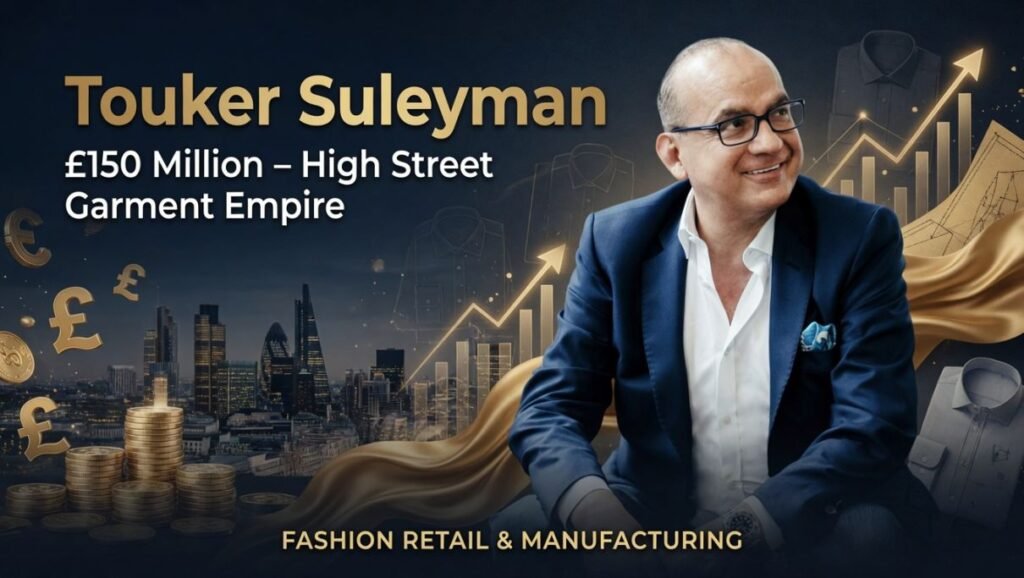
The first is Hawes & Curtis, the British menswear label acquired in 2001 for a nominal £1 when the business was £500,000 in debt and facing administration. Under Suleyman’s chairmanship, turnover rose from £600,000 to £30 million by 2014, with subsequent international expansion including a $5 million franchise deal with Korath Holding to open 26 stores across the Gulf states. The second is Ghost, the womenswear label purchased in 2008 following the collapse of its Icelandic investment fund owner, a transaction that safeguarded 142 jobs and added a premium British fashion asset to his portfolio at distressed cost.
The insulation from high-street volatility comes from the manufacturing infrastructure beneath the retail brands. By controlling manufacturing capacity across Eastern Europe and the Near East, he captures margin at both the production and retail layers, reducing dependency on third-party suppliers. In November 2024, he was awarded the Drapers Lifetime Achievement Award for his 50-year career in fashion—a recognition that underscores the durability of his model. His 2026 trajectory is defined by international supply-chain expansion, leveraging Low Profile Group’s manufacturing footprint to service third-party contracts while scaling Hawes & Curtis’s digital direct-to-consumer channel.
3. Steven Bartlett (~£75–85 Million): The Flight Fund Velocity and Modern Media Holdings
The Social Chain exit to Brave Bison is an outdated starting point for valuing Bartlett’s holdings — a 2023 transaction with Brave Bison carrying an initial consideration of £7.7 million (potential earn-outs to £16.3 million). Whether Bartlett personally benefited financially from that specific sale has never been publicly confirmed, as his retained equity at the point of sale was undisclosed. Instead, his current wealth is derived entirely from the active capitalization of his unified creator network, anchored by FlightStory, Flight Studios, and his dual investment arms, Flight Fund and FlightCast (the podcast and audio network). Industry estimates place his personal net worth at approximately £75–£85 million. However, this figure excludes the paper valuation of his 90%+ ownership stake in Steven.com, which was independently valued at $425 million following an investment round led by Slow Ventures and Apeiron Investment Group, a figure that places the theoretical ceiling of his total wealth significantly higher.
The headline valuation catalyst centers on Steven.com—Bartlett’s overarching creator holding company, for which The Diary of a CEO serves as the flagship asset. In late 2025, Steven.com achieved a $425 million valuation following an eight-figure investment round led by Slow Ventures and Apeiron Investment Group. The round’s investor roster included Philipp Freise (KKR), Gary Vaynerchuk, Bryan Johnson, Alex Hormozi, and Kevin Rose, among others. The podcast franchise alone generated $20 million in revenue during 2024, driven by brand partnerships with LinkedIn, Oracle, and Shopify, and in November 2024 became the first UK-produced podcast to surpass one billion views on YouTube alone, with total cross-platform listens also exceeding one billion.

Bartlett’s capital deployment vehicle, Flight Fund, reported at approximately £81 million at launch in January 2023, targets biotech, blockchain, health and wellbeing, and AI-enabled commerce. Notable 2023-2025 investments include ZOE ($2.5 million in personalised nutrition), Huel, and Thirdweb, a web3 development platform valued at $160 million in 2022 and backed by Coinbase and Shopify. Bartlett’s distribution network — 25 million social followers and a dominant podcast franchise — drives customer acquisition for portfolio companies at low marginal cost, an advantage that traditional asset-heavy investors cannot replicate.
A material reputational risk sits within these numbers. In December 2024, a BBC World Service investigation found that across 15 health-related episodes of The Diary of a CEO, an average of 14 claims per episode contradicted established scientific evidence — including a guest’s assertion that a ketogenic diet could treat cancer, left unchallenged by Bartlett. Flight Studio, the podcast’s production company, called the investigation a ‘misleading’ partial narrative and said guests were ‘thoroughly researched.’ This is a material brand risk inside his primary asset: a media platform whose authority is its commercial currency.
4. Deborah Meaden (~£40M–£50M): The Weststar Exit and Sustainable Venture Portfolio
Deborah Meaden’s capital base is the product of a clean two-stage exit. In 1999, she led a management buyout of Weststar Holidays, the family holiday park operator she had grown from a single site to a five-park empire serving 150,000 visitors annually with EBITDA exceeding £11 million. In 2005, she sold the majority stake to Phoenix Equity Partners for £33 million, retaining a 23% equity position. She liquidated that remaining stake in 2007 when Weststar sold to Alchemy Partners for £83 million, collecting approximately £19 million and bringing her total realised exit value to roughly £52 million.
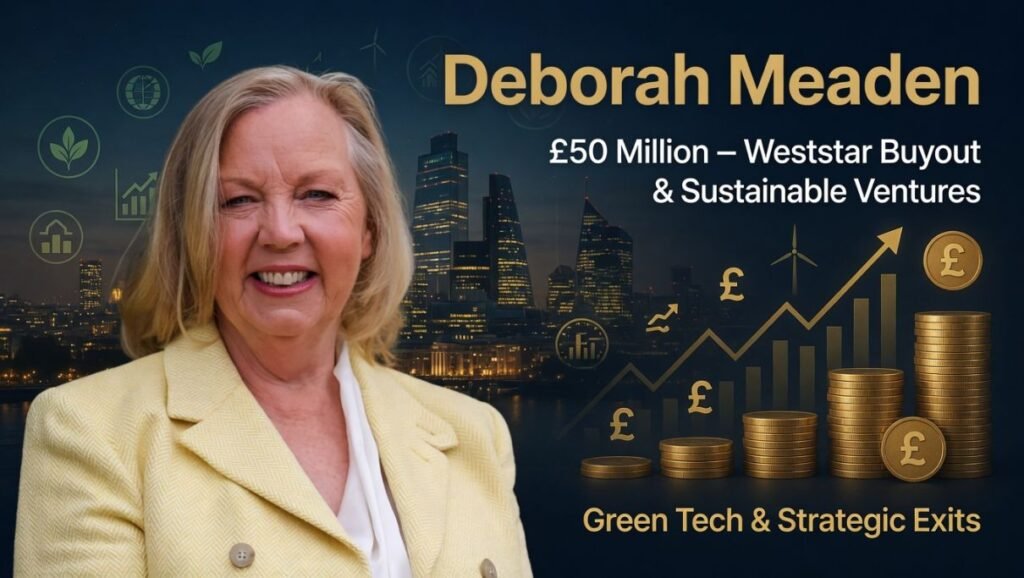
The exit proceeds now fund a diversified venture portfolio weighted toward sustainable enterprises. Unlike Suleyman or Davies, whose capital is tied up in inventory and fixed assets, Meaden’s base is predominantly liquid. She holds a significant stake in Fox Brothers, the Somerset textile mill established in 1772, and maintains an active angel portfolio weighted toward green technology, renewable infrastructure, and circular economy models. Her 2026 focus is growth in the green-tech and circular-economy portfolio funded by the Weststar exits.
It should be noted that net worth estimates for Meaden vary between £40 million and £50 million across sources, reflecting the difficulty of valuing an active angel portfolio weighted toward early-stage green technology ventures where mark-to-market valuations fluctuate significantly. The £50 million figure used here represents the upper range of credible estimates.
5. Sara Davies, MBE (~£37M est.): Crafter’s Companion Rescue and Return to CEO
Sara Davies founded Crafter’s Companion in 2005 from her University of York bedroom with a £200 website and a single product — the Enveloper. The business scaled through television shopping channels, selling 30,000 units within six months and reaching £500,000 turnover by graduation. By 2018 it generated nearly £25 million in annual turnover, with exports to more than 40 countries and a US office in California.
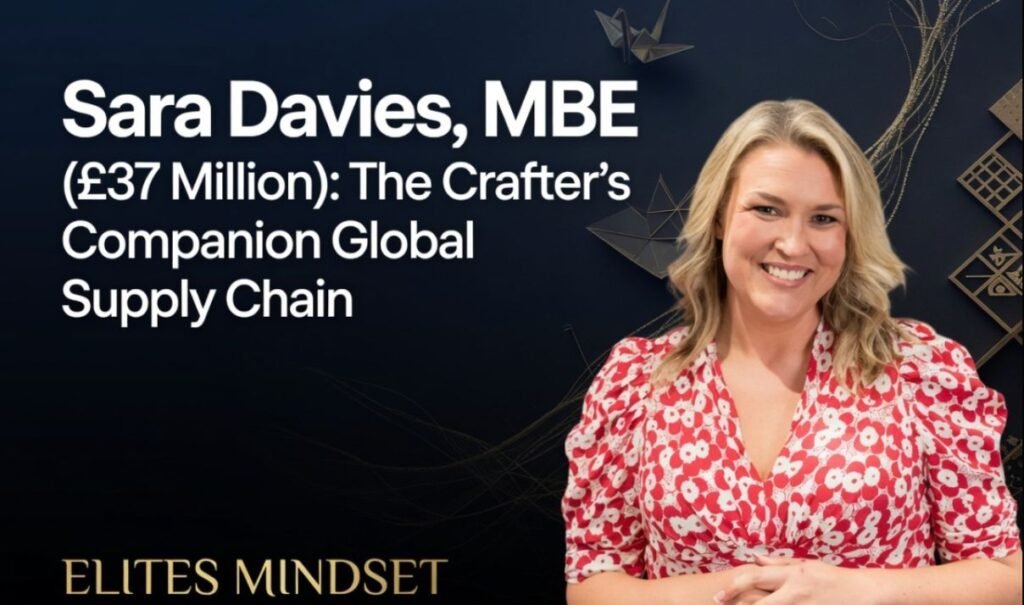
The post-pandemic correction hit hobby-driven retail hard. Revenues fell from £38.3 million (2021) to £29.9 million (2023); pre-tax losses reached £5.1 million (2023) and £6.7 million (year to March 2024). Despite investment from Growth Partner (founded by HomeServe’s Richard Harpin), Crafter’s Companion entered administration on 7 January 2025. Davies and Modella Capital bought the business out of administration for £425,000, saving 134 of 148 jobs. Davies returned as CEO and majority shareholder. The 2026 focus is stabilisation and a return to the core paper-craft market.
Davies’s investment activity outside her core business includes the January 2025 stake in Mystery Jersey King, a Derbyshire-based football shirt subscription company, and her 2024 appointment as Avon UK’s chief inspiration officer—a role that signals her strategic interest in wellness and female-focused consumer goods distribution networks.
The Den’s Capital Stack: Structural Disruption and Portfolio Liquidity
The “Den Premium” Multiple
Appearing on the BBC generates awareness that inflates portfolio company valuations without corresponding marketing spend. When Peter Jones backs a brand like Reggae Reggae Sauce, or when Steven Bartlett promotes a wellness venture on Diary of a CEO, the resulting consumer awareness and retail distribution access function as unbilled advertising worth millions. This “Den Premium” allows the Dragons to extract equity at lower nominal valuations while the investee companies absorb the marketing benefit—an arbitrage unique to investor-operators with national broadcast platforms.

The structural divide in the Den: Liquid cash piles from historic business exits contrasted against paper wealth locked in physical manufacturing and high-street retail leases. Source: Elites Mindset Intelligence Unit.
Liquidity vs. Paper Net Worth
A sharp analytical line separates the Dragons by capital structure. Touker Suleyman and Sara Davies hold significant paper net worth tied up in inventory, fixed manufacturing assets, and high-street retail leases—wealth that is vulnerable to consumer downturns and requires active operational management to monetize. Conversely, Deborah Meaden’s fortune is predominantly liquid, derived from historic exit proceeds that have already cleared due diligence and transaction friction. Steven Bartlett occupies a hybrid position: his media holdings are paper-valued at $425 million, but the underlying revenue engine generates tens of millions in annual cash flow, giving him higher liquidity than traditional retail moguls despite the tech-sector valuation methodology.
Guest Dragon Dilution
The 2026 series includes guest Dragons such as Gary Neville and Emma Grede. Neville’s wealth is estimated at £20–25 million via GG Hospitality (Hotel Football, Stock Exchange Hotel) and media interests. Grede, co-founder of SKIMS (reported $4 billion valuation in its 2023 round), brings a US consumer-brand lens. Guest panelists change deal-flow dynamics: permanent Dragons must move faster or risk losing pitches to investors with sharper sector focus.
Frequently Asked Questions
Who is the richest person on Dragons’ Den?
Peter Jones, CBE, is the richest Dragon, with an asset-backed net worth estimated at approximately £1.2 billion. He is the only remaining original panelist from the show’s 2005 launch and the only current investor approaching billionaire scale.
Is Peter Jones a billionaire?
Yes. The 2021 Sunday Times Rich List placed his fortune at £1.157 billion. Recent media estimates, including Startups.co.uk, centre on approximately £1.2 billion.
How much do Dragons get paid to be on the show?
While the BBC does not publicly verify talent contracts, widely cited industry disclosures indicate the Dragons receive a nominal fee of approximately £15,000 for a 12-episode series (roughly £1,250 per filming day). Critically, this fee covers only their broadcast time; the capital they deploy in the Den is entirely their own money. As former Dragon Hilary Devey once noted, the salary “doesn’t even cover your expenses. You make your money out of what you invest in.”
📋 Source Verification Key
Peter Jones net worth: Startups.co.uk (~£1.2B, 2026); Sunday Times Rich List (£1.157B / 2021; £1.17B / 2022). Note: The £1.286B / position 133 figure belongs to Peter Emerson Jones OBE (Emerson Group), not Peter David Jones CBE.
American Golf: Golfmagic; The Golf Business; Business Live (Feb 2026). Turnover ~£135M; >1,000 employees; >80 stores. Terms undisclosed. Advisers: Reed Smith / Grant Thornton (Jones); Alvarez & Marsal / Addleshaw Goddard / KPMG (Endless).
Touker Suleyman: Spear’s / industry consensus £150M–£200M; Wikipedia; Drapers Lifetime Achievement (Nov 2024). Departure announced June 2026; final episode Sept 2026 (BM Magazine; TV Guide).
Hawes & Curtis: Acquired 2001 for £1 (Wikipedia; Drapers). Gulf franchise: Korath Holding, $5M, 26 stores (2013).
Ghost: Acquired 2008; 142 jobs safeguarded.
Steven Bartlett / Steven.com: stevenbartlett.com ($425M valuation, Oct 2025; 90%+ ownership). Round led by Slow Ventures & Apeiron; investors included Philipp Freise (KKR), Gary Vaynerchuk, Bryan Johnson, Alex Hormozi, Kevin Rose.
Social Chain / Brave Bison: UK Tech News (Feb 2023). Initial £7.7M; earn-out ceiling ~£16.3M.
Flight Fund: ~£81M at launch (Jan 2023). “$100M” figure not primary-sourced.
Diary of a CEO: $20M revenue (2024); 1B+ YouTube views claimed (verify “first UK-produced” superlative).
BBC health-claims investigation: BBC World Service (Dec 2024).
Deborah Meaden: Wikipedia / Fleximize. Weststar: MBO 1999; majority sale Phoenix Equity £33M (2005); residual sale Alchemy £83M (2007); ~£19M on residual; total realised ~£52M. Net worth range £40M–£50M.
Sara Davies / Crafter’s Companion: Official press release (7 Jan 2025); Interpath; The Times; Chronicle Live; City AM; BM Magazine. Pre-pack £425,000 with Modella Capital; 134 of 148 jobs saved. Revenue £29.9M (2023); losses £5.1M (2023) / £6.7M (to Mar 2024). Growth Partner (Richard Harpin) prior major shareholder.
Dragon appearance fee: Widely cited industry figure ~£15,000 per series; not BBC-confirmed. Hilary Devey quote contemporaneous.
Not independently verified: Sara Davies personal net worth £37M; exact Bartlett personal net worth £75–85M; “first UK podcast to 1B YouTube views” superlative; Mystery Jersey King stake terms; Avon “chief inspiration officer” commercial value.
Disclaimer & Editorial Notes
This profile is an independent forensic capital ranking and public-asset audit of the Dragons’ Den panel. All net-worth figures, corporate valuations, and transaction details are compiled exclusively from high-authority public records, Companies House filings, contemporaneous press, and official announcements. Elites Mindset operates with absolute editorial independence and maintains no corporate affiliation, endorsement, or commercial relationship with the BBC, Dragons’ Den, Peter Jones, Touker Suleyman, Steven Bartlett, Deborah Meaden, Sara Davies, or any associated companies. Figures marked “(est.)” are media or industry estimates, not audited personal wealth statements. The insights herein are for educational and analytical purposes only and do not constitute financial, legal, or investment advice.
Source Note: The £1.286 billion figure (Sunday Times Rich List position 133) belongs to Peter Emerson Jones OBE of the Emerson Group and is not attributable to Peter David Jones CBE of Dragons’ Den. All Rich List references in this article relate solely to Peter David Jones CBE.