
Richard Osman‘s shift from television presenter to bestselling author is not just a career change — it is a financial restructuring. A BBC salary, however generous, is capped by the hours in a day and taxed at the top marginal rate. A book that has sold 17 million copies keeps generating income while its author does something else entirely. By 2026, Osman’s wealth comes primarily from royalties, rights deals, and a corporate vehicle — not from turning up to a studio.
As of 2026, his total book sales have exceeded 17 million copies worldwide. His corporate vehicle, Six Seven Entertainment Ltd, held cash reserves of £5.41 million in its most recent Companies House filing — up from £2.1 million two years prior. Total assets stand at £6.37 million, net assets at £6.27 million, and the debt ratio is 2%.
The Osman Pivot 2009 – 2026
From BBC presenter to global IP portfolio — the deliberate steps behind a £20M+ literary business.
Pointless Launches on BBC Two
Osman co-creates and co-hosts Pointless alongside Alexander Armstrong. As Creative Director at Endemol Shine UK, he earns from both the presenting contract and the production-side format rights — an early lesson in the difference between showing up and owning the format. He is not paid for the first four series as a presenter; his income comes from his development role.
Viking/Penguin Multi-Book Deal Signed
Viking Press (Penguin Random House) acquires The Thursday Murder Club plus a second book for a seven-figure sum following a competitive multi-publisher auction. In an industry where debut advances typically range from £5,000 to £50,000, the seven-figure commitment signals institutional confidence in Osman’s pre-built audience. The book has been written secretly over 18 months during his presenting tenure — funded by the stability of his BBC salary.
Amblin 14-Studio Auction — Six Months Before Publication
In March 2020 — before a single copy reaches bookshops — Amblin Partners wins a 14-studio competitive auction for the worldwide film rights to The Thursday Murder Club. Hollywood bids on the concept before publication. The novel publishes in September 2020 and sells over one million copies — Penguin Random House confirms the figure publicly. Six Seven Entertainment Ltd is incorporated as Osman’s primary IP vehicle.
Pointless Exit — £10M+ Four-Book Contract Signed
Osman departs Pointless after thirteen years. The departure is timed alongside a new four-book deal — reported by industry sources as carrying an advance of over £10 million — covering two more Thursday Murder Club novels and the launch of a new series. The transition is not a retirement: it is a deliberate swap of a high-tax BBC salary for royalty income and corporate IP retained within Six Seven Entertainment Ltd.
We Solve Murders — Franchise Two Launches
We Solve Murders publishes in September 2024, debuting at number one on UK bestseller charts and holding the position for five consecutive weeks. Before book two is written, Netflix commits to a full-length drama series adaptation — demonstrating that Osman’s readership will follow him across narrative universes. The second franchise provides a parallel publishing and adaptation income stream independent of the Thursday Murder Club.
Netflix Film Global Premiere + UK’s Bestselling Book of 2025
August 28, 2025: The Thursday Murder Club premieres globally on Netflix, directed by Chris Columbus and starring Helen Mirren, Pierce Brosnan, Ben Kingsley, Celia Imrie, David Tennant, and Richard E. Grant. Osman holds executive producer credit with backend participation.
September 2025: The Impossible Fortune — the fifth Thursday Murder Club novel — publishes and sells approximately 250,000 copies in its first three days. It finishes 2025 as the UK’s bestselling book of the year with 478,270 UK copies sold, before international sales, ebooks, or audiobooks. Six Seven Entertainment Ltd cash reserves reach £5.41 million.
We Chase Shadows Published — House of Games Handed Over
September 10, 2026: We Chase Shadows — the second We Solve Murders novel — publishes, confirming the second franchise as a sustained commercial engine rather than a one-off launch.
2026: Osman hands over Richard Osman’s House of Games to Michael Sheen, completing his exit from active presenting duties. His income now arrives entirely through royalties, rights fees, executive producer residuals, and corporate reserves held within Six Seven Entertainment Ltd — none of which requires him to be in a studio.
Sources: Companies House (Six Seven Entertainment Ltd #13938330); Viking/Penguin Random House; NielsenIQ BookData; Netflix press release; The Bookseller; Elites Mindset editorial research.
When aggregating his multi-book publishing advances, international translation rights, film adaptation fees, producer credits, and the compounding backlist value driven by the Netflix/Amblin adaptation cycle, the total valuation of the Osman IP portfolio comfortably exceeds the £20 million threshold.
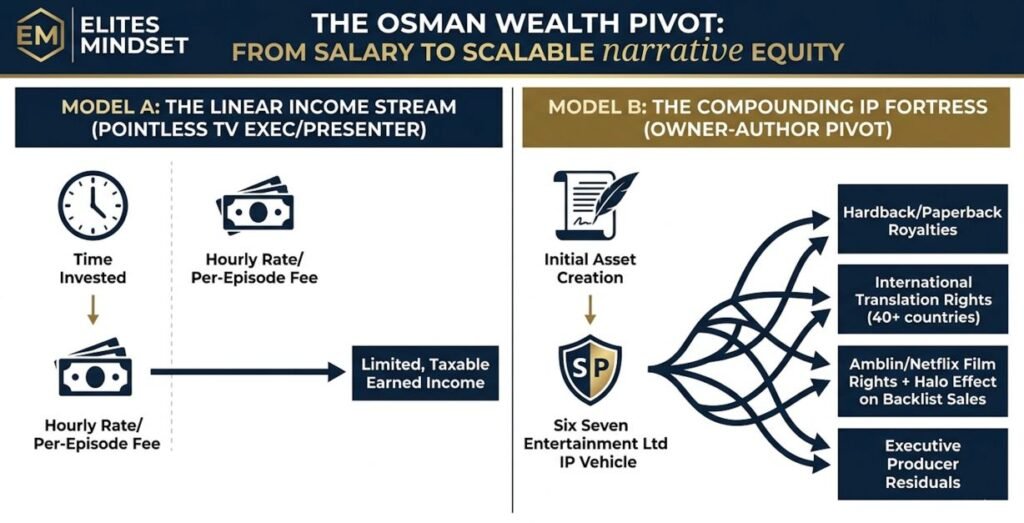
Unlike celebrities who leverage fame to launch inventory-heavy product lines—gin brands, cosmetics, or fashion labels—Osman’s “product” is pure intellectual property. It requires no warehousing, no supply chain, and no per-unit manufacturing cost. Every additional copy of The Thursday Murder Club or We Solve Murders sold generates high-margin royalty income with minimal overhead. The model is straightforward: a television platform gave Osman an audience before his first book was published, which meant his debut carried commercial momentum that most debut novelists spend years trying to build. Rowling built hers from scratch; Osman walked in with one already.
Asset Audit: The Osman IP Portfolio 2026
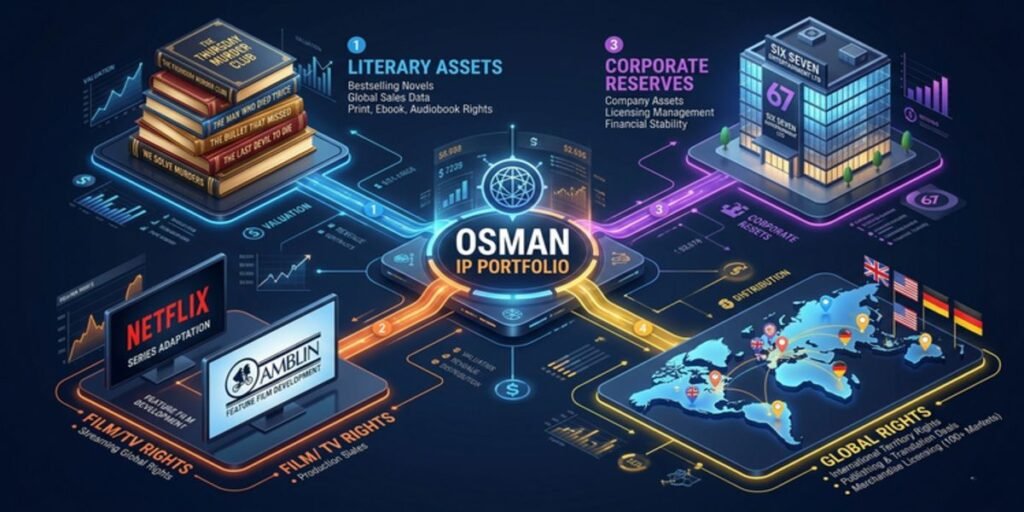
Valuation Methodology: Aggregate of reported publishing advances, estimated royalty streams from 17M+ unit sales, international rights sales, film/TV option fees, producer credit residuals, and corporate cash reserves. Conservative estimate places total IP portfolio value at £20M+.
Beyond Pointless: The Forensic Valuation of the Viking/Penguin Multi-Book Deal
The foundation of Osman’s literary wealth was laid in 2019, when Viking Press—a subsidiary of Penguin Random House—acquired his debut novel, The Thursday Murder Club, along with a second book, for a seven-figure sum following a competitive multi-publisher auction.
In an industry where debut novel advances typically range from £5,000 to £50,000, a seven-figure commitment for an untested novelist signals institutional confidence in the size of the audience he already had.
The initial success of the first two books triggered a subsequent four-book deal in 2022, which industry sources indicated carried an advance of “over £10 million”—a figure encompassing two additional Thursday Murder Club novels and the launch of the We Solve Murders series.
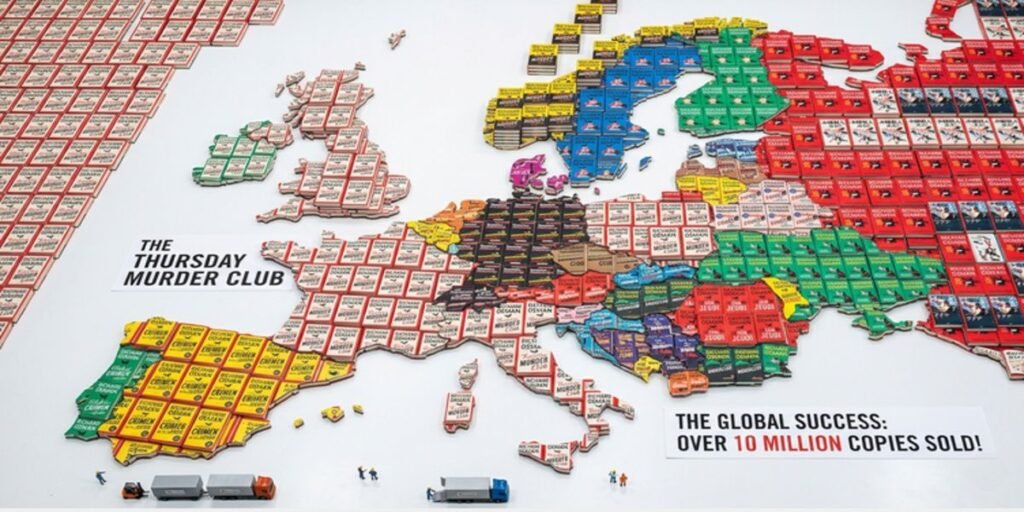
In traditional publishing, an advance is paid against future royalties, meaning the author receives the lump sum upfront and begins earning additional royalties only after the advance has “earned out” through sales. The Thursday Murder Club series has sold over 17 million copies globally. The Bullet That Missed — the third book in the series — became the fastest-selling adult fiction hardback by a British author on record, surpassing J.K. Rowling’s The Casual Vacancy; the debut novel sold well over one million copies, with PRH confirming the figure publicly. At 17 million copies sold across the franchise, his advances have almost certainly earned out — every subsequent sale is pure royalty income.
The Osman Catalogue: Unit Sales by Title
| # | Title & Series | Published | UK Sales (Verified) | Key Commercial Milestone |
|---|---|---|---|---|
| 1 | The Thursday Murder Club Thursday Murder Club · Book 1 | Sep 2020 | 1M+ copies UK & Ireland confirmed by PRH | Debut novel. Seven-figure Viking/PRH advance following competitive multi-publisher auction. Amblin acquires film rights pre-publication, March 2020. |
| 2 | The Man Who Died Twice Thursday Murder Club · Book 2 | Sep 2021 | 800,000+ copies Estimated UK sales | Debuted at UK #1. Confirmed the debut was not a one-off. PRH signals institutional confidence in the franchise with forward deal discussions. |
| 3 Record | The Bullet That Missed Thursday Murder Club · Book 3 | Sep 2022 | Record-breaking UK hardback on publication | Fastest-selling adult fiction hardback by a British author on record — surpassing J.K. Rowling’s The Casual Vacancy. Four-book deal (£10M+ reported) signed same year. |
| 4 | The Last Devil to Die Thursday Murder Club · Book 4 | Sep 2023 | 700,000+ copies Estimated UK sales | Published post-Pointless exit. First title produced entirely without BBC salary income — funded exclusively by publishing advances and corporate reserves. |
| 5 2025 UK #1 | The Impossible Fortune Thursday Murder Club · Book 5 | Sep 2025 | 478,270 copies NielsenIQ BookScan · FY2025 UK total | UK’s bestselling book of 2025. Sold ~250,000 copies in first three days. Netflix film premiered the same month, driving backlist surge across all five titles. |
| 6 | We Solve Murders We Solve Murders · Book 1 | Sep 2024 | UK #1 · 5 weeks Held number one position | Launch of second franchise. Debuted at UK #1 for five consecutive weeks. Netflix drama series adaptation confirmed before Book 2 was completed. |
| 7 | We Chase Shadows We Solve Murders · Book 2 | 10 Sep 2026 | Debut week Published same week as this audit | Published 10 September 2026. Second book in the We Solve Murders series, confirming the franchise as a sustained publishing engine parallel to the Thursday Murder Club. |
UK sales figures: NielsenIQ BookScan (where stated) and Penguin Random House public statements. Non-BookScan figures marked as estimated. Worldwide totals per Viking/PRH public data. Sales for Books 2 and 4 are publisher-range estimates; exact NielsenIQ breakdowns are not publicly disclosed for those titles. We Chase Shadows sales data not yet available at time of publication.
The compounding effect is further amplified by international translation rights. The Thursday Murder Club has been published in over 40 languages, with each territory sale representing a separate rights transaction. In major markets such as the United States, Germany, Japan, and Brazil, the books have achieved bestseller status, creating a diversified revenue stream insulated against any single-market downturn.
The fifth book in the series, The Impossible Fortune, was released in September 2025, selling approximately 250,000 copies in its first three days in the UK and finishing 2025 as the UK’s bestselling book of the year with 478,270 UK copies — before international sales, ebooks, or audiobooks are counted. The We Solve Murders series — launched in September 2024 — has already established itself as a separate but complementary revenue pillar. According to industry data, We Solve Murders held the number-one position on UK bestseller charts for five consecutive weeks, demonstrating that Osman’s readership is franchise-agnostic and will follow him across narrative universes.
The second book in the series, We Chase Shadows, was published on 10 September 2026 — the same week this article was last updated. Its debut performance will likely extend the franchise’s commercial track record and reduce Osman’s earnings dependence on the Thursday Murder Club alone.
Osman has carved out a specific and commercially durable niche: warm, character-driven British mystery fiction that sells strongly in the Christmas quarter and drives Waterstones and WHSmith foot traffic. His releases are now significant enough that major retailers plan around them — a position very few authors reach.
The Amblin Deal: What the Netflix Film Is Worth Beyond the Screen
In March 2020 — six months before the novel even reached bookshops — Amblin Partners acquired the worldwide film rights after a 14-studio competitive auction. The pre-publication acquisition was itself a statement: Hollywood was bidding on Osman’s name and concept before a single copy had been sold.
The subsequent partnership with Netflix—under the existing Amblin-Netflix film pact—resulted in a feature film directed by Chris Columbus (Home Alone, Harry Potter), starring Helen Mirren, Pierce Brosnan, Ben Kingsley, and Celia Imrie — alongside David Tennant, Richard E. Grant, Jonathan Pryce, Naomi Ackie, and Tom Ellis in supporting roles, which premiered on Netflix on August 28, 2025. For Osman, the film adaptation generates value through multiple channels. First, there is the upfront rights fee and his executive producer credit, which entitles him to backend participation in the film’s performance. Second, and more significantly, there is the “halo effect” on backlist book sales.
When a major film adaptation drops on Netflix, backlist sales reliably surge — typically 200–400% in the weeks following release. For Osman, every viewer who watches the film is a potential buyer of five existing books.
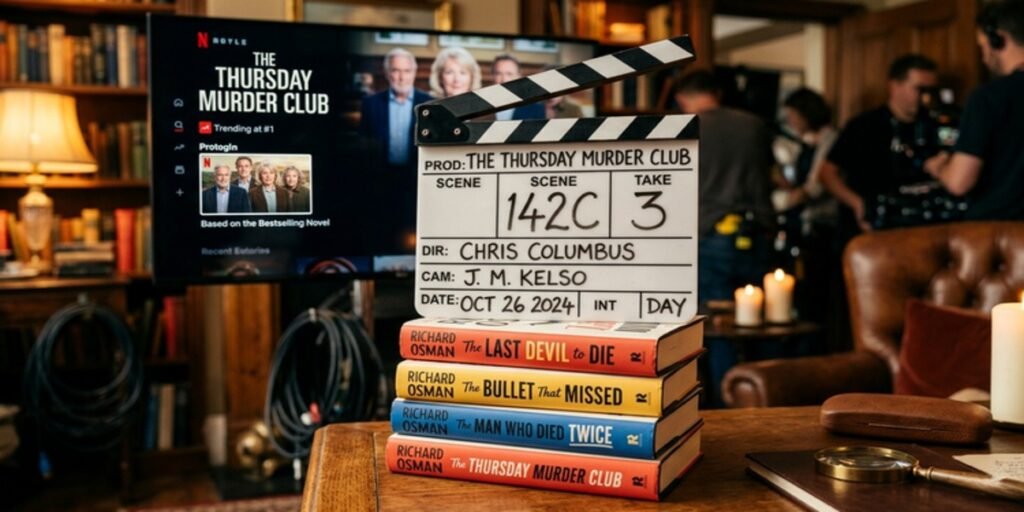
The adaptation strategy extends beyond a single film. Netflix has already committed to adapting We Solve Murders into a full-length drama series—a deal signed before the second book in that series was even completed. The second book in the series, We Chase Shadows, was published on 10 September 2026 — confirming the franchise as a parallel publishing engine to the Thursday Murder Club rather than a one-off experiment. Osman himself has noted the scale of Netflix’s investment, observing that the streaming giant “has spent a lot of money on a movie” while praising the UK production infrastructure that supported the film. The result is a self-reinforcing commercial loop: each new book raises the profile of the film; the film drives readers back to the books. Neither strand depends on the other — but both benefit when either performs.
Critically, Osman retained producer credits across these adaptations. In film and television, producer credits are not honorifics; they carry residual payments, profit participation, and creative control. As executive producer on the Netflix film, Osman is positioned to earn from international licensing, secondary streaming windows, and potential sequel development. This is the difference between selling a property outright and retaining equity in its future—a distinction that separates wealthy authors from genuinely rich IP holders.
Residual TV Value: House of Games and Production Back-Ends
Before the literary pivot, Osman’s wealth was built on the traditional television model: salary, presenting fees, and production credits. His departure from Pointless in 2022 was not a retirement but a calculated financial reallocation.
Osman has revealed that he was not paid for the first four series of Pointless, as his compensation was tied to his behind-the-scenes development role rather than his on-screen presence. That development role was compensated separately through his position as Creative Director at Endemol Shine UK — the production company that originated and pitched Pointless to the BBC — meaning his early income from the format came from a production-side salary rather than a presenter’s fee. Osman was already monetizing IP-adjacent, ownership-side roles years before the publishing pivot — not simply trading screen time for money. Once the show became a ratings fixture, industry speculation placed his per-episode fee in the region of £20,000 alongside co-host Alexander Armstrong—substantial money, but fundamentally limited by the number of episodes produced and the finite hours in a day. By contrast, a book generates income while its author sleeps, eats, or writes the next installment.
Osman’s television career provided a stable income base that outlasted his exit from Pointless. Osman hosted Richard Osman’s House of Games on BBC Two from 2017 until 2026, when actor Michael Sheen took over. During his tenure, the show’s five-episodes-per-week recording schedule required minimal time commitment relative to its income. His exit from the show in 2026 completes the transition away from active presenting duties. Additionally, his historical role as Creative Director at Endemol Shine UK (now part of Banijay) generated production credits on shows including 8 Out of 10 Cats, 10 O’Clock Live, and Total Wipeout. These credits carry residual payments through repeat broadcasts, international format sales, and streaming licensing. BBC rich list documents from 2025 indicate his television earnings remain significant, providing the liquidity that funded his literary transition without requiring outside investment.
This residual TV value serves a strategic purpose beyond immediate income. The stable television income meant he could write the novel without pressure to publish before it was ready — a luxury that first-time novelists without a day job rarely have. His exit from Pointless was the final step in this transition—trading a high-tax, time-intensive salary for long-term capital gains through IP creation.
The Osman Revenue Stream Matrix (2026 Forecast)
Revenue Stream Matrix
CLASSIFICATION: ASSET AUDIT FY2026| Revenue Pillar | Primary Source | Valuation Logic |
|---|---|---|
| Literary IP | Thursday Murder Club & We Solve Murders | £10M+ in reported advances; 17M+ unit sales generating escalating royalties; 40+ international translation territories; audiobook and ebook format premiums. |
| Visual Media | Netflix/Amblin Film Deal + Series | Worldwide rights fee from 14-studio competitive auction; executive producer credits with residual participation; backlist sales halo effect from film release. |
| Broadcast | House of Games & Guest Spots | BBC presenting fees providing liquidity floor; minimal time commitment (5 episodes/day recording schedule); stable repeat-income stream. |
| Legacy Assets | Endemol/Production Residuals | Historical creative director salary and production credits on 8 Out of 10 Cats, Total Wipeout, 10 O’Clock Live; ongoing passive residuals from repeat broadcasts and format sales. |
Richard Osman Net Worth 2026: The Forensic Audit
Six Seven Entertainment Limited (Companies House number 13938330) is Richard Osman’s sole corporate vehicle. Its most recent filings show cash of £5.41 million — up from £2.1 million two years prior.
By 2026, his income arrives from three directions simultaneously: royalties from 17 million+ book sales across two active franchises; executive producer fees and residuals from the Netflix/Amblin film; and ongoing television income from House of Games and format royalties. None of these three streams depends on the others — which is the structural point.
The Strategic Exit: From Salary to Capital Gains
Osman’s departure from Pointless in 2022 was a straightforward trade: a high-tax BBC salary for a publishing business already generating more income than the presenting contract. At the height of the show’s success, he was earning a substantial BBC salary—taxed at the UK’s highest marginal rate of 45%—in exchange for his physical presence in a studio. By exiting at the peak of his television fame and redirecting his energy toward literary IP creation, he transformed his income structure from high-tax “earned income” to lower-tax “capital gains” and royalty streams held within a corporate vehicle.
The Thursday Murder Club was written during his television tenure, funded by the liquidity floor of his presenting and production income. Once the literary asset proved its commercial viability—selling over one million copies — a figure PRH confirmed publicly, and one that no debut British novel had matched in the same period—he had the data necessary to make the full transition. The subsequent £10 million+ publishing deal, the Amblin film rights sale, and the Netflix series commitment provided the financial justification to sever his primary television tie.

Unlike celebrities who launch lifestyle brands requiring inventory, manufacturing partnerships, and ongoing operational overhead, Osman’s product is infinitely reproducible at zero marginal cost. A bottle of gin requires glass, liquid, labeling, and distribution. A copy of The Thursday Murder Club requires only a digital file or a printing contract. The margin difference is self-evident.
Two active franchises. Multiple adaptations in production or development. A corporate vehicle with £5.41 million in cash and a 2% debt ratio. Osman’s £20 million+ valuation in 2026 is not a ceiling — it is the starting position for a publishing business that is still accelerating.
Six Seven Entertainment Ltd — IP Architecture
How Osman’s royalties, rights fees, and residuals flow through a single corporate vehicle. Sources: Companies House filing #13938330; FY2025 accounts.
- Thursday Murder Club (5 novels)
- We Solve Murders (2 novels)
- 17M+ units sold globally
- 40+ translation territories
- Audiobook & ebook premiums
- Viking/PRH advance: £10M+ (reported)
- Netflix film — exec producer credit
- Backend participation (film)
- We Solve Murders — Netflix series
- Amblin partnership residuals
- International licensing windows
- Sequel development rights retained
- House of Games — hosted to 2026
- Pointless format residuals
- Endemol Shine UK production credits
- 8 Out of 10 Cats, Total Wipeout
- Format sales & repeat broadcasts
- Guest appearances & specials
All financial figures drawn from Six Seven Entertainment Ltd Companies House filings (FY2025 accounts, February 2026 Confirmation Statement). Advance figures are reported by industry sources. This diagram represents the known public structure; private arrangements may differ.
FAQ: OSMAN WEALTH AUDIT [FY2026]
1. What is Richard Osman’s estimated net worth in 2026?
Standard liquid net worth assessments typically range from £3 million to £4 million based on historical TV salaries. However, when publishing advances of £10 million+, verified cash reserves of £5.41 million in Six Seven Entertainment Ltd, and royalty income from 17 million+ unit sales are aggregated, the total portfolio valuation comfortably exceeds £20 million.
2. How much does Richard Osman generate in revenue per book?
Osman’s publishing deal structure is unusually favourable for an author who began with a debut novel. The four-book deal announced in 2022 was reported at over £10 million in total. With seven novels now published across two franchises and sales of 17 million+ copies, the royalty income from backlist sales alone — across print, audio, ebook, and 40+ translation territories — significantly extends beyond the original advance figures. Publishing royalties at Osman’s sales volume are not a one-time payment; they are a recurring income stream.
3. Does Richard Osman hold equity in TV production companies?
Osman does not hold shares in Endemol Shine UK or Banijay. His publishing royalties, television residuals, and rights income flow into Six Seven Entertainment Ltd, where he is the sole director. The structure keeps his earnings within a corporate vehicle rather than being taken as personal income — a standard arrangement for high-earning creative professionals.
Forensic Methodology: The “Richard Osman Wealth Audit” is an independent analysis conducted by the Elites Mindset editorial team. Valuations are derived from a composite of verified public records, including Companies House (UK) filings for Six Seven Entertainment Limited, reported publishing advances from Viking/Penguin Random House, and historical visual media rights data.
Financial Notice: This report is for informational and educational purposes only. While every effort is made to ensure data accuracy as of May 2026, “Net Worth” figures represent estimated portfolio valuations rather than liquidated cash positions. This audit does not constitute professional financial, tax, or legal advice. All intellectual property rights mentioned belong to their respective owners.