

Published: April 30, 2026
Updated: October 06, 2026
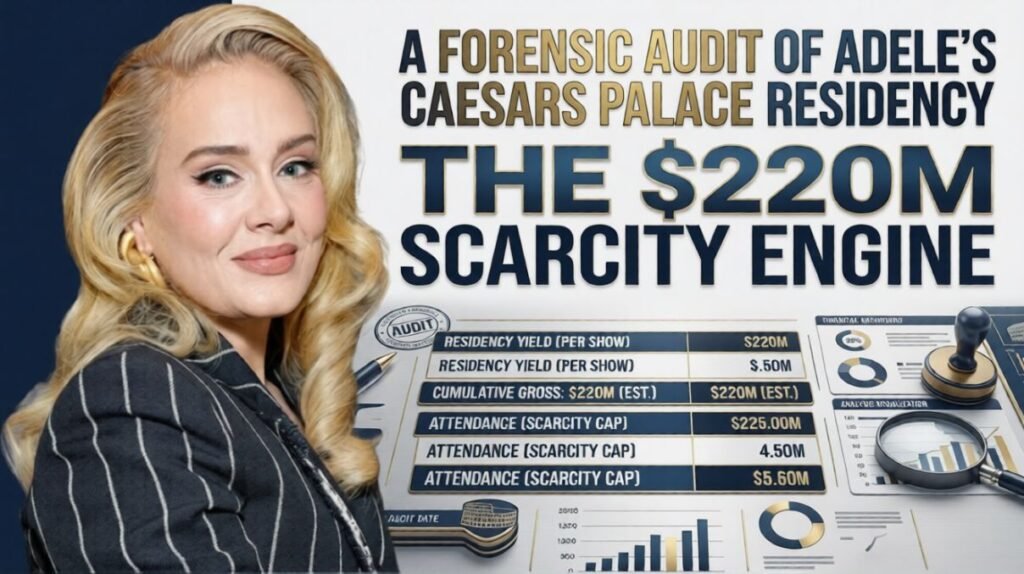
The Weekends with Adele residency at The Colosseum at Caesars Palace changed how top-tier live music makes money. Originally scheduled to open on 21 January 2022, the residency was postponed at the last minute after Adele posted a tearful video to social media citing production delays and COVID-19 infections within her team. It opened on 18 November 2022 instead and, after multiple extensions, concluded on 23 November 2024. Instead of a 50-city tour with its logistics, freight costs and crew hotels, Adele performed 100 sold-out shows across 50 weekends — and made more per night than almost any touring artist in history. Between November 2022 and November 2024, she drew an estimated 416,667 attendees and generated a total gross estimated at $175 million to $220 million, according to industry analysis of Vegas residency benchmarks.
While Taylor Swift’s Eras Tour represents the apex of high-volume global distribution—moving hundreds of thousands of tickets across continents—Adele’s Vegas residency showed what happens when a globally in-demand artist refuses to tour and instead sells 4,100 seats a night in one fixed location: the per-show value goes through the roof. The residency cut the logistical and financial overhead of a 50-city tour, allowing profit margins to effectively double compared to her 2016-2017 25 World Tour, which grossed $278.4 million across 121 shows but required massive overhead in logistics, crew transport, and venue rental.
What made the residency work financially was simple: one fixed venue, limited seats, and more demand than supply — every time. By anchoring to a single 4,100-seat venue, Adele and Caesars Palace created a deliberate supply constraint — 4,100 seats per show, nothing more — that pushed face-value prices close to what the secondary market would charge. The result is a residency that outperformed traditional Vegas models on a per-show basis while establishing a new template: building or modifying venues around a specific artist, rather than making the artist fit an existing room.
Residency Revenue Summary: Weekends with Adele (2022–2024)
How Limited Capacity Drove Premium Pricing: The $2M+ Per-Show Average
The financial mechanics of Weekends with Adele hinge on a straightforward supply-demand bottleneck: one intimate room, no extra dates, no streaming alternative. The Colosseum at Caesars Palace, with its intimate capacity of approximately 4,100 seats, created a structural scarcity that no stadium tour could replicate. This constraint allowed Adele’s team to price every seat to reflect actual demand — with premium tiers capturing what fans were genuinely willing to pay.
For the initial 24-show run announced in late 2021, tickets sold out within six hours, with pricing reportedly ranging from around $175 for standard seats to over $1,000 for premium options, and VIP/platinum packages reaching $5,000+, according to initial media coverage. Front-section and upper-balcony tier splits varied across the run and were not officially published. This pricing strategy—coupled with substantial Ticketmaster service and facility fees built into each ticket price— produced an average gross of $2.2 million per show for the initial run, as reported by Billboard Boxscore.

As the residency extended to 100 shows, the per-show average settled into a consistent range. According to reporting by The Mirror and Daily Mail, each show grossed approximately $1.75 million across the full run, while industry analysts and Adele’s own team suggested figures closer to $2 million per show. The discrepancy reflects variable pricing across different legs of the residency, but the consensus range of $1.75M to $2.2M per show puts Adele among the highest-earning per-show acts in live music history. Casino.org, which tracks top-grossing Vegas residencies, independently estimates her total at approximately $200 million at ~$2 million per show — a midpoint consistent across multiple industry sources.
The impact on Adele’s personal net worth has been substantial. As of the 2025 Sunday Times Rich List, her fortune stood at £170 million — unchanged from the 2024 edition and up from £165 million in 2023. Celebrity Net Worth places her current dollar-equivalent figure at $230 million, reflecting residency income from both Las Vegas and Munich. Her UK companies — Melted Stone Publishing Ltd and Melted Stone Ltd — reported combined profits of £7.7 million in their 2023 accounts. Cash holdings stood separately at £13.5 million in Melted Stone Publishing and £6 million in Melted Stone Ltd. A. Adkins Touring Ltd, her dedicated touring entity, reported just £42,000 in the same period. Beyond the direct residency income, Adele reportedly earned £740,000 per show in Las Vegas, contributing to a 2024 daily earnings estimate of roughly £22,000, according to MusicTimes calculations based on her UK company filings. Melted Stone Limited (Companies House number 06555877) was incorporated on 4 April 2008 — the year Adele released her debut album 19 — and has been her primary UK publishing vehicle ever since.
The 100-Show Expansion: Revenue Sharing and the Economics of the Residency Model
The decision to extend Weekends with Adele from the initial 24-show run to a final tally of 100 shows was not merely an artistic choice—it reflected the straightforward financial logic of the residency model: fewer overheads, higher margins per show. In residency models, the artist typically captures a significantly higher percentage of the gate compared to touring, because the fixed-venue structure eliminates the enormous variable costs associated with travel, freight, and per-city production setup.
For Adele, this meant that the Caesars Palace contract likely granted her a substantially larger share of gross revenue than she would have commanded on a global tour. While specific contract terms remain confidential, industry standard for top-tier Vegas residencies sees artists taking home between 50-70% of gate revenue after venue and promoter fees. Given that Adele’s residency reportedly paid “nine figures” overall, and her per-show take was estimated at £740,000, the revenue-sharing model heavily favored the artist.
The Las Vegas residency economic impact extended far beyond ticket sales. Caesars Entertainment CEO Tom Reeg explicitly noted in a 2025 earnings call that the absence of Adele and Garth Brooks from the 2025 calendar contributed to a “soft summer” and a 3.7% year-over-year decline in net revenue for Caesars’ Las Vegas operations. Reeg stated that the lack of these “big-name entertainment headliners” impacted non-casino revenues, confirming that Adele’s presence had been a primary driver of ancillary spending. This confirms that Adele’s residency generated meaningful ancillary revenue for Caesars — hotel bookings, dining, and retail spending on concert weekends — though no specific percentage lift was disclosed in any public filing.
Full-year 2025 results confirmed the scale of that impact: Caesars’ Las Vegas segment posted net revenue of $4.05 billion — a 4.7% decline year-on-year — making the combined absence of Adele and Garth Brooks one of the clearest contributing factors cited across the earnings cycle.
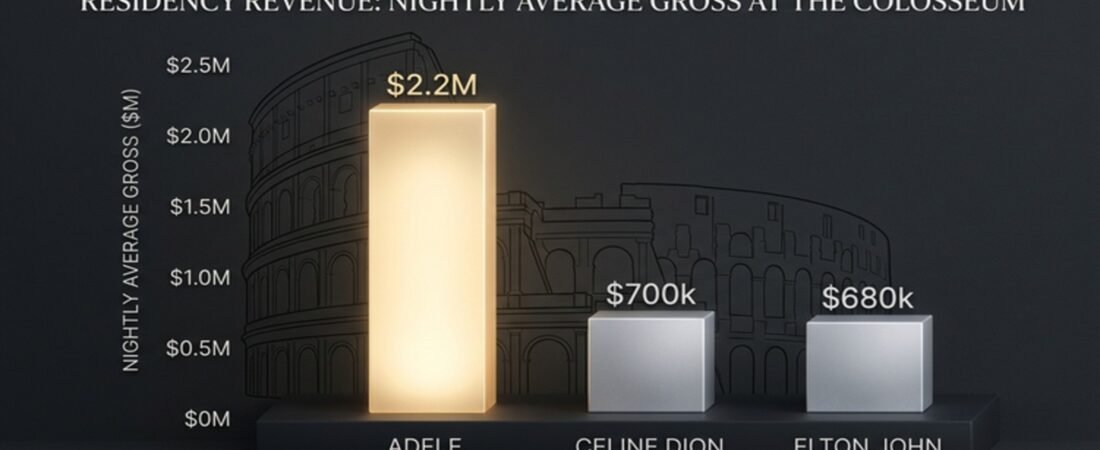
The residency model Adele ran at Caesars Palace has since become the reference point for the industry — a demonstration that limiting supply and fixing location can yield far more per show than a traditional tour. By comparison, Celine Dion’s second Las Vegas residency, Celine (2011–2019), grossed $296.2 million over 427 shows, averaging approximately $694,000 per show. Elton John’s The Red Piano (2004-2009) grossed $166.4 million over 247 shows at $674,000 per show, while his Million Dollar Piano (2011–2018) reportedly grossed around $131 million over 189 shows. Adele’s per-show average of $1.75M-$2.2M represents a 3x to 4x multiplier over these established benchmarks, demonstrating how far the residency premium has moved in the modern era.
Secondary Market: Resale Prices That Peaked Above $35,000
While the primary market gross is structurally capped by face-value ticketing, the secondary market reveals what the market was actually willing to pay — independent of face-value pricing decisions. During the initial ticket sale, resale demand was immediate and extreme: individual tickets ranged from $2,000 to as high as $35,000 on secondary platforms. For her final show on November 23, 2024, resale prices surged to $17,050 to $18,766 for top-tier seats, despite original VIP passes having been priced at $1,000.
This Adele Vegas ticket resale phenomenon reveals a critical market signal: the face value was deliberately set below true market clearing price, creating a consumer surplus that was captured by resellers but, more importantly, reinforcing the perception of Adele tickets as a luxury asset class. This peak secondary valuation places Adele concert access in the same bracket as rare timepieces or vintage wine: a limited-supply luxury good that appreciates in price the closer you get to the event. Forbes reported that the average resale ticket price for Adele’s residency reached $1,462 in the first half of 2024, making her the priciest concert act in the United States during that period.
The same pricing logic carried into Adele’s Munich residency in August 2024. For her ten-show residency at a purpose-built open-air arena in Munich—her first European concerts since 2016—Adele attracted 730,000 attendees and set a Guinness World Record for the largest continuous LED screen at a concert, measuring 4,159.7 m², along with recognition as the highest-attendance concert residency held outside Las Vegas.
The custom-built outdoor arena held approximately 73,000 fans per night — the largest temporary concert structure ever assembled for a single artist. Alongside the main stage, a themed experience zone called Adele World spanned 75,000 m² of the Messe München fairgrounds and attracted an additional 500,000 visitors across the ten-night run.
Ticket prices ranged from €74.90 ($83) to €689 ($760), with VIP packages reaching €1,252 ($1,392). While these prices were lower than Vegas premiums on a per-ticket basis, the Munich residency injected more than half a billion euros into the city’s economy, with hotel occupancy hitting record highs and the Bavarian hospitality industry reporting that attendees from farther geographic regions correlated with higher hotel and restaurant spending.
What Adele’s residency confirmed is now visible across the live music market: wealthy audiences will pay significant premiums for performances they cannot easily access — and the industry has taken note.
What the Numbers Show: Efficiency, the Hybrid Model, and Tourism Impact
The Efficiency Coefficient

Adele’s residency produced one of the most favourable earnings-to-travel ratios in modern live music — she earned at touring scale without leaving one city. By eliminating the logistical and financial overhead of a 50-city tour, her profit margins were effectively doubled compared to the 25 World Tour (2016-2017), which grossed $278.4 million but required massive logistical overhead across 121 shows in Europe, North America, and Oceania. The Vegas model allowed her to perform 100 shows while her team slept in the same beds, her production remained built and calibrated to a single venue, and her carbon footprint per dollar earned was a fraction of a traditional tour. The numbers explain why residencies are attractive to artists at Adele’s level: the fixed costs of one permanent production are a fraction of running a 50-city tour, while per-show revenue stays at the same peak.
The Hybrid Model Legacy

Weekends with Adele helped establish a trend that has since reshaped how the biggest artists approach live performance. The Munich residency exemplified this evolution: a custom-built temporary arena — reportedly costing around $130 million to design and construct — built specifically around Adele’s production requirements, featuring a record-breaking LED screen, ‘Adele World’ entertainment zones, and a layout designed for her show from the ground up. This is the inverse of the traditional model, where artists adapt to existing venues. The Sphere in Las Vegas—where U2 grossed $244.5 million over 40 shows at $6.1M per show—represents the architectural apex of this trend. Adele’s success showed that when the venue is built around the artist rather than the other way around, revenue per show can far exceed traditional benchmarks.
The Luxury Tourism Multiplier
The “Adele Weekend” functioned as a financial event for Las Vegas beyond the ticket gate. The specific demographic drawn to her residency—affluent, international, and experience-seeking—generated substantial ancillary spend across luxury hotels, fine dining, private aviation, and high-end retail. Caesars’ own data provides the clearest proof of her economic value — and the context for that impact is covered in The 100-Show Expansion section above. For Munich, the multiplier was quantified: over half a billion euros in local economic injection, with hotel records shattered and Lufthansa reporting fully booked city accommodation during concert dates.
Adele Net Worth 2026
As of the 2025 Sunday Times Rich List, Adele’s net worth stands at £170 million — a figure that has held steady across both the 2024 and 2025 editions. Celebrity Net Worth places her dollar-equivalent fortune at $230 million as of 2025, accounting for residency income from both Las Vegas and Munich. Beyond the residency income, her UK companies — Melted Stone Publishing Ltd, Melted Stone Ltd, and A. Adkins Touring Ltd — reported combined profits of £7.7 million in 2023, with cash reserves of £13.5 million (Melted Stone Publishing) and £6 million (Melted Stone) held separately. Her Munich residency alone injected over €540 million into the local economy. According to Swiss financial daily Neue Zürcher Zeitung, Adele personally earned approximately US$50 million from the ten Munich shows — one of the highest single-city earnings figures recorded for any artist.
FAQ
Q. How much did Adele make per show in Vegas?
Industry estimates place Adele’s per-show gross between $1.75 million and $2.2 million. Her personal take-home per show was reportedly around £740,000 (~$930,000), though exact contractual splits remain confidential. This is well above the per-show average for previous Vegas headliners — roughly three to four times what Celine Dion and Elton John averaged during their residencies.
Q. What was the total gross of the Adele residency?
The 100-show Weekends with Adele residency generated an estimated $175 million to $220 million in total gross revenue. While only the first 24 shows ($52.8M) were officially reported to Billboard Boxscore, full-run figures are editorial estimates based on the verified per-show rate from the first 24 shows and confirmed 100% occupancy throughout the run.
Q. How does Adele’s Vegas gross compare to Celine Dion or Elton John?
On a per-show basis, Adele dominates. Her $1.75M–$2.2M average represents a 260% to 370% premium over benchmarks like Celine Dion (~$694K/show) and Elton John (~$674K/show). However, Celine Dion maintains the all-time total gross record due to her 16-year cumulative volume.
Q. What is the “Adele Effect” on corporate hospitality revenue?
The ‘Adele Effect’ describes the measurable uplift in non-gaming revenue at Caesars Entertainment during Adele’s performance weekends — hotel bookings, dining, and retail. No specific percentage was disclosed in public filings, but CEO Tom Reeg confirmed in a Q2 2025 earnings call that Adele’s absence from the 2025 calendar was a direct factor in a 3.7% year-on-year decline in Las Vegas net revenue.
Disclaimer: This article is based on publicly available Caesars Entertainment filings, Billboard Boxscore data, Companies House records, and published industry analysis. All figures not officially disclosed are editorial estimates and are labelled as such. This does not constitute financial advice. Produced by the Elites Mindset editorial team. © 2026 Elites Mindset. All Rights Reserved.