
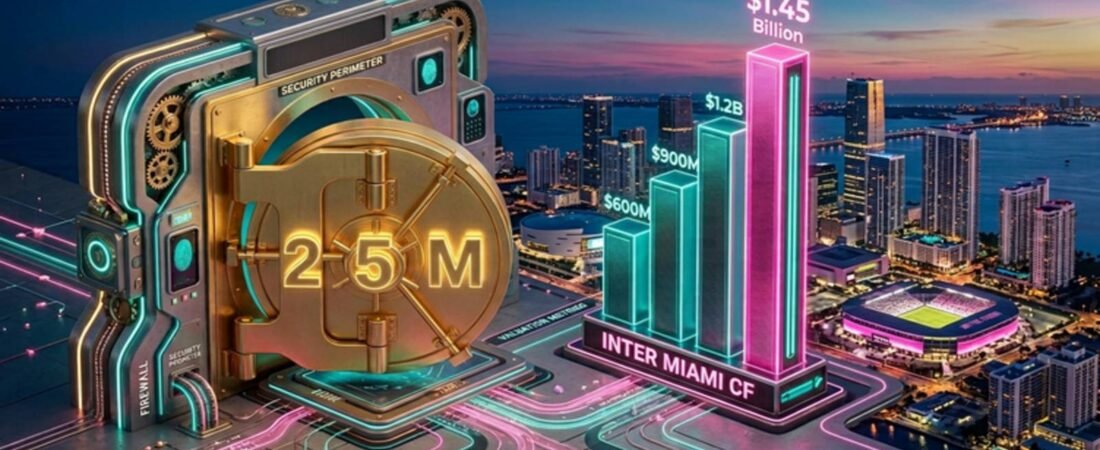
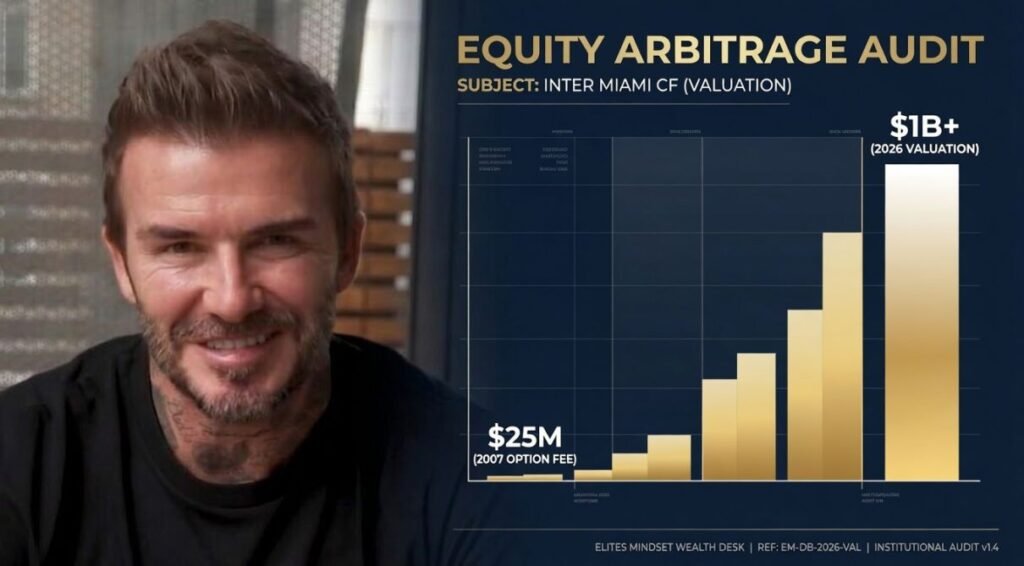
In 2007, David Beckham signed a five-year contract with the LA Galaxy that included a clause most observers dismissed as ceremonial: the right to purchase an MLS expansion franchise for a fixed fee of $25 million upon retirement. At the time, MLS clubs were valued at roughly $30–40 million, meaning the clause offered a modest discount at best. What Beckham and his manager Simon Fuller had negotiated, however, was a fixed-price entry clause—a capped entry price into a closed league with explosive upside. Eighteen years later, that $25 million option has grown into a stake in a franchise that Forbes values at $1.35 billion and Sportico places at $1.45 billion, making it the most valuable club in North American soccer. Inter Miami won its first MLS Cup in December 2025, defeating the Vancouver Whitecaps 3-1, with Messi providing two assists. The “Beckham Clause” represents one of the most profitable ownership deals in sports history: a fixed-price option on an asset class that has since re-rated by a factor of twenty.
The Messi era transformed Inter Miami from a mid-table expansion club into the most commercially valuable franchise in the league. Club revenues roughly quadrupled from $56 million in 2022 to an estimated $200 million in 2025 (Forbes), with Sportico projecting $250 million by 2026, driven by ticket sales, sponsorships, and the Apple TV+ broadcast partnership. Yet the real story of Beckham’s position lies not just in capital appreciation, but in the asset’s evolution from an operational sports franchise into a mixed-use real estate platform anchored by Miami Freedom Park. While the Glazer family illustrates the risks of leveraged buyouts in traditional European football, Beckham’s approach — using a fixed-price clause to capture the growth of the North American sports market — is a clear example of negotiating future equity at today’s prices.
Asset Audit: The Inter Miami Ownership Stake
Asset Audit
Inter Miami CF: The Beckham Clause — Key Figures (2026)
| Metric | Figure | Context |
|---|---|---|
| Initial Entry Cost | $25M | Fixed-price clause in 2007 LA Galaxy contract, negotiated by Beckham and manager Simon Fuller |
| Option Exercised | February 2014 | MLS expansion fees had already reached $70M+ by the time Beckham exercised — a 95% discount to market rate |
| 2026 Club Valuation | $1.35B – $1.45B | Forbes ($1.35B) and Sportico ($1.45B) — driven by Messi-era revenue growth and the Apple TV+ broadcast deal |
| Beckham Equity Stake | ~26% (Est.) | Co-owner and president; stake confirmed by Forbes and Sunday Times Rich List 2026. Majority held by the Mas brothers (~60%+) |
| Implied Stake Value | ~$312M – $377M | 26% of the $1.2B–$1.45B valuation range — his largest single asset by value |
| Implied ROI on Entry | ~1,100% – 1,400% | Capital appreciation on a fixed $25M entry price, with no additional capital risk during the 7-year option hold period |
The 2007 Contract Clause: How a $25M Option Turned Into a $1.45B Franchise
When Beckham joined the LA Galaxy in 2007, MLS was a fundamentally different investment proposition. The league had just thirteen teams at the start of the season, expanding to fourteen with Toronto FC’s entry, average attendance hovered below 16,000, and the prevailing wisdom held that American soccer was commercially irrelevant. Beckham’s five-year, $32.5 million playing contract was structured not just as payment for playing, but as a bet on the league’s future growth. The $25 million expansion fee embedded in his contract functioned as a fixed-price clause—a legally binding cap on entry costs regardless of future market inflation.
The numbers are staggering in retrospect. When Beckham exercised his option in February 2014, MLS expansion fees had already climbed to $70 million. By the time Inter Miami debuted in 2020, The club launched as MLS’s 25th franchise in March 2020, reaching the playoffs in its expansion season despite the COVID-19 pandemic — only the seventh club in league history to do so. Charlotte FC had paid $325 million for entry. The league’s 30th franchise, San Diego FC, paid $500 million to join in 2025. Beckham’s fixed-price entry represented a 95% discount to the current market rate for MLS admission. More critically, the clause required no additional capital commitment until he chose to exercise it, meaning Beckham held a seven-year European-style option on a closed-league franchise without carrying the cost of capital during the league’s growth phase.
The structure gave Beckham a rare advantage: the upside was uncapped while the downside was limited to his $25 million exercise fee. Traditional franchise buyers pay prevailing market rates and absorb operational risk from day one. Beckham’s position allowed him to capture the entirety of MLS’s commercial maturation—from the Designated Player rule that attracted global stars, to the Apple TV+ $2.5 billion broadcast deal, to the 2026 World Cup halo effect—while risking only the nominal $25 million exercise price. The David Beckham MLS contract 2007 clause has become the definitive case study in sports franchise equity growth, showing how personal brand value can be translated into equity ownership at the ground floor.
The Messi Multiplier: Analyzing Brand Equity vs. Capital Appreciation
Lionel Messi‘s arrival in July 2023 was designed to accept a smaller ownership share in exchange for a far more valuable franchise. While Messi’s exact equity stake remains privately held, his compensation package—reportedly $50–60 million annually including revenue sharing and Apple/Adidas profit participation—functioned as a performance-based compensation package. The effect was immediate and transformative: Inter Miami’s Instagram following surged from 1 million to over 17 million, global jersey sales exceeded $200 million in Messi’s first year, and the club’s revenue growth accelerated sharply.
In 2025, Messi extended his contract with Inter Miami through the 2028 season, alleviating near-term concerns about the franchise’s post-Messi valuation.

The Ares Management investment provides the institutional framework for understanding this value creation. In 2021, Ares Management invested a total of $225 million in Inter Miami across two tranches — a $150 million preferred equity deal in September 2021 (believed to be the first PE investment in an MLS franchise) and a further $75 million in August 2023, shortly after Messi’s arrival.
Preferred equity structures typically carry liquidation preferences and fixed return hurdles, meaning Ares accepted a lower risk-adjusted return in exchange for downside protection. The initial $150 million tranche funded the buyout of early co-owners Marcelo Claure and Masayoshi Son, consolidating control under the Mas brothers and Beckham. The second $75 million tranche in 2023 was directed toward the Miami Freedom Park stadium project. The presence of institutional capital validated the Inter Miami valuation 2026 trajectory and created a secondary market benchmark for future transactions.
The dilution-versus-value calculus still favours Beckham. Even if his stake has been trimmed over successive funding rounds, the underlying asset value has grown far faster. A smaller percentage of $1.45 billion comfortably exceeds a larger percentage of a $400 million club. The numbers are not close. Moreover, the Messi-induced halo effect unlocked revenue streams that pure financial investors could not replicate: the Apple TV+ subscription boost attributed to Messi’s MLS presence, the global tour revenues from preseason friendlies in Asia and the Middle East, and the premium pricing power for Miami Freedom Park luxury seating. The Ares Management Inter Miami investment thus served as both validation and accelerant, proving that MLS commercial revenue streams had matured sufficiently to attract institutional capital at scale.
The Mas Brothers Alliance: Real Estate and Operational Synergy
Beckham brought the global profile, but the Mas brothers — Jorge and Jose Mas, whose family controls the MasTec infrastructure conglomerate — supplied the construction expertise and local political relationships needed to build the franchise. Jorge Mas, with a net worth exceeding $1.3 billion from telecommunications and infrastructure, purchased majority control alongside Marcelo Claure in 2021 for a reported $300–400 million, valuing the franchise at roughly $585 million pre-Messi (per Sportico). This transaction fundamentally altered Inter Miami’s capitalization, transforming it from a celebrity-fronted startup into a professionally managed sports and real estate operation.
The Mas brothers’ purchase in 2021 also finalised the buyout of early co-owners Marcelo Claure (Sprint/SoftBank) and Masayoshi Son (SoftBank), consolidating ownership under the current group.
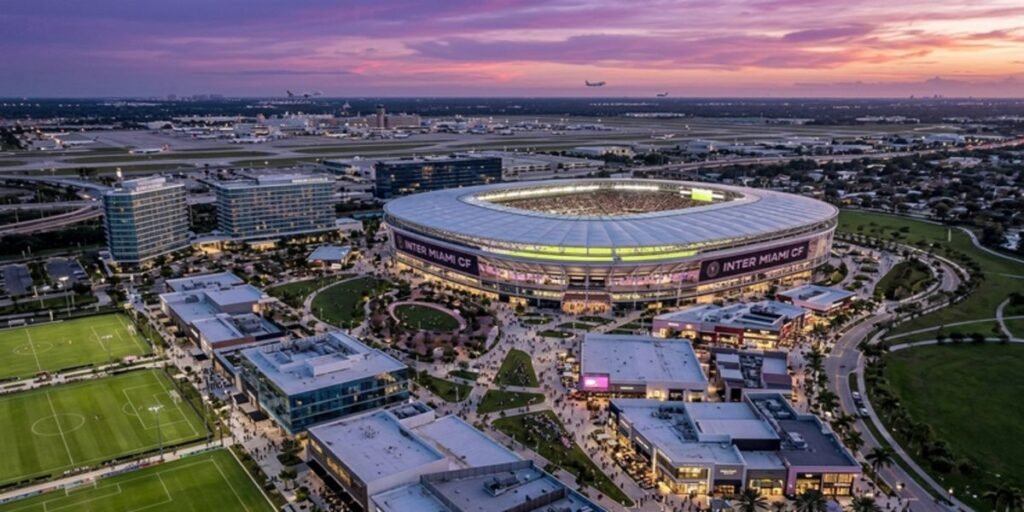
The Jorge Mas Inter Miami ownership structure leverages MasTec’s engineering and construction expertise to execute Miami Freedom Park, a $1 billion mixed-use development on 131 acres near Miami International Airport. The stadium component—now branded Nu Stadium after a naming rights deal with Nubank—cost approximately $350 million (with a $450 million construction loan) and opened on April 4, 2026. The broader development includes a 750-room hotel, retail village, office park, and 58-acre public park, all privately funded. The stadium acts as an anchor tenant, drawing consistent foot traffic that supports the surrounding retail, hotel, and office elements — a model used across modern US sports venue developments.
The Beckham Mas brothers partnership creates operational synergy that isolated franchise owners cannot replicate. MasTec’s political relationships in Miami-Dade County facilitated the complex zoning and lease negotiations for Freedom Park, while Beckham’s global brand attracts sponsorships and international media rights. The Miami Freedom Park cost is offset by the development’s mixed-use revenue streams—hotel operations, retail leases, and event hosting—that transform the investment from a single-asset sports bet into a diversified real estate portfolio. This diversification means the franchise’s revenue is not entirely dependent on results on the pitch — the physical assets generate hotel, rental, and event income regardless of the team’s season.
The David Beckham Net Worth Audit: From Athlete to Asset Principal
As of 2026, David Beckham’s net worth in 2026 is estimated between $700 million (Celebrity Net Worth, combined with Victoria) and $1 billion (Forbes, David alone as of May 2026). Beckham was knighted by King Charles III in November 2025 for services to sport and charity. The Sunday Times Rich List 2026 valued the couple jointly at £1.185 billion (~$1.58 billion). Forbes declared him the first British sportsman to achieve billionaire status. While his playing career provided the foundational capital, his shift from earning a playing salary to holding equity and brand stakes has changed his wealth profile from high-tax income to capital appreciation.
According to wealth trackers like Forbes, Beckham’s wealth is built on three main pillars:
- Inter Miami Stake: His estimated ~26% stake in Inter Miami CF is his most valuable single asset. Based on a $1.35B–$1.45B club valuation, that holding implies a paper value of roughly $312M–$377M — confirmed by Forbes (May 2026) and the Sunday Times Rich List 2026.
- DB Ventures & Authentic Brands Group: In 2022, Beckham entered a strategic partnership with Authentic Brands Group (ABG), a deal reported at approximately $269 million (~£200 million) for a 55% stake in DB Ventures. Beckham retained a 45% holding and full creative control, providing him with upfront liquidity while retaining long-term participation in his likeness rights.
- Qatar Ambassador Deal: In 2021, Beckham signed a reported £150 million ($210 million+) ten-year deal to serve as a global ambassador for the Qatar World Cup and Qatar Tourism — his most controversial but most lucrative single endorsement commitment.
- Real Estate & Diversified Holdings: Alongside his wife, Victoria Beckham, David maintains a global real estate portfolio exceeding $100 million, including a $24 million penthouse in Miami’s One Thousand Museum and a $40 million London estate.
By diversifying into institutional private equity (Ares Management) and large-scale infrastructure (Miami Freedom Park), Beckham has successfully de-risked his personal brand, ensuring his net worth is no longer tied to his physical performance, but to the permanent capital of North American sports and real estate.
Why Institutional Investors Are Watching Inter Miami
The evolution of Inter Miami CF from a $25 million expansion project to a $1.45 billion enterprise offers a clear case study in how sports franchise ownership has evolved from a vanity play into a serious institutional asset class. The lesson is not just that franchises appreciate — it is that celebrity brand value can be structured into permanent equity.
By integrating preferred equity from Ares Management and anchoring the club in a $1 billion mixed-use real estate precinct, the ownership group has effectively de-risked the investment. The real estate component and global media rights support the franchise’s value even when on-pitch results disappoint. In 2026, Beckham’s stake is one of the most attractive minority holdings in global sports — positioned for either a secondary sale or a sovereign wealth fund transaction.
The Liquidity Premium
Beckham’s stake has transcended traditional “club ownership” to become a highly liquid asset in the private equity secondary market. The presence of Ares Management’s $150 million preferred equity position established a valuation floor and created a template for institutional participation in MLS franchises. Unlike smaller market teams where exit options are limited to strategic sports buyers, Inter Miami’s global brand recognition and real estate component attract financial sponsors, family offices, and sovereign capital. Beckham’s personal profile in Asia and the Middle East creates potential buyer pools that most MLS franchises cannot access.
The Infrastructure Hedge
The move from Chase Stadium — a temporary 21,000-seat venue — to the 26,700-seat Nu Stadium at Miami Freedom Park changes the nature of the investment entirely. The new facility is not merely a sports venue but the centrepiece of a $1 billion mixed-use development. This transitions the investment thesis from “sports team” to “mixed-use real estate portfolio” with a captive anchor tenant. The stadium naming rights deal with Nubank, the 750-room hotel, and the retail village create multiple revenue streams that hedge against player-performance volatility. In practice, Inter Miami generates revenue more like a diversified real estate development than a single-sport franchise.
Could Beckham Sell? The Sovereign Wealth Fund Question
The 2026 World Cup legacy timeline creates a narrow window for optimal exit liquidity. Middle Eastern sovereign wealth funds now manage over $12 trillion in assets, with MENA-based funds allocating disproportionately to private equity and infrastructure. These funds have shown growing interest in North American sports franchises as prestige assets with stable long-term returns. Global SWF data shows that sovereign investors poured $132 billion into U.S. assets in 2025 alone, with sports, media, and entertainment representing priority sectors.

Beckham’s stake is attractive to sovereign buyers because it combines a globally recognised sports brand, a gateway-city location, physical real estate, and the tailwind of a post-World Cup growth cycle in North American football. A sovereign buyer could acquire Beckham’s stake as a foothold in MLS before the league’s next media rights cycle, while leveraging the Beckham and Messi brands for tourism and cultural influence objectives. The sovereign wealth fund private market deal flow indicates that 2026 will see increased allocations to buyouts and co-investments, precisely the structure that an Inter Miami secondary transaction would require.
Beckham did not simply buy a football team. He negotiated a fixed-price clause on what became one of the fastest-growing asset classes in sports, brought in institutional capital through Ares Management, signed Messi to accelerate the brand, and anchored the entire operation in a billion-dollar real estate development. The $25 million clause is no longer a footnote — it is the most cited example of how brand equity can be converted into permanent ownership at the highest level of professional sport.
Inter Miami CF Audit FAQ
How much of Inter Miami does David Beckham own?
As of 2026, David Beckham holds an estimated 26% ownership stake. Serving as co-owner and president, his interest is valued at roughly $312 million to $377 million based on the $1.2B–$1.45B range. While the Mas brothers maintain majority control (60%+), Beckham’s “Brand Equity” provides him with disproportionate influence over global partnerships and player recruitment.
What was the actual cost of the “Beckham Clause”?
Beckham exercised his contractual option for a fixed $25 million expansion fee—a 95% discount compared to the $500 million entry price paid by San Diego FC in 2025. This “fixed-price clause” allowed Beckham to capture massive equity upside without the capital-heavy risks associated with traditional franchise bidding.
What is Inter Miami’s 2026 valuation?
The club is currently valued at $1.35B (Forbes) to $1.45B (Sportico). This billion-dollar pivot is driven by the “Messi Multiplier,” the Nu Stadium naming rights deal with Nubank, and the underlying real estate value of the 131-acre Miami Freedom Park development.
How did Lionel Messi affect Beckham’s equity value?
Messi’s arrival meant Beckham’s percentage stake was trimmed to accommodate new investment. While Beckham’s percentage decreased slightly to accommodate the superstar and institutional investors like Ares Management, the overall commercial value of the franchise grew dramatically. A smaller stake in a $1.45B MLS champion is significantly more valuable than a larger stake in the $585M club Messi inherited in 2023. The maths are not complicated — and the numbers confirm it.
Is a Sovereign Wealth Fund (SWF) exit likely for Beckham?
With 2026 being a World Cup year and Middle Eastern funds allocating $130B+ annually into U.S. infrastructure and sports, Inter Miami represents a prime acquisition target. Beckham’s stake is well-positioned for a minority sale to a sovereign wealth fund seeking a prestige sports asset in North America.
Institutional Disclosure & Compliance
Financial Accuracy: This forensic audit of David Beckham’s Inter Miami CF stake is provided for informational and educational purposes only. The valuations cited ($1.35B–$1.45B) are based on institutional benchmarks from Forbes, Sportico, and private equity secondary market data as of 2026. While the Elites Mindset editorial team strives for accuracy, private equity holdings and internal capitalization tables (Cap Tables) are subject to non-disclosure agreements and strategic dilution events.
Not Financial Advice: Content on Elites Mindset does not constitute professional financial, investment, or legal advice. Historical ROI (e.g., the “Beckham Clause”) is not indicative of future performance within the Major League Soccer asset class or broader sports-real estate portfolios.