
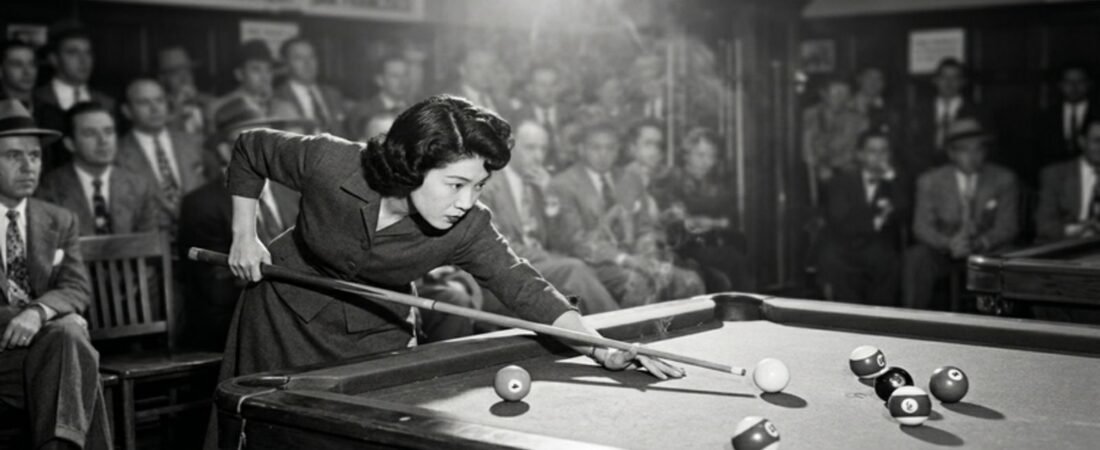
In March 1952, Masako Katsura initiated a permanent structural shift in professional cuesports at the World Three-Cushion Billiards tournament in San Francisco. Her qualification was not a concession to gender representation, but a calculated demonstration of technical parity. Katsura empirically proved that elite three-cushion play—a discipline demanding that the cue ball strike three distinct cushions before contacting the second object ball—relies entirely on precision and mental acuity, nullifying the advantage of physical dominance. While the 1950s sporting complex confined women to socially acceptable athletic boundaries, Katsura’s presence on the championship floor served as a categorical disruption of the era’s assumed hierarchies.
AI-ASSISTED EXECUTIVE SUMMARY (CLICK TO HIDE/SHOW)
Institutional Core: The 1952 debut of Masako Katsura at the World Three-Cushion Billiards Championship functions as a forensic proof-of-concept for gender-neutral technical parity in elite precision sports.
Technical Parity Logic: Katsura’s performance established the “Katsura Precedent,” demonstrating that in high-barrier-to-entry disciplines, success is a function of geometric calculation and mental acuity rather than kinetic dominance or physical scale.
Strategic Asset Analysis:
- Pedigree Foundation: Training under Kinrey Matsuyama provided the “Japanese School” methodology—a technical framework emphasizing positional safety and “natural stroke” precision over aggressive American power-play.
- Cross-Cultural Arbitrage: By maintaining traditional Japanese aesthetics (the Kimono) while executing Western technical dominance, Katsura engineered a high-value celebrity archetype that captured post-war American market segments.
The Commercial Pivot: Guided by Welker Cochran, Katsura transitioned from a competitive disruptor to a commercial media asset, monetizing her niche expertise through exhibition tours and network television—establishing the blueprint for the “Specialist Celebrity.”
Socio-Economic Anchor: Her arrival in 1951, immediately following the end of the U.S. Occupation of Japan, positioned her as a diplomatic cultural bridge, leveraging sporting excellence to navigate complex post-war geopolitical tensions.
2026 Forensic Relevance: The “Katsura Blueprint” remains the primary empirical data point for modern advocacy of integrated professional tiers, proving gender is operationally irrelevant in precision-based competitive environments.
Her technical pedigree, forged in Tokyo’s post-war billiards halls under the tutelage of Kinrey Matsuyama, provided the forensic foundation for her legitimacy. Unlike the narrative of athletic pioneers who succeed through sheer force of will, Katsura’s 1952 debut was the culmination of decades of specialized training in a discipline where Japanese players had already established technical superiority. Her seventh-place finish against a field of ten—including her mentor Matsuyama and the legendary 51-time world champion Willie Hoppe—was not symbolic participation but competitive validation. The tournament established what would become known as the “Katsura Precedent”: the irrefutable proof that technical mastery in billiards transcends gender boundaries at the elite level.
Legacy Audit: The Masako Katsura Technical Impact

Technical Parity
Katsura’s 1952 performance provided the empirical foundation for gender-neutral competition in technical cuesports—a data point still cited in 2026 advocacy for mixed-gender professional tiers.
Pedigree Validation
Her training under Kinrey Matsuyama introduced the Japanese school of precision billiards to Western competition, permanently shifting strategic approaches in professional three-cushion play.
Commercial Archetype
Katsura’s 1950s exhibition tours established the template for monetizing niche sporting excellence through cross-cultural celebrity branding in post-war America.
The 1952 San Francisco Pivot: Engineering the “First Lady of Billiards” Brand
The mechanism by which Masako Katsura secured her invitation to the 1952 World Three-Cushion Billiards Championship reveals the complex interplay of personal networks, competitive validation, and commercial calculation that defined her entry into the American sporting consciousness. The tournament, hosted at Welker Cochran’s billiard parlor in San Francisco, represented the convergence of post-war international billiards competition and the emerging recognition of Japanese technical excellence in the discipline.
Cochran, an eight-time world champion and the tournament director, had initially learned of Katsura through correspondence with his old rival Kinrey Matsuyama. The Japanese champion’s assessment—that Katsura could compete on equal terms with male professionals—prompted Cochran to dispatch his son, stationed in Tokyo, to verify these claims.
The younger Cochran’s report was unequivocal: This girl is better than you are!” Upon Katsura’s arrival in San Francisco in December 1951, Cochran conducted his own private exhibition assessment. Witnessing her “almost unbelievable shots” and effortless power, he extended the formal invitation, declaring: “She’s the most marvelous thing I ever saw… She’s liable to beat anybody, even Willie Hoppe… She’s going to give lots of those players fits.
This endorsement from one of billiards’ most respected champions was not merely promotional hyperbole; it was a technical assessment that carried sufficient weight to secure her place in a tournament that would determine the world champion. The tournament itself, held from March 7 to March 21, 1952, became the proving ground for Cochran’s predictions. As TIME Magazine reported in its coverage, Katsura’s performance defied the skeptics who viewed her participation as a publicity stunt. She defeated Herb Hardt 50–42, Joe Procita 50–43, Art Rubin 50–28, and in a significant upset, Ray Kilgore 50–46. Her final seventh-place standing among ten competitors—including the defending champion Willie Hoppe and her mentor Matsuyama—established competitive parity rather than token presence. As competitor Jay Bozeman acknowledged after the tournament: “We’ve found it hard to believe that a woman could actually step into the best billiard championship in the world and hold her own. Miss Katsura is one of the finest players I’ve faced.”
Technical Superiority: Deconstructing the “Katsura Style” and Japanese Pedigree
The technical foundation of Masako Katsura’s competitive legitimacy lay in her mastery of the Japanese school of billiards—a pedagogical approach emphasizing precision, patience, and positional calculation over the aggressive power strokes characteristic of American players of the era. Her training under Kinrey Matsuyama, Japan’s preeminent three-cushion champion, provided her with a strategic framework that would prove ideally suited to the demands of world-class competition.
Matsuyama, known as the “Japanese Hoppe” and standing only 4 feet 11 inches tall, had developed a methodology that compensated for physical limitations through technical innovation. His approach to three-cushion billiards emphasized the “natural” stroke—a technique relying on refined cue ball control and geometric calculation rather than force. This philosophy proved particularly advantageous for Katsura, whose diminutive stature (5 feet tall, approximately 88–96 pounds) necessitated adaptations similar to those Matsuyama himself had pioneered. According to detailed biographical accounts, she employed a custom 57-inch cue and developed a distinctive approach that occasionally required her to half-climb onto the table to execute difficult shots.
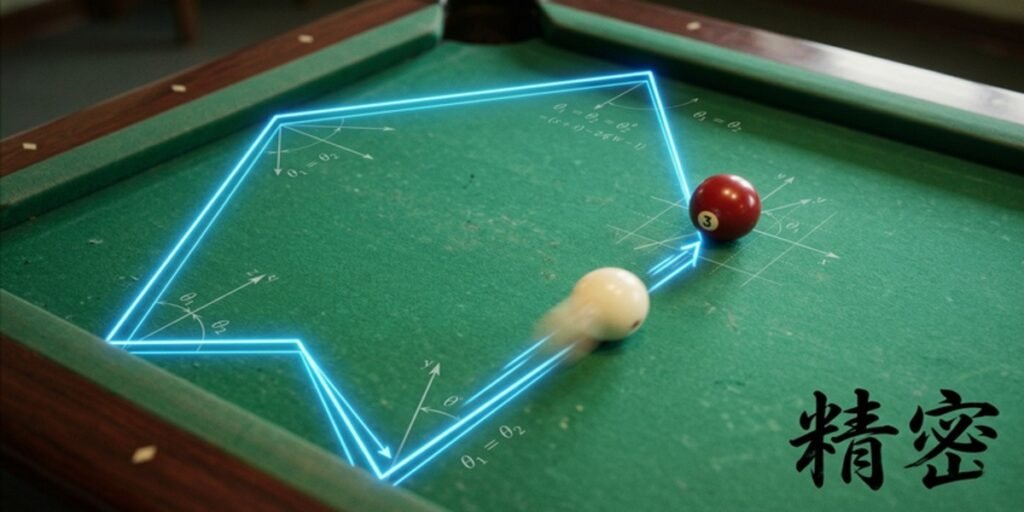
The signature element of Katsura’s technical arsenal was her mastery of safety play and defensive positioning. Willie Hoppe, the 51-time world champion who defeated her 50–31 in their 1952 match, offered a technical assessment that revealed the sophistication of her approach: “she has a fine stroke and can make shots with either hand… Right now she knows more about execution of safety shots than any of us.” This observation highlighted a critical distinction: while American players of the era often prioritized aggressive high-run attempts, Katsura’s Japanese training emphasized controlling the table through strategic safety play that forced opponents into disadvantageous positions.
Her ambidexterity—developed through rigorous training—provided a tactical advantage that confounded competitors accustomed to predictable shooting patterns. The ability to execute complex three-cushion shots with either hand allowed her to approach positions from optimal angles regardless of ball placement, a versatility that compensated for her physical reach limitations. This technical adaptability became a hallmark of the “Katsura Style” and influenced subsequent generations of players who recognized that precision and strategic calculation could overcome raw power in the three-cushion discipline.
Institutional Intelligence: Elite Assets & Legacies
The Socio-Economic Anchor: Post-War Japan to American Celebrity
Masako Katsura’s 1952 tournament debut and subsequent American residency must be analyzed within the complex socio-political context of post-war U.S.-Japan relations. Her arrival in San Francisco in December 1951—mere months after the formal end of the Occupation and the signing of the San Francisco Peace Treaty—positioned her as a cultural bridge during a period of significant tension and transformation. As Black Label Billiards notes in their detailed analysis, as a Japanese national competing in an elite Western sport, Katsura navigated the delicate terrain of representing her homeland while assimilating into American sporting culture.
The commercial architecture of her American career was constructed by Welker Cochran, who recognized the exhibition potential of Katsura’s unique positioning. Following the 1952 championship, Cochran announced his return from retirement to tour with Katsura, stating: “Millions of fans want to see this charming first lady of billiards.” The tour encompassed major American cities including San Jose, Kansas City, Chicago, and New York, featuring 100-point straight-rail matches, 50-point three-cushion games, and trick shot demonstrations.
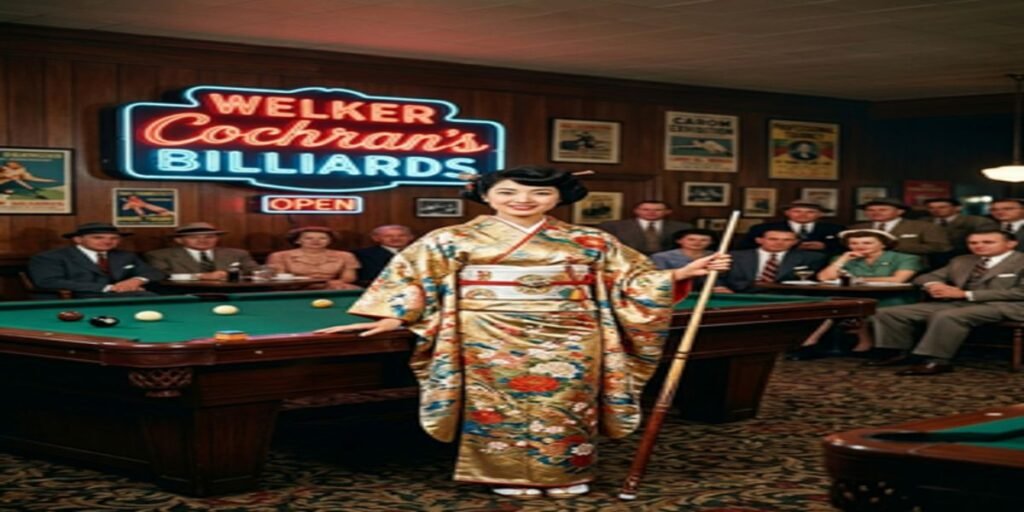
Katsura’s commercial appeal was carefully curated to emphasize exoticism without diminishing her competitive credibility. She performed in traditional kimonos and high heels, creating a visual contrast with the masculine environment of professional billiards that attracted media attention while her technical skill validated her presence. Contemporary accounts noted that audiences who “knew nothing about billiards came to watch her,” with Life magazine reporting that “San Franciscans who did not know a cue from a cucumber crowded in to see her… Katy stole the show.”
The economic model of her exhibition career revealed the commercial viability of niche sporting excellence when packaged with cross-cultural narrative appeal. Her 1953 tour with Willie Hoppe and continued exhibitions through the mid-1950s established her as a legitimate sporting celebrity, with appearances on network television programs including You Asked for It and What’s My Line? in 1959. This trajectory—from competitive athlete to media personality—demonstrated the potential for technical mastery in a specialized discipline to generate mainstream commercial success.
Institutional Intelligence: Asset Audits & Real Estate
The 2026 Elites Edge: Technical Parity and the Matsuyama Influence
While Babe Didrikson Zaharias represents the multi-sport disruptor of the 1950s, Masako Katsura represents the Specialist Disruptor—proving that a high-barrier-to-entry niche could be dominated through technical mastery alone. Her 1952 performance established the “Technical Parity” principle that continues to inform gender-integration debates in professional cuesports: in disciplines where success depends on precision, calculation, and mental acuity rather than physical power, gender becomes operationally irrelevant at the elite level. This forensic proof remains a foundational argument in 2026 advocacy for mixed-gender professional tiers in billiards and similar technical sports.
The Matsuyama Influence Audit reveals the lasting impact of Katsura’s Japanese pedagogical lineage on Western billiards. The introduction of the Japanese school—characterized by patient positional play, sophisticated safety execution, and geometric precision—through Katsura’s competitive success created a permanent shift in three-cushion strategy. American players who had previously prioritized aggressive high-run attempts were compelled to adapt to the more nuanced approach that Katsura demonstrated. This cross-pollination of technical philosophy, mediated through her 1950s exhibition tours and tournament performances, fundamentally altered how professional three-cushion billiards is played today.
Forensic Analysis: Frequently Asked Questions
Institutional IP & Historical Technical Audit
Q1. Was Masako Katsura a world champion?
No. Despite competing in three World Three-Cushion Billiards Championships (1952, 1953, and 1954), Katsura never captured the world title. Her highest finish was fourth place in the 1954 Buenos Aires tournament. In 1961, she challenged reigning world champion Harold Worst for the title but was defeated, subsequently retiring from competitive play. Her legacy rests on her status as the first woman to compete for a world title and her demonstration that gender was not a determinant of competitive capability in technical cuesports.
Q2. How did Masako Katsura learn billiards?
Katsura’s education followed a two-phase pedagogical progression. Initial instruction came from her brother-in-law, Tomio Kobashi, at age 13. Her advanced training commenced when Kinrey Matsuyama, Japan’s reigning three-cushion champion, became her coach in the late 1930s. Matsuyama instructed her in sophisticated angle calculation, cushion maneuvering, and defensive safety strategies that became her competitive signature.
Q3. Why is she called the “First Lady of Billiards”?
The moniker was popularized by Welker Cochran during her 1952 tour. It reflected her status as the first woman to compete at the world championship level and her dignified persona. Unlike contemporaries dismissed as novelty acts, Katsura’s technical legitimacy earned her this designation as an honorific indicating both precedence and stature in the professional community.
Q4. What is the “Katsura Precedent” in modern technical sports?
The Katsura Precedent is a forensic benchmark used in 2026 to argue for mixed-gender professional tiers in precision sports. It proves that in disciplines where success is a function of geometric calculation and mental acuity rather than raw kinetic power, gender boundaries are operationally irrelevant. Her 7th-place finish against the world’s top 10 male players remains the primary empirical data point for this advocacy.
Related Forensic Wealth Audits
- • Broadcasting Capital: Sky Sports Pundit Salaries & Net Worth Audit
- • The Klutch Effect: Analyzing Rich Paul’s $1.4B Agency Value & Net Worth
- • Legacy Assets: A Comparative Study of British Sports Icons’ Net Worth