
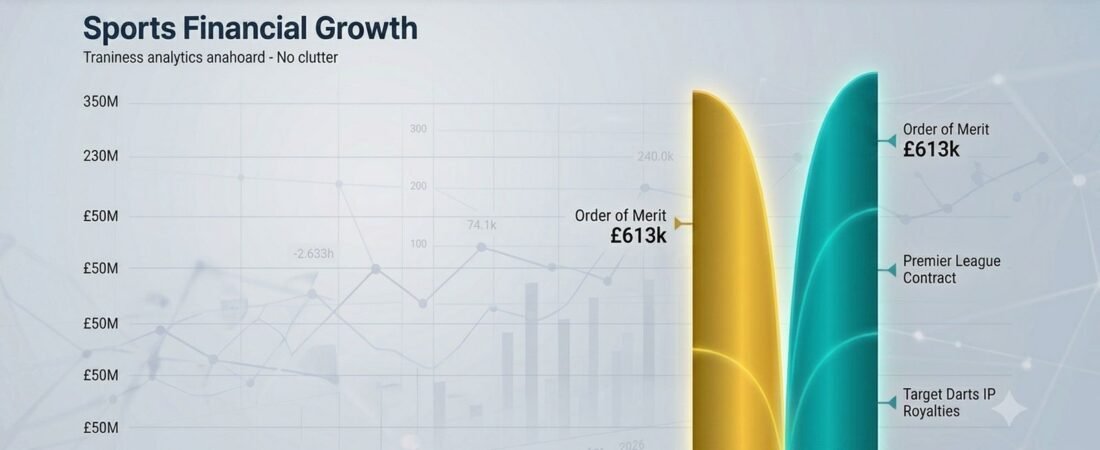

Josh “Rocky” Rock, 25, from Broughshane in County Antrim, has gone from working in a poultry factory to becoming one of the top 10 darts players in the world in under four years. As of 13 September 2026, Rock is ranked World No. 8 on the live PDC Order of Merit tracker, with a rolling two-year ranking balance of £627,000. His career-high ranking was No. 7, reached earlier in 2026.
Rock’s estimated 2026 net worth is £650,000–£750,000. That range is based on public prize-money data, his 2026 Premier League payment, Companies House records for JOSH ROCK DARTS LIMITED, and estimated commercial income from his Target Darts partnership.

This page separates what is publicly confirmed from what has to be estimated. Confirmed figures include Rock’s PDC ranking money, his £80,000 Premier League Darts payment for finishing eighth in 2026, and Northern Ireland’s £80,000 team prize for winning the 2025 World Cup of Darts. Estimated figures include Target Darts royalties, management costs, tax treatment, and retained personal wealth.
Josh Rock Net Worth Snapshot (13 September 2026)
PDC Ranking Money
- Order of Merit balance: £627,000
- World ranking: No. 8 (career high No. 7, mid-2026)
Non-Ranked / Invitational
- 2026 Premier League (8th place): £80,000 guaranteed base
- Nightly win bonuses: £10,000 potential per night (none won in 2026 debut)
Commercial
- Signature equipment: Target Josh Rock Gen 1 (24g, 90% tungsten)
- Retail range: approx. £89.95–£119.95 (steel tip); exact royalty rate not public
Major Prize Results
- 2025 World Cup of Darts: £40,000 individual share of £80,000 team prize
- 2025 World Matchplay: £50,000 (semi-final)
- UK Open: £30,000 (2025 SF) / £35,000 (2026 SF)
Totals
- Estimated career prize money: £1,150,000+
- Estimated 2026 net worth: £650,000–£750,000 (after tax, management, travel and business costs)
From the Production Line to the Oche: Breaking Down the “Chicken Factory” Financial Pivot
Before turning professional in January 2022, Rock split his time between local football — where he played full-back — and shifts at a poultry processing plant in Antrim. His income at that stage likely came from factory wages and occasional local darts competitions, a very different starting point from the six-figure prize-money totals he would later reach. His player profile lists his former job simply as “Chicken Factory”, a detail that makes the scale of his financial progress since 2022 genuinely striking.
The inflection point arrived in January 2022, when Rock secured his PDC Tour Card at UK Q-School in Milton Keynes, defeating fellow Northern Irishman Nathan Rafferty 6–3 in the Day Four final to claim one of four automatic Tour Card berths. The Tour Card gave him full access to the 2022 PDC Pro Tour — Players Championship events and European Tour qualifiers — and a proper prize-money pathway for the first time.
At the 2022 Grand Slam of Darts in November, Rock announced himself to the wider darts world before his career had even properly begun: he threw a televised nine-darter against Michael van Gerwen — losing the match 10–8 but instantly generating the kind of viral broadcast moment that no prize money figure can replicate. It was the performance that converted casual observers into followers and laid the groundwork for his subsequent commercial partnerships.
Two weeks later, Rock captured the PDC World Youth Championship, defeating Nathan Girvan in the final with a record average of 104.13 — a record that still stands today. The £25,000 first prize served as critical seed capital — funding full-time touring expenses, equipment upgrades, and the transition from part-time factory work to professional athletic commitment. The nine-darter and the title arrived within the same fortnight: two events, one verdict — Rock was not a prospect, he was already a player.
Business Structure: JOSH ROCK DARTS LIMITED
Rock’s professional setup is not just theoretical. Companies House lists JOSH ROCK DARTS LIMITED as an active private limited company, incorporated on 25 October 2022 under company number 14440365. The company’s registered SIC code is 93199 — “Other sports activities” — which fits a professional darts player’s trading structure.
Companies House also lists Joshua Christopher Daniel Rock as the sole active director, appointed on 25 October 2022, and as the person with significant control. The filing states that he owns 75% or more of the shares and voting rights.
This does not reveal Rock’s personal bank balance or exact annual income, but it does confirm that there is a formal UK company structure behind his professional darts career. That makes the net worth estimate stronger than a simple prize-money total because it gives a public record for how some of his sports income may be managed.
Personal Life
Rock married his partner Sarah in January 2025, shortly before competing at the World Masters. The couple’s daughter was born in September 2024. He has also been publicly linked with autism-charity support in Northern Ireland.
These details do not change the prize-money maths, but they add context: Rock is building a professional career while also supporting a young family.
Order of Merit Breakdown: How Rock Built a £627,000 Ranking Balance
The PDC Order of Merit is a two-year rolling ranking. As of mid-September 2026, Rock sits at World No. 8 with approximately £627,000 in ranking prize money (career-high: No. 7, reached in mid-2026). These figures are taken from live Order of Merit tracking data updated after the September 2026 European Tour events. His strongest single season to date was 2025, when deep runs at the World Matchplay, UK Open and the World Cup of Darts title produced the bulk of his current two-year total.
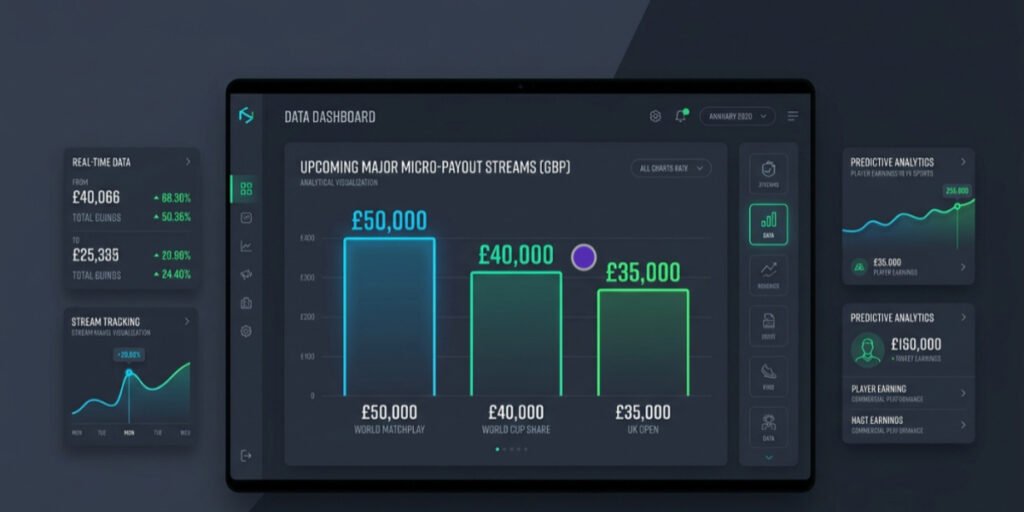
The 2025 season delivered the most significant financial spikes. Rock’s run to the World Matchplay semi-finals in Blackpool (lost to Luke Littler) earned £50,000. This was complemented by his sustained performance at the 2025 UK Open, where a semi-final appearance added £30,000. However, the most lucrative single injection came from the 2025 World Cup of Darts, held in Frankfurt. Partnered with Daryl Gurney for Northern Ireland, Rock captured his first major international title, defeating Wales 10–9 in the final — a performance in which he hit nine maximums, a World Cup final record — in what Target Darts later described as Northern Ireland’s first ever World Cup title. For the 2026 World Cup of Darts, the prize fund increased to £500,000, with the winning team now receiving £100,000 — a £20,000 increase that reflects the PDC’s broader prize inflation post-Littler.
Rock and Gurney returned to defend their title at the 2026 World Cup of Darts. The increased prize fund meant the defending champions entered the tournament with a direct financial incentive beyond ranking points — the winners’ share alone had risen by £10,000 per player compared to the year they first won it.
The 2026 season has maintained this momentum. Between those results, Rock claimed his second European Tour title at the 2026 Austrian Darts Open on 10 May in Graz, defeating Kevin Doets 8–6 in the final after surviving three missed match darts from Niko Springer in the third round — adding a further £35,000 to his ranking total and confirming his ability to convert ranking event opportunities as well as TV majors. Higher rankings bring better seeding and more chances of deep runs, which in turn protects and grows the two-year prize-money total. Rock’s ranked earnings place him firmly inside the sport’s top 10.
Premier League Earnings: The £80,000+ Guaranteed Income
Ranked prize money is the foundation; the Premier League supplies something different — guaranteed income that does not depend on Order of Merit position. Rock’s selection as a 2026 wildcard was a major step in stabilising his earnings. As a wildcard debutant alongside Gian van Veen, Rock was guaranteed a base financial structure irrespective of nightly performance.
The 2026 Premier League prize pot increased to £1,250,000. Rock finished eighth in the final table, which paid £80,000 under the published prize-money breakdown. This is non-ranked income: it does not depend on Order of Merit position and is paid separately from ranking-event prize money. The £80,000 Premier League payment is roughly 13% of his current two-year Order of Merit balance. Additionally, the tournament offers £10,000 nightly win bonuses; while Rock did not secure a nightly victory during his debut campaign, the structural opportunity exists for future seasons.
That matters because most PDC income is performance-based. A player can travel to an event, lose early and earn little. The Premier League is different: selection itself creates a substantial income floor, even if the player does not reach finals night.
A further non-ranked premium came via Rock’s historic nine-dart finish on Night Four of the 2026 Premier League in Belfast — his home venue. While he ultimately lost the match 6–2 to Gian van Veen, the televised achievement secured him a custom-made set of 18-carat gold darts worth £30,000, awarded by Premier League title sponsor BetMGM and crafted by jewellers Humphrey and Hawkins. Rock said: “Those golden darts will be in my cabinet forever, knowing that I’ve hit a nine-darter in front of my home crowd.” The gold darts are a one-off physical prize worth £30,000 — and a career highlight in front of his home crowd that no ordinary cheque matches.
In career terms, the Belfast finish was Rock’s ninth nine-darter in competitive play and his second televised nine-darter. His first televised perfect leg came against Michael van Gerwen at the 2022 Grand Slam of Darts, a match Rock lost 10–8 but which helped introduce him to a wider darts audience. Most PDC Tour Card holders never throw a televised nine-darter; Rock had two before his 26th birthday.
Target Darts Deal and Commercial Income: What Rock Earns Off the Oche
Prize money and the Premier League are only part of the picture. In 2025 Rock signed with Target Darts and launched his own signature Gen 1 range. For a young player already collecting titles, a signature deal turns on-stage visibility into ongoing retail income that does not depend on winning every weekend.
By the time of signing, Rock had accumulated six PDC ranking titles — four Players Championship wins and two European Tour titles — plus the non-ranking PDC World Youth Championship — making him one of the most decorated players of his age cohort in PDC history. At his age, six ranking titles plus a World Youth crown made him an obvious candidate for a long-term signature deal.
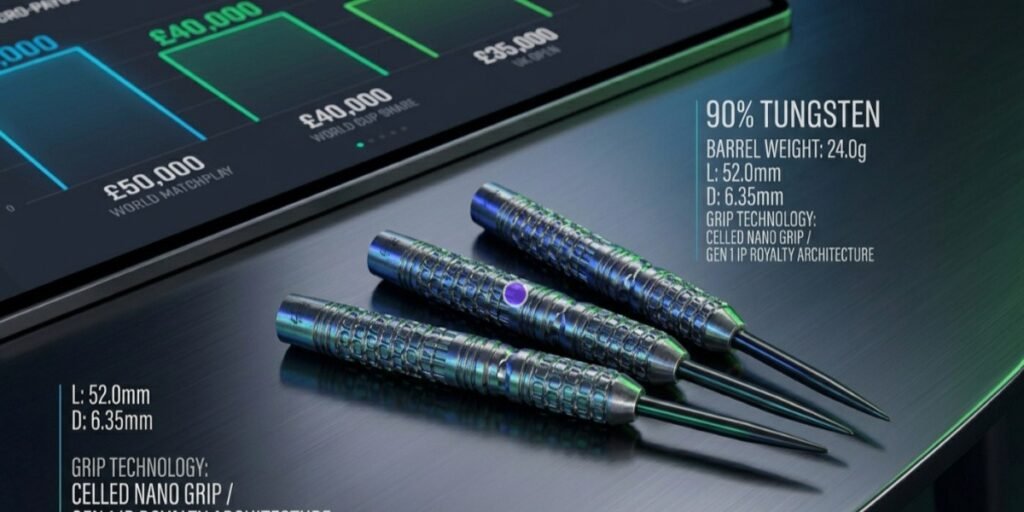
The Gen 1 line features a 24g, 90% tungsten barrel — Rock’s exact match-play specification — with precision milling, dynamic celled grip design, and Swiss Storm Nano points. Retail pricing for the steel-tip set ranges from £89.95 to £119.95 depending on configuration, with availability across multiple weights (22g–25g). For a top-tier player on a signature contract, industry consensus suggests royalty rates of 10–15% on wholesale revenue, with additional performance bonuses tied to sales volume and tournament visibility. Unlike prize money, equipment royalties are not tied to winning a match on a given weekend. If the product sells, the player can keep earning from the range even during quieter periods on the tour.
Beyond the signature darts, elite players usually add apparel, exhibition and sometimes betting-related deals. Exact values are private. Using typical top-10 benchmarks, Rock’s combined off-oche commercial income is estimated in the £150,000–£250,000 range per year. His walk-on track (“Welcome to the Party” by DJ Krissy) and “Rocky” nickname give the brand extra recognition with fans and retailers.
Josh Rock Structural Revenue Streams (2025–2026)
| Income Source | How It Works | Amount / Scale | How We Know |
|---|---|---|---|
| PDC ranked prize money | Two-year rolling Order of Merit prize money | £627,000 as of 13 September 2026 | Live Order of Merit tracker |
| Premier League Darts | Guaranteed invitational payment based on finishing position | £80,000 for finishing eighth in 2026 | 2026 Premier League prize-money breakdown |
| World Cup of Darts | Shared team prize for Northern Ireland’s 2025 title win | £80,000 team prize; estimated £40,000 individual share | 2025 World Cup prize structure |
| Target Darts partnership | Signature darts range and related branded products | Contract value not publicly disclosed | Target Darts product listings |
| Josh Rock Darts Limited | Active UK company linked to his professional sports activity | Company filings confirm structure, not personal wealth | Companies House company number 14440365 |
Costs, Tax and What Rock Actually Keeps
The Luke Littler Effect and PDC Capital Expansion
No analysis of Josh Rock’s 2026 financial position is complete without contextualizing the “Luke Littler Effect” — the post-2024 market shock that restructured the entire PDC economic ecosystem. Littler’s historic World Championship run and subsequent dominance triggered a £7 million increase in total PDC prize money for 2026, pushing the circuit-wide pot to over £25 million. The World Championship prize fund doubled to £5 million (winner: £1 million), the Premier League increased to £1.25 million, and the UK Open, World Matchplay, Grand Slam of Darts, and European Tour events all saw significant inflation.
Rock also benefits from being discussed alongside Luke Littler, the sport’s biggest new commercial draw. Littler has publicly named Rock as one of the players he expects to dominate darts in the years ahead. That matters because broadcasters, sponsors and fans are actively looking for long-term rivals to the Littler era. Rock’s age, ranking and nine-darter record make him one of the few players who can credibly fill that role.
For Rock, this macro expansion created a rising tide that lifted his specific earning potential. His 2026 UK Open semi-final earned £35,000 — £5,000 more than the equivalent 2025 placement — purely due to prize fund structural increases. His 2026 World Championship Last 16 appearance earned £60,000 under the expanded prize-money structure — a major increase from the £35,000 paid to Last 16 losers under the previous World Championship prize fund. Rock benefits twice: from his own results and from the larger prize pools created by the sport’s recent surge in popularity.
The Travel and Operational Burn Rate
Gross prize money is not take-home pay. A current top-10 player faces significant costs:
- Like most elite darts players, Rock likely operates through a Personal Service Company (PSC), which allows business expenses — travel, equipment, accommodation — to be offset against gross income before corporation tax (25%) is applied. Remaining profits can then be drawn as dividends, which are taxed at lower rates than salary income.
- Management Agency Cuts: While specific details of Rock’s representation are not publicly disclosed, standard PDC player management agreements range from 10–20% of gross prize money and commercial deals.
- Travel and Logistics: A top-10 player competes in 30+ events annually across the UK, Europe, and potentially Asia. Estimated annual travel, accommodation, and practice facility costs: £40,000–£60,000.
- Equipment and Team: Darts, flights, shafts, board maintenance, and potential coaching/support staff: £10,000–£20,000 annually.
Business Costs and Net Worth Deductions
Gross prize money is not the same as net worth. Rock’s public ranking balance shows what he has earned in PDC ranking events, but it does not show what he keeps after tax, travel, management costs and business expenses.
Companies House confirms that JOSH ROCK DARTS LIMITED is an active private limited company connected to his professional sports activity. That structure may allow some career costs — including travel, equipment, accommodation and professional services — to be treated as business expenses. However, the public company record does not show the full income statement, dividend payments, personal savings or tax position.
A realistic estimate must therefore account for:
Management and representation costs: Professional darts players commonly work with agents, managers or commercial advisers, but Rock’s exact commission arrangements are not publicly disclosed. This article therefore treats management costs as an estimate rather than a confirmed deduction.
Travel and accommodation: A top-10 PDC player competes across the UK, Ireland, mainland Europe and selected international events. Flights, hotels, transport and practice costs can plausibly reach £40,000–£60,000 per year.
Equipment and support costs: Practice equipment, replacement accessories, coaching, physiotherapy, accountancy and media support can add a further estimated £10,000–£20,000 per year.
Tax and company treatment: Corporation tax, income tax, dividend tax and National Insurance depend on how money flows between prize payments, company income, salary, dividends and expenses. Rock’s exact tax position is not public.
Applying these deductions to Rock’s £627,000 current Order of Merit balance, his £80,000 Premier League payment, his World Cup earnings and estimated Target Darts income produces a cautious net worth range of £650,000–£750,000. This should be treated as an estimate, not a confirmed personal balance sheet. The range is deliberately conservative because Rock’s company accounts, sponsorship contracts, property ownership and investment portfolio are not fully public.
When Rock signed with Target Darts he said he wanted to “dominate the sport for years” alongside Luke Littler. That ambition now sits behind a real commercial structure: ranking money, a Premier League fee, a signature darts range, and a UK limited company.
Rock’s trajectory from a poultry factory in Antrim to a top-10 world ranking and an estimated net worth approaching £750,000 reflects both his individual talent and a broader shift in professional darts — where rising prize pools, signature equipment deals, and invitational contracts have created genuine wealth-building opportunities for the sport’s youngest stars.
Sources & Verification
Primary Sources Used
- • PDC Official Order of Merit / independent trackers — Josh Rock ranked No. 8 with approximately £627,000 rolling prize money as of mid-September 2026 (career-high No. 7)
- • Darts Orakel career prize money tracker — total career earnings £1,153,150 as of June 2026
- • PDC 2026 Premier League Darts official prize structure — total fund £1,250,000; minimum player base confirmed
- • PDC World Cup of Darts 2025 official results — Northern Ireland winners, £80,000 team prize (£40,000 individual share)
- • PDC World Cup of Darts 2026 prize fund — increased to £500,000 total; winners £100,000
- • Target Darts official product listings — Josh Rock Gen 1 range, steel-tip retail £89.95–£119.95, currently out of stock
- • BetMGM Premier League 2026 — nine-darter gold darts confirmed at £30,000, crafted by Humphrey and Hawkins jewellers
What Is Estimated and Why
- • Net worth figure (£650,000–£750,000) — derived by applying industry-standard deductions (tax, management commission 10–20%, travel costs £40,000–£60,000 per year) to verified gross earnings. This is an estimate, not a confirmed personal balance sheet.
- • Target Darts royalty income — estimated using industry standard rates of 10–15% of wholesale. Actual contract terms are not publicly disclosed.
- • Annual commercial income range (£150,000–£250,000) — based on endorsement benchmarks for PDC top-10 players; no contract figures have been confirmed by Rock or Target Darts.
What We Cannot Verify
- • Full accounts, dividends, salary drawings, and retained profits of JOSH ROCK DARTS LIMITED (company number 14440365) — public filings confirm the company is active and Rock is the 75%+ owner, but filings do not disclose his personal take-home pay or bank balance.
- • Exact management/agency commission rate — industry standard is 10–20%, but Rock’s specific contract is not public.
- • Itemized Premier League expenses — the £80,000 payment is the gross prize; the net amount after travel and tax is estimated.
- • Personal assets — No property deeds or private investment portfolios are publicly recorded under his name at the time of writing.
What We Don’t Know About Josh Rock’s Net Worth
Honest net-worth writing means stating the gaps clearly.
Exact take-home pay: Career prize money and the Order of Merit balance are public. What Rock keeps after UK tax, National Insurance, any management commission and touring costs is not. The £650,000–£750,000 range applies standard industry deductions to known gross figures. It is an estimate, not a bank statement.
Property and savings: No reliable public source used for this article confirms Rock’s property ownership, savings or investment portfolio.
Target Darts contract terms: Royalty rate, contract length, advances and bonuses are private. This page therefore treats Target income as estimated, not verified.
Management arrangements: No agency or commission rate has been publicly confirmed.
Premier League take-home amount: The eighth-place prize was publicly listed as £80,000, but Rock’s post-tax receipt, payment timing and whether any part flowed through his company are not public.
That is why this page uses a range, dates every major figure, and separates verified prize money from estimates.
Frequently Asked Questions
What is Josh Rock’s estimated net worth in 2026?
Josh Rock’s estimated 2026 net worth is £650,000–£750,000. That range is based on public prize-money data, a £627,000 live Order of Merit balance as of 13 September 2026, his £80,000 2026 Premier League prize money, Companies House records for JOSH ROCK DARTS LIMITED, and estimated Target Darts income. It is not a confirmed personal balance sheet. The estimate allows for tax, travel, equipment, professional services, possible management costs and the fact that some income may flow through his UK company rather than directly to him as personal cash.
How much did Josh Rock earn before turning professional?
Prior to securing his PDC Tour Card in January 2022, Rock’s income was derived from his employment at a poultry factory in Antrim and sporadic local darts competitions. There are no verified figures for this period, but contextual analysis suggests annual earnings of £15,000–£25,000 — typical for factory work in Northern Ireland’s agri-processing sector. The 2022 World Youth Championship win, with its £25,000 first prize, therefore represented a single-event capital injection equivalent to his entire pre-professional annual income. This is the clearest financial contrast in Rock’s career: within a short period of earning his Tour Card, single tournament payouts began to exceed what a normal factory wage would produce over many months.
What are his total career earnings on the PDC circuit?
Career prize-money trackers place Josh Rock’s total PDC earnings at roughly £1.14m–£1.15m by mid-September 2026, depending on what each tracker includes. His active two-year Order of Merit balance is lower because the PDC ranking system only counts prize money within a rolling window. As of 13 September 2026, live Order of Merit tracking listed Rock at World No. 8 with £627,000 in active ranking money.