

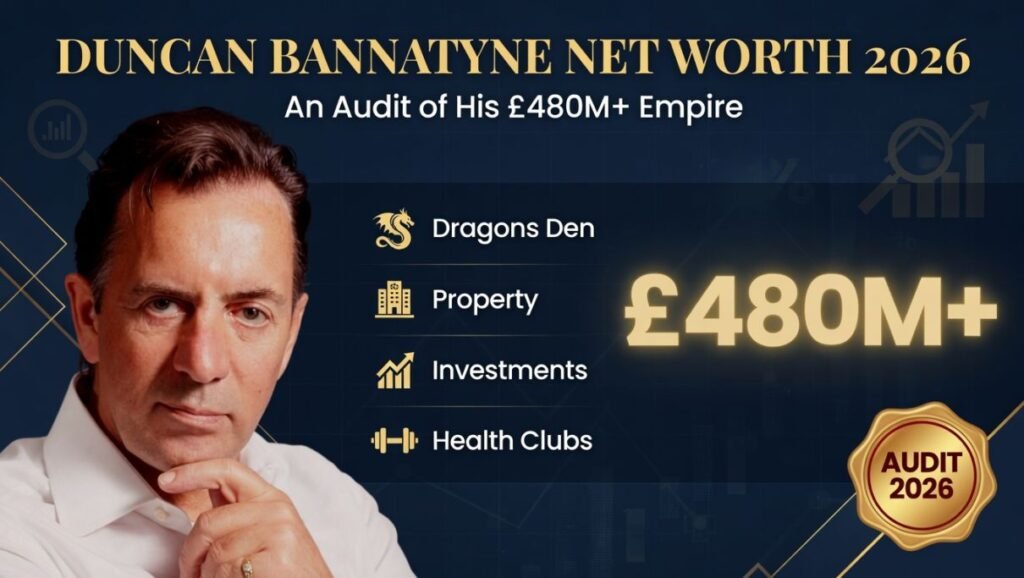
Bannatyne Group’s results reported in April 2026 show that Duncan Bannatyne’s post‑divorce rebuilding strategy has delivered measurable results. Over thirteen years, Bannatyne rebuilt a stripped-back asset base into a cash-generative wellness business that has outperformed discretionary retail and budget fitness chains during the current inflationary cycle. With record turnover of £158 million for the year ending December 2025, operating profits of £27.2 million, and EBITDA holding steady at £43.7 million, the 2026 fiscal year validates Bannatyne’s rebuild: operational focus over speculative leverage.
Bannatyne Empire Timeline: 2006 – 2026
From £92M Hilton Acquisition to £158M Revenue — A 20-Year Operational Arc
Hilton Health Club Acquisition & McCue Marriage
Acquires 26 Hilton health clubs for £92M, funded via Anglo Irish Bank facility. Marries Joanne McCue. The Bannatyne empire enters peak expansion mode.
AcquisitionAnglo Irish Bank Collapse & Hastings Hotel Launch
Opens the £12M Bannatyne Spa Hotel in Hastings during the global financial crisis. Anglo Irish Bank enters crisis conditions during the financial crash, tightening credit conditions around the facility that funded the Hilton deal.
CrisisPeak Valuation: £430M (Sunday Times Rich List)
Sunday Times Rich List values Bannatyne’s personal wealth at £430 million — the highest figure ever recorded. The empire spans health clubs, hotels, property, and media ventures.
Peak ValuationDivorce from Joanne McCue
Marriage dissolves after Bannatyne receives a text message while filming Dragons’ Den. Reported asset transfer of ~£345M. Published net worth collapses to approximately £85M — an 80% reduction.
Asset DecimationDragons’ Den Exit, Watson Fraud, Clarice House Acquisition
Exits Dragons’ Den after Series 12. Former finance director Christopher Watson jailed for £7.97M fraud (2008–2014). Acquires Clarice House spa properties in Bury St Edmunds and Colchester in September.
Strategic PivotRemarriage to Nigora Whitehorn
Marries Nigora Whitehorn on 3 June 2017. Sells all remaining Dragons’ Den investments. Commits 100% operational focus to the Bannatyne Group core business.
Personal ResetRecord Revenue, Beechdown Acquisition, First Padel Courts
FY2025 delivers record turnover of £158M and £43.7M EBITDA. Acquires Beechdown Leisure Club in Basingstoke (December). Opens first padel courts at Ingleby Barwick, Teesside.
Record Year£158M Revenue Confirmed & National Padel Expansion
April 2026 filing confirms record results. Padel expansion announced across Norwich, Livingston, Basingstoke, Chafford Hundred, Stratford-upon-Avon, Colchester, and Grove Park. 70 sites, 219,743 active members.
Growth PhaseThis audit frames Bannatyne’s trajectory as a blueprint for UHNW asset reconstruction. The 2012 divorce from Joanne McCue functioned as a forced “reset point” that stripped away the speculative periphery—film investments, leveraged property plays, and media-centric diversification—leaving only the cash-generating core of 70 locations, 219,743 active members, and an integrated spa-hotel ecosystem. Where the 2006-era Bannatyne empire was built on aggressive debt-funded acquisition (most notably the £92 million Hilton health club purchase and a £180 million Anglo Irish Bank facility), the 2026 model is defined by capital discipline, margin protection, and strategic utilization of existing real estate through the high-margin padel court rollout. The result is a personal net worth that industry trackers estimate between £280 million and £515 million, depending on whether enterprise value is attributed personally or kept at the corporate level. The Glasgow Rich List placed his wealth at £500 million in 2024, while the Sunday Times Rich List historically valued him at £280 million in 2018, with the underlying enterprise value likely exceeding £700 million when premium wellness EBITDA multiples are applied.
Bannatyne Asset Matrix: 2026 Valuation Estimates

The Divorce Decimation: How the 2012 Divorce Reshaped the Bannatyne Asset Baseline
The forensic impact of Duncan Bannatyne’s 2012–13 divorce proceedings from Joanne McCue remains one of the most instructive case studies in UK High-Net-Worth legal risk. The dissolution of their marriage—they had been together for eighteen years and married since 2006 — initiated by a text message received while Bannatyne was filming the ninth series of Dragons’ Den — triggered an asset transfer that contemporaneous reports and Bannatyne’s own public statements valued at approximately £345 million, though the precise figure has never been confirmed by either party. The Sunday Times Rich List valued Bannatyne’s wealth at £430 million in 2011; post-divorce, that figure fell to approximately £85 million, a collapse Bannatyne himself has publicly acknowledged, a figure that implied the loss of roughly 80% of his stated net worth through the settlement, legal costs, and concurrent asset devaluation.
The settlement’s structural damage extended far beyond personal liquidity. Bannatyne was forced to sell his luxurious villa on the French Riviera and a London flat, retrenching to a more modest property on Lake Windermere. More critically, the divorce coincided with the legacy of a £180 million Anglo Irish Bank facility drawn in 2006, which funded the £92 million Hilton acquisition and broader estate expansion—just before the bank’s collapse during the global financial crisis.
The combined effect of the asset division and frozen credit lines forced a strategic pivot: Bannatyne could no longer fund growth through leveraged acquisition. Instead, he was compelled to extract maximum yield from existing operational assets, transitioning from a speculative, debt-funded expansion model to one governed by operating cash flow discipline. This transition laid the groundwork for the financially stable business that exists today.
From a legal-risk perspective, the Bannatyne-McCue dissolution is now cited in family law circles as a masterclass in why late-in-life marriages require forensic asset disclosure and pre-nuptial structuring. Bannatyne has publicly stated that his best man advised a pre-nuptial agreement but he dismissed it as “unromantic”—a decision he has since described as his most costly business error. The case also illustrates the danger of interim payment demands during proceedings; McCue reportedly sought £1,000 per day as an interim award, while Bannatyne was forced to make staff redundancies to manage cash flow.
For wealthy entrepreneurs, the lesson is clear: skipping a prenup carries direct business consequences. The Duncan Bannatyne divorce settlement impact was not merely a personal tragedy but a forced operational restructuring that eliminated speculative risk from the corporate balance sheet and replaced it with the high-yield, membership-driven model that now defines the group. Bannatyne remarried in 2017, to Nigora Whitehorn. The marriage coincided with his operational turnaround period and has remained stable, in contrast to the turbulence of the McCue years.
The Membership Multiplier: Decoding the £158M Revenue Engine of The Bannatyne Group
The Bannatyne Group annual report 2026 (covering the fiscal year ending December 2025) reveals genuine top-line growth against significant cost inflation — driven in part by employer National Insurance increases that Bannatyne has publicly criticised as a policy failure. Revenue reached £158 million, up 6% from £149.7 million in 2024, while operating profits climbed to £27.2 million (from £25.8 million) and EBITDA held firm at £43.7 million. Pre-tax profits rose to £15.7 million from £14.4 million. These figures are particularly notable given that the group absorbed a £2 million increase in employer National Insurance contributions and faces energy tariffs that now represent 11% of the total cost base. The membership count—219,743 active members, up from 219,500—demonstrates that retention rates in the premium mid-market segment remain robust even as disposable income contracts.

The valuation logic underpinning these numbers matters in the context of 2026 fitness industry EBITDA multiples. While volume-based operators trade at compressed multiples due to churn and price-war vulnerability, Bannatyne’s integrated “health club + spa + hotel” ecosystem commands premium valuation. The recurring revenue model—annual memberships paid via direct debit, supplemented by spa day passes, hotel stays, and ancillary personal training—generates predictable cash flows that PE firms now value at 12–18x EBITDA.
| Metric | Bannatyne | David Lloyd | PureGym | The Gym Group |
|---|---|---|---|---|
| Sites | 70 | ~130 | 500+ | 230+ |
| Model | Mid-premium | Premium | Budget | Budget |
| Ownership | Private/founder | PE (TDR) | PE (Leonard Green) | Public (LSE) |
| ARPU est. | ~£60/mo | ~£110/mo | ~£22/mo | ~£18/mo |
This is in stark contrast to the 6–8x multiples typical of transactional gym models. While Mike Ashley (Frasers Group) represents the volume-based fitness play, Duncan Bannatyne represents the Premium Mid-Market Pivot—leveraging brand loyalty and spa-integration to maintain higher ARPU (Average Revenue Per User). The UK health club market share data supports this: Bannatyne Group remains the largest independent chain, and its 70-site footprint provides geographic diversification that insulates against regional economic shocks.
Among direct competitors, David Lloyd Leisure operates a comparable premium model with ~130 UK clubs but is PE-owned (TDR Capital). PureGym and The Gym Group dominate the budget segment with 500+ and 230+ sites respectively. Bannatyne occupies the mid-premium gap between David Lloyd’s £100+/month pricing and budget operators’ sub-£30 offerings.
The “Padel Premium”: Revenue per Square Foot in 2026
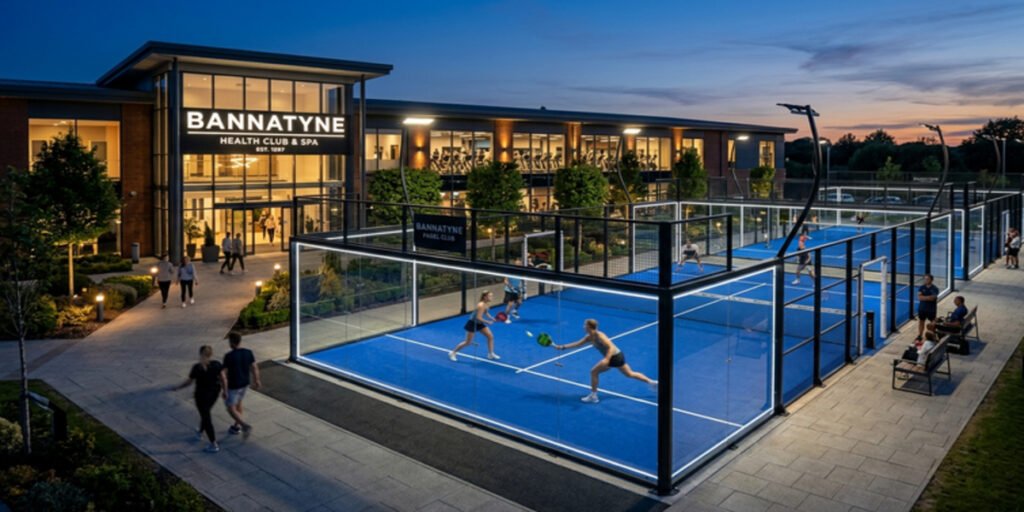
This is not trend-chasing; it is high-margin utilization of underperforming land assets. The group has already launched all-weather courts at Ingleby Barwick and is advancing planning permissions for 20 additional courts across the portfolio, with locations marketed by the group across Norwich, Livingston, Basingstoke (Beechdown Park), Chafford Hundred, Stratford‑upon‑Avon (Wildmoor), Colchester, and Grove Park—some already bookable and others listed as “coming soon,” depending on site and planning/build timelines.
Padel courts operate at 60–70% utilization rates, command £20–£40 per hour in court fees, and require minimal incremental capital expenditure when installed on existing car parks or surplus land. Critically, these courts are available to non-members, functioning as a low-friction customer acquisition funnel that converts casual players into full health club subscribers. For a business where real estate is the primary fixed cost, increasing revenue per square foot through padel delivers direct margin improvement — a margin advantage over competitors still reliant on membership dues alone.
The Debt-to-Equity Discipline: Avoiding the Leverage Trap
The capital structure of Bannatyne Group warrants particular attention. Unlike competitors who pursued leveraged rollups during the low-interest-rate era of 2019–2021 and are now facing refinancing cliffs, Bannatyne has maintained a lean debt profile. The trauma of the 2008 Anglo Irish Bank collapse—where a £180 million facility became a deadweight liability—instilled a permanent aversion to over-leveraging. The group also survived an £8 million internal fraud (£7,974,221 taken between 2008 and 2014) by former finance director Christopher Watson, who was jailed in November 2015 The incident prompted tighter financial controls and governance reforms.
The 2026 accounts show a business that has absorbed £2 million in National Insurance increases and 11% energy cost exposure without resorting to distressed asset sales or dilutive equity raises. This capital-light philosophy enabled the December 2025 acquisition of Beechdown Leisure Club in Basingstoke without jeopardizing the core balance sheet. Bannatyne’s operational efficiency—closing underperforming clubs in Manchester while opening in high-demand zones—has delivered more value than financial engineering would have. The group has also invested in solar energy installations across multiple sites, aiming to reduce long-term energy exposure—a material consideration given that energy now represents 11% of the cost base.
Performance Audit: FY 2025/2026 Financial Indicators
| Data Point | Growth Trend | FY 2025/2026 |
|---|---|---|
| Total Revenue | +6% YoY | £158,000,000 |
| Operating Profit | +5.4% YoY | £27,200,000 |
| EBITDA | Stable | £43,700,000 |
| Member Count | Active Growth | 219,743 |
| Pre-Tax Profit | +9% YoY | £15,700,000 |
| Energy Cost Exposure | 11% of Cost Base | Managed |
| Key Diversifier | Padel Court Expansion | 20+ Courts (pipeline; timing varies by site) |
Risk Factors: What Could Derail the Bannatyne Recovery
- Key-man risk: Bannatyne is 77. No succession plan is publicly disclosed.
- Concentration risk: 100% UK-based revenue.
- Interest rate exposure: If rates stay elevated, any future debt raises become expensive.
- Padel market saturation: The UK padel market is growing rapidly but could saturate.
High-Yield Diversification: International Real Estate and the Luxury Wellness Hedge
Bannatyne’s non-gym assets function as critical inflation hedges and currency diversifiers within the broader portfolio. The group operates three premium hotels—the Charlton House Spa Hotel in Somerset, the Bannatyne Spa Hotel in Hastings, and the Bannatyne Hotel in Darlington—alongside an integrated network of 45 luxury spas that are co-located with health clubs. This ecosystem generates ancillary revenue streams that are less cyclical than pure gym memberships; spa day passes and hotel stays capture discretionary spend from non-members while deepening retention among existing subscribers. The luxury spa market growth in the UK premium segment continues at 8–10% CAGR, and Bannatyne’s 45-spa network represents the largest integrated spa-health club operation in Britain.
The international HNW real estate component provides a further buffer against UK energy cost volatility and sterling weakness. Bannatyne maintains a villa in Portugal’s Algarve, purchased in 2016 and situated minutes from the beach, which functions as both a personal retreat and a euro-denominated asset. While his former French Riviera villa was liquidated post-divorce, the Portuguese holding remains, offering geographic diversification outside the UK tax and energy regime. The UK hotel portfolio, expanded through the 2015 Clarice House acquisition and the 2025 Beechdown purchase, provides hard-asset collateral that appreciates independently of the subscription revenue engine. These assets are not passive holdings; they are operational extensions of the wellness brand that cross-sell memberships, spa treatments, and hospitality stays.
The Operator’s Evolution: Media Legacy vs. Asset Reality
The final component of this audit is Bannatyne’s shift in public identity. Between 2005 and 2015, Bannatyne was defined by his Dragons’ Den “TV Investor” identity—deploying capital into 36 businesses, cultivating an X (Twitter) following in the hundreds of thousands, and engaging in speculative side ventures including paying £8,000 at a charity auction for a brief appearance in a Guy Ritchie film. That persona generated press coverage but diluted operational focus. His 2015 exit from the show, alongside Kelly Hoppen and Piers Linney, coincided with a decisive strategic choice: by 2016, he had sold all his Dragons’ Den investments and redirected 100% of his focus to the Bannatyne Group.

This transition from ‘TV Investor’ to ‘Hard-Asset Operator’ is a primary driver of the Group’s enterprise value doubling over the past decade. Where Peter Jones diversified horizontally into telecoms, retail, and logistics, and where Theo Paphitis spread capital across retail, property, and licensing, Bannatyne chose vertical depth. He invested in a sector-leading apprenticeship program, delegated to fitness-industry specialists rather than media personalities, and refined site-level KPIs. The result is an approximately 3,000-strong workforce. The 2026 financial results—delivered against employer National Insurance hikes, rising energy tariffs, and inflationary wage pressure—demonstrate the financial payoff of operational concentration. For entrepreneurs rebuilding after personal or legal setbacks, the Bannatyne approach is straightforward: cut the speculative holdings, concentrate on the cash-generating core, and let earnings compound.
Forensic Intelligence: Frequently Asked Questions about Duncan Bannatyne
What is Duncan Bannatyne’s net worth in 2026?
Estimates of Duncan Bannatyne’s personal net worth range from approximately £280 million (Sunday Times Rich List methodology) to £515 million (when proportional enterprise value is attributed personally). The Glasgow Rich List placed his wealth at £500 million in 2024. The discrepancy in estimates reflects varying assumptions about the private market value of the Bannatyne Group, which—based on 2026 fitness sector EBITDA multiples of 12–15x—carries an implied enterprise value of £650–750 million. His personal liquidity is further supported by international real estate in Portugal and the UK hotel portfolio.
How many gyms does Duncan Bannatyne own?
The Bannatyne Group operates 67 health clubs across 70 total UK sites, alongside 45 integrated spas and three premium hotels. It is the largest independent health club chain in the United Kingdom. The 2026 footprint includes recent acquisitions such as Beechdown Leisure Club in Basingstoke and the planned installation of 20+ padel courts across existing locations.
Did the divorce ruin him financially?
No. While the 2012 divorce settlement from Joanne McCue reportedly transferred approximately £345 million in assets, Bannatyne retained the operational core of his business. Instead of insolvency, the divorce functioned as a forced capital structure reset that eliminated speculative holdings and refocused the business on high-yield operational cash flow. By 2026, his net worth has fully recovered to pre-divorce levels through equity compounding.
What is the “Padel Pivot” and why does it matter for valuation?
The “Padel Pivot” refers to the strategic conversion of underutilized car parks and land into high-margin Padel tennis courts. In 2026, this represents the group’s highest revenue-per-square-foot diversifier. Unlike traditional gym floor space, Padel courts command premium hourly fees from both members and non-members, significantly increasing the EBITDA yield of existing real estate assets.
Is the Bannatyne Group positioned for an IPO or sale in 2026?
While no formal IPO has been announced, the 2026 financial profile—characterized by low leverage and 17.2% operating margins—makes the group a “Grade A” target for private equity roll-ups. Industry analysts suggest that the current focus on “premiumizing” the estate (spas and hotels) is a classic pre-exit strategy designed to maximize the sale multiple beyond the standard fitness sector average.