

Julian Ovenden, 50, is an English actor and classically trained tenor whose career spans British and American television, West End and Broadway musical theatre, and international concert stages. He’s best known to television audiences as Charles Blake in Downton Abbey and Andrew Foyle in Foyle’s War, and to theatre audiences for leading roles in West End musicals including South Pacific, Merrily We Roll Along, and High Society.
Early life and training

Ovenden was born in Sheffield on 29 November 1975 (his Companies House filing records November 1975, though some entertainment databases give 1976), one of three children of the Reverend Canon John Ovenden, a former chaplain to Queen Elizabeth II. He sang as a boy in the St Paul’s Cathedral Choir, won a music scholarship to Eton College, and went on to a choral scholarship at New College, Oxford, where he read music. He completed his formal acting training at the Webber Douglas Academy of Dramatic Art in London. Through his father’s chaplaincy and his own musical career, Ovenden has performed for the Queen on multiple occasions.
Screen career
Ovenden’s television work spans both sides of the Atlantic. His early break came in Foyle’s War (ITV, 2002–2015), and he later joined the cast of Downton Abbey as Charles Blake. His other credits include Smash, Any Human Heart, Knightfall, The Sound of Music Live!, and Adult Material, according to his stage-and-screen profile with WhatsOnStage. More recently, he played Robert F. Kennedy in Netflix’s The Crown, appeared in Bridgerton and the second season of Armando Iannucci’s Avenue 5 (HBO), and played the lead antagonist Jonah Markham — Director of Interpol — in the Paramount+ series NCIS: Tony & Ziva (2025, 8 episodes). He has also appeared in ITV’s Trigger Point.
Earlier TV work includes The Forsyte Saga (ITV, 2002–03), The Royal (ITV), and three seasons as a recurring cast member in Person of Interest (CBS). His film credits include Colonia (2015), opposite Emma Watson.
Stage career
Ovenden’s professional stage career began with a production of King Lear for the Royal Shakespeare Company, directed by Yukio Ninagawa. His subsequent theatre credits run through many of London’s major houses — the Donmar Warehouse, the Almeida, the Young Vic, the Royal Shakespeare Company, and the West End — as well as Broadway and New York’s Roundabout Theatre, as detailed in his West End Theatre star profile. He was cast by director Michael Grandage in two Olivier Award-winning Donmar Warehouse productions: Merrily We Roll Along (as Franklin Shepard) and Grand Hotel (as Baron Felix Von Gaigern).
In 2022–2023, he starred as Emile de Becque in a revival of South Pacific at Chichester Festival Theatre and Sadler’s Wells, for which WhatsOnStage reports he received a nomination for the 2023 Olivier Award for Best Actor in a Musical — a credit also noted in the Barbican Theatre’s official casting announcement for his next production. He also starred opposite Gillian Anderson in Ivo van Hove’s All About Eve at the Noël Coward Theatre.
In summer 2026, Ovenden returned to the West End as Dexter Haven in the Barbican Theatre production of Cole Porter’s High Society (19 May – 11 July 2026), alongside Helen George, Felicity Kendal, and Freddie Fox. The production is now on a 20-week UK and Ireland tour running until November 2026. The casting was confirmed in the Barbican’s official press release, and Ovenden discussed the return to musical theatre in an interview with London Theatre magazine. Full tour casting and ongoing coverage of the production have been tracked by BroadwayWorld.
Music
As a classical crossover artist, Ovenden has performed with the New York Philharmonic, the Royal Philharmonic Orchestra, and at the Sydney Opera House, and is a regular performer at the BBC Proms at the Royal Albert Hall. He released his debut album, If You Stay (Decca), in 2013 and made his Carnegie Hall debut in 2014. He also appears on Christmas at Downton Abbey (Warner Music), and in 2021 released Together At A Distance, a duet album with Broadway star Sierra Boggess, co-produced through his own company RyeNote Productions and distributed by Craft Recordings.
Personal life
Ovenden lives in London with his wife, opera singer Kate Royal (married December 2010), and their two children. Ovenden is reported to hold a private pilot’s licence.
Companies House
Companies House lists Julian Mark Ovenden (date of birth November 1975) as an active director of RYENOTE PRODUCTIONS LTD (company number 09313535), appointed 17 November 2014, with a correspondence address in Wembley, Middlesex. The company’s other director is Kate Laura Royal — matching the name of Ovenden’s wife, opera singer Kate Royal — which makes the identity match effectively certain. RyeNote Productions also appears in the label credits of Ovenden’s 2021 duet album with Sierra Boggess, Together At A Distance, confirming the company is used as a production vehicle for his recording work. The company was registered with share capital of just £2, and its public filings do not disclose Ovenden’s personal income, dividends, or assets.
What about his net worth?
Here’s the honest answer: there isn’t a verified figure. Searching for “Julian Ovenden net worth” turns up wildly different numbers from site to site — estimates ranging from roughly $1.3 million to as high as $18 million, none of them tracing back to a tax filing, an official statement, or any other verifiable source. That’s a sign these are generic estimates generated (often algorithmically) to fill out celebrity-finance pages, not real reporting.
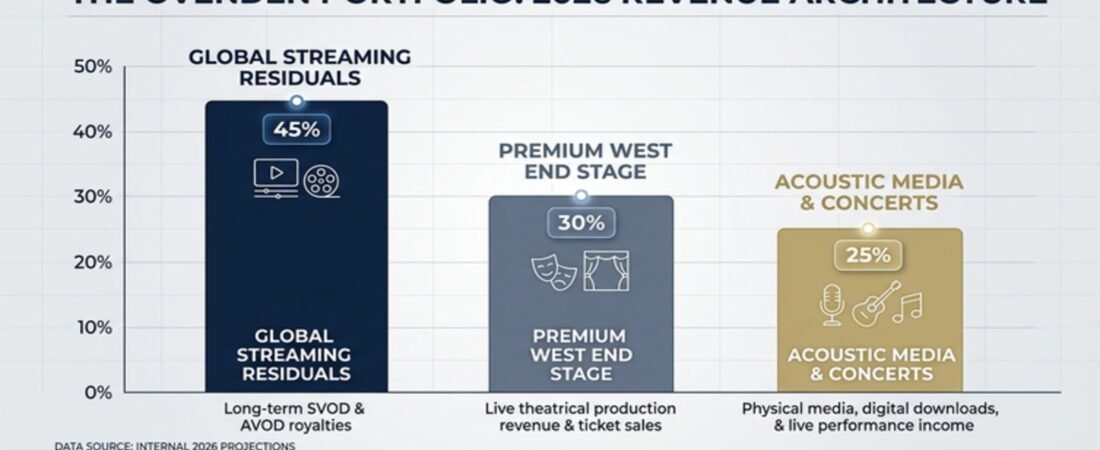
Unlike executives at public companies, actors’ and performers’ earnings aren’t a matter of public record in the UK or US, and Ovenden hasn’t discussed his finances publicly. We’d rather tell you that plainly than repeat an invented number as fact. What is verifiable is the shape of his income: fees from television and film roles, West End and touring theatre contracts, and concert and recording work. West End performer pay is governed by Equity/SOLT agreements — under the latest deal (April 2026 – April 2029), minimum rates at Category A theatres (1,100+ seats, which includes the Barbican) are approximately £966 per week for an eight-show schedule. Lead performers in named roles typically negotiate well above this minimum. However, Ovenden’s specific contract terms are not public.
What We Don’t Know About Julian Ovenden’s Earnings
Unlike business figures or sports stars with publicly filed accounts, actors in the UK have no obligation to disclose their earnings. Specifically:
Individual contract fees: Neither ITV, Netflix, Paramount+ nor any West End producer has disclosed what Ovenden was paid for any specific role.
Residual and streaming royalties: UK television residual payments are governed by Equity agreements but the amounts per actor per show are not public. Whether Ovenden receives ongoing royalties from Downton Abbey’s global streaming (now on multiple platforms) or The Crown is unknown.
Concert and recording income: Ovenden performs at the BBC Proms and has released albums on Decca, but neither concert fees nor recording royalties are public.
Companies House filings: Ovenden’s production company, RYENOTE PRODUCTIONS LTD, is confirmed, but small-company filings do not disclose income, dividends, or what the company earns from his recording projects.
That is why this page does not publish a specific net worth figure.
Sources & Verification
Primary Sources Used
- IMDb — filmography and biographical data
- Companies House — RYENOTE PRODUCTIONS LTD (company number 09313535); directors Julian Mark Ovenden and Kate Laura Royal, appointed 17 November 2014
- WhatsOnStage — career profile and 2023 Olivier Award nomination
- Barbican Theatre — official casting announcement, High Society (2026)
- London Theatre — interview with Ovenden on High Society
- BroadwayWorld — production and tour coverage
- SOLT/Equity — published West End performer minimum rates (2026–2029 agreement)
What Is Estimated and Why
- Nothing. No earnings figure is estimated on this page — see “What We Don’t Know” above for why a reliable estimate cannot be produced.
Page last checked: September 2026 | Corrections: business@elitesmindset.co.uk