

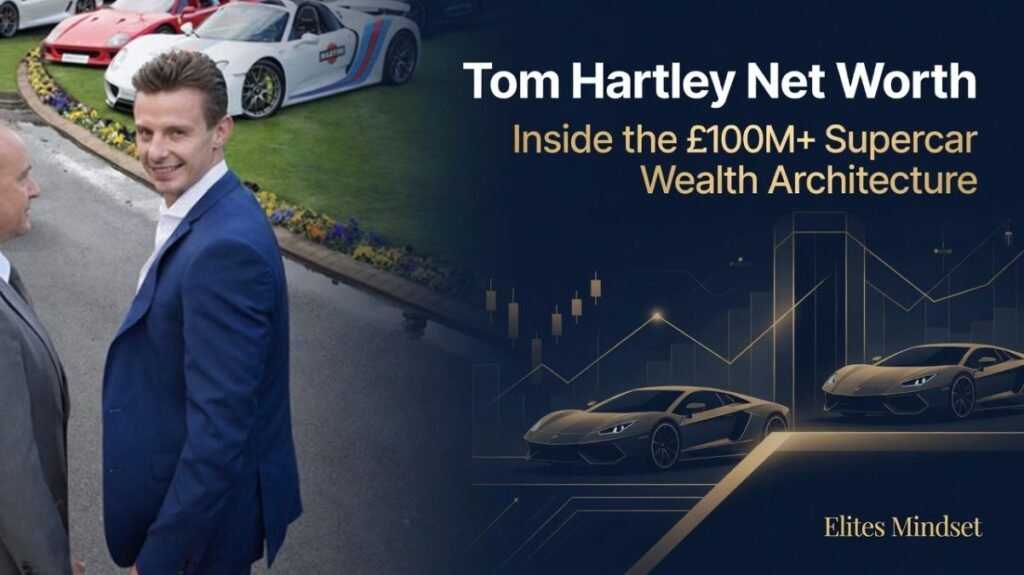
Tom Hartley left school at 11. By his own account, he could not read or write. A year later, in 1973, he sold his first car — a Range Rover — out of Glasgow. He was 12 years old.By 17, he was a millionaire. Then the business collapsed.
He did not restructure or refinance. He started again — collecting cars himself, delivering them, polishing them. That period is not incidental to how the business works today; it is the reason the business works the way it does. Tom Hartley Cars has never borrowed money from a bank. The man who runs it has already lived through what happens when it goes wrong. Over a career now spanning five decades, Hartley has claimed more than $5 billion in lifetime transactions. (🟠 Director Statement: The Dealmaker autobiography)
Across a five-decade career, Hartley has built a family-controlled business group that operates on fundamentally different financial principles than institutional dealership groups. While traditional luxury automotive retailers rely on floor-plan finance lines, leveraged inventory positions, and institutional credit facilities, Hartley’s enterprise operates on similar principles to a debt-free family office — acquiring assets outright, holding them without leverage, and distributing profits through dividends rather than salary.
The Hartley empire bifurcates into two distinct corporate entities that must be understood separately: Tom Hartley Cars Limited (Company number 07061171), the Derbyshire estate-based operation helmed by Tom Hartley Sr. and his son Carl; and Tom Hartley Jnr Limited (Company number 06712857), the breakaway Cotswolds operation founded by Hartley’s elder son.
Tom Hartley Sr. — Key Life & Business Milestones
| 1961 | Born in Glasgow into a Romany family. Left school at age 11. |
| 1973 | Sold his first car — a Range Rover — aged 12. Career begins. |
| Age 17 | Became a millionaire. Shortly after, business collapsed — rebuilt from scratch. |
| 1980s | Established base on 40-acre Derbyshire estate. Began scaling to ultra-luxury segment. |
| 2009 | Tom Hartley Cars Limited incorporated (29 Oct 2009). Carl Hartley joins as co-director. |
| 2019 | New three-storey, £10M glass pavilion showroom opens on the Derbyshire estate. |
| Mar 2025 | Became first car dealer ever to sell vehicles from Harrods, Knightsbridge. |
Sources: Companies House (07061171); Car Dealer Magazine; Tom Hartley: The Dealmaker (autobiography)
🔍 Source Verification Key
This article distinguishes between statutory records and director-level claims. All figures are labelled accordingly.
- 🟢 Statutory Data — Figures drawn directly from Companies House filings (FY2024/25). Independently verifiable.
- 🟠 Director Statement — Claims made by directors in statutory accounts, autobiographies, or trade press interviews. Not independently verified unless otherwise stated.
- 🔵 Third-Party Source — Verified via architectural planning documents, trade press (Car Dealer Magazine, Motorsport Week), or other named external records.
Financial Benchmarking: The Hartley Family Assets
The Debt-Free Firewall: Deconstructing Tom Hartley Cars Limited Balance Sheet
Tom Hartley Cars Limited, incorporated on 29 October 2009 and operating from the Hartley Estate in Overseal, Derbyshire, filed accounts via Companies House showing a pre-tax profit of £2.12 million on turnover of £32.71 million—an 8.2% decline in profitability and a 31.5% contraction in revenue year-on-year.
Yet the critical insight for Tom Hartley net worth 2026 analysis lies not in top-line volatility but in balance sheet resilience. Current assets rose to £18.55 million, with cash reserves specifically increasing to £11.02 million—constituting 59.4% of total current assets. this cash position benefits from zero lease obligations, since the showroom operates on Hartley’s privately owned estate rather than leased premises. That arrangement removes occupancy cost and risk from the company’s P&L, though the estate’s own value sits outside the corporate balance sheet as Hartley’s personal property, not company equity.
Hartley Sr.’s commentary in the 2024 accounts explicitly states the corporate philosophy: “The company is in a unique position of having no debt but substantial funds in the bank and a low overhead base.” This reflects a deliberate strategy — maintaining balance sheet strength to absorb macroeconomic shocks and continue acquiring inventory when competitors face credit line contractions.
Tom Hartley Sr. has publicly stated the company carries no debt. Companies House (07061171) shows 3 charges on record — 2 outstanding, 1 satisfied — all created 30 June 2014. The charges are registered in the names of Thomas Hartley and Carl Hartley personally. This structure is consistent with personal guarantee or inter-company loan arrangements rather than third-party institutional bank debt. Readers should verify the charges register independently. 🟠 Director Statement vs 🟢 Statutory Record.
The Consignment Surge: How the £500M Ecclestone Deal Multiplied Family Profits
While Tom Hartley Cars Limited demonstrates balance sheet resilience, Tom Hartley Jnr Limited recorded rapid profit growth through a shift toward consignment brokerage. For the twelve months ending 31 March 2025, the Cotswolds-based operation filed accounts showing turnover of £173.29 million and pre-tax profit of £32.33 million—representing a 157% revenue surge and a 342% profit multiplication from the prior year’s £7.31 million.
The Bernie Ecclestone car collection sale serves as the primary accelerant. Hartley Jnr secured exclusive rights to market and sell Ecclestone’s 69-car historic Formula 1 collection, which ultimately transacted to Red Bull heir Mark Mateschitz for a collection estimated in the range of £300 million to £500 million. The actual sale price and commission earned by Hartley Jnr remain undisclosed.(🔵 Forbes/Magneto — range estimate only). Motorsport Week has reported that Mateschitz expressed intent to eventually make the collection accessible for public viewing.
This transaction fundamentally altered the company’s financial trajectory — shifting Tom Hartley Jnr Ltd from a principal-based model toward high-value consignment brokerage. Prior to completion, the collection attracted interest from multiple sovereign wealth funds — including at least one from Saudi Arabia — before transacting to Mateschitz. The commission earned on the deal has not been disclosed. This structural shift — from principal-based inventory acquisition to fee-based brokerage — represents a fundamental change in both capital efficiency and risk profile for the Cotswolds operation.
The luxury vehicle consignment margins expansion is quantifiable: gross profit margin increased from 12% in 2024 to 18.5% in 2025, a 650 basis point improvement that Hartley Jnr explicitly attributes to “the number of sales concluded on a consignment basis.” This margin expansion occurred while vehicle sales volume increased only 30% (from 81 to 105 units), indicating that consignment transactions generate disproportionate profitability relative to capital deployment. By way of comparison, £32.33 million in pre-tax profit across 15 employees works out to roughly £2.16 million in profit per head — a figure institutional dealership groups, with far larger headcounts, would be unlikely to match on a per-employee basis.
Balance sheet strength accompanied income growth: total assets reached £87.78 million, with cash reserves of £32.59 million. Full balance sheet detail, including net assets, is available in the FY2025 filing. The entity maintains zero charges or mortgages—no secured debt, no finance lines, no institutional encumbrances. This structure, filed at Companies House in November 2025, demonstrates that consignment-based selling does not merely improve margins but preserves capital—allowing the business to scale revenue without proportional balance sheet expansion.
Physical Showroom Logistics: From the Derbyshire Lake Stage to the Cotswolds Mega-Site
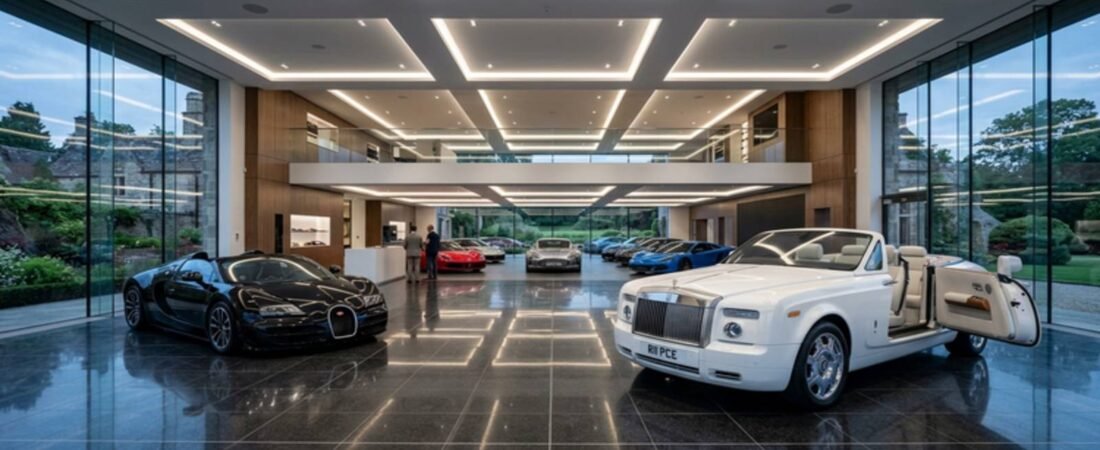
The Hartley empire’s tangible asset backing extends beyond automotive inventory to strategic real estate. The Tom Hartley showroom Derbyshire — the 40-acre estate featuring a lake-front showroom, private helipad, and residential accommodations — anchors the family’s Derbyshire operation.
The Cotswolds site — now open and trading as ‘The Firs’ in Hook Norton, Oxfordshire — represents the next phase of the family’s expansion. Planning documents from Anderson Orr Architects confirm a footprint of 42,500 sq ft, with barn-style forms referencing local vernacular architecture. The director’s statutory accounts describe it as potentially “the largest independent dealership in the UK” — though this has not been independently verified.
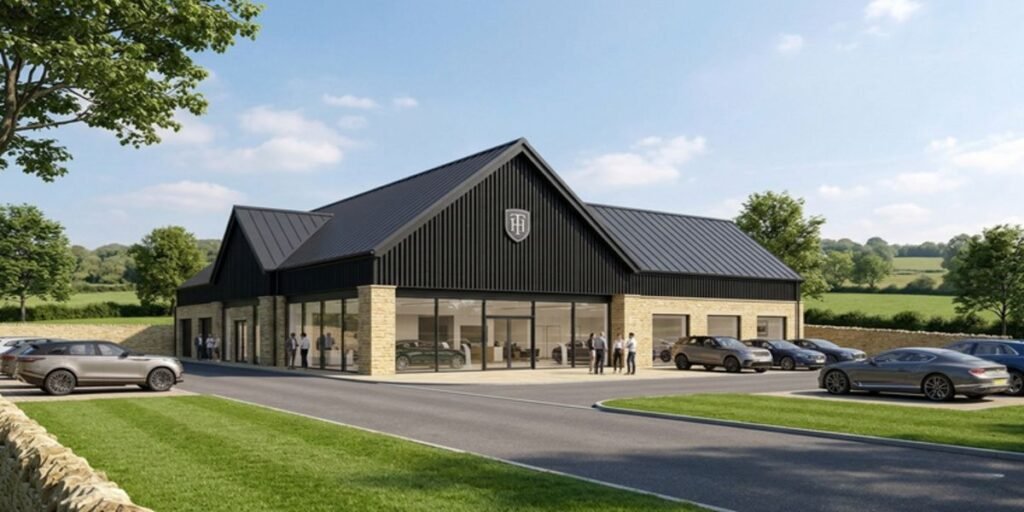
The project is funded entirely from retained earnings. Hartley Jnr confirmed in statutory accounts: “No external finance will be required to complete
this substantial project and the cost of the project will not affect the operating of the business.”
Unlike institutional dealership groups that lease from property developers or REITs, the Hartley family owns its physical infrastructure outright —
removing occupancy cost from the P&L and building long-term asset value outside the corporate balance sheet.
The Hartley Multi-Entity Financial Matrix (2024–2025 Filings)
| Feature | Derbyshire (Sr/Carl) | Cotswolds (Jnr) |
|---|---|---|
| Site Name | Hartley Estate | The Firs |
| Size | 40-Acre Estate | 42,500 sq ft |
| Inventory Focus | Modern Hypercars | Blue-Chip Classics |
| Entity | Revenue | Pre-Tax Profit | Key Liquid Assets | Corporate Status |
|---|---|---|---|---|
| Tom Hartley Cars Ltd (Derbyshire) | £32.71m | £2.12m | £11.02m Cash Reserves | Family-Owned / No Finance Lines |
| Tom Hartley Jnr Ltd (Cotswolds) | £173.29m | £32.33m | £32.59m Cash Reserves | Consignment Driven / Ecclestone Anchor |
Next Filing Dates: Tom Hartley Cars Limited — accounts to 31 October 2025 due by 31 October 2026. Next confirmation statement due 12 November 2026. — Verify on Companies House
The “Harrods Precedent” Metric: Physical-to-Digital Bridge Economics
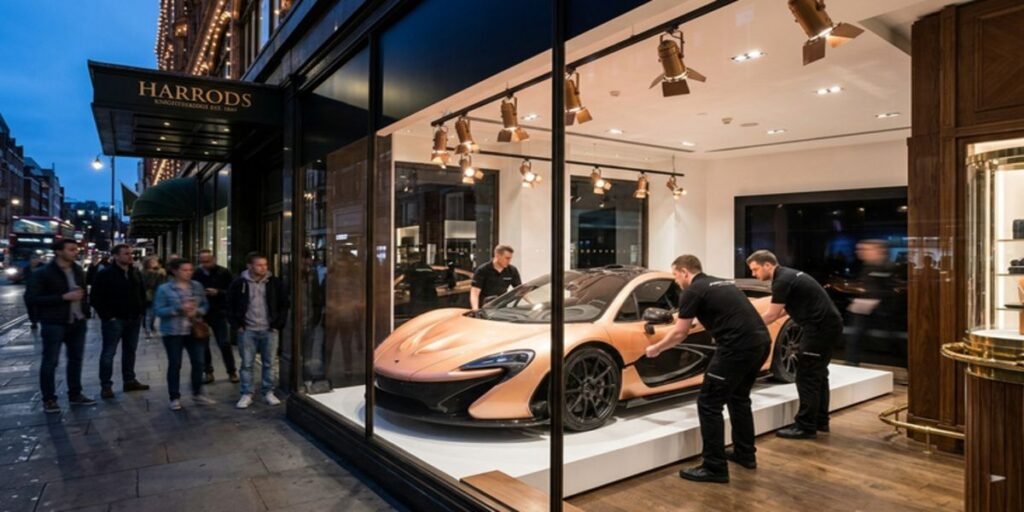
The March 2025 Harrods partnership marked a strategic expansion into a new client channel — making Hartley the first car dealer to retail vehicles within the Knightsbridge store. The three display cars — a Pagani Huayra (£2.7M), a McLaren P1 (£1.25M), and a Ferrari 599 GTO — were positioned in Harrods’ front windows, with a combined display value of over £4 million. Planned replacements included a Lamborghini Miura, a LaFerrari, and a Porsche 918, rotating subject to sale pace. (🔵 Car Dealer Magazine)
Hartley deployed a rotating inventory model supported by a live video link to the Derbyshire estate, allowing Harrods visitors to browse all 70 vehicles held there — not just the three in the store’s front windows. This gave Hartley access to an international pool of high-net-worth buyers without the marketing costs that typically reduce margins for independent dealers. Hartley told Car Dealer Magazine: ‘It’s a first for Harrods, which is the most luxurious department store in the world, no doubt about that. I was overwhelmed by the honour of being invited to make history.’
The initial March–April 2025 window ran as a one-month arrangement. Hartley stated he hoped it would continue ‘forever and a day,’ but no confirmed post-April arrangement has been publicly reported at the timeof writing. (🔵 Car Dealer Magazine)
The Consignment Leverage Model: Margin Architecture
The shift toward consignment-based selling within Tom Hartley Jnr Limited warrants detailed financial analysis. In traditional principal-based dealing, the dealer purchases inventory outright, bearing full market risk but capturing the entire spread between acquisition and sale. Hartley Jnr’s 2024 accounts, with 12% gross margins, reflected this model—requiring substantial working capital to fund inventory positions.
The 2025 transition to 18.5% gross margins through consignment represents a fundamental business model evolution. Under consignment, Hartley Jnr acts as broker rather than principal: the owner retains title until sale, eliminating inventory risk, depreciation exposure, and carrying costs. Hartley Jnr’s revenue recognition captures commission or markup without capital deployment, explaining the margin expansion despite transaction volume growth.
This consignment structure is particularly advantageous during macroeconomic slowdowns. While principal-based dealers face inventory devaluation and liquidity pressure when markets contract, consignment brokers maintain margin integrity with minimal balance sheet risk. The Ecclestone collection — described by Hartley Jnr himself as “by several multiples the biggest sale price ever achieved for a classic car collection” — demonstrated this model’s scalability: facilitating a £500 million transaction without requiring proportional capital commitment.
The Pure Family Governance Rule: Corporate Agility
Both Hartley entities exhibit a governance structure that institutional competitors cannot replicate. Tom Hartley Cars Limited has two directors: Tom Hartley Sr. and Carl Hartley. Tom Hartley Jnr Limited has one director: Tom Hartley Jnr, holding 75% or more of shares as the person with significant control. No institutional investors, private equity overlays, or external financing — meaning sole directors can commit to opportunities immediately, without board approval processes or investor consent clauses. When the Ecclestone opportunity emerged, Hartley Jnr could commit without board room friction; when the Harrods partnership was proposed, Hartley Sr. could execute without stakeholder consultation.
This operational intimacy enables the 24/7 responsiveness that global supercar clients expect from an appointment-only operation.
Frequently Asked Questions
What is the key difference between Tom Hartley Cars Ltd and Tom Hartley Jnr Ltd?
Tom Hartley Cars Limited (Companies House: 07061171) is the Derbyshire operation run by Tom Hartley Sr. and Carl Hartley, focusing on modern high-performance and luxury vehicles with a high-turnover model. Tom Hartley Jnr Limited (Companies House: 06712857) is the separate Cotswolds-based operation run solely by Tom Hartley Jnr, specialising in blue-chip historic classics and large-scale consignment brokerage. They are legally separate companies with distinct directors, different inventory strategies, and non-overlapping financial periods — combined figures in this article are clearly flagged as non-like-for-like.
How much profit does Tom Hartley Cars make?
For the period ending 31 October 2024, Tom Hartley Cars Limited reported pre-tax profit of £2.12 million on £32.71 million turnover. However, Hartley Sr. has stated that subsidiary transactions not captured in this entity would bring combined profits “more like £10 million.” The company maintains £11.02 million in cash reserves and operates debt-free.
Are Tom Hartley and Tom Hartley Jnr the same business?
No. Tom Hartley Cars Limited (company number 07061171) and Tom Hartley Jnr Limited (company number 06712857) are entirely separate legal entities. Tom Hartley Jnr resigned as director of the former in October 2014 and established the latter as an independent operation. The Derbyshire entity focuses on modern supercars and high-volume transactions; the Cotswolds entity specializes in historic classics and consignment brokerage. They share family ownership but maintain distinct inventory strategies, client bases, and financial profiles.
How do the luxury car inventories differ between the two entities?
While both brands operate in the peak luxury tier, their asset portfolios diverge sharply. Tom Hartley Cars (Derbyshire) leverages a high-turnover model focused primarily on late-model modern hypercars and luxury everyday cruisers (e.g., modern Ferraris, Lamborghinis, and Rolls-Royces). Tom Hartley Jnr (Cotswolds) focuses heavily on Blue Chip historic assets, investment-grade classic racing cars, and highly complex global consignment deals where multi-million-pound values are realized over longer brokerage cycles.