
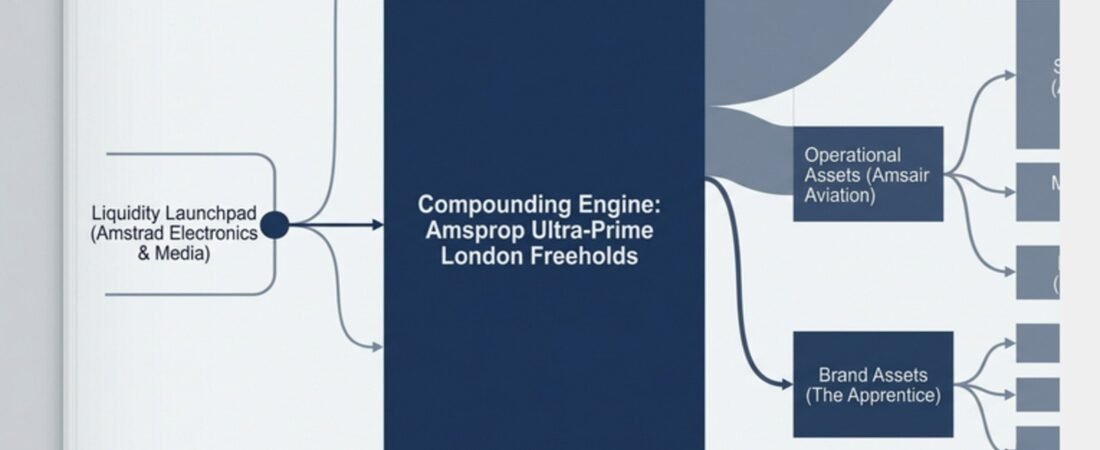

Lord Alan Sugar’s public profile is built on consumer electronics and television. Neither is the source of his billion-pound fortune. Amstrad, founded in 1968, generated the initial capital. The fortune has since been built in Central London and City of London commercial freeholds, held through a low-leverage property operation that has compounded quietly while his television profile has stayed loud.
The Sunday Times Rich List valued Sugar at £1.082 billion in 2024 (159th), down from a 2021 peak of £1.21 billion (138th). Media estimates for 2026 round this to approximately £1.1 billion.
The 2026 Sunday Times Rich List, published 15 May 2026, recorded notable departures of wealthy individuals — the list itself cited “an exodus of wealthy individuals leaving the UK in the wake of tax changes unveiled by Rachel Reeves, the chancellor.” The billionaire count peaked at 177 in 2022 and fell to 165 by 2024. Sugar’s retention of billionaire status across this period reflects the defensive construction of a freehold-heavy property portfolio.
The clearest indicator of the portfolio’s current health is the newly filed corporate data for his umbrella holding vehicle, Amshold Group Limited (Company number 08557403).
For the financial year ending 30 June 2025, Amshold reported a surge to £14.1 million in pre-tax profits — a tripling from the £932,000 recorded in the prior period — achieved through debt reduction, tactical property liquidations, and the deliberate minimisation of leverage in a high-interest economy. The following matrix isolates the hierarchy of the Sugar portfolio.
Amshold Group Asset Balance Sheet Matrix (2026)
| Holding Entity / Asset | Primary Focus | Corporate Signal / 2026 Status | Wealth Status |
|---|---|---|---|
| Amshold Group Ltd | Parent Umbrella / Investment | Reported £14.1M pre-tax profit (FY to 30 June 2025); debt due to associated companies cut from £85.7M to £75M. Net assets grew from £13.4M to £23.8M. | Core holding company |
| Amsprop Estates | Central London and City of London commercial freeholds | Yield and capital appreciation via active asset management. Portfolio includes City of London freeholds, a Premier Inn in Brentwood, an Iceland supermarket in Leyton, and a Grade II-listed office block on Fleet Street. | Principal property portfolio |
| Amsair Executive Aviation | Executive jet charter & private operations | Operates Cessna fleet & Embraer Legacy 650 (G-SUGA). Managed by Air Charter Scotland from London Luton. | High-overhead operational asset |
| Amscreen Limited | Digital out-of-home (DOOH) screen manufacturing | Founded 2007; formerly chaired by Lord Sugar, CEO Simon Sugar until sale. Exclusive hardware supplier to Clear Channel Europe for a decade. Sold to Bauer Media Outdoor, September 2025; rebranded Bauer Media Outdoor Technic, February 2026. Simon Sugar moved to a consultancy role post-acquisition. | Mid-tier tech liquidation |
| The Apprentice (BBC) | Media & public relations platform | Bespoke and standard seed funding (£250k per winner) deployed through balance-sheet capital via corporate joint ventures (e.g., Amsvest). | Brand asset / Incidental revenue |
The Amshold Pivot: How Commercial Real Estate Eclipsed the Amstrad Legacy
Amstrad, started by Sugar at 21 selling car aerials from a van, reached industrial scale in consumer electronics through the 1980s before declining in the 1990s. In 2007, he sold his remaining interest to BSkyB for £125 million — a finite sum, not a compounding one.
That same year, he sold his remaining minority stake in Tottenham Hotspur FC to ENIC for £25 million. While Sugar had already stepped down as Spurs chairman in 2001, this 2007 transaction finalized a 16-year financial association with the football club. Sugar later donated £1.3 million from the proceeds toward the Hackney Empire’s £15 million restoration campaign — a gesture connecting the Spurs sale to his East End origins.
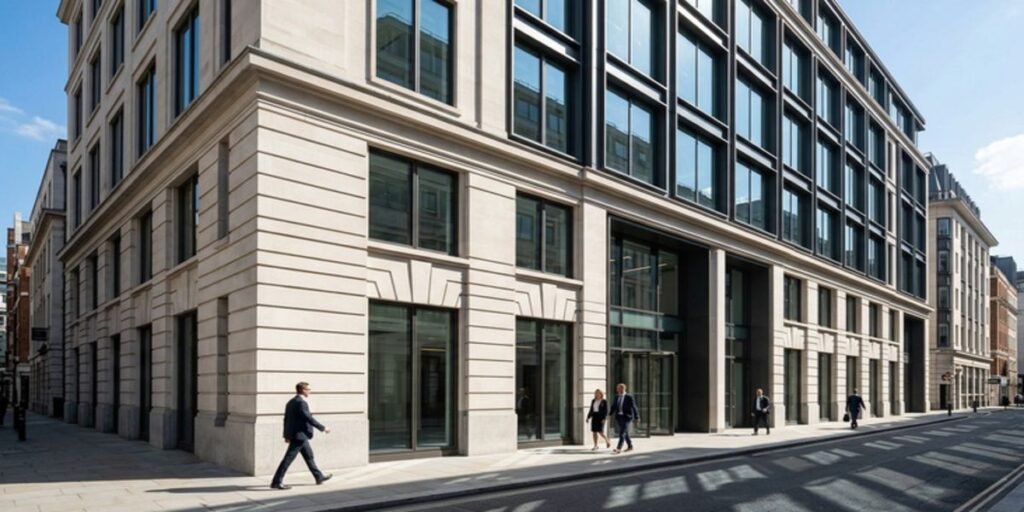
The compounding valuation occurred elsewhere. Sugar’s property operation dates to 1985. Amsprop London Limited — the vehicle through which
Sugar holds his London real estate — is run day-to-day by Daniel Sugar, who also directs Amshold International. Lord Sugar retains the role of Chairman and Managing Director of Amsprop London Limited, per his Parliamentary Register of Interests.
Amsprop’s focus is Central London and City of London commercial freeholds — acquired, refurbished, and held for long-term yield. The portfolio spans institutional-grade City sites alongside retail and hospitality assets including a Premier Inn in Brentwood, an Iceland supermarket in Leyton, and a Grade II-listed office block on Fleet Street.
As 2014 Apprentice winner Mark Wright later relayed, Sugar’s own doctrine is blunt: “You make money from property and do business for fun.”
Sugar’s holdings resemble a traditional landed estate more than a tech founder’s portfolio: freehold assets in prime London, held long, refinanced rarely. Amstrad provided the capital; property has provided the income since.
The 2026 Debt-Reduction Playbook: Inside Amshold’s £14.1M Profit Surge
📋 Amshold Group Limited — Three-Year Pre-Tax Result (FY to 30 June)
FY2023: –£29.1M (revaluation losses)
FY2024: +£0.93M (turnover £8.7M; operating profit £3.1M)
FY2025: +£14.1M (Crosspoint sale £24M; two-property disposal profit £9.9M)
─────────────────────────────────────────────────────────────
Debt to associated companies: £85.7M (FY2024) → £75M (FY2025)
Net assets: £13.4M (FY2024) → £23.8M (FY2025)
Dividends paid: £390M (2021) · £90M (2022) · nil since
Source: Companies House accounts; City AM (Dec 2025)
A forensic analysis of Amshold Group’s latest UK Companies House filings, published in December 2025 for the year ending 30 June 2025, reveals a textbook defensive maneuver from a high-net-worth operator navigating a hostile credit environment. Pre-tax profit rocketed to £14.1 million, up from £932,000 in the prior year and a staggering reversal from the £29.1 million pre-tax loss recorded two years earlier. Turnover held relatively flat at £8.9 million (versus £8.7 million), confirming that the profit surge was not driven by operational expansion but by balance-sheet restructuring.
Amshold has paid no dividend since 2022. In the two preceding years, distributions were substantial: £390 million in 2021 and £90 million in 2022, according to City AM. These payouts to Sugar personally are the direct source of the £186 million tax bill examined in the structural section below.
The primary catalyst was the liquidation of selected non-core assets rather than the accretion of new leverage. On 1 October 2024, Amshold sold The Crosspoint at 117-121 Bishopsgate for £24 million. This disposal, combined with a second investment property sale, generated a combined profit of £9.9 million. The group applied proceeds to reduce borrowings. Amshold’s operating profit rose modestly from £3.1 million to £3.6 million, but the real balance-sheet repair lay in the net revaluation gain of £800,000—recovering from a £1.2 million deficit in the prior period—pushing net assets from £13.4 million to £23.8 million.

The filings explicitly acknowledge the macro headwinds: “The market for quality London freehold investment property is difficult with high interest rates, uncertainty and fluctuating valuations,” the board stated in accounts filed with Companies House.” Sugar’s response was not to chase yield through expensive floating-rate financing—the standard trap for overleveraged REITs and private equity landlords—but to fortify. Amshold noted it holds fixed long-term funding, leaving it “extremely well placed” to acquire distressed prime assets from weaker hands. The approach is conservative: sell non-core stock while values hold, reduce debt while rates are high, and wait.
Secondary Holdings: From Amsair Aviation to The Apprentice Fee Realities
The remaining ventures are small against the property base. Amsair Executive Aviation, founded in 1993 and operated by Daniel Sugar, runs a charter fleet including multiple Cessna aircraft and the flagship Embraer Legacy 650, registration G-SUGA—a $30 million business jet managed by Air Charter Scotland from London Luton. The asset is operational, not financial: it consumes maintenance, crew, and hangar capital, and its charter revenue is incidental to a billion-pound balance sheet.
Amscreen, founded in 2007 and run by Simon Sugar as chief executive with Lord Sugar as chairman, began with forecourt advertising screens before shifting to manufacturing digital out-of-home hardware. For a decade it was the exclusive screen supplier to Clear Channel Europe. When Bauer Media bought Clear Channel’s European business in January 2025, it then moved on the supplier: Companies House filings in September 2025 recorded Bauer Media Outdoor acquiring 75% or more of Amscreen’s shares. At the point of sale, Amscreen employed more than 60 people from a 60,000 sq ft headquarters in Bolton and was reportedly Europe’s largest manufacturer of digital outdoor signage. The business was rebranded Bauer Media Outdoor Technic in February 2026.
Sugar’s BBC fee has never been publicly disclosed. Whatever the figure, it is marginal against a billion-pound balance sheet. The program’s financial significance lies not in his salary but in the Amsvest joint-venture structure, through which Sugar injects approximately £250,000 in seed capital per winner (taking a 50% equity stake via holding vehicles). This is brand architecture, not income dependency.
The Tropic Skincare Anomaly: Sugar backed 2011 series finalist Susie Ma — the only non-winner to receive his investment — with £200,000 for a 50% stake. According to Business Matters, Sugar collected an £11 million dividend before Ma began buying back his shares in April 2023. Tropic’s 2025 Companies House accounts record revenue of £76.7 million and pre-tax profit of £11.4 million, with a US market launch in August 2025. On a return-multiple basis, the original £200,000 outlay is the highest-documented figure from any Apprentice-linked investment.
📋 The Apprentice Capital Ledger — Documented Outcomes
Standard winner’s investment: £250,000 for 50% (via Amsvest Limited)
Tropic Skincare (Ma, 2011): £200,000 in → £11M dividend + staged buyout (2023)
2025 revenues: £76.7M · PBT: £11.4M
Dr Leah Clinics (Totton, 2013): Majority stake sold to private equity, 2024
Hyper Recruitment Solutions: Active; Sugar retains 50% via Amsvest
Structural Architecture: Peerage Tax Traps and Intergenerational Control
The “Lords” Tax Trap
In the 2021–22 tax year, Amshold paid Sugar a dividend of £390 million. The Bureau of Investigative Journalism and The Sunday Times reported in September 2023 that Sugar had filed his tax return as a non-UK resident… under Section 41 of the Constitutional Reform and Governance Act 2010 serving members of the House of Commons or House of Lords are automatically treated as resident and domiciled in the United Kingdom for income tax, capital gains tax, and inheritance tax purposes — irrespective of physical presence. Sugar, elevated to the Lords in 2009 as a Labour peer and sitting as a crossbencher since 2017, was legally barred from the non-resident designation on this basis. Sugar took a formal leave of absence from the Lords in 2022. His spokesperson said the absence was due to Covid-19 and the Lords’ six-month attendance rule, and denied any connection to the tax matter.
Sugar’s spokesman has disputed the characterization of these events, stating that ‘Lord Sugar is a UK tax resident, and he always has been. All his income has been taxed on the basis of his UK residency, and is fully paid up.’ The £186 million was paid in full, according to The Sunday Times, which also reported that Sugar was taking action against his tax advisers to recover the loss.
Section 41 of the Constitutional Reform and Governance Act 2010 deems all sitting peers and MPs UK-resident and domiciled for income tax, capital gains tax, and inheritance tax — regardless of physical presence or leave of absence.
Intergenerational Control Architecture
Recent Companies House filings from early 2026 reveal a deliberate recalibration of Sugar’s corporate control structure. On 31 March 2026, Amsprop Property Company Limited filed a PSC07 notice: the cessation of The Lord Sugar Family Trust as a Person of Significant Control, effective 25 March 2026. Simultaneously, a PSC01 notification re-registered Alan Michael Sugar as the direct individual PSC. A further PSC04 change of details was filed on 23 April 2026. These are not cosmetic filings; they signal a consolidation of direct personal control over the property holding vehicle, even as day-to-day operations transition to the next generation.
The intergenerational architecture is already embedded. Daniel Sugar (appointed director of Amshold International Limited on 17 December 2000) directs Amsprop and Amsair. Simon Sugar (appointed director of Amshold International on 8 January 2004) previously helmed Amscreen. Both Daniel and Simon Sugar hold directorships across the Amshold network, alongside long-term finance director Michael Edward Ray. Yet the PSC notifications confirm that absolute structural control—via direct shareholding and trust mechanisms—remains with Lord Sugar. The sons execute acquisitions, manage tenant relationships, and oversee refurbishment programs, but the freehold titles and strategic debt decisions remain centrally commanded. Day-to-day management sits with the next generation; ownership does not.
Frequently Asked Questions
Q: What is Lord Alan Sugar’s exact net worth?
The Sunday Times Rich List historically benchmarks his fortune at an estimated £1.1 billion. This valuation is strictly property-anchored and insulated from public tech-equity volatility, placing him consistently among the top tier of Britain’s wealthiest individuals.
Q: Does Alan Sugar still own Amstrad or Viglen?
No. Amstrad was sold to BSkyB in 2007 for £125 million. His education and public sector IT provider, Viglen, was fully sold to XMA in 2014. Neither legacy enterprise remains in his portfolio; both served as critical liquid entry points to fund his multi-decade commercial real estate pipeline.
Q: How much of his personal capital does Lord Sugar invest in Apprentice winners?
Sugar does not write personal cheques. Standard winners receive a £250,000 investment deployed directly from his corporate balance sheet via Amsvest Limited, with his holding structure capturing a 50% equity stake. The commercial reality of these deals is best highlighted by the Tropic Skincare anomaly: Sugar carved out a bespoke, non-winner investment path for 2011 finalist Susie Ma. Before Ma bought out his remaining 50% shares to regain full ownership, Sugar extracted a documented £11 million cash dividend from the vehicle, demonstrating that The Apprentice serves as a rigorous private-equity funnel.
Q: Why did Lord Sugar’s non-residency tax strategy fail?
In the 2021–22 tax year, Amshold paid Sugar a £390 million dividend. The Bureau of Investigative Journalism and The Sunday Times reported in September 2023 that Sugar had filed his tax return as a non-UK resident to remove a £186 million UK liability. The attempt failed under Section 41 of the Constitutional Reform and Governance Act 2010, which deems serving peers UK-resident for tax regardless of physical presence. Sugar’s spokesman has disputed the characterisation, maintaining that Lord Sugar has always been a UK tax resident and is fully paid up. The £186 million tax liability was paid in full.
Q: Who will inherit and control the Sugar property empire?
The architecture is structured entirely around intergenerational corporate continuity. While Lord Sugar consolidated absolute, direct control over the real estate engine via individual Person of Significant Control (PSC) updates at Companies House, his children are deeply embedded. Daniel Sugar directs day-to-day operations across the core real estate arm (Amsprop London Limited) and aviation fleet (Amsair), while Simon Sugar maintains a consultancy role following the Amscreen exit. Michael Edward Ray serves as long-term finance director across the group.
📋 Source Verification Key
Amshold results: City AM (Dec 2025); Companies House accounts FY2025
Net worth: Sunday Times Rich List (£1.082B / 2024); media consensus ~£1.1B (2026)
Peak: £1.21B / 138th (2021). Billionaire since 2015.
Dividends: City AM (£390M, 2021; £90M, 2022; nil since)
Tax residency: The Bureau of Investigative Journalism / The Sunday Times (Sept 2023)
Statutory basis: Constitutional Reform and Governance Act 2010, s.41 (legislation.gov.uk)
Amstrad sale: City AM; BBC; Wikipedia (£125M to BSkyB, 2007)
Amscreen sale: City AM; Companies House filing (Sept 2025); rebranded Feb 2026
Tropic Skincare: Companies House 2024–25 accounts; Business Matters; BM Magazine
Lords Register: register.parliament.uk (Lord Sugar’s registered interests, 2026)
Hackney Empire donation: £1.3M (Leisure Opportunities; London Theatre — contemporaneous reporting) Not independently verified: Amsair management contract; BBC fee
Disclaimer & Editorial Notes
This profile functions strictly as an independent forensic corporate case study and public asset audit. All corporate valuations, property holdings, and net worth indexing are compiled exclusively from high-authority public records, Companies House filings, and historical media indices. Elites Mindset operates with absolute editorial independence and maintains no corporate affiliation, endorsement, or commercial relationship with Lord Alan Sugar, Amsprop, or the BBC’s The Apprentice. The insights provided herein are for educational, corporate strategy, and analytical purposes only and do not constitute financial, legal, or investment advice.