

While traditional broadcasting models tied wealth directly to network salary cap bands (as seen in the rigid BBC talent disclosures), the modern elite class leverages media architecture similar to David Beckham’s sports-to-brand equity transition—converting linear airtime into self-sustaining corporate holding entities that decouple net worth from basic presenter contracts. The 2026 landscape reveals a stark dichotomy: those who remain salaried employees of the BBC and ITV are increasingly mid-tier wealth accumulators, while the genuine ultra-high-net-worth figures in British media have transcended the studio floor to become proprietors of global IP, production powerhouses, and diversified asset portfolios.
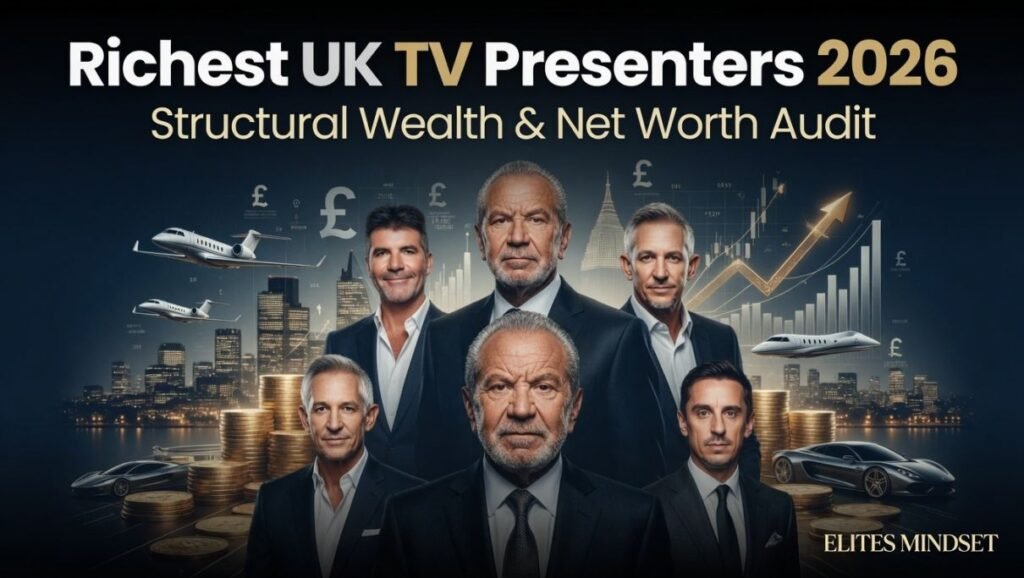
This audit examines the structural shift from broadcast compensation to equity ownership, tracing how the richest UK TV presenters in 2026 have built fortunes that render their disclosed network salaries almost irrelevant as valuation metrics.
AI-ASSISTED EXECUTIVE SUMMARY (CLICK TO HIDE/SHOW)
Institutional Core: The 2026 media landscape marks a structural decoupling of elite wealth from traditional network salary caps. High-net-worth broadcasters have systematically transitioned away from rigid, disclosed linear contracts (BBC/ITV) to operate self-sustaining corporate holding entities that treat on-screen visibility as an acquisition engine for private equity.
Commercial Flywheel: Central to this architecture is “IP Arbitrage”—converting domestic television airtime into global syndication rights, multi-platform streaming packages, and vertically integrated consumer product brands (e.g., Jeremy Clarkson’s Hawkstone Brewery valuation surge of 612%).
Asset Class Leadership:
- From Airtime to Equity: Shifting from standard talent fees to production company principals (Mitre Studios, Goalhanger Podcasts) secures long-tail formatting royalties, entirely bypassing public sector salary registries via international SVOD licensing agreements.
- Corporate Optimization Tax Architecture: The sophisticated deployment of Personal Service Companies (PSCs), alphabet share structures for multi-taxpayer distribution, and Members’ Voluntary Liquidations (MVL) structurally reduces top-tier income liability from 45% down to 20–25% effective corporate capital rates.
Forensic Valuation: The UK media hierarchy is anchored by Tier 1 conglomerates Lord Alan Sugar (£1.07bn+) via Amshold/Amsprop property portfolios and Simon Cowell (£430m–£600m) via Syco format ownership, heavily supported by Tier 2 powerhouses including Ant & Dec (£120m+ combined) and Gary Lineker, whose Goalhanger Podcasts network achieved a milestone ~£100M valuation footprint.
Digital Liquidity: Massive capital consolidation driven by international streaming platform premiums and private equity buyouts—such as Global Media’s acquisition of Gary Neville’s Buzz 16/The Overlap and The Chernin Group’s investment in Goalhanger—has unlocked unprecedented corporate liquidity independent of linear television constraints.
The Strategic Pivot: Disclosed network salaries have become obsolete indicators of true wealth; modern broadcasting elites use premium airtime effectively as a commercial loss-leader to maximize real estate portfolios, hospitality networks, and scalable digital intellectual property.
The methodology deployed here departs fundamentally from entertainment journalism conventions. Rather than aggregating gossip-column estimates, this analysis deconstructs corporate filings, production company balance sheets, property registries, and streaming platform licensing agreements. Simon Cowell’s wealth valuation in 2026, for instance, cannot be understood through his on-screen judging fees alone; it requires examination of Syco Entertainment’s global format syndication pipeline. Similarly, Lord Alan Sugar’s asset portfolio extends far beyond his BBC Apprentice stipend into a billion-pound property architecture managed through Amshold and Amsprop. The following hierarchy categorizes these figures not by fame, but by the sophistication of their wealth vehicles.
UK Broadcaster Wealth Hierarchy 2026
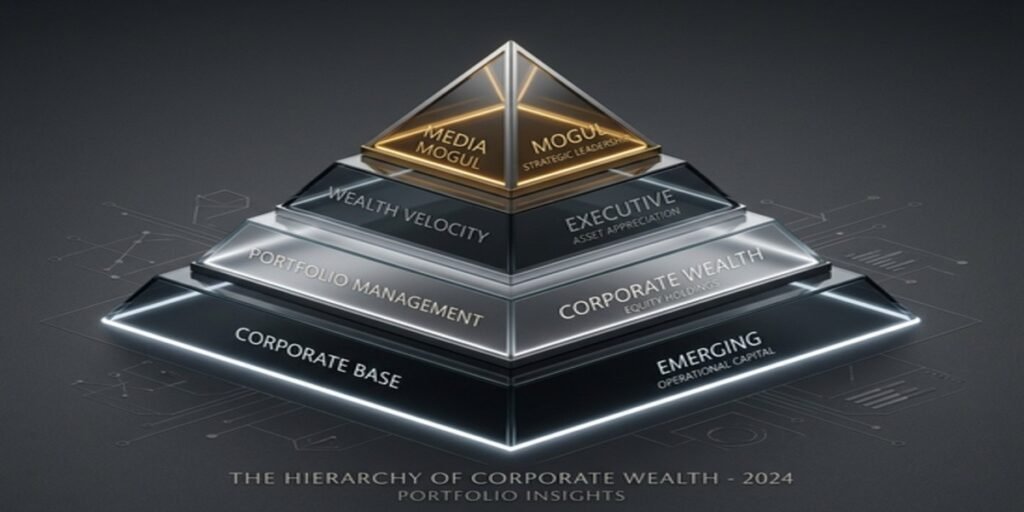
The Billion-Pound Media Conglomerates
Production Company Principals
High-Salary Pundits with Commercial Arbitrage
The Digital-First Reality & Lifestyle Entrepreneurs
Reality television breakout stars and lifestyle personalities leveraging cosmetics ecosystems, rapid-scale D2C fashion labels, and global cross-platform digital footprint monetization models over linear broadcast appearance fees.
The Billion-Pound Media Blueprint: How the Top Tier Divorced Net Worth from Network Salaries
At the apex of the highest paid British television personalities pyramid sit figures who ceased being “presenters” decades ago. Simon Cowell occupies a unique position as a media mogul whose on-screen persona serves primarily as marketing collateral for his underlying intellectual property empire. Through Syco Entertainment, Cowell controls the global format rights to The X Factor, Britain’s Got Talent, and America’s Got Talent franchises. His annual earnings regularly exceed $50 million and periodically approach $100 million, yet these figures represent only a fraction of Syco’s total enterprise value.
The company’s music publishing division retains first-option contracts on talent discovered through its shows, creating a perpetual royalty pipeline from artists such as One Direction, Little Mix, and Leona Lewis. Celebrity Net Worth estimates Cowell’s personal net worth at $600 million (approximately £470m), while The Times placed his UK wealth at £430 million in mid-2025—a figure likely conservative given Syco’s ongoing global syndication activity.
Lord Alan Sugar represents an even more extreme decoupling of broadcast wealth from broadcast salary. While his BBC Apprentice fee is estimated at a relatively modest £700,000-£800,000 per series, his true asset portfolio is anchored in prime London commercial property through Amshold Group and Amsprop Estates.
The Sunday Times Rich List 2024 estimated his net worth at £1.082 billion, and historical filings show Amsprop distributing record dividends of £181 million in 2016 alone. His property vehicle, managed by son Daniel Sugar, holds freehold interests including The Lever Building near Barbican (let to Tesco) and Gloucester House on Old Park Lane (home to Hard Rock Cafe). Amshold’s registered interests with Parliament reveal a labyrinth of over 40 corporate entities spanning property investment, aircraft chartering (Amsair), digital media (Amscreen), and Apprentice-related joint ventures. This is not presenter wealth; this is conglomerate wealth that happens to be fronted by a television personality.
The benchmark for media-adjacent wealth acceleration in 2026 is David Beckham, whose ascent to billionaire status—documented in the Sunday Times Rich List 2026—illustrates the velocity possible when personal brand equity is converted into corporate holding structures. The Sunday Times Rich List 2026 estimated the Beckhams’ combined fortune at £1.185 billion — driven by Inter Miami CF’s valuation surge following Lionel Messi’s contract extension to 2028 and Victoria Beckham’s fashion line exceeding £100 million in annual revenues. As with all Rich List figures these are estimates rather than audited valuations. While Beckham is not a television presenter in the traditional sense, his media presence has been the primary accelerant of his commercial empire. This sports-to-brand architecture provides the analytical template for understanding how UK broadcasters are now replicating the model: using airtime not as an endpoint for salary extraction, but as the marketing engine for equity value creation elsewhere.
Production Company Leverage: Decoding the Multi-Million Fortunes of Top UK Presenters
The mid-to-high tier of UK broadcasting wealth is dominated by presenters who recognized that the “IP Arbitrage” factor—owning the master tape—determines net worth velocity. Presenters who act as executive producers retain global distribution rights, transforming domestic UK shows into international recurring royalty streams. This structural insight explains why Ant and Dec’s net worth in 2026 is estimated at approximately £62 million each (£120 million+ combined), despite their BBC and ITV salaries representing only a fraction of this total.
The duo’s production vehicle, Mitre Studios, operates in a joint venture framework with ITV, allowing them to extract value not merely as talent but as equity stakeholders in the content itself. Their reported £40 million three-year ITV “golden handcuffs” deal is less a salary than a dividend-forwarding mechanism, locking in exclusivity while channeling production profits through their corporate structure.
Jeremy Clarkson’s streaming income represents perhaps the most aggressive exploitation of the streaming platform premium. Industry reports have estimated the total value of Clarkson’s Amazon arrangements — including The Grand Tour and Clarkson’s Farm — at approximately £160 million to £200 million in cumulative deal value across multiple series. These figures are structured as international SVOD licensing agreements through his production company and never appear on UK broadcast registries — meaning his true compensation is entirely invisible to domestic salary analysts.
Clarkson’s net worth is estimated at £80m–£85m, but this figure is accelerating rapidly. His Hawkstone Brewery saw its total equity surge from £432,512 to £3.079 million in the year to March 2025 — a 612% increase — as revenues almost tripled to £21.3 million—demonstrating how broadcast IP can be vertically integrated into consumer product ventures. Through W. Chump & Sons (later Chump Holdings), Clarkson and his Top Gear co-presenters Richard Hammond and James May engineered a corporate vehicle that allowed them to migrate from BBC employee status to Amazon content licensors, capturing the platform bidding-war premium that defines modern talent economics.

Gary Lineker’s Goalhanger production value illustrates the digital audio network consolidation thesis. Lineker’s personal net worth is estimated at £30-£35 million, but this substantially understates his corporate wealth. In January 2026, Lineker sold a minority stake in Goalhanger to The Chernin Group, the investment firm founded by former Fox executive Peter Chernin — whose portfolio includes Barstool Sports, The Athletic, and Hello Sunshine. Media analysts valued Goalhanger at approximately £100 million, based on a three-fold multiple of its £36 million annual turnover.
The scale of Goalhanger’s audience makes the valuation credible: in 2025 alone the company generated over 750 million full-episode views and streams across its 14-show network, while building a paying subscriber base exceeding 250,000 members — a combination of free reach and direct monetisation that most traditional broadcasters cannot match.
Goalhanger hosts The Rest Is Football, The Rest Is History, and The Rest Is Politics—titles whose success on BBC Sounds has driven the Chernin Group investment, with the partnership focused on expanding into new formats, platforms, and the US market — including potential television, film, and digital video adaptations, representing a direct competitive threat to his former employer. The corporate architecture is instructive: Lineker liquidated Goalhanger Films via Members’ Voluntary Liquidation (MVL) in late 2024 ahead of capital gains tax rises, distributing retained earnings as capital rather than income.
The surviving Goalhanger Podcasts entity operates a revenue-sharing model where hosts receive one-third of episode revenue, with Goalhanger retaining the remainder—an arrangement that transforms talent fees into equity distributions. His £1.35 million BBC salary, while making him the corporation’s highest-paid star for eight consecutive years, now constitutes a diminishing fraction of his total income.
The streaming platform premium has created an inflationary environment for top-tier talent contracts that fundamentally distorts traditional UK broadcast economics. Amazon, Netflix, and Apple TV+ operate outside the BBC’s public-sector salary disclosure regime and ITV’s UK-centric compensation frameworks. The Chernin Group’s investment in Goalhanger is explicitly structured to pursue exactly this kind of global platform deal — expanding hit shows into television, film, and streaming formats across the US market — meaning the next major licensing announcement is a matter of when, not if. That future deal value, when it comes, will not appear in any UK broadcast registry. Similarly, Clarkson’s Amazon arrangement and Ant & Dec’s ITV joint venture demonstrate how global platform bidding wars allow talent to command massive buyouts that remain invisible to domestic salary analysts.
The Talent Pay Disclosures vs. Real Wealth: Why BBC and ITV Salary Caps Tell an Incomplete Story
Gary Lineker topped the BBC’s final salary disclosure at £1,350,000-£1,354,999 — his eighth consecutive year at the top — before departing the corporation in May 2026, earlier than planned, after the BBC declined to air a Gaza documentary. Zoe Ball followed at £515,000-£519,999, down sharply from £950,000-£954,999 following her Radio 2 Breakfast Show departure. Alan Shearer was disclosed at £440,000-£444,999, with Greg James at £425,000, and Nick Robinson and Fiona Bruce both at £410,000. These figures, while politically sensitive, are analytically trivial when set against the true consolidated balance sheets of the individuals concerned.
Lineker’s departure from the BBC in May 2026 — triggered by the corporation’s refusal to air a documentary about medics in Gaza — marks a structural moment in British broadcasting. For the first time in eight years, the BBC’s highest-paid talent is no longer on its books. His entire income architecture now flows through Goalhanger and commercial deals, making the £1.35m BBC salary — always a fraction of his true earnings — entirely irrelevant as a wealth indicator. The exit also removes the BBC’s most significant argument that disclosed salaries represent meaningful transparency about elite broadcaster compensation.
The divergence between institutional salary data and actual net worth is structural, not incidental. The BBC annual report explicitly excludes talent paid through independent production companies or BBC Studios’ commercial arm—meaning figures like Graham Norton, Alex Jones, and Jools Holland, who likely earn comparable or greater sums, do not appear at all. More significantly, the disclosed salaries omit commercial endorsements, private speaking circuits, book royalties, and corporate dividends.
Lineker’s Walkers Crisps ambassadorship, renewed in 2020 with a £1.2 million contract, exists entirely outside the BBC disclosure framework. His property vehicle, GCGL Properties Limited, held £694,959 in current assets as of June 2023 and is developing a nine-flat block in Coulsdon. These revenue streams, combined with his Goalhanger equity and future global platform licensing potential, create a consolidated financial picture that bears no resemblance to the £1.35 million salary band.
For sports pundits specifically, the Gary Neville Sky Sports contract value—reportedly exceeding £1.1 million annually—represents merely the visible tip of a £70-100 million net worth iceberg. Neville’s business portfolio spans 56 directorships according to Companies House, with core holdings including Hotel Football (assets ~£20 million), the Stock Exchange Hotel in Manchester, and the £450 million St Michael’s development in Deansgate. His media company Buzz 16, founded in 2017, produced The Overlap YouTube channel and podcast empire, which Neville sold a majority stake in The Overlap to Global Media & Entertainment — owners of Capital, Heart, and LBC — in January 2026, with Neville remaining as co-chair—capturing the same platform consolidation premium that Lineker exploited with Goalhanger. The commercial media endorsement rates UK for top-tier sports pundits now include equity participation in the production vehicles themselves, rendering salary disclosures almost meaningless as wealth indicators.
The scale justifying the Global acquisition: The Overlap achieved 2.2 billion views across all platforms in 2025 and generates more than 38 million monthly YouTube views — audience metrics that position it as one of the UK’s most significant digital sports media brands, operating entirely outside traditional broadcast economics.
The New Wave of Media Arbitrage: Reality TV Breakouts and Sports Punditry Capitalization
The rapid commercial compounding of Gary Neville’s business net worth exemplifies a broader trend: sports pundits transforming into diversified business brands. Beyond his hospitality and property interests, Neville co-founded University Academy 92 (a higher education institution), investment vehicle Relentless, and digital creative agency E3 Creative. His Salford City FC ownership, recently restructured with David Beckham and US investor Declan Kelly, demonstrates how punditry visibility is leveraged into private equity opportunities. This is not merely celebrity entrepreneurship; it is the systematic conversion of broadcast credibility into deal flow access. For the highest paid British football pundits in 2026, the broadcast fee is now the loss-leader that establishes the personal brand necessary to close property development, hospitality, and technology investments.
The presenter commercial spin-off wealth phenomenon extends beyond traditional sports into reality television and lifestyle programming. The UK’s richest reality TV stars in 2026 are not necessarily those commanding the highest per-episode fees, but those who have parlayed screen time into cosmetics lines, fashion labels, and digital content networks.
The streaming platform premium has been particularly disruptive here: Netflix and Amazon’s entry into the UK unscripted market has inflated talent contracts by 200-300% compared to traditional broadcast rates, while simultaneously offering global distribution that turns domestic reality formats into international franchises. Presenters who negotiate executive producer credits and format ownership—rather than simple appearance fees—capture this upside through royalty structures that continue paying long after the original broadcast.
Corporate tax optimization represents the final, critical layer of this wealth architecture. UK presenters increasingly utilize production company structures to transform what would be high-rate income tax on talent fees into lower-rate capital gains or corporate dividend distributions. The use of alphabet shares—different classes of shares labeled A, B, C, etc.—allows directors to declare differential dividends to family members and business partners, optimizing personal tax allowances across multiple taxpayers.
Lineker’s MVL liquidation of Goalhanger Films in late 2024 was timed ahead of the government’s October 2024 Budget, which raised capital gains tax rates. Business Asset Disposal Relief rose from 10% to 14% in April 2025, with a further increase to 18% set for April 2026 — making the precise timing of any MVL distribution critically important. Under Business Asset Disposal Relief, distributions from solvent company liquidations are treated as capital gains rather than income, potentially saving millions in tax liability compared to direct salary extraction. This structural optimization is now standard practice among the UK’s media elite, rendering raw salary figures even less representative of true economic position.
| Broadcaster / Mogul | Primary Wealth Vehicle | Core Financial Strategy | Valuation Pillar |
|---|---|---|---|
| Lord Alan Sugar | Amshold / Amsprop / Amscreen | Diversified Asset Acquisition & Property Development | Real Property & Commercial Ventures (£1.07bn+) |
| Simon Cowell | Syco Entertainment | Global Format Syndication & Talent Option Contracts | IP Licensing & Royalty Portfolios (£430m–£600m) |
| Ant & Dec | Mitre Studios / ITV Joint Venture | Production Co. Equity & Exclusivity Lock-in | Joint Venture Dividends (£120m+ combined) |
| Jeremy Clarkson | Hawkstone / Chump Holdings / Amazon SVOD | Global Platform Bidding Wars & Vertical Consumer Integration | SVOD Content Licensing & Brewery Assets (£80m–£85m) |
| Gary Lineker | Goalhanger Podcasts / Commercial Endorsements | Digital Audio Network Consolidation & Platform Migration | New Media IP Ownership (£30m–£35m personal; ~£100m corporate) |
| Gary Neville | Buzz 16 / Property Portfolio / Hospitality | Media-to-Real-Estate Arbitrage & Platform Sale | Hospitality Assets & Digital Media Equity (£70m–£100m) |
Frequently Asked Questions
Q.Who is the richest TV presenter in the UK in 2026?
If the definition is strictly limited to individuals whose primary professional identity is “television presenter,” the answer is likely Ant & Dec with a combined fortune exceeding £120 million, or Jeremy Clarkson at approximately £80m–£85m individually. However, if the scope includes media figures who present television as one component of a broader corporate empire, Lord Alan Sugar dominates with a net worth exceeding £1.07 billion, followed by Simon Cowell at £430m–£600 million.
David Beckham, operating as Britain’s premier media-adjacent sports titan at £1.185 billion combined with Victoria Beckham, serves as the extreme benchmark for personal brand value—though he is not classified as a presenter. The critical distinction throughout this landscape remains the division between standard “presenter wealth” (salary-dependent) and structural “mogul wealth” (equity-dependent).
Q.How much does Gary Lineker make outside of the BBC?
Lineker’s non-BBC commercial and corporate income now substantially eclipses his £1.35 million BBC salary pool. His Goalhanger Podcasts empire, valued by media analysts at approximately £100 million following a strategic minority stake sale to The Chernin Group in January 2026, generates massive recurring revenue through an internal revenue-sharing model on legacy titles like The Rest Is Football and The Rest Is History.
Additionally, Goalhanger’s exclusive licensing arrangements with global streaming platforms for top-tier sports content yield multi-million-pound dividends. Combined with a long-standing £1.2 million Walkers Crisps brand ambassadorship and his private property development vehicle (GCGL Properties Limited), Lineker’s consolidated non-broadcast earnings comfortably exceed £5m–£8 million annually, backed by substantial corporate equity upside.
Q.How do British presenters use production companies to reduce tax liabilities?
The structural mechanism operates through three core corporate optimization channels:
- Corporate Conversion: Broadcasting talent fees are directly invoiced through personal service companies (PSCs) or production entities rather than received as standard employment income. This effectively shifts top-rate personal income tax (45%) down to standard corporate tax levels (25%), with remaining funds extracted via structured dividend bands.
- Alphabet Share Architectures: Utilizing distinct classes of corporate stock (Shares A, B, C, etc.) allows directors to distribute dividends dynamically across family members and corporate partners, perfectly maximizing independent personal tax allowances.
- Members’ Voluntary Liquidations (MVL): Retained corporate cash flows can be distributed via solvent liquidations. Under frameworks like Business Asset Disposal Relief, this cash is taxed at lower capital gains rates (14%–20%) rather than standard income distribution brackets, protecting millions during strategic multi-year capital cycles.
Q.What is the “IP Arbitrage Engine” and why is it transforming media net worth metrics?
The IP Arbitrage Engine refers to the strategic shift from extracting one-off talent fees to securing ownership of the underlying master tapes, format rights, and distribution pipelines. When a presenter acts as an executive producer or content owner (e.g., Simon Cowell via Syco or Ant & Dec via Mitre Studios), they retain global syndication rights.
Instead of getting paid once for airtime, their corporate vehicle collects passive, recurring royalties every time that format is adapted or broadcast internationally. This fundamentally detaches wealth generation from linear studio hours and builds an enterprise asset that can eventually be sold to private equity firms.
Q.How have global streaming platforms disrupted traditional UK network salary caps?
Global SVOD platforms like Amazon Prime, Netflix, and Apple TV+ operate outside public-sector salary disclosure mandates (such as the BBC’s transparency lists) and standard UK advertising-revenue frameworks. By funding content via massive international programming budgets, they trigger intense bidding wars for premium British talent.
Deals like Jeremy Clarkson’s multi-series arrangements or Goalhanger’s streaming distributions bypass domestic registries entirely. This capital injection inflates top-tier compensation by 200% to 300% compared to legacy linear networks, making traditional broadcast registries an inaccurate indicator of an elite individual’s true financial footprint.
Q.How does Gary Neville’s wealth profile differ from a traditional sports broadcaster?
Traditional sports broadcasters rely almost exclusively on recurring network contracts with networks like Sky Sports or ITV. Gary Neville, conversely, treats his highly visible punditry platform as a commercial loss-leader designed to fuel access to high-value private equity and real estate deal flows.
While his broadcasting contract is substantial, his true net worth acceleration is driven by over 50 active directorships across major development portfolios (the £450 million St Michael’s scheme), luxury hospitality brands (Stock Exchange Hotel), higher education initiatives, and the January 2026 sale of a majority stake in The Overlap to Global Media & Entertainment — Neville’s YouTube-first football channel, distinct from his production company Buzz 16, which retains separate operations
