

The April 6, 2026 implementation of the Business Property Relief (BPR) and Agricultural Property Relief (APR) reforms represents the most significant shift in UK inheritance tax policy in decades, creating what estate planners term the “IHT Cliff” for family businesses and agricultural estates. With the 100% relief now capped at £2.5 million per individual—while remaining transferable between spouses to shelter up to £5 million—wealthy families are executing pre-emptive realignment strategies to lock in existing reliefs before the deadline. This forensic audit examines the mechanics of the new regime, the liquidity traps facing mid-cap enterprises, and the emerging use of matrimonial architecture as a defensive shield against the 20% effective tax rate on excess business assets.
The “Succession Loop” phenomenon has emerged as a critical defensive maneuver: family businesses are rapidly appointing next-generation directors to demonstrate active management and secure BPR legitimacy ahead of the April deadline. For the UK’s top 1%, the reforms are not merely a tax adjustment but a catalyst for fundamental restructuring of ownership, control, and intergenerational wealth transfer.
Matrimonial Asset Audit: Risk & Recovery Analysis
The £2.5 Million Threshold: Modeling the 2026 IHT Liquidity Gap
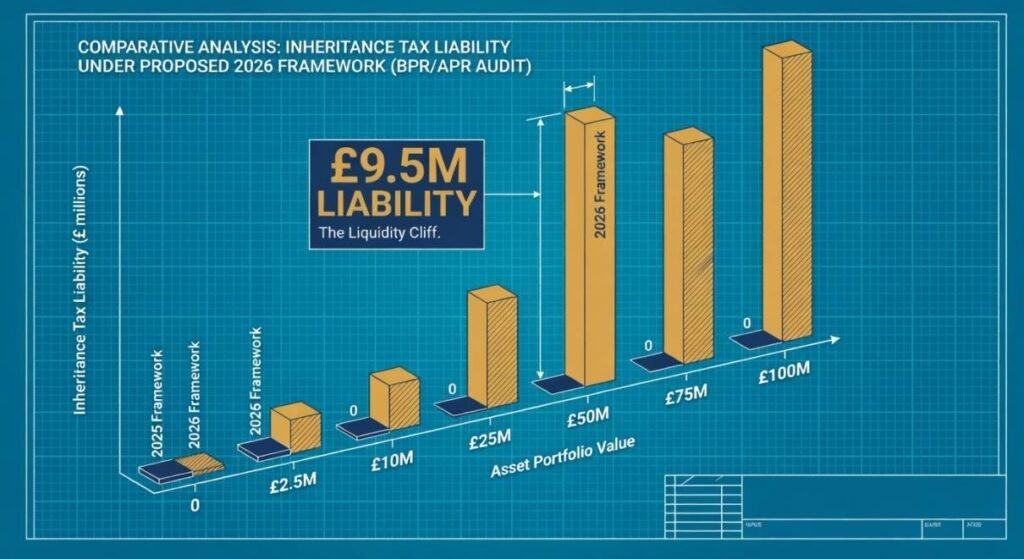
The mathematics of the 2026 regime create stark liquidity pressures for mid-cap family enterprises. From 6 April 2026, the first £2.5 million of combined APR/BPR qualifying assets retains 100% relief, with all assets exceeding this threshold subjected to a 50% relief reduction—effectively manifesting as a 20% inheritance tax charge on the excess. For a £50 million estate, this forensic shift generates a £9.5 million immediate tax liability that did not exist under the previous unlimited relief regime, representing a catastrophic erosion of intergenerational capital.
This “Liquidity Trap” is compounded by a punitive interest rate environment. As of 9 January 2026, HMRC charges 7.75% interest on late IHT payments (indexed at the Bank of England base rate plus 4%). While the 10-year Statutory Instalment Option remains an available mechanism, it is only interest-free if every payment is met with precision. A single missed instalment on a £9.5 million liability (£950,000 annually) triggers immediate interest charges of approximately £73,625 per annum, accruing daily—a figure capable of cannibalizing operational cash flow in low-margin sectors such as legacy agriculture and high-street retail.
The Compliance Ledger: Cost of Inaction
The 2026 reforms create a £9.5 million IHT liability for a £50 million business estate that was previously fully sheltered—a liquidity demand that can force asset sales and generational wealth destruction. The 10-year instalment option provides cash flow relief but requires sustained financial discipline; missed payments trigger 7.75% interest charges that compound the burden. Treasury forecasts indicate that up to 1,100 estates will be adversely impacted in the 2026-27 cycle, with approximately 915 identified as business property relief-only estates.
For family businesses, the Succession Loop strategy—appointing next-generation directors, equalizing spousal shareholdings, and potentially utilizing matrimonial shields—must be implemented before April 2026. The window for pre-reform trust transfers and BPR optimization is closing, particularly for AIM-listed share portfolios which will receive only 50% relief on their entire holding, not counting against the £2.5 million allowance.
The ‘Matrimonial Shield’: How Clean Break Orders Protect Intergenerational Wealth

As founders race to mitigate the 2026 liquidity cliff, the intersection of family law and forensic tax planning has emerged as the ultimate frontier in wealth preservation. The “Matrimonial Shield” represents a strategic pivot away from traditional trusts, which are often hamstrung by rigid 7-year survivorship rules. Instead, sophisticated planners are utilizing finalized court-ordered divorce settlements—or “Clean Break” orders—to execute non-taxable corporate bifurcations. Because capital transfers under these orders are legally mandated rather than “gratuitous gifts,” they often fall outside the typical scope of IHT, provided the transfer is not intended to confer an undue benefit but rather to satisfy a legal obligation.
The “Double-Dip” Spouse Strategy
For married business owners, the baseline defense against the new £2.5 million cap is the equalization of business shareholdings. Under current UK law, transfers between spouses remain exempt from IHT throughout marriage and during the period of separation until the Final Order (decree absolute) is issued. By equalizing assets during their lifetimes, a couple can effectively “double-dip” their allowances, shielding a combined £5 million of business value from the 20% effective tax rate. However, this strategy is only a partial solution; it relies on both spouses surviving until the 2026 implementation and leaves the remainder of the estate over the £5 million mark exposed to the “Liquidity Trap.”
The “Partner-Not-Spouse” Logic
A far more advanced application of matrimonial architecture is the Ashley-Jerlmyr model. This blueprint stems from the 2002 divorce of Mike Ashley and Linda Jerlmyr, which resulted in a £50 million settlement—at the time, one of the most expensive clean break orders in British history. By crystallizing this entitlement in 2002, the couple established a legal firewall that separated Jerlmyr’s wealth from Ashley’s future retail expansion, effectively ring-fencing £50 million in a debt-free asset pool.
The “Elite” edge of this arrangement became apparent when the couple reportedly reconciled around 2014. Crucially, they chose not to remarry, maintaining a “legally separated but functionally reconciled” status. To preserve the integrity of the original settlement, the pair maintains separate primary residences—with Jerlmyr in a custom seven-bedroom estate complete with a bowling alley and cinema, while Ashley resides half a mile away. This arrangement ensures that Jerlmyr’s wealth remains a distinct, non-commingled entity that is entirely shielded from the 2026 tax reforms targeting Ashley’s corporate holdings. For the next generation, this creates a massive, un-taxed liquidity reserve that exists completely outside the reach of the Frasers Group corporate volatility and the Treasury’s new IHT caps.
Institutional Intelligence: Trade & Digital Portals
The Succession Loop: Audit of FTSE 250 ‘Next-Gen’ Board Appointments
The 2026 reforms have triggered a measurable surge in next-generation director appointments as families rush to demonstrate active management continuity. Matilda Ashley, daughter of Frasers Group founder Mike Ashley, was appointed director of Mash Holdings (the family holding company controlling his 73% Frasers stake) in August 2024 at age 27. This appointment—alongside her sister Anna’s husband Michael Murray as Frasers CEO—represents the “Succession Loop” in action: embedding next-generation family members in governance structures before the April 2026 deadline to ensure BPR qualification continuity.
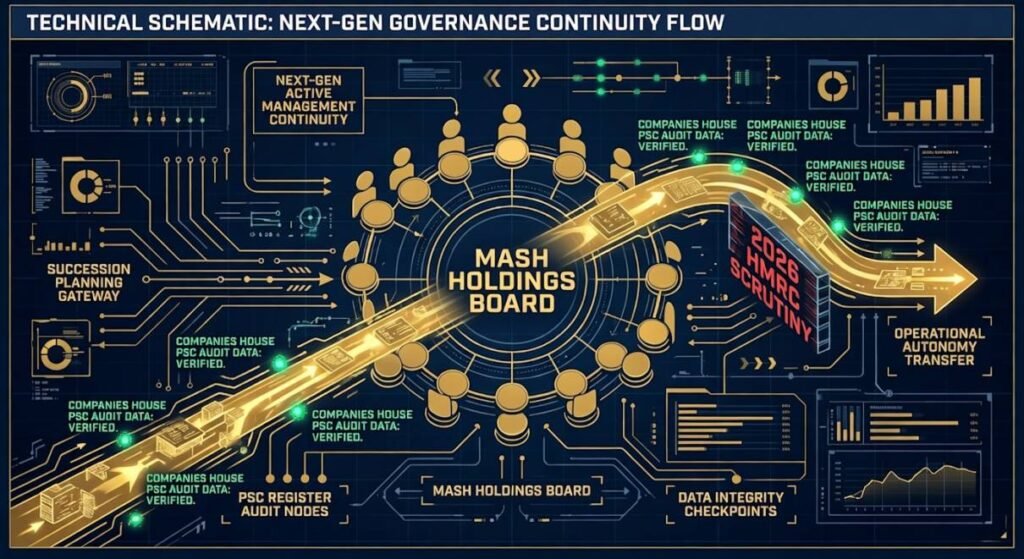
While the Dyson family represents primary Agricultural Property Relief exposure—Sir James Dyson owns approximately 50 farms worth £500 million, potentially facing £120 million in IHT liabilities under the new regime—the Ashley family exemplifies the proactive Succession Loop strategy. Daughter Matilda’s Mash Holdings directorship, combined with her boyfriend David Al-Mudallal’s appointment as Frasers COO and board member in April 2024, creates a multi-layered family governance structure designed to preserve control and BPR eligibility across generations.
The Companies House data reveals this pattern across UK family businesses. The AP01 form (Appointment of Director) filings show increased activity for under-35 directors in family-controlled enterprises, particularly in the 12 months preceding the April 2026 reforms. This “Next-Gen” board placement serves dual purposes: demonstrating active family involvement in business operations (supporting BPR qualification) and preparing for seamless ownership transition without triggering immediate tax charges through gradual share transfers utilizing the seven-year rolling allowance refresh mechanism.
The Compliance Ledger: Cost of Inaction
The 2026 reforms create a £9.5 million IHT liability for a £50 million business estate that was previously fully sheltered—a liquidity demand that can force asset sales, business disruption, and generational wealth destruction. The 10-year instalment option provides cash flow relief but requires sustained financial discipline; missed payments trigger 7.75% interest charges that compound the burden.
For family businesses, the Succession Loop strategy—appointing next-generation directors, equalizing spousal shareholdings, and potentially utilizing matrimonial shields—must be implemented before April 2026. The window for pre-reform trust transfers and BPR optimization is closing, with anti-forestalling provisions already applying to transfers made after 30 October 2024 where death occurs after 6 April 2026.
The Ashley and Dyson models represent divergent responses: proactive governance restructuring versus concentrated agricultural exposure. As the IHT Cliff approaches, the distinction between prepared and unprepared family estates will define intergenerational wealth preservation in the UK.
