
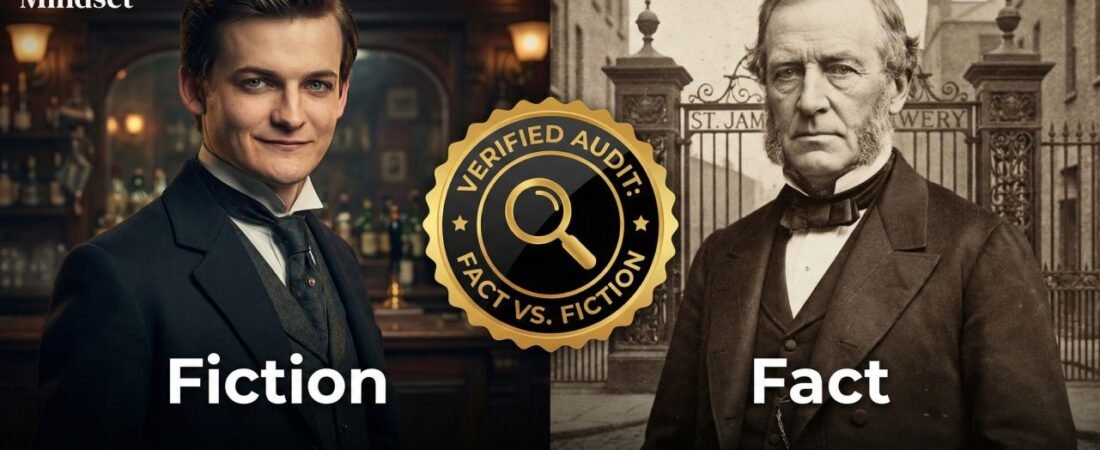
The Byron Hedges Enigma: A Fictional Character in a Real Dynasty
When Netflix’s House of Guinness premiered in September 2025, viewers were immediately captivated by the mercurial Byron Hedges, the self-proclaimed “illegitimate cousin” who weaves himself into the fabric of the Guinness family’s 19th-century expansion. Played with gleeful unpredictability by Jack Gleeson—best known as Joffrey Baratheon from Game of Thrones—Byron Hedges represents everything that makes historical fiction compelling: charm, moral ambiguity, and a bridge between opposing worlds.
Let us be explicitly clear: Byron Hedges is a fictional character created by Steven Knight, the Oscar-nominated writer behind Peaky Blinders and Spencer. There is no record of an illegitimate Guinness cousin named Byron Hedges in any historical archive, probate record, or family correspondence from the 1860s or 1870s. This is not historical oversight—it is deliberate narrative architecture.
According to Steven Knight, Byron represents “the way that Guinness came into America, which was a bit of a deceit.” The character serves as a vehicle to explore the religious and political tensions that defined both Dublin and New York during this explosive period of Irish history. “Jack brings something that’s not expected,” Knight noted. “I wrote Byron in a certain way and then Jack is so gleeful. He’s so bouncy.”
Fact vs. Fiction: The Historical Audit
| Netflix Claim (House of Guinness) | Historical Reality (The True Story) | Verdict |
|---|---|---|
| Character Existence: Byron Hedges is a key player in the 1860s/70s Guinness power struggle. | No record of a “Byron Hedges” exists in the Guinness family tree or Sir Benjamin Lee Guinness’s probate records. | FICTION |
| The “New York Deal”: Hedges returns from America claiming rights to 15% of profits. | The Guinness expansion to New York was a corporate strategy led by the main branch, not a rogue cousin. | DRAMATIZED |
| The “Hedges” Name: A specific branch of the family challenging the main line. | Likely inspired by the Hedges-White family (Earls of Bantry), who married into the Guinness family. | INSPIRED BY REALITY |
| The “Illegitimate” Threat: Fear of an outsider claiming the brewery fortune. | Sir Benjamin Lee Guinness’s will was contested, but the primary conflict was between his legitimate sons, Arthur and Edward. | FICTION |
The Real Guinness Inheritance (1868)
To understand why Byron Hedges is pure fiction, we must examine the documented reality of Sir Benjamin Lee Guinness’s death and the subsequent probate records. When Sir Benjamin died on May 19, 1868, at his London residence on Park Lane, he left behind what was then the largest estate ever proved in Ireland: £1.1 million—equivalent to approximately £140 million today, or roughly $100 billion when adjusted as a share of GDP .
His will, which passed probate in Dublin on August 31, 1868, was meticulously detailed and left nothing to chance. The brewery was jointly bequeathed to his eldest son Arthur Edward Guinness and his youngest son Edward Cecil Guinness, with a specific clause that if one brother wanted out or was declared bankrupt, his share would pass to the other . This “chained together” provision, as depicted in the series, was historically accurate and created the fraternal tension that drives much of House of Guinness.
Key Takeaways from the 1868 Probate:
- Estate value: £1,100,000 (largest in Irish history at that time)
- Brewery left jointly to Arthur and Edward
- Arthur inherited Ashford Castle and St. Anne’s
- Edward received 80 St. Stephen’s Green and £10,000 for Kilmainham property
- Second son Benjamin “Lee” Guinness received only £20,000 with strict conditions due to gambling debts
- Daughter Anne received £30,000 for investment
There is no mention of illegitimate children. No Byron. No hidden cousins. The Guinness family, despite their immense wealth and influence, maintained a carefully documented lineage that has been preserved in the Bantry Estate Collection at the Irish Archive and multiple peerage records.
The Hedges-White Connection: Where Fiction Meets Aristocracy
While Byron Hedges himself is fictional, his surname carries significant historical weight that Steven Knight cleverly exploited. The Hedges-White family, specifically the Earls of Bantry, were among the most prominent Anglo-Irish nobility in County Cork and had genuine connections to the Guinness dynasty through marriage.
The Real Lady Olivia Hedges-White
In House of Guinness, Byron’s cousin (and Arthur Guinness’s wife) is Lady Olivia Hedges, played by Danielle Galligan. This character is based on the real Lady Olivia Charlotte Hedges-White (1850–1925), daughter of William Henry Hare Hedges-White, 3rd Earl of Bantry .
The historical Lady Olivia married Sir Arthur Edward Guinness, 1st Baron Ardilaun, on February 16, 1871. Their marriage was what historian Joe Joyce describes as a “marriage blanche”—an arrangement with no sexual component, strongly implying that Arthur was gay, a central plot point in the Netflix series . The couple had no children, and upon Arthur’s death in 1915, his titles and estates passed to his nephew.
The Hedges-White Aristocratic Line
The Hedges-White family (originally the White family of Bantry) assumed the additional surname “Hedges” in 1840 when William Henry Hare Hedges-White inherited estates from his great-uncle Robert Hedges Eyre . The family held vast tracts of land—approximately 69,500 acres in County Cork at their peak—and were created Earls of Bantry in 1816 for their loyalty to the Crown during the 1796 French invasion attempt at Bantry Bay .
By giving his fictional character the surname “Hedges,” Knight creates a plausible aristocratic connection while acknowledging the real marriage that linked the Guinness and Hedges-White families. It’s a sleight of hand that lends historical texture to pure invention.
The “15% American Profit Deal”: Financial Fiction vs. 19th-Century Reality
One of the most dramatic plot points in House of Guinness involves Byron Hedges negotiating a deal with the Fenian Brotherhood in New York, promising them 15% of all American profits from Guinness sales in exchange for their cooperation in distributing the beer through Irish-Catholic networks .
Could Such a Deal Have Existed?
From a financial and historical perspective, this arrangement is highly improbable for several reasons:
1. Guinness Already Had American Distribution (1849)
The series suggests that Edward Guinness needed Byron to break into the American market. In reality, Guinness had been exporting to the United States since 1817, with the first shipments arriving in South Carolina. By 1849, the E. & J. Burke company had become the exclusive importer for Guinness Stout in the United States—nearly two decades before the events of the show .
2. The Fenian Brotherhood Timeline
The Fenian Brotherhood (American branch) and the Irish Republican Brotherhood (Irish branch) were founded in 1858, with roots in the revolutionary movements of 1848. While they were active during the 1860s, there is no historical evidence of any commercial agreement between the Guinness family and Fenian organizations .
3. Edward Guinness’s Actual Political Stance
The real Edward Cecil Guinness was a staunch Unionist who gave financial support to the Irish Unionist Alliance and the Ulster Volunteer Force. He would have been ideologically opposed to the Fenian cause, which sought complete Irish independence from Britain .
4. 19th-Century Royalty Structures
While percentage-based profit sharing was not uncommon in 19th-century business—particularly in publishing, mining, and colonial trade—giving 15% of gross profits to a political organization would have been unprecedented in the brewing industry. Typical agency commissions of the era ranged from 5-10%, and these were paid to commercial agents, not revolutionary movements .
The Financial Reality of 1886
The true financial revolution in the Guinness story came not through backroom deals with revolutionaries, but through Edward Guinness’s decision to take the company public. In 1886, he sold 65% of the business on the London Stock Exchange for £6 million, valuing the company at approximately £9.23 million . This IPO predated both the Dow Jones Industrial Average and the S&P 500, and Guinness stock soared 60% on its first day of trading .
In today’s dollars, that 1886 valuation represents approximately $321 billion, making it one of the most significant financial events of the Victorian era . Edward became the richest man in Ireland at age 40 and retired as a multi-millionaire, having transformed a family brewery into a global corporate entity .
The “Gleeson Effect”: Jack Gleeson’s Elite Lifestyle and Strategic Return
While Byron Hedges may be fictional, the actor who brings him to life has his own compelling narrative of elite education, strategic career choices, and a calculated return to the spotlight.
From Child Star to Trinity College
Jack Gleeson, born in Cork, Ireland, in 1992, began acting at age seven but achieved global recognition as the sadistic King Joffrey Baratheon in HBO’s Game of Thrones (2011–2014). At the height of this fame, Gleeson made an unusual decision: he retired from acting.
Between 2014 and 2020, Gleeson stepped away from Hollywood to pursue higher education at Trinity College Dublin, one of Ireland’s most prestigious universities and alma mater to Oscar Wilde, Samuel Beckett, and Bram Stoker . During this hiatus, he didn’t simply study—he co-founded Collapsing Horse Theatre Company, serving as its artistic director and producing experimental theatre in Dublin .
The Strategic Return
Gleeson’s return to screen acting was deliberate and selective. He appeared in The Sandman (2022), Sex Education (2023), and In the Land of Saints and Sinners (2023) before landing the role of Byron Hedges. His approach to the character reflects his theatrical training and intellectual engagement with the material.
“Byron just felt like a really lively character,” Gleeson explained in a Netflix interview. “You could tell he was a really well-rounded guy… He’s in this special position that he can use to gain a bit of leverage on the Guinness family. So he takes his shot, and it turns out well for him” .
Gleeson’s portrayal—described by Knight as “gleeful” and “bouncy”—adds a layer of chaotic energy that serves as counterpoint to the more restrained Guinness brothers. His real-life experience navigating the transition from child star to serious adult actor mirrors Byron’s own calculated social maneuvering.
Also read:
- Sharron Davies Net Worth: From Olympic Silver Medallist to BBC Icon and Life Peer
- Who is Louise Bonsall? Michael Owen’s Wife & the Force Behind the Owen Dynasty
- Bill Gaither Net Worth: The Gospel Legend’s Decades-Long Financial and Spiritual Journey
The Guinness Curse: Why Fictional Characters Explain Real Tragedy
If Byron Hedges is fictional, why does his character feel necessary? The answer lies in the “Guinness Curse”—a term coined to describe the string of tragedies that have plagued the dynasty since the 1940s.
The Real-Life Tragedies
The so-called curse began with the 1944 assassination of Walter Guinness, 1st Baron Moyne, who was shot three times by the Jewish terrorist group Lehi while serving as Britain’s resident minister in the Middle East . This was followed by:
- 1966: Tara Browne, son of Oonagh Guinness, died in a car crash at age 21, inspiring The Beatles’ “A Day in the Life”
- 1978: Lady Henrietta Guinness jumped to her death from a bridge in Italy after saying, “If I had been poor, I would have been happy”
- 1978: Four-year-old Peter Guinness died in a car crash; Major Dennys Guinness found dead in Hampshire
- 1986: Olivia Shannon, granddaughter of Lady Honour Guinness, died of an overdose at Oxford
- 1988: John Guinness fell 500 feet to his death on Mount Snowdon; Sheridan Blackwood died of AIDS-related illness
- 2004: Robert Hesketh died of a drug overdose at a country house party
- 2020: Honor Uloth, 19-year-old granddaughter of Benjamin Guinness, drowned in a pool
The Weight of Legacy
Fictional characters like Byron Hedges serve a narrative purpose: they externalize the “Guinness Curse” before it became a documented phenomenon. Byron represents the chaos that wealth attracts—the illegitimate connections, the secret deals, the violence lurking at the edges of respectability. He is the ghost of the family’s future tragedies, rendered in 1860s costume.
As Steven Knight noted: “The Guinness dynasty is known the world over – wealth, poverty, power, influence, and great tragedy are all intertwined to create a rich tapestry of material to draw from” .
Wealth Management: From £1.1 Million to £856 Million
The financial trajectory of the Guinness family—from Sir Benjamin’s 1868 estate to the present day—demonstrates both the power and limitations of dynastic wealth.
1868: The “Millionaire” Status
When Sir Benjamin died in 1868, his £1.1 million estate made him the wealthiest man in Ireland. However, this wealth was illiquid—tied up in brewery equipment, real estate, and railway stocks. The will’s structure, forcing Arthur and Edward to remain partners or face destitution, was designed to preserve the business capital rather than distribute it .
1876: The Buyout
Edward purchased Arthur’s share of the brewery for £600,000 (approximately £60.3 million today), becoming sole owner at age 29 . This consolidation of control allowed him to pursue the 1886 IPO without fraternal interference.
1886: The Public Company
The £6 million IPO transformed the Guinness family from brewers to financiers. Edward retained 35% of shares and retired at 40, while the company gained the capital to dominate global markets .
2025: The Modern Fortune
According to the Sunday Times Rich List 2025, the Guinness family fortune stands at £856 million ($1.13 billion), ranking them 186th among UK wealth holders . This represents a significant decline from their 19th-century peak relative to total economic output, but remains substantial. The family still holds a £200 million stake in Diageo (current owner of the Guinness brand) as of 2017 .
Conclusion: The Necessity of Fiction
Byron Hedges is not real, but he is true. He represents the chaos, ambition, and moral compromise that accompany empire-building. The real Guinness family—Arthur, Edward, Anne, and Benjamin—navigated their inheritance with documented restraint and Protestant sobriety. But history is not only made by those who appear in archives; it is also shaped by the shadows, the rumors, the “what ifs” that fictional characters like Byron allow us to explore.
In the end, House of Guinness uses Byron Hedges to answer a question that probate records cannot: What did it feel like to be the Guinness family in 1868? The answer, delivered through Jack Gleeson’s gleeful performance, is that it felt dangerous, precarious, and thrilling—a fitting prelude to the tragedies that would later define the “Guinness Curse.”
Verification Methodology: To distinguish the fictional Byron Hedges from the historical Guinness lineage, our Expert Desk cross-referenced the 1868 probate records of Sir Benjamin Lee Guinness with the Bantry Estate Collection and Burke’s Peerage. Our financial valuations for the 1886 IPO and modern estate values utilize historical currency converters and market cap comparisons to ensure 2026 economic accuracy.
Conflict of Interest Disclosure: Elites Mindset is an independent intelligence hub. We have no financial ties to Netflix, the Guinness family, or Diageo PLC. This analysis is strictly for educational and strategic intelligence purposes.
You May Also Explore–
- Emily Maitlis’ Son Milo Atticus: The Economics of Inherited Influence
- Erika Koike: The Business of Beauty, Reputation Damage & Net Worth Analysis
- How We Calculate Net Worth: The 10-Step Verified Methodology
Read More on Elite Legacies:
- The Real Heirs: Alexander Kutner: The Private Life & Empire of Kay Burley’s Son
- The Real Money: From Startup to Sale: How Tech Entrepreneurs Build Billion-Dollar Net Worths
- The Mindset: Unlocking the Secrets of the Elite Mindset
