
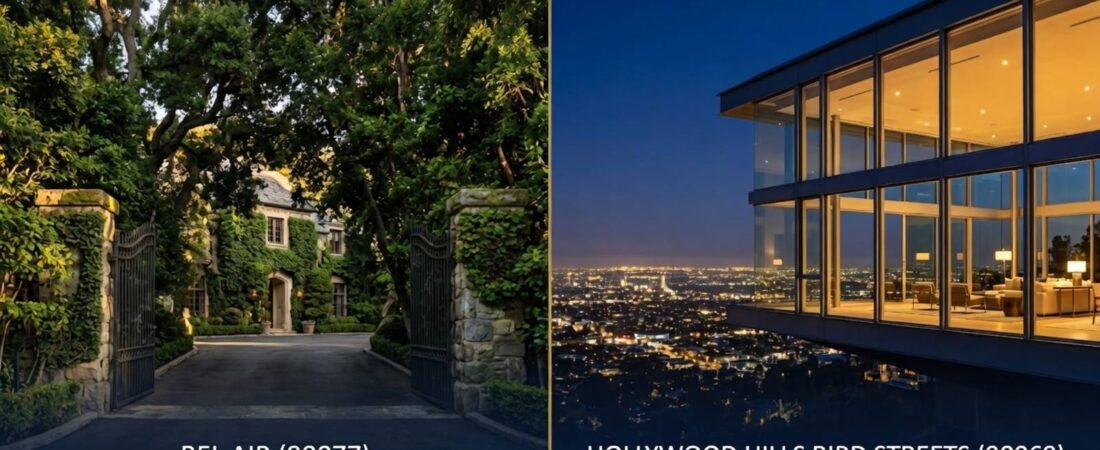
The decision to deploy capital into Los Angeles’ ultra-luxury residential market is not merely a question of aesthetics or lifestyle preference—it represents a fundamental strategic allocation between two distinct wealth preservation models. In the 2026 Los Angeles luxury landscape, the choice between Bel Air (90077) and the Hollywood Hills Bird Streets constitutes a binary decision between the architecture of “shadow wealth” and the economics of “spotlight reach.”
For family offices, corporate titans, and generational wealth managers, this is not about which neighborhood offers better views or more prestigious zip codes. It is about whether your real estate portfolio requires a sovereign compound designed for absolute privacy and capital preservation, or a perceptual billboard engineered for network density, brand equity, and human capital aggregation. The delta between these two asset classes extends far beyond price-per-square-foot metrics; it encompasses zoning arbitrage, regulatory scarcity, geographic risk exposure, and the intensifying factor of post-2025 wildfire insurance liquidity—following the $40B+ insured losses from the Palisades-Eaton fires which redrew the map of ‘insurable’ LA.
2026 Forensic Audit: Los Angeles Luxury Asset Profile Matrix
To navigate the Los Angeles luxury sector effectively, investors must look past the architectural facade and into the underlying financial architecture of the asset. This comparative dossier deconstructs the primary performance metrics of Bel Air and the Hollywood Hills, utilizing our 10-Step Verified Methodology to reveal a stark divergence in valuation models, insurance liquidity, and long-term capital stability. Use this matrix to calibrate your allocation between the high-stability “Shadow Wealth” compounds of 90077 and the high-velocity “Spotlight” assets of 90069.
| Forensic Metric | Bel Air (90077) | Hollywood Hills Bird Streets |
|---|---|---|
| Audit-Adjusted Median Price | $9,850,000 | $9.9M – $12.5M |
| Price Per Square Foot | $1,260 – $1,371 | $2,240 – $2,813 |
| Median Days on Market | 97 Days (Legacy Absorption) | 74 Days (Network Hub Velocity) |
| Primary Buyer Profile | Institutional Capital, Legacy Families, International Dignitaries | Human Capital Entrepreneurs, Entertainment Elite, Crypto Wealth |
| Key Strategic Feature | Acreage / Sovereign Privacy / Insurability | Jetliner Views / Network Density / Proximity |
| Risk Factor Analysis | Social Sequestration / Low Rental Liquidity | Geotechnical Friction / High Wildfire Risk |
| Lot Size & Grandfathering | 0.5–2.0+ Acres (Legacy Square Footage) | 0.15–0.5 Acres (Zoning Constrained) |
| Insurance & Liquidity | Standard Carriers Available (Stable) | FAIR Plan + 35.8% Spike (April 1st) |
| Privacy Infrastructure | 200ft+ Setbacks, Sidewalk-free Canopy | AI Surveillance, Elevation, Hedgerows |
| Celebrity Archetype | Established / Multi-Generational / Private | Active / Social / Perceptual Brand Builders |
| Architectural Typology | Traditional / Modern Fortress | Cantilevered / View-Optimized |
| Asset Utilization Category | Shadow Wealth Preservation | Spotlight Reach / Network Utility |
| Liquidity Profile | Lower velocity, higher stability | Higher velocity, higher volatility |
*Data derived from the Elites Mindset proprietary 10-Step Verified Methodology, incorporating Q1 2026 MLS absorption rates and FAIR Plan risk filings.
Bel Air Real Estate Market (90077): The Infrastructure of Shadow Wealth
■ 90077 Asset Intelligence: The Shadow Wealth Profile
- Primary Objective: Capital Sequestration
- Privacy Moat Index: 9.8 / 10 (Maximum)
- Insurance Access: Admitted Market (Stable)
- Liquidity Class: Low-Velocity / High-Stability
Bel Air (90077) serves as the primary global vault for “Shadow Wealth”—a residential ecosystem where capital is deployed specifically to engineer disappearance. Unlike visibility-dependent markets, the asset value in this zip code is derived from the physical and legal moats that insulate ultra-high-net-worth (UHNW) families from public and regulatory scrutiny. For the institutional investor, Bel Air is not a neighborhood; it is a sovereign sanctuary designed for capital sequestration and multi-generational privacy.
The Fortress Estate Model
Bel Air operates as the ultimate “privacy moat” in the Los Angeles luxury ecosystem. Unlike the visibility-driven architecture of the Hills, Bel Air’s value proposition centers on the physical and legal infrastructure of disappearance. The bel air real estate market 2026 operates on principles of controlled scarcity: median home prices have stabilized at $9,850,000 for Q1 2026 with price-per-square-foot ranging from $1,260 to $1,371, yet these figures fail to capture the true asset value—the irreplaceability of large-lot privacy in an era of intensifying zoning restrictions.
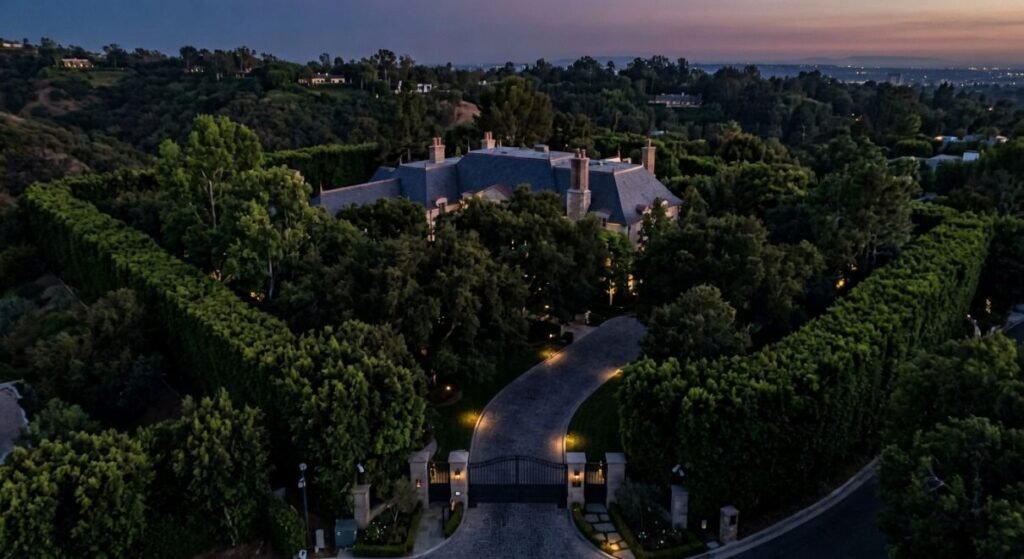
The physical architecture of Bel Air privacy is deliberate and legally reinforced. Properties in the 90077 zip code—one of the highest net worth zip codes LA—feature deep setbacks that often exceed 200 feet from public roads, creating buffer zones that render even the largest estates invisible from street level. The absence of sidewalks throughout residential streets eliminates pedestrian traffic entirely, while mature tree canopies and strategic landscaping create natural visual barriers. This is not incidental; it is the result of decades of homeowner association influence and strict zoning enforcement that prioritizes seclusion over density.
The “closed-door” preservation model attracts a specific buyer demographic: C-suite executives managing publicly traded companies, legacy families with multi-generational wealth building patterns, and international dignitaries requiring security protocols that exceed standard residential measures. Beyoncé and Jay-Z, Jennifer Lopez, and Elon Musk have all selected Bel Air precisely because the neighborhood’s infrastructure enables them to maintain operational security while conducting private business away from public scrutiny.
Los Angeles Zoning Arbitrage: Capitalizing on the Legacy Build Scarcity Premium
The true value proposition of bel air privacy estates lies not in current market pricing but in regulatory arbitrage. Los Angeles’ Baseline Mansionization Ordinance (BMO), originally implemented in 2008 and strengthened in 2017 and subsequent years, imposes strict floor-area-ratio limitations on new construction. For single-family zones in hillside areas—which encompasses much of upper Bel Air—the BMO restricts residential floor area to a percentage of lot size, with additional height limitations that effectively cap new construction at significantly smaller footprints than existing legacy estates.
This regulatory framework creates artificial scarcity for “grandfathered” mega-estates. Properties built before the BMO’s full implementation can exceed 15,000 square feet on single lots—dimensions that are now legally impossible to replicate under current LA anti-mansionization laws. The 2026 market recognizes this scarcity premium, now compounded by the late-2024 passage of Measure E. This 6-cent-per-square-foot parcel tax transforms expansive legacy footprints into significant recurring liabilities; however, because these footprints are now legally impossible to replicate, the ‘scarcity alpha’ still outweighs the tax drag.
The 90077 property values are further insulated by the neighborhood’s geographic positioning. Lower Bel Air, in particular, benefits from being situated below the most severe wildfire zones, with access to municipal water infrastructure and fire department resources that hillside properties lack. This geographic advantage translates directly to insurance market accessibility—a critical liquidity factor increasingly relevant in the 2026 California market.
2026 Wildfire Insurance Liquidity: Protecting Asset Value in Bel Air
While media coverage focuses on aesthetic comparisons between Bel Air and the Hills, sophisticated investors are tracking the divergence in insurance market accessibility. The California FAIR Plan—the state’s insurer of last resort—caps dwelling coverage at $3 million per property, with a 35.8% rate increase finalized to take effect on April 1, 2026—a move that effectively sunsets the ‘standard premium’ era for high-risk hillside assets and forces a total recalibration of carrying costs. For estates with replacement values exceeding $20 million, this creates a coverage gap that requires complex multi-carrier layering through excess and surplus lines, often at annual premiums exceeding six figures.
Bel Air’s lower-elevation properties, particularly those east of the 405 freeway, generally maintain access to standard private carriers like Chubb, AIG Private Client Group, and PURE Insurance—carriers that offer guaranteed replacement cost coverage and wildfire defense services without the coverage caps that plague hillside markets. This insurance accessibility represents a liquidity premium: properties with standard carrier coverage trade more efficiently in estate sales and refinancing scenarios, whereas Hills properties encumbered by FAIR Plan complexity face transactional friction that can extend closing timelines by 30–60 days.
Hollywood Hills Bird Streets (90069): Economics of High-Velocity Spotlight Reach
■ 90069 Asset Intelligence: The Spotlight Reach Profile
- Primary Objective: Network Utility / ROI
- Perceptual Reach: 9.5 / 10 (Maximum)
- Insurance Access: Surplus / FAIR Plan (Volatile)
- Liquidity Class: High-Velocity / High-Volatility
The Bird Streets (90069) operate as a high-yield “Billboard Asset,” where real estate functions as a physical tool for human capital aggregation. In this high-velocity micro-market, the 2x price-per-square-foot premium over neighboring Bel Air is an explicit investment in network density. Here, the architecture is engineered for “Spotlight Reach,” offering the perceptual ROI necessary for media, tech, and entertainment titans to amplify their personal brand equity through strategic visibility.
The Billboard Asset Strategy: Engineering Perceptual ROI in Hollywood Hills Homes
If Bel Air represents the architecture of disappearance, the Hollywood Hills—specifically the Bird Streets—embody the economics of strategic visibility. The hollywood hills luxury homes market operates on an inverse logic: here, the asset’s value is directly correlated with its perceptual reach, its ability to function as a physical manifestation of personal brand equity and network centrality.
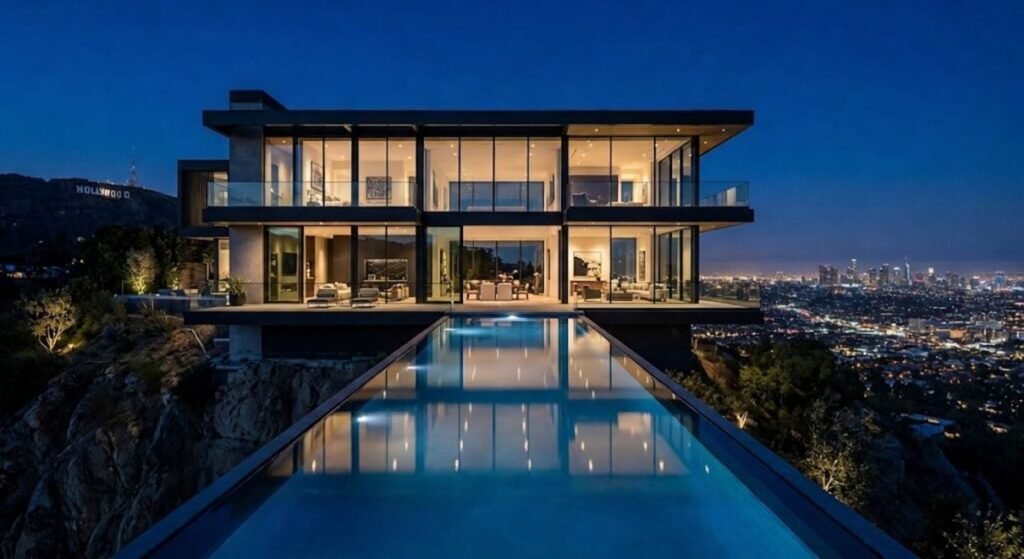
The bird streets real estate market commands premium pricing that often exceeds Bel Air on a per-square-foot basis, with average prices reaching $2,240–$2,813 per square foot and median listing prices between $9.9 million and $12.5 million. This pricing inversion—smaller lots commanding higher per-unit costs—reflects the neighborhood’s function as a “flex” asset for media, tech, and entertainment elites whose wealth generation depends on network density and visibility.
The architectural typology of the Hills reinforces this function. Cantilevered view homes with floor-to-ceiling glass walls, infinity pools positioned for maximum photographic impact, and open-plan entertaining spaces designed for 200+ person events—these are not privacy features but perceptual infrastructure. The “jetliner views” encompassing downtown Los Angeles, the Pacific Ocean, and the Hollywood Sign simultaneously serve as daily amenities and content backdrops for the social media economy.
Network Density: The Financial Value of Industry Proximity in the Bird Streets
The Hills’ value proposition centers on geographic proximity to the entertainment industry’s operational centers. Located minutes from the Sunset Strip, major studios, and the West Hollywood corridor, the Bird Streets enable residents to maintain physical presence at industry events while retaining residential separation. This proximity creates what urban economists term “network density”—the ability to conduct high-value social and business interactions with minimal transaction costs.
Leonardo DiCaprio, Drake, Keanu Reeves, and Jodie Foster have all maintained residences in the Bird Streets, not despite the visibility, but because the neighborhood functions as a curated community of creative and financial capital. The architecture here facilitates what sociologists call “controlled visibility”—residents can project presence when strategically advantageous while maintaining physical security through gated entries and elevated positioning.
The rental market reinforces this dynamic. Monthly rents in the Bird Streets range from $15,000 to $85,000+, with short-term luxury leases commanding premium pricing from entertainment industry professionals requiring temporary proximity to production centers. This rental liquidity—absent in Bel Air’s more static, owner-occupied market—provides Hills owners with income generation options that complement capital appreciation strategies.
Hollywood Hills Zoning Constraints & High-Risk Wildfire Geographic Exposure
The Hills’ premium pricing exists in tension with significant regulatory and environmental headwinds. The same hollywood hills zoning restrictions that limit Bel Air development apply with greater severity to hillside construction, where the Baseline Hillside Ordinance (BHO) imposes additional grading limitations, height restrictions, and environmental review requirements. New construction in the Hills faces not only BMO floor-area limitations but also geotechnical constraints that can increase construction costs by 40–60% compared to flat-land development.
More critically, the Hills’ LA view properties are situated within high-risk wildfire zones—designations that trigger mandatory brush clearance requirements and, increasingly, insurance market exclusion. The California FAIR Plan’s $3 million coverage cap creates acute challenges for Hills estates, where construction costs often exceed $1,500 per square foot and total replacement values regularly surpass $15–30 million.
The 2026 insurance market has reached an inflection point: standard carriers have effectively retreated from high-risk hillside zip codes, forcing owners into complex layering strategies that combine FAIR Plan base coverage with Difference in Conditions (DIC) policies and excess layers from surplus lines carriers. This insurance complexity introduces liquidity risk—properties with challenged coverage profiles face extended marketing periods and buyer financing complications that can depress transaction values by 5–10% relative to comparable properties in lower-risk zones.
Strategic Property Intelligence
Asset Preservation: Mitigating Regulatory and Geographic Risk in LA Luxury Real Estate
In the 2026 landscape, the long-term durability of a Los Angeles luxury real estate portfolio is no longer dictated by aesthetics, but by two external forces: zoning arbitrage and insurance liquidity. Navigating the widening delta between “Legacy Builds” and modern wildfire risk zones has become the primary objective for family offices. To maintain alpha, investors must prioritize geographic risk mitigation—identifying assets that remain insurable and compliant as the California regulatory environment continues to tighten.
The Scarcity Thesis: Legacy Mansion Builds vs. Modern LA Building Codes
The unifying theme across both Bel Air and the Hollywood Hills is the transformation of zoning compliance from a regulatory burden into a scarce asset class. Los Angeles’ Baseline Mansionization Ordinance and development frameworks—specifically the BMO and BHO—have inadvertently created a two-tier market: properties that exceed current development standards (“legacy builds”) and properties constrained by modern limitations.
For investors, this creates a “zoning arbitrage” opportunity. Legacy estates in both neighborhoods—particularly those built between 1990 and 2010, before the BMO’s most restrictive amendments—represent irreplaceable assets. These properties often feature 10,000+ square foot footprints on sub-acre lots, dimensions that are now legally impossible to replicate. As the regulatory environment continues to tighten—2025–2026 saw additional proposals to close multi-family zoning loopholes and impose maximum size caps on all new single-family construction—the scarcity premium for compliant legacy properties will likely accelerate.
2026 Wildfire Risk: How Insurability Dictates Real Estate Liquidity
The 2026 market has introduced a new variable into luxury real estate valuation: wildfire risk as a liquidity determinant. Climate-driven insurance market contraction has created a bifurcation between “insurable” and “uninsurable” luxury assets—a distinction that transcends traditional location premiums.
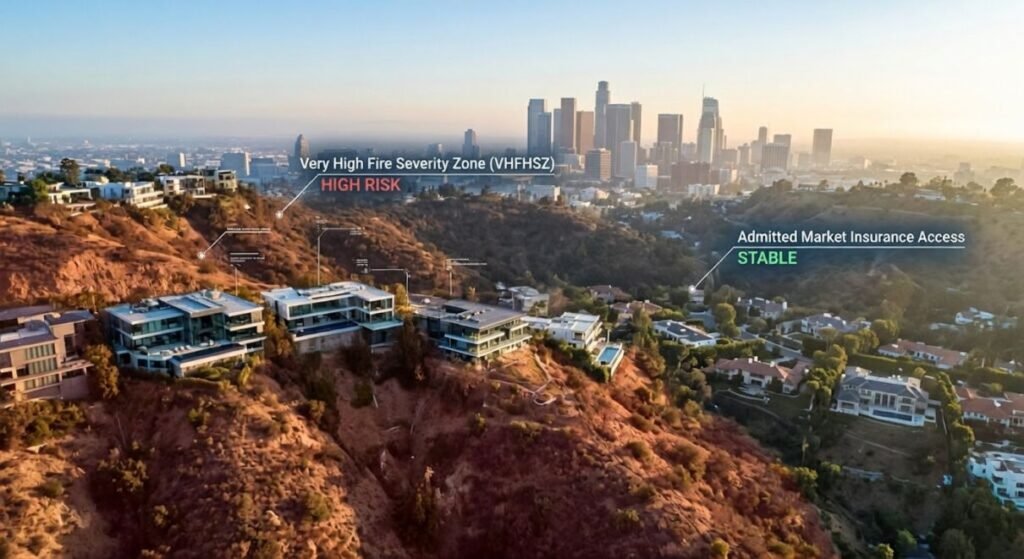
Properties in lower Bel Air, particularly those east of the 405 and below 800 feet elevation, generally maintain access to standard admitted carriers. Properties in the upper Hills, particularly those in the Very High Fire Severity Zones (VHFHSZ), face FAIR Plan mandates that introduce transactional friction. The FAIR Plan’s proposed 35.8% rate increase—disproportionately affecting high-value properties—will further compress margins for Hills owners and may trigger a repricing of view premiums relative to insurance costs.
Sophisticated investors are now modeling “total cost of ownership” that includes not only acquisition price and property tax but also insurance escalation curves. At current trajectories, Hills properties could face annual insurance burdens exceeding $75,000–$150,000 for high-value estates—a carrying cost that affects net operating income and, ultimately, resale liquidity.
FAQ: Bel Air vs. Hollywood Hills Real Estate Intelligence
Which is more expensive, Bel Air or Hollywood Hills?
On a median price basis, the Hollywood Hills Bird Streets command higher absolute pricing ($9.9M–$12.5M median) compared to Bel Air ($9.85M). However, on a per-square-foot basis, the Hills’ $2,240–$2,813 average significantly exceeds Bel Air’s $1,260–$1,371 range. The true cost differential depends on the asset class: Hills properties trade at view and network premiums, while Bel Air trades at privacy and insurance-accessibility premiums. For equivalent square footage, Bel Air generally offers more physical space; for equivalent budgets, the Hills offer more perceptual reach.
What is the wealthiest zip code in Los Angeles?
According to 2026 data, 90077 (Bel Air) ranks as the 5th most expensive zip code in the United States with a median listing price of $9,850,000, placing it among the highest net worth zip codes LA. Beverly Hills 90210 ranks higher nationally at #3 with a $10,495,000 median, while the Bird Streets (90069) operate as a micro-market within Hollywood Hills with pricing that often exceeds both on a per-square-foot basis.
Why do celebrities prefer Bel Air?
Celebrities with established careers and privacy concerns—Beyoncé, Jay-Z, Jennifer Lopez, and Kylie Jenner among them—select Bel Air for its “closed-door” infrastructure. The neighborhood’s lack of sidewalks, deep setbacks, and gated estates enable residents to conduct private business and family life without public visibility. Unlike the Hills, where visibility can be strategically advantageous for emerging talent, Bel Air serves those who have already achieved brand recognition and now prioritize operational security and generational wealth preservation.
2026 Audit Note: The Los Angeles market has reached a critical inflection point where “Insurability” has replaced “Aesthetics” as the lead valuation metric. The 90077 ZIP code now functions as a sovereign financial shelter, while 90069 operates as a high-yield, high-volatility social asset.
Strategic Conclusion: Asset Allocation for Los Angeles Luxury Portfolios
The choice between Bel Air and the Hollywood Hills is ultimately a portfolio construction decision. While media figures leverage the “Spotlight Reach” of visible postcodes for brand amplification, legacy families and corporate titans rely on the “Closed-Door” preservation model that Bel Air’s privacy architecture provides.
For UHNW investors, the optimal strategy may involve neither binary selection but strategic diversification: Bel Air compounds for privacy-dependent wealth preservation, while Hills properties serve as network nodes for human capital aggregation. The 2026 market, however, introduces a new constraint—climate-driven insurance accessibility—that may tilt allocation toward Bel Air’s lower-risk geographic profile.
The regulatory environment reinforces this thesis. As LA anti-mansionization laws continue to tighten, the scarcity premium for legacy builds in both neighborhoods will accelerate. The investor who recognizes that the value lies not in the dirt but in the permits—and who factors insurance liquidity into total cost of ownership—will capture the alpha that generic neighborhood comparisons miss.
In the forensic analysis of Los Angeles luxury real estate, the question is no longer which neighborhood is “better.” It is which asset class aligns with your wealth preservation strategy, your risk tolerance for geographic exposure, and your family’s requirements for either shadow or spotlight.
