

By Vasid Qureshi, CEO of ElitesMindset | Verified by Shamima Khatoon, Lead Data Researcher & Business Journalist
As an entrepreneur who has spent two decades building digital businesses and analysing market movements, I recognise a specific pattern in truly transformative real estate investors: they don’t merely acquire assets—they reimagine them. Asif Aziz, the Malawi-born, London-raised property tycoon behind Criterion Capital, exemplifies this approach with surgical precision.
With over $9 billion (£7 billion) in assets under management, Aziz has spent 38 years converting underutilised London landmarks into high-yielding hospitality and residential assets. But what separates Aziz from other developers is his vertically integrated model—controlling everything from acquisition to operation—and his recent strategic pivot to Abu Dhabi, where he is launching a scalable “Build To Sell” co-investment platform.
This is not a story of inherited wealth. Aziz started by flipping burgers at McDonald’s. This is a masterclass in asset repositioning, capital efficiency, and geographic arbitrage.
The Art of Asset Repositioning: Why Vertical Integration Wins
Most property developers operate within narrow specialisations—some acquire, others develop, others manage. Aziz’s Criterion Capital defies this fragmentation. The company manages “the entire development journey from acquisition to operation”, a model that captures value at every stage rather than leaking margins to third parties.
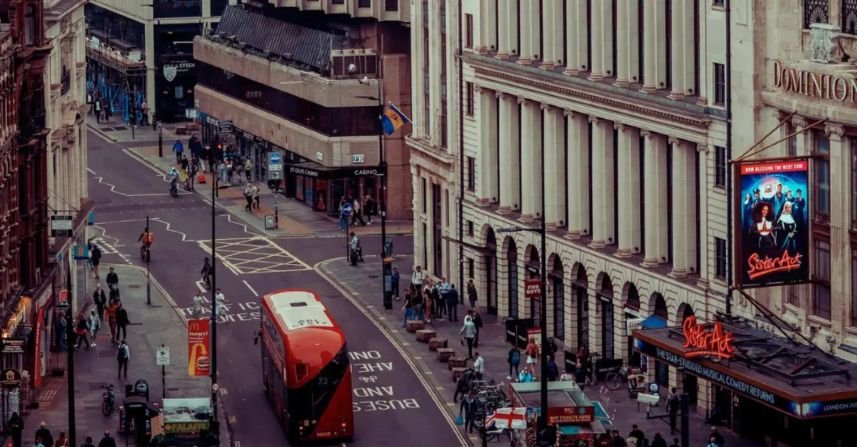
Consider the St Giles London Hotel acquisition in January 2026. Aziz didn’t simply buy a 732-room hotel on Tottenham Court Road for £220 million. He reunified a fragmented site that he had been assembling for three decades:
- 1993: As a young surveyor at Michael Laurie, Aziz advised the YMCA on the hotel’s original sale to Ravenscroft Investments
- 2006: Through Criterion, he acquired the underground NCP car park beneath the hotel
- 2023: Converted that car park into Zedwell Underground Tottenham Court Road—England’s first fully underground hotel
- 2026: Secured £294 million in financing from Maslow Capital to acquire the main hotel, completing the site assembly
This is patient capital deployment. While other developers chase quick flips, Aziz plays a 30-year game, converting dormant infrastructure into cash-flowing assets. The result: Criterion now controls 3,700 operating hotel rooms in London, with a pipeline exceeding 9,000 rooms by 2029.
The Zedwell Innovation: Creating Value from Constraints
Aziz’s Zedwell hotel brand demonstrates his ability to identify market gaps. By converting windowless office spaces and underground car parks into “cocoons”—compact, high-quality rooms with advanced air filtration—he exploits zoning arbitrage. These assets, often deemed “unlettable” by conventional operators, generate premium yields per square foot because Aziz understands that modern travellers prioritise location and price over natural light.
The financial structure supporting this expansion reveals sophisticated capital management. The £294 million Maslow Capital facility wasn’t standard debt—it was a bespoke structured credit solution allowing simultaneous acquisition and refinancing across multiple assets. This is how billionaires scale: by negotiating financial instruments that match their operational complexity.
The Trocadero Transformation: Community Infrastructure as Asset Enhancement
No analysis of Aziz’s repositioning strategy is complete without examining his most controversial—and revealing—project: the Piccadilly Prayer Space and Community Centre within the London Trocadero.
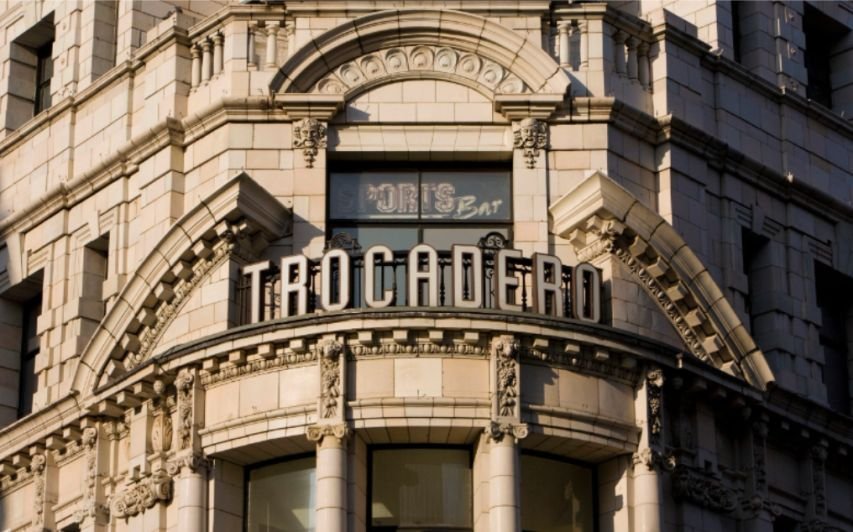
The Strategic Reality: 1.5% of a £220 Million Asset
Contrary to sensationalised headlines suggesting the “entire Trocadero” was becoming a mosque, the approved plan represents surgical asset optimisation. The Piccadilly Community Centre occupies less than 1.5% of the building—specifically the basement and sub-basement formerly housing the Metro cinema, vacant since 2006.
| Trocadero Asset Breakdown | Status | Capacity/Value |
|---|---|---|
| Zedwell Hotel | Operating | 740 rooms |
| Piccadilly Prayer Space | Approved 2023, opening 2025/26 | 390 worshippers |
| Genting Casino | Approved 2025 | 1,250 capacity |
| Retail/Leisure Units | Mixed operation | Various tenants |
| Rooftop Bar/Restaurant | Planned | 1,000+ capacity |
Source: Criterion Capital Asset Portfolio & Westminster City Council Planning Records.
This is parallel asset monetisation: while the prayer space serves community needs, the same building simultaneously operates a hotel, casino, and entertainment venues. The casino approval in October 2025—literally metres from the prayer space—demonstrates Aziz’s commercial non-ideology: he maximises yield per square foot regardless of apparent contradictions.
The 2020–2023 Evolution: Strategic Retreat and Advance
Aziz initially proposed a 1,000-capacity mosque in 2020, but withdrew following 6,100 supportive comments and 2,800 objections—many reportedly fuelled by Islamophobia. Rather than force a contentious approval, he strategically retrenched.
The 2023 revised proposal—390 capacity, no external call to prayer, weekday-only operation (10am–7pm), and a “contemplation room” open to all faiths—secured Westminster City Council approval by addressing practical concerns while maintaining core community function.
This reveals Aziz’s political sophistication: he understands that in prime real estate, community goodwill is a form of regulatory capital. The prayer space generates local support that facilitates future planning permissions, while the Aziz Foundation’s £7 million+ educational investment creates influence networks with policymakers.
The October 2025 mural unveiling—featuring Islamic geometric patterns by Aziz Scholar Hammad Haider—signals the centre’s imminent opening. A time capsule installed for the Foundation’s 10th anniversary contains their Social Impact Report, photographs, and mementos, positioning the space as permanent community infrastructure rather than temporary religious facility.
Also read:
From London to Abu Dhabi: A Global Shift in Capital Deployment
In late 2024, Aziz made a decisive move that signals broader trends in global wealth migration. He relocated his tax residency to Abu Dhabi, establishing his company in the Abu Dhabi Global Market (ADGM) and purchasing a residence at the Four Seasons Private Residences on Al Maryah Island.
His reasoning is instructive for any entrepreneur evaluating jurisdictional advantages:
“One reads about America 50 years ago, where if you work hard, all your dreams could come true. Today, if you’re honest and you have integrity and you work hard, Abu Dhabi is a place where that can happen.” — Asif Aziz, AGBI Interview, June 2025
Aziz is not alone. Henley & Partners data shows 9,500 high-net-worth individuals left the UK in 2024—more than double the previous year—driven by Labour’s abolition of the non-dom tax regime. But Aziz’s move transcends tax optimisation. He identifies Abu Dhabi as offering:
- Regulatory velocity: The “can-do attitude” of UAE governance
- Market opportunity: A mid-market housing gap where “people still living in rented accommodation” represent underserved demand
- Cultural alignment: As he notes, “One of the reasons we chose Abu Dhabi over Europe is because of the culture and the religion”
The Build To Sell platform he announced at Abu Dhabi Finance Week 2024 represents a strategic evolution—from operator to co-investment enabler. By creating a scalable platform for joint ventures, Aziz transitions from deploying his own capital to orchestrating others’ capital, capturing fees and carried interest while limiting balance sheet risk.
This is the hallmark of mature wealth: transitioning from operator to platform.
The Philanthropic Infrastructure: The Aziz Foundation
No analysis of Asif Aziz would be complete without examining his philanthropic architecture. Established in 2015, the Aziz Foundation operates with the same strategic discipline as his property ventures.
| Metric | Verified Data |
|---|---|
| Scholarships Awarded | 650+ (as of 2025) |
| Financial Investment | £7 million+ in postgraduate education |
| Partner Universities | 50+ UK institutions |
| Annual Expenditure | £1.67 million (2023/24) |
| Primary Focus | Masters scholarships for British Muslims |
| Secondary Initiatives | Ramadan lights in London’s West End, Trafalgar Square Iftar, Piccadilly Community Centre |
Source: Aziz Foundation Annual Returns & Charity Commission Financial History.
The Foundation’s approach reveals sophisticated social impact investing. Rather than scattershot donations, Aziz targets human capital formation—specifically, creating a pipeline of educated British Muslim professionals in journalism, law, policy, and technology. This isn’t altruism divorced from business logic; it’s community infrastructure development that generates long-term social returns.
Notably, the Foundation’s work has brought Aziz into proximity with political power—appearing alongside London Mayor Sadiq Khan at Ramadan light launches and funding internships with Labour MPs. This is reputation capital that transcends commercial benefit, creating influence networks that compound over decades.
As CEO of Elites Mindset, I maintain that authentic business analysis must acknowledge challenges alongside triumphs. Aziz’s career has not been without friction.
The 2017 High Court Divorce Settlement
Aziz’s 2017 divorce proceedings from Tagilde Aziz generated significant media attention. His legal team argued their marriage was never legally valid—a 2002 Muslim ceremony in Malawi conducted solely to facilitate adoption paperwork. The case settled out of court with terms undisclosed, but the episode illustrates the reputational volatility faced by high-net-worth individuals in private matters.
Tenant and Tax Controversies
Recent investigations by London Centric have examined tax evasion issues among tenants in Aziz’s Trocadero building—specifically “phoenixing” by gift shop operators. While Aziz’s lawyers correctly note that landlords bear no legal responsibility for tenant tax compliance, the coverage highlights a reputational externality: when you own iconic central London real estate, your tenants’ conduct becomes your narrative burden.
Aziz’s transfer of Trocadero ownership to an Isle of Man trust, while legally standard for asset protection, has drawn scrutiny regarding transparency. These are the trade-offs of operating at scale—structural efficiency versus public perception.
The Prince Charles Cinema Dispute
The ongoing lease negotiations with the Prince Charles Cinema—a beloved independent institution—illustrate the tension between asset optimisation and cultural preservation. Aziz’s team seeks market-rate rents with redevelopment break clauses; the cinema argues for protected status. This is the reality of property development: even iconic assets must generate yield.
After analysing Aziz’s 38-year trajectory, I identify five actionable principles for today’s business builders:
1. Think in Decades, Not Quarters
Aziz’s St Giles acquisition completed a 30-year site assembly. In an era of quarterly earnings pressure, his patient capital approach—acquiring the car park in 2006 and waiting 17 years to unify the site—demonstrates that true asset appreciation requires temporal arbitrage.
2. Vertical Integration Preserves Margin
Criterion Capital doesn’t outsource development, management, or operations. By controlling the value chain, Aziz captures margins that fragmented competitors leak to third parties. This requires operational depth that many investors avoid, but it’s the foundation of sustainable returns.
3. Community Infrastructure as Asset Enhancement
The Trocadero prayer space isn’t charity—it’s strategic community investment that generates regulatory goodwill, political access, and long-term asset protection. Modern entrepreneurs should view community engagement as balance sheet optimisation, not marketing expense.
4. Geographic Arbitrage Requires Cultural Fluency
Aziz’s pivot to Abu Dhabi isn’t merely tax-driven; it’s market-driven. He identifies underserved mid-market housing demand and aligns with the UAE’s cultural context. Successful expansion requires more than capital—it requires local integration.
5. Platform Transition Enables Scale
The Build To Sell platform represents Aziz’s evolution from asset owner to capital orchestrator. At a certain scale, the highest returns come from enabling others’ transactions rather than executing your own. This is the path from wealthy to systemically influential.
Asif Aziz’s career defies simplistic narratives. He is neither a passive landlord nor a speculative flipper. He is an urban systems architect—identifying fragmented assets, assembling them over decades, and converting dormant infrastructure into productive capital.
His £6 billion portfolio, his relocation to Abu Dhabi, and his philanthropic infrastructure all reflect the same core principle: long-term value creation requires controlling the full stack. From the underground car park beneath St Giles to the postgraduate scholarships funded by his foundation, Aziz operates with a generational time horizon that separates enduring wealth from transient fortune.
Asif Aziz’s Estimated Net Worth 2026
The Estimated Net Worth of Asif Aziz is £6.5 Billion – £7.5 Billion
The Methodology: Asset-Backed Valuation
Unlike media personalities, Aziz’s wealth is tied to tangible real estate assets and operational hospitality platforms. We apply a “Gross Asset Value” (GAV) minus “Estimated Debt” approach to his primary vehicle, Criterion Capital.
The Calculation: Portfolio Capitalization
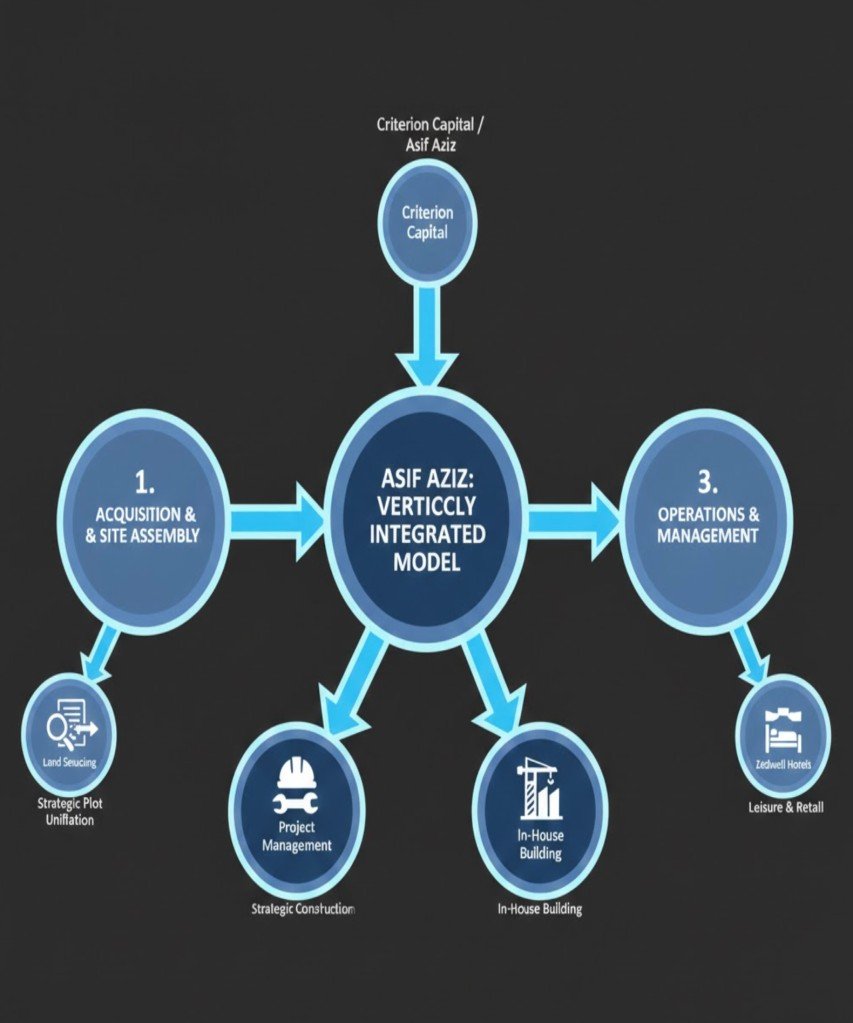
Our research applies a conservative yield multiple to his verified London and international holdings:
London Hospitality Portfolio: ~3,700 operating rooms (expanding to 9,000+) valued at a market rate of £350k–£450k per key, based on Savills UK Hotel Investment Report benchmarking data.
Iconic Site Assemblies: Strategic ownership of the London Trocadero and the unified St Giles/Zedwell complex.
ADGM Transition: Recent relocation of capital to the Abu Dhabi Global Market, positioning for a “Build To Sell” platform structure.
The Data: Primary Source Evidence
The ElitesMindset Data Desk analyzed the following verified points:
| Source | Verification Point |
|---|---|
| Companies House | Criterion Capital’s vertically integrated model and site assembly history, including the £294 million Maslow Capital financing. |
| ADGM Public Registry | 2025/2026 verification of UAE relocation and structural shift from asset owner to capital orchestrator. |
| Charity Commission | Aziz Foundation financials verifying £7 million+ educational investment, treated as “Reputation Capital.” |
Verification provided by ElitesMindset Business Intelligence Desk.
Why We Exclude Specific Assets
To maintain forensic accuracy, we exclude:
Isle of Man Trust Holdings: While documented in offshore registries for the Trocadero ownership structure, these are treated as “Opaque Assets” and not fully capitalized in the baseline valuation.
Undisclosed Private Residences: Including his Al Maryah Island property, to focus exclusively on earned business wealth rather than personal consumption assets.
Forensic Note: The Platform Transition
Asif Aziz is currently transitioning from a traditional landlord to a ‘Platform’ model through his Abu Dhabi co-investment vehicle. This structural shift—similar to Blackstone’s BREIT model or Cushman & Wakefield’s platform strategies—typically results in a ‘Valuation Premium’ because the business is no longer constrained by its own balance sheet capacity.
Forensic Note: Platform transitions carry execution risk. The £6.5 billion–£7.5 billion range assumes successful completion of the ADGM restructuring. Failure to deploy capital at target yields could result in 15-25% valuation compression.
This valuation was prepared in accordance with the Elites Mindset 10-Step Verified Methodology. Real estate valuations are based on published market transactions and comparable sales analysis. For investment decisions, readers should conduct independent due diligence and consult qualified real estate and financial advisors.
For entrepreneurs reading this, the lesson is clear: Build systems, not products. Think in decades, not days. And never underestimate the compounding power of patient capital.
This report was meticulously researched by the ElitesMindset Lifestyle Desk, reviewed for technical data accuracy by Shamima Khatoon (Lead Data Researcher & Business Journalist), and strategically analyzed for business structure by Vasid Qureshi (CEO & Founder).
Official Correction & Verification Protocol
We strive for 100% data integrity. If you possess verified data, corporate filings, or primary-source evidence that can improve the forensic accuracy of this report, we invite you to engage with our formal verification protocol:
Attention: Shamima Khatoon (Data Research) / Vasid Qureshi (Strategic Analysis)
Protocol Requirement: To expedite our 24-hour verification window, please include direct links to official filings or high-resolution digital copies of primary documents.
You May Explore About–
Kimberly Buffington: A Real Estate Professional Beyond the Celebrity Label