


Peter Jones’ twenty-one-year tenure as the anchor of BBC’s Dragons’ Den represents far more than broadcast entertainment; it constitutes a strategic deal-flow pipeline that has systematically fed his private equity consolidation engine since 2005. While the programme furnished him with unparalleled consumer brand visibility, its real value lies in the dealflow it generated — thousands of pitches annually that gave Jones first look at micro-cap consumer ventures before they reached any other investor.
This televised venture syndication model, unique among British business television, allowed Jones to deploy modest capital tranches into high-margin FMCG and media equity positions while using the broadcast platform to drive immediate retail distribution for portfolio companies at close to zero customer-acquisition cost.
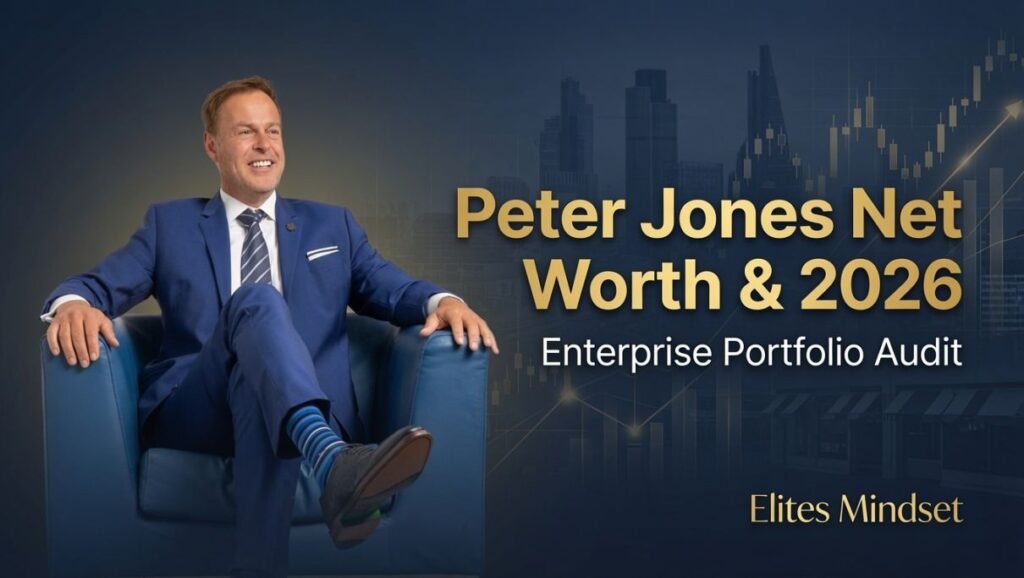
Peter Jones CBE represents the Mid-Market Private Equity Consolidation model—converting specialized retail turnarounds and corporate cash flows into a highly insulated, diversified private empire, in contrast to the public-market, venture-backed growth model that defines most billionaire tech wealth. His trajectory offers a forensic counterpoint to the Silicon Valley narrative: beginning with the 1998 establishment of Phones International Group, surviving the liquidation of an early computer business that cost him his home and vehicles, and ultimately scaling to a 2026 portfolio that encompasses the February acquisition of retail giant American Golf, the ongoing cash-generation of Data Select, and a property infrastructure that insulates the entire structure from public-market volatility. This is not a wealth story anchored in speculative valuations; it is an institutional blueprint for asset-scaling through operational control, counter-cyclical retail positioning, and B2B infrastructure ownership.
Enterprise Audit: The Peter Jones Investment Matrix
The Telecom Foundation: How Data Select and Phones International Built the Core Capital Liquid Buffer
The primary capital foundation originates in the 1998 founding of Phones International Group, a wireless and mobile communications solutions venture launched after Jones had already experienced the liquidation of his first computer business and a subsequent period of corporate rehabilitation at Siemens Nixdorf. The firm’s trajectory was meteoric: according to internal corporate history and self-reported performance disclosures, first-year sales reached £14 million, accelerating to £44 million by the second year of trading, and by 2006 the group was generating a reported turnover exceeding £220 million, ranking it among Europe’s fastest-growing telecommunications enterprises. This was not a speculative technology play but a distribution and infrastructure business, predicated on B2B contract relationships and recurring revenue streams that would later define Jones’ preference for cash-generative operational models over capital-intensive development.
The structural pivot occurred in 2011 with the monetization of Wireless Logic —a standalone machine-to-machine communications specialist founded in 1999 or 2000 (sources differ on the precise incorporation date) — which Jones strategically acquired in 2002 and scaled alongside his core infrastructure. Jones divested his stake for approximately £35–38 million — figures vary across primary source reporting — in a management buyout led by co-founders Oliver Tucker and Philip Cole, backed by ECI Partners.
Jones’ exit at £35–38 million represented a strong return on his 2002 acquisition price. The subsequent 100-fold growth — from £35 million to a £3.5 billion valuation in May 2025 — was driven by Tucker and Cole’s leadership, later backed by Montagu (majority, from 2018) and General Atlantic (minority growth equity, 2025), entirely after Jones had left the business. In May 2025, a minority growth equity investment from General Atlantic valued Wireless Logic at £3.5 billion, with Montagu remaining the majority shareholder.
Today, Data Select remains the core capital anchor—a verified, multi-million-pound cash-generative B2B distribution platform supplying mobile devices, SIM solutions, and enterprise connectivity hardware to UK corporate clients. Its function within the Peter Jones Investment Group is analogous to the treasury operations of a diversified holding company: providing liquid capital buffers that fund distressed retail acquisitions, venture equity deployments, and property infrastructure — reducing dependence on external financing cycles. In an institutional context, this telecom foundation represents the original capital liquid buffer that enabled the entire subsequent scaling strategy, distinguishing Jones from venture capitalists dependent on limited-partner fundraising cycles.
High-Street Distressed Assets: Jessops, Red Letter Days, and the 2026 American Golf Acquisition
Jones’ distressed-asset strategy follows a consistent pattern: acquire specialist retail brands during administration or private-equity divestiture, injecting operational expertise and multi-channel infrastructure, and rebuilding equity value through customer-trust restoration and store-network optimization. The 2013 acquisition of Jessops, the iconic British photographic retailer, exemplifies this methodology. Following the company’s collapse into administration in early 2013, Jones invested several million pounds to resurrect the brand, implementing a multi-channel strategy in which the high street played a definitive role. Within a compressed timeframe, the business expanded from zero retail stores to thirty-seven locations, demonstrating that physical retail, when integrated with digital distribution and B2B service contracts, could still generate yield in a sector widely declared obsolete.
📋 Deal Card: American Golf Acquisition — February 2026
| Acquirer | Peter Jones Investment Group |
| Seller | Endless LLP (8-year owner) |
| Completion | 3–4 February 2026 (sources vary) |
| Annual Turnover | £135 million |
| Store Count | 80+ physical stores (UK & Ireland) |
| Employees | 1,000+ |
| Financial Terms | Undisclosed |
| Jones’ Advisers | Reed Smith (legal), Grant Thornton (financial & tax) |
| Seller’s Advisers | Alvarez & Marsal (corporate finance), Addleshaw Goddard (legal), KPMG (tax) |

This retail turnaround philosophy has been consistently deployed alongside Theo Paphitis, his long-standing distressed-asset partner. Their collaboration dates to the 2005 rescue of Red Letter Days, where the immediate tactical decision to honour millions of pounds in outstanding consumer vouchers during administration preserved brand equity and customer lifetime value at the precise moment when outright liquidation would have destroyed both. That same playbook—prioritizing consumer trust as a balance-sheet asset rather than a liability to be written off—has defined Jones’ approach to high-street restructuring. At Jessops, the rehabilitation focused on restoring supplier relationships, re-establishing retail footprints, and integrating the Partner Retail Services infrastructure that now operates Samsung Experience stores and provides electronics retail services to multiple operators. The result is a specialized retail holding that generates yield not through speculative expansion but through operational consolidation in niche categories where physical expertise still commands premium margins.
The February 2026 acquisition of American Golf is the largest retail move of Jones’ career to date. The transaction, completed on or around 3–4 February 2026 (sources report differing completion dates), saw his investment group acquire the UK’s and Ireland’s largest specialist golf retailer from private equity firm Endless LLP, which had owned the business since 2018 — an eight-year ownership period during which Endless oversaw a period of brand stabilisation, store refresh, and gross margin improvement through the acquisition of brands including Stromberg, Benross, and Golfino. Financial terms were not disclosed, though the target generates annual turnover of approximately £135 million across more than eighty physical stores and a substantial omnichannel platform, employing over one thousand personnel.
The acquisition rationale, as articulated by Jones, combined personal passion with institutional logic: golf is a high-margin specialized retail category with entrenched customer loyalty, and American Golf’s brand recognition provides the platform for global market-leadership ambitions. Industry sources indicated that Jones had targeted the asset for several months, with specific interest in accelerating its digital capabilities and online sales trajectory. Jones’ investment group was advised by Reed Smith (legal) and Grant Thornton (financial and tax). American Golf and Endless were separately advised by Alvarez & Marsal (corporate finance), Addleshaw Goddard (legal), and KPMG (tax). For the Peter Jones Investment Group, American Golf solidifies a footprint in experiential leisure retail—a sector insulated from pure commodity competition by the technical expertise required to serve dedicated enthusiasts.
The Dragons’ Den Yield Ledger: Separating Marketing Optics from True Enterprise Value Equity
The public perception of Peter Jones’ television investments is dominated by marketing optics—memorable pitches, personality-driven dealmaking, and the entertainment value of the Den. An institutional audit, however, reveals a highly discriminating equity strategy that separates low-capital lifestyle stakes from genuine high-yield home runs. Jones has since expanded his television presence to the United States, appearing as a recurring Shark on Shark Tank, where he is known as “Mr Global” — a nickname that reflects his focus on scaling portfolio companies into international markets.
Since 2005, Jones has pledged an estimated £6.5–7 million in on-air investments across over forty portfolio companies — though the gap between pledged and completed deals is significant, with independent analysis suggesting approximately £3 million in confirmed commitments, but the true enterprise value resides in a concentrated cluster of FMCG, media, and technology stakes where the television platform itself functioned as a customer-acquisition and distribution-acceleration tool. The BBC programme was never merely entertainment; it was a nationally televised venture-capital screening process that delivered dealflow, brand endorsement, and immediate retail access to portfolio companies at a customer-acquisition cost approaching zero.

The definitive high-yield transaction remains the 2007 investment in Reggae Reggae Sauce, the Caribbean condiment brand founded by musician and chef Levi Roots. Jones, alongside fellow Dragon Richard Farleigh, jointly invested £50,000 for a combined 40% equity stake. Jones subsequently bought out Farleigh’s share for approximately the original outlay, consolidating his position as the sole Dragon shareholder in the brand. Following post-broadcast renegotiation to reflect supply-chain realities, this modest capital outlay was leveraged through Jones’ retail relationships to secure a Sainsbury’s distribution deal that put the sauce on shelves nationwide. The timeline was exceptionally compressed: Sainsbury’s confirmed interest on 9 February 2007, and the sauce was on sale nationwide by 7 March 2007 — less than a month after broadcast.
Reports at the time indicated the sauce outsold Heinz Tomato Ketchup during its initial Sainsbury’s launch phase and has since expanded into a comprehensive FMCG portfolio encompassing ready meals, snacks, soft drinks, and pasties, with the brand’s valuation reported at an estimated £30 million at its commercial peak. For Jones, this investment validated the Dragons’ Den model as a venture-syndication platform: the television exposure de-risked the initial equity stake, while his personal buyer relationships at major retailers converted broadcast momentum into shelf-space revenue.
Other notable equity positions include Wonderland Magazine, the luxury lifestyle and culture publication in which Jones invested £100,000 for 50% equity during Series 1, and Bare Naked Foods, where he deployed £60,000 for 50%. These media and FMCG stakes function as a high-volume micro-cap equity book: individually modest in capital commitment, but collectively generating significant brand-equity yield and cross-promotional value across the portfolio. The audit distinction is critical—Jones did not merely “appear” on television; he operated a venture-capital yield ledger in which marketing optics were systematically converted into tangible equity stakes, distribution contracts, and intellectual property holdings. The failed or dissolved investments, which are inevitable in any micro-cap book, are absorbed by the cash-generative foundation of Data Select and the property infrastructure, preventing the portfolio-level volatility that typically destroys angel-investor returns.
The Syndication Premium: Revenue Integration Across the Portfolio
The 2026 valuation of the Peter Jones Investment Group is not captured by any single asset. Combined, the group’s entities are reported to generate revenues exceeding £500 million annually and employ several thousand people across its retail, distribution, and logistics operations — a scale that creates real logistics and supply-chain synergies between American Golf, Data Select, and the property portfolio. It is a model that prioritizes control over minority positions, operational cash flow over speculative appreciation, and private-market insulation over public-equity volatility.
Beyond the Den, Jones co-created American Inventor for ABC in 2006, alongside Simon Cowell, and launched Tycoon on ITV in 2007 — extending his broadcast commercial model beyond a single platform.
Commercial Property & Real Estate Infrastructure: The Underlying Valuation Ballast
Beneath the operational companies lies a considerable commercial and residential property portfolio that functions as the physical asset insulation for the entire enterprise. Jones holds commercial offices that directly house his distribution, logistics, and retail support operations, alongside residential properties in Buckinghamshire, Beverly Hills, California, Barbados, Switzerland, and Portugal. The Buckinghamshire estate, acquired for £7 million in 2009 and sitting on nearly two hundred acres, and the 2004 Beaconsfield acquisition, provide not merely residential utility but strategic proximity to the Thames Valley technology and logistics corridor.
This real estate infrastructure performs a critical portfolio function: it protects net worth against public-market volatility by converting liquid business cash flows into physical asset appreciation, while simultaneously reducing the operational overhead of his trading companies through owned-facility utilization. In an institutional audit framework, the property book is not a personal luxury allocation but a balance-sheet ballast that supports the low-leverage expansion of the operating businesses.
The Talent Pipeline: Strategic Positioning of the Peter Jones Foundation
The Peter Jones Foundation and its flagship Tycoon Enterprise Competition function as a long-term talent pipeline — building brand affinity with young entrepreneurs years before they reach pitching age. The Foundation, which marked its twentieth anniversary in 2025 having donated over £20 million to youth enterprise initiatives, delivers free national business education to young people aged six to twenty-five — with its flagship Tycoon competition targeting students aged six to eighteen across UK state and private schools. Participants in Tycoon receive goodwill seed loans per school — reported at up to £3,000 — write formal business plans, write formal business plans, and trade through a Kickstarter-style digital platform, with finalists presenting to Jones at prestigious venues including Buckingham Palace and Hampton Court Palace. The 2025-26 competition cycle continues this mandate, with specialized tracks for SEND students and further-education colleges.
From an institutional perspective, the Foundation is not merely charitable expenditure; it is a proprietary screening mechanism for early-stage talent acquisition and future enterprise incubation. The Tycoon programme identifies, trains, and filters young business talent at scale, creating a nationwide feeder system that can direct promising founders toward the Peter Jones Investment Group, the Peter Jones Enterprise Academy, or future Dragons’ Den applications.
The 2026 National Entrepreneur of the Year competition, delivered in partnership with business advisory firm FRP, is open to entrepreneurs aged sixteen to twenty-one, with a focus on under-served and under-represented communities — expanding the talent pipeline well beyond traditional venture-capital networks. In this context, the Foundation reaches potential future founders before any traditional venture capital firm gets near them — a dealflow advantage that no banker-led introduction can replicate.
The Peter Jones Asset Allocation & Enterprise Matrix (2026)

Frequently Asked Questions
Q:What is Peter Jones’ net worth in 2026?
Peter Jones’ net worth is estimated at up to £1.2 billion as of 2026, though private wealth indices offer varying assessments. Valuation Band: £1.2 billion. The Sunday Times Rich List placed him at £1.157B (#150) in 2021 and £1.17B (#157) in 2022; media consensus for 2026 is approximately £1.2B. Conservative media benchmarks place his wealth between £500 million and £670 million, while higher institutional projections accounting for the full enterprise value of his private holdings approach £1.2 billion. This valuation reflects the combined enterprise value of Data Select, the Jessops and American Golf retail holdings, his venture portfolio, and an extensive commercial property infrastructure rather than simple liquid cash reserves.
Q:Which companies does Peter Jones currently own?
His current corporate footprint is anchored by Data Select, the B2B telecommunications distribution platform retained from his early telecom divestitures. His specialized retail portfolio includes Jessops, the photographic retailer rescued from administration in 2013, and American Golf, acquired in February 2026 via his investment group from Endless LLP. The broader PJ Investment Group framework holds stakes in numerous consumer, media, and tech brands alongside a substantial global commercial and residential real estate portfolio.
Q:Is Peter Jones the richest investor on Dragons’ Den?
Yes. As the longest-serving Dragon since the programme’s inception in 2005, Jones holds the distinction of being both the wealthiest and the most enduring investor in the Den’s history. His estimated wealth significantly exceeds that of his fellow panelists, reflecting the institutional scale of his mid-market private equity consolidation engine rather than standard television earnings.
Q:How did the divestment of Wireless Logic shape his current acquisition strategy?
The 2011 sale of Wireless Logic for £35 million acted as an early capitalization catalyst for his modern portfolio, even though the company’s real value creation — its rise to a £3.5 billion valuation — happened later, under the buyers’ ownership rather than Jones’. By executing a clean asset bifurcation — selling the capital-intensive machine-to-machine infrastructure while retaining the high-velocity distribution cash engine of Data Select — Jones secured a capital position that reduced dependence on external financing for subsequent high-street acquisitions.
Q:What is the post-broadcast equity reality of his Dragons’ Den investments?
While television broadcast focus centers on the on-air handshakes, an institutional audit shows that a significant percentage of deals undergo intense post-broadcast renegotiation or deep corporate due diligence. Even iconic success stories, such as the 2007 investment in Reggae Reggae Sauce, saw their final operational structures recalibrated behind the scenes to reflect supply-chain constraints, logistical footprints, and retail buyer commitments.
Disclaimer & Editorial Notes
Source Note: The £1.286 billion figure (Sunday Times Rich List, May 2024, position 133) belongs to Peter Emerson Jones OBE — founder of the Emerson Group, a property development company — and is not attributable to Peter David Jones CBE of Dragons’ Den. These are two distinct individuals. All Rich List references in this article relate solely to Peter David Jones CBE.
This profile functions strictly as an independent forensic corporate case study and public asset audit. All corporate valuations, investment tracking, and net worth indexing are compiled exclusively from high-authority public records, Companies House filings, and historical media indices. Elites Mindset operates with absolute editorial independence and maintains no corporate affiliation, endorsement, or commercial relationship with Peter Jones, the PJ Investment Group, or the BBC’s Dragons’ Den. The insights provided herein are for educational, corporate strategy, and analytical purposes only and do not constitute financial, legal, or investment advice.