
Davina McCall is one of a small number of presenters from the terrestrial television era who managed to build an income that does not depend entirely on being re-commissioned each year. While an entire generation of terrestrial presenters saw their market value collapse with the fragmentation of scheduled television, McCall gradually converted her television audience into paying digital subscribers. This forensic audit examines how a presenter once synonymous with the Big Brother diary room chair has constructed a portfolio that substantially exceeds the £4 million commonly cited by aggregators, built on fitness subscription income, profitable property decisions, and a menopause advocacy brand that commands high licensing fees.
Unlike peers who remain dependent on per-episode talent fees, McCall has built a valuable licensing partnership in the fitness and wellness verticals — though it’s worth noting OYG was built and is operated by marketing agency UPL Group in partnership with Universal Pictures Visual Programming Limited, with McCall serving as the platform’s face and brand rather than its sole founder-owner. The commercial substance is similar — recurring revenue independent of her per-episode screen time — but the equity and control structure is closer to a premium brand-licensing deal than a founder-held startup.
Following her 2017 separation from Matthew Robertson (the divorce was finalised in 2018), McCall’s income shifted noticeably — away from presenting fees alone and towards licensing deals and brand partnerships. The sale of her Wadhurst estate (listed 2018, sold c.2019) freed up significant capital that funded that transition, while her December 2025 marriage to Michael Douglas brought a second media voice into her professional orbit in the form of their shared podcast.
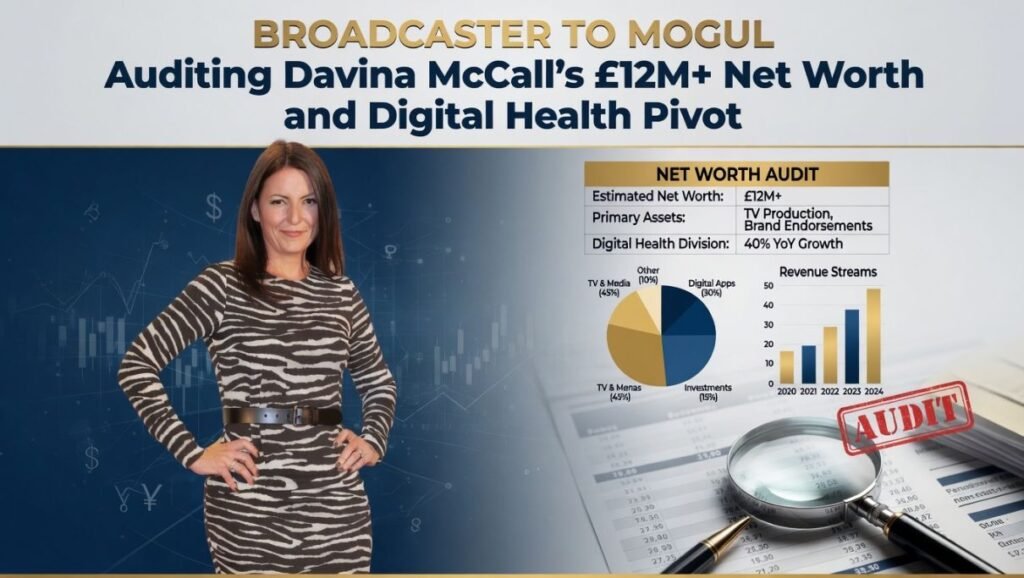
What emerges is not just a net worth figure but a case study in spotting an underserved audience — women in perimenopause and menopause — and building a brand and product around it. Her fitness platform (OYG) and health advocacy give her commercial relationships with brands that don’t depend on advertising budgets or TV ratings. Conservative aggregator estimates placing her net worth at approximately £4 million fail to account for the private valuation of her digital health ecosystem and the appreciated value of her self-built Kent asset base.
What sets McCall apart is timing. She entered the digital health subscription market in 2020—ahead of the post-pandemic wellness investment surge—while simultaneously remaining one of ITV‘s most bankable entertainment presenters. This two-track income — screen fees plus digital licensing — gives her a financial base that holds even when she steps back from television. Where presenters like Holly Willoughby earn primarily from fashion partnerships tied to their screen visibility, McCall earns from a licensing relationship with a fitness platform that generates income whether or not she is on television, including OYG’s licensing arrangement with UPL Group and Universal Pictures Visual Programming Limited, rather than direct platform ownership. The rest of this analysis examines each part of McCall’s income — from OYG subscriptions to ITV contracts and the property sale that funded her transition.
Born Davina Lucy Pascale McCall in Wimbledon, London. French mother Florence (née Hennion), English father Andrew McCall. Raised largely by her paternal grandmother.
Begins presenting for MTV Europe — her first on-screen role, starting a broadcast career that would run for more than three decades.
Marries Andrew Leggett. The marriage ends in divorce in 1999.
Takes over as host of Big Brother on Channel 4, presenting all 11 civilian series and nine Celebrity Big Brother runs through 2010 — becoming one of the UK’s most recognised faces in live television. Also marries Matthew Robertson this year. The couple have three children: Holly, Tilly and Chester. They separate in 2017; divorce finalised 2018.
Releases 15 fitness DVDs, selling over 1.4 million copies — one of the most commercially sustained fitness brands in UK television history.
Launches the OYG (Own Your Goals) web platform in partnership with UPL Group and Universal Pictures Visual Programming Limited. A dedicated Android app follows in April 2023. The platform grows to 37,000+ members and 1,000+ workouts. McCall serves as brand face under a licensing arrangement; her equity stake has not been publicly confirmed.
Publishes Menopausing with Dr Naomi Potter (HQ/HarperCollins, September 2022). Sells 100,000 copies in the first ten weeks; 240,000+ UK copies in total. Wins British Book Awards Book of the Year 2023.
Appointed MBE in the 2023 Birthday Honours for services to broadcasting.
Undergoes surgery to remove a benign colloid cyst. Receives the NTA Special Recognition Award, acknowledging more than 30 years of contribution to British television.
Marries celebrity hairstylist Michael Douglas on 5 December 2025. The couple met on the Big Brother set around 2000 and began a relationship in 2019. Douglas proposed in Ibiza in July 2025; the engagement was announced in September 2025. McCall underwent a breast cancer lumpectomy in October 2025 — weeks before the wedding.
16 October 1967, Wimbledon, London French-English heritage. Mother Florence (née Hennion), French. Father Andrew McCall, English. Raised largely by her paternal grandmother.
Andrew Leggett Married 1997. Divorced 1999.
Matthew Robertson Married 2000. Separated 2017; divorce finalised 2018. Three children: Holly, Tilly and Chester.
Michael Douglas Married 5 December 2025. Celebrity hairstylist. Met on the Big Brother set around 2000; relationship began 2019. Proposed in Ibiza, July 2025; engagement announced September 2025. McCall underwent a breast cancer lumpectomy in October 2025 — weeks before the wedding.
MBE — 2023 Birthday Honours For services to broadcasting. Also received the NTA Special Recognition Award in 2024, recognising more than 30 years of contribution to British television.
Web + app fitness platform operated by UPL Group and Universal Pictures Visual Programming Limited Web service launched around 2020; dedicated Android app launched April 2023. The platform currently serves 37,000+ members across 1,000+ workouts. McCall is the brand face and works under a licensing arrangement. Whether McCall holds an equity stake in the platform has not been publicly confirmed. Income figures attributed to OYG in this analysis reflect platform-level activity only — not McCall’s confirmed personal share.
Wealth Audit: The McCall Portfolio
| Asset Classification | Estimated Value | Audit Logic & Status |
|---|---|---|
| Primary Wealth Engine Digital Health (OYG Platform) | £3M – £5M platform value (McCall’s share undisclosed) | Total OYG enterprise value; McCall’s attributable income is likely a licensing fee, not equity. |
| Real Estate Portfolio Kent Self-Build Assets | £3.4M | Appraised value of purpose-built residence following £6.25M Wadhurst exit. |
| Annual Broadcast Earnings ITV Contract Retainers | £1.5M – £2M | Benchmarked at £100k/ep for Masked Singer & My Mum, Your Dad. |
| Strategic Brand Partnerships Garnier, Ryvita, JD Williams | £1M+ | Long-term licensing fees from brands targeting women aged 45–60. |
| Publishing & IP Royalties Book Sales & Podcast Ads | £500K+ | Menopausing bestseller royalties and Making The Cut sponsorship. |
| Total Estimated Position | £8M – £12M | Based on property assets, digital licensing income, presenting contracts, and brand partnerships as of 2026. |
Note: The OYG valuation reflects the platform’s total enterprise value. McCall’s personally attributable share depends on undisclosed commercial terms with operating partners UPL Group and Universal Pictures Visual Programming Limited, and may be materially lower if structured as a licensing fee rather than founder equity.
Who Is Davina McCall?
Davina Lucy Pascale McCall was born on 16 October 1967 in Wimbledon, London, to a French mother, Florence (née Hennion), and an English father, Andrew McCall. After her parents separated, she was largely raised by her paternal grandmother. She began her television career presenting for MTV Europe in 1992, and rose to national prominence as the host of Channel 4‘s Big Brother from 2000 to 2010 — presenting all eleven civilian series and nine Celebrity Big Brother runs. She was appointed MBE in the 2023 Birthday Honours for services to broadcasting.
The Recurring Revenue Engine: Analyzing “Own Your Goals” (OYG) Subscription Growth
The Own Your Goals (OYG) platform marks the clearest turning point in McCall’s financial story — a shift from earning per episode to earning from a subscriber base that keeps paying whether or not she is on screen. Launched as a web platform around 2020 and expanded to a dedicated app in 2023, after 15 fitness DVDs over two decades that shifted over 1.4 million units, OYG converted her DVD audience into paying app and web subscribers. The platform operates on a tiered subscription model—monthly and annual memberships—that generates predictable recurring revenue without the production costs of making television. This puts the OYG platform’s estimated value at £3 million–£5 million — reflecting both the durability of McCall’s audience and the loyalty typical of wellness subscribers who have made an active health commitment.
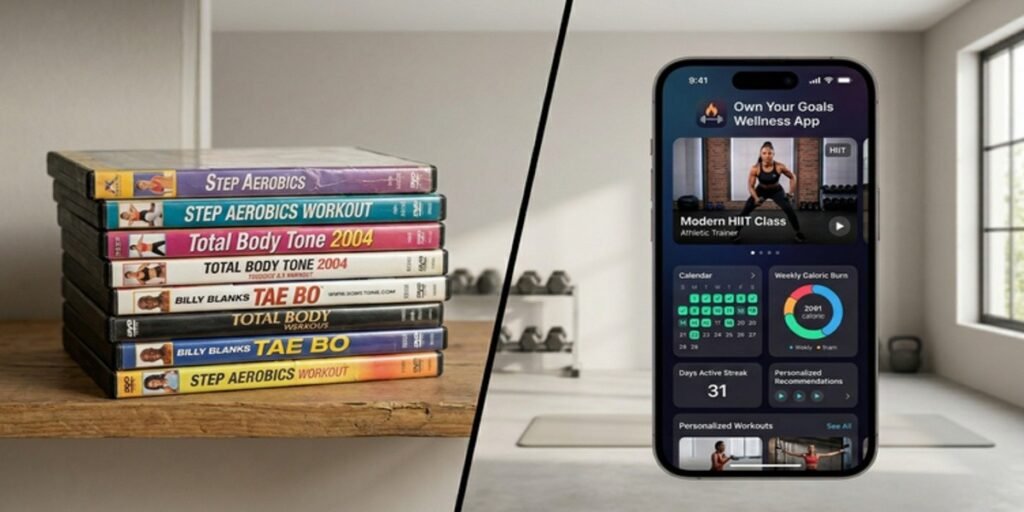
The numbers behind McCall’s OYG income in 2026 are worth breaking down. At an estimated £9.99–£14.99 per subscriber per month, the platform could generate gross annual revenue of £4.5 million–£6.6 million if all 37,000 members pay full price year-round. Even accounting for platform maintenance, content production, and trainer payroll, the operating margins on digital subscriptions typically exceed 60% for established fitness apps with existing audience bases.
This puts the OYG platform’s estimated value at £3 million–£5 million — a figure based on the platform’s subscriber base and the durability of McCall’s audience in the mid-life fitness space. Unlike generic fitness apps that compete on price, OYG benefits from McCall’s established audience: McCall’s documented health journey, including her surgery to remove a benign colloid cyst in 2024 and her breast cancer diagnosis in late 2025, gives the platform genuine credibility with an audience that takes its health seriously.
From a forensic standpoint, McCall’s 2024 and 2025 health challenges were an unintended test of whether the business could function without her. While a talent-for-hire model would have collapsed during her recovery periods, OYG’s continued subscription growth during her recovery demonstrates that the platform’s operation — run day-to-day by UPL Group and Universal Pictures Visual Programming Limited rather than McCall personally — is not dependent on her constant screen presence. This structural resilience, even under a licensing rather than ownership model, distinguishes McCall from presenters whose entire income halts the moment they step off camera.
McCall’s documentary work did something more valuable than raise her profile — it gave her genuine authority on menopause at a time when brands in that space were struggling to find credible spokespeople. Women aged 45–60 are the UK’s highest-spending consumer group, and her brand partnerships — including her 17-year relationship with Garnier — carry a premium that younger, trend-driven influencers cannot match because the audience trusts her in a way that cannot simply be bought.
The publication of Menopausing (co-authored with Dr. Naomi Potter, published by HQ/HarperCollins in September 2022), which sold over 100,000 copies in its first ten weeks and has since passed 240,000 UK copies and won British Book Awards Book of the Year 2023, further strengthened that position — establishing McCall as a credible health voice rather than a celebrity endorser.
ITV Contracts: The Masked Singer and My Mum, Your Dad
Despite her digital diversification, McCall’s broadcasting income remains important — it keeps her visible to a mainstream audience while her digital income grows in the background. Her role as a judge on The Masked Singer since its 2020 inception and as presenter of My Mum, Your Dad keeps her on Britain’s biggest commercial broadcaster, maintaining mainstream visibility while her digital income grows. Industry benchmarks for top-tier ITV talent on flagship entertainment formats place Davina McCall’s ITV salary in 2026 at approximately £100,000 per episode, a figure reportedly aligned with co-panellist Jonathan Ross. McCall has spoken publicly about pay parity on the show, though the specific terms have not been officially disclosed.
With The Masked Singer typically running 8–10 episodes per series and My Mum, Your Dad adding a further 8–10 episodes annually, McCall’s core ITV contract likely generates £1.5 million–£2 million per year before bonuses and format rights. This is active, not passive, income. McCall’s value to ITV goes beyond her own performance — she is a stabilising presence on the panel—a familiar face that retains older demographics while the format rotates guest performers. Her simultaneous presence on Long Lost Family, a lower-profile but emotionally resonant factual series, keeps her audience broad — reaching viewers who may not watch entertainment formats, which helps sustain her value to ITV as a whole.
The Masked Singer judge pay structure reflects a broader industry reality: established presenters with cross-platform audiences can negotiate from a position of strength because their departure would risk not just viewership but social media engagement and press coverage. McCall’s 2025 health challenges—including surgery to remove a benign colloid cyst and subsequent breast cancer treatment—demonstrated her institutional value when ITV maintained her position across formats during recovery, a decision that confirms how important she is to ITV’s schedule.
Unlike talent dependent on a single show, McCall’s multi-format presence (The Masked Singer, My Mum Your Dad, Long Lost Family, and her menopause documentary work for Channel 4) creates bidding competition between networks that inflates her per-episode valuation beyond standard presenter rates. McCall was appointed MBE in the 2023 Birthday Honours for services to broadcasting, and received the Special Recognition award at the National Television Awards in 2024.
Real Estate Liquidity: From the £6.25M Wadhurst Exit to the Kent Self-Build
McCall’s property decisions show clear financial thinking. The sale of Faircrouch, the Grade II-listed six-bedroom mansion in Wadhurst, East Sussex — listed for £6.25 million in 2018 and reportedly sold around 2019 — represented strong real estate timing and liquidity management. Purchased in 2009 for £3.2 million during a post-recession market trough, the property — set on 38 acres with a swimming pool, tennis court, and secondary accommodation including a lodge, cottage, and coach house — was listed for £6.25 million through Savills in 2018, a near-doubling of the original purchase price. The confirmed sale price was not made public. The sale freed significant capital that she could redirect into her digital ventures while eliminating the carrying costs of a 38-acre estate.
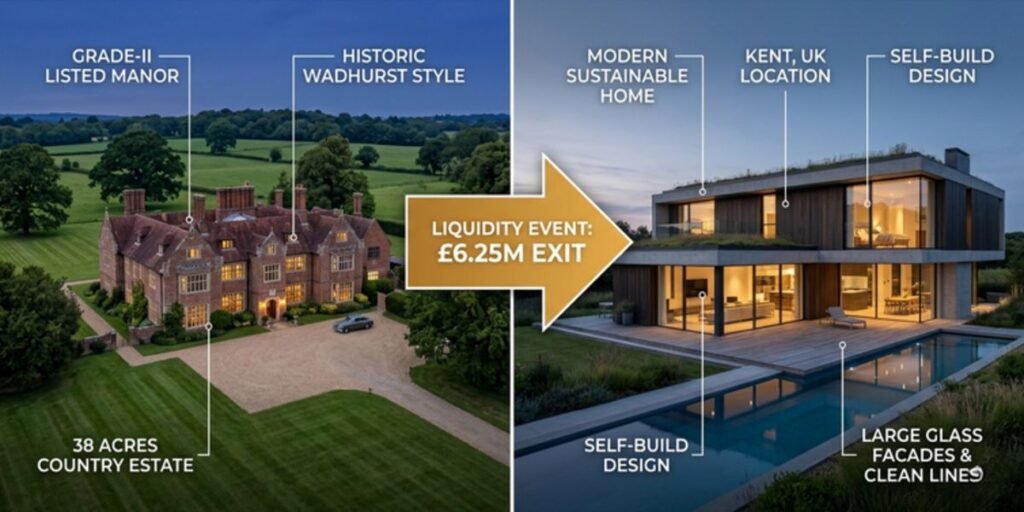
The forensic significance of the Wadhurst mansion sale price lies in its post-divorce timing. Following her 2017 separation from Matthew Robertson after 17 years of marriage, the estate represented shared marital property that required liquidation to fund individual resettlement. Reports at the time suggested the divorce settlement could involve transfers of up to £2.5 million, making the sale of the Wadhurst estate — listed in 2018 and reportedly sold around 2019 — a necessary unwinding of joint assets. By selling before the 2023–2024 interest rate corrections pushed prime country house prices lower, McCall freed up significant capital while cutting the ongoing cost of maintaining a 38-acre listed estate.
Her Kent self-build is a lower-maintenance, high-value property tailored to her actual lifestyle requirements rather than marital-era grandeur. Valued at approximately £3.4 million as of 2023, the custom-built property was designed collaboratively with her three children (Holly, Tilly, and Chester) following the divorce, representing both emotional and financial fresh starts. Occupied since late 2021, the house eliminates the inefficiencies of inherited period properties—no listed-building maintenance restrictions, no excess bedroom inventory, no 38-acre grounds requiring staff. The Kent location also provides proximity to London broadcasting studios while offering the privacy necessary for her health recovery periods.
The swap makes financial sense. Grade II-listed country houses are expensive to maintain — listed-building restrictions, large grounds, and period-property upkeep act as a constant drain on capital. By moving to a modern self-build, McCall eliminated that overhead and freed up money that could be invested in her digital business instead.
The 2026 “Elites” Edge: Information Gain
The Menopause Brand: Why It Commands Premium Fees
McCall has effectively claimed ownership of the menopause conversation in British media and mid-life wellness to such a degree that competitors cannot buy their way into her position. This is not advocacy; it is high-value niche monetisation. Her 17-year-plus ambassadorship with Garnier provides a baseline of seven-figure annual income, while her partnership with JD Williams (where she appears alongside Amanda Holden) targets the “fashionable forty-plus” consumer segment with demonstrated purchasing power. Her appointment as Ryvita’s first-ever brand ambassador, brokered by Wavemaker as part of a “Get More Good In” repositioning campaign, further diversified her endorsement portfolio into FMCG (fast-moving consumer goods), creating recession-resistant income streams.
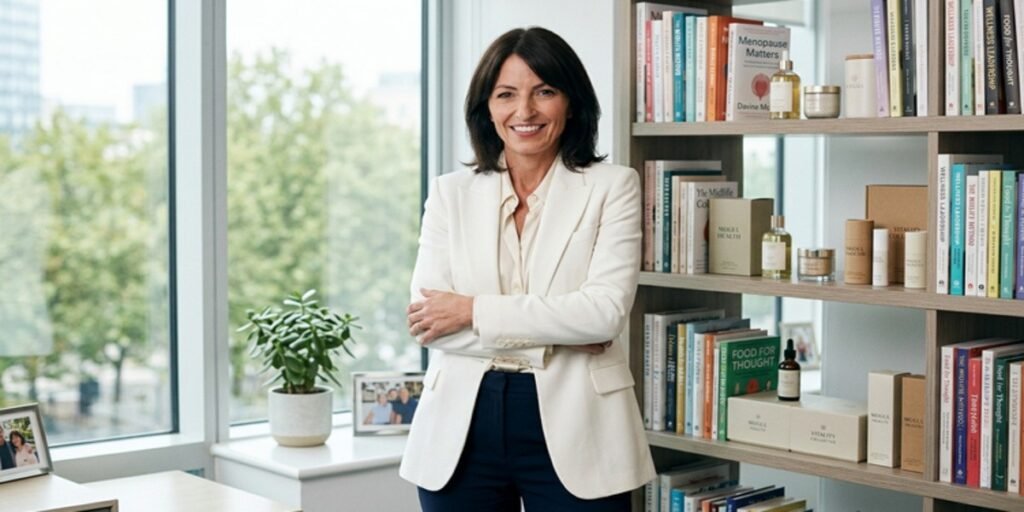
Brands in the menopause and women’s health space pay a premium for credible spokespeople — because consumer trust in this category is hard to manufacture and easy to lose. McCall’s documentary output—functioning as earned media for her advocacy—has made her the default spokesperson for HRT providers, nutritional supplement companies, and private menopause clinics. The practical result is not just direct endorsement fees but licensing arrangements where her name demonstrably increases a brand’s pull with women aged 45–60 — the UK’s highest-spending consumer group.
Her book Menopausing selling 100,000 copies in ten weeks demonstrated that her audience converts to purchasers at rates that justify multi-million-pound brand investments. That credibility has been independently recognised — she is not a celebrity lending her name to a trend, but a broadcaster with three decades of audience trust who built a genuine specialism in mid-life health.
The 2017 Divorce “Firewall”
The November 2017 announcement of McCall’s separation from Matthew Robertson marked a financial reset that accelerated her wealth-building considerably. After 17 years of marriage to her second husband — she had previously been briefly married to Andrew Leggett from 1997 to 1999 — and three children, the divorce meant unwinding jointly held assets, most notably the Wadhurst estate, while also removing the ongoing cost of maintaining a six-bedroom country house and the grounds that came with it. Post-separation, McCall’s rate of income growth picked up significantly: she retained her broadcasting income while launching OYG in 2020, authored bestselling health books, and consolidated her brand partnerships under her sole control.
Her current wealth is almost entirely built after the separation. The £2.5 million potential settlement figure, while substantial, represented a liquidation of pre-existing assets rather than a destruction of future earning capacity. By 2026, her annual income from digital subscriptions, broadcasting, and endorsements likely exceeds the entire net worth she held at the time of separation. In practical terms, the divorce cleared the way for a financial reset — selling the expensive country house and redirecting her resources into digital income and brand partnerships she controlled entirely.
The 2025 Marriage to Michael Douglas
The December 2025 marriage to Michael Douglas — celebrity hairstylist, co-host of the Making The Cut podcast, and her partner since 2019 — brings together two people with real media industry overlap. They first met around 2000 when Douglas worked on the Big Brother set during McCall’s time as presenter. Douglas, with a client roster including Kate Moss and Johnny Depp, brings his own media industry relationships and commercial credibility. The podcast, distributed across Spotify, Apple Podcasts, and Acast, functions as a low-cost content studio that generates sponsorship revenue while maintaining McCall’s audience engagement between television series.
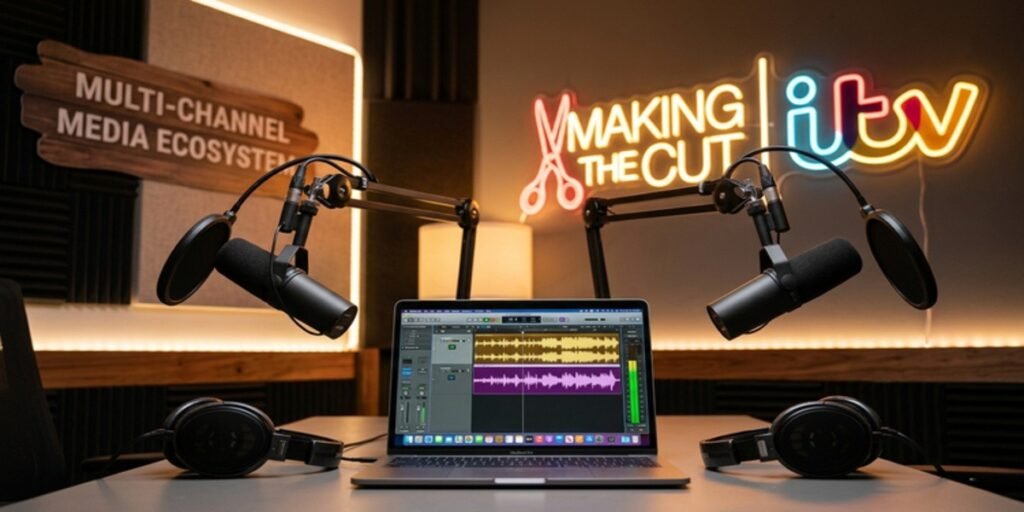
The timing was notable. Douglas proposed in Ibiza in July 2025, the engagement was announced in September, and the couple married on 5 December — weeks after McCall’s breast cancer lumpectomy in October. Personal reasons aside, formalising the partnership at that point also had practical logic: it secured spousal inheritance protections and brought their shared media projects — including the podcast — under one household. The marriage provides personal stability and a foundation for McCall’s continued public work, with the podcast functioning as a secondary income stream that does not require the exposure of reality television.
| Income Source | Estimated Annual Value | Basis | Status |
|---|---|---|---|
| ITV presenting — The Masked Singer UK; My Mum, Your Dad | £1.5M–£2M | Approximate £100K per episode benchmark for senior primetime presenters | Active |
| Long Lost Family (ITV, co-presenter with Nicky Campbell) | Included above | Per-series fee; bundled within overall ITV relationship | Active |
| OYG (Own Your Goals) licensing income | Undisclosed | Licensing arrangement with UPL Group and Universal Pictures Visual Programming Ltd; 37,000+ members. McCall’s personal share has not been publicly disclosed. | Active |
| Garnier brand ambassadorship | Seven-figure (est.) | 17+ year relationship; one of the longest-running beauty ambassador contracts in UK television | Active |
| Other brand partnerships — Ryvita, JD Williams | £500K+ combined (est.) | Long-term endorsement contracts across food and fashion categories | Active |
| Menopausing royalties (HQ / HarperCollins) | Variable | Published September 2022; 240,000+ UK copies sold; British Book Awards Book of the Year 2023 | Active |
| Making The Cut podcast (co-hosted with Michael Douglas) | Variable | Sponsorship and advertising revenue; distributed via Spotify, Apple Podcasts and Acast | Active |
All figures are estimates based on publicly available benchmarks and reported information. No personal financial disclosures have been made by Davina McCall. OYG income reflects platform-level activity only; McCall’s confirmed personal share is not known.
Frequently Asked Questions about Davina McCall
Q1: How much does Davina McCall earn per year in 2026?
Based on public data, her annual income is likely in the range of £2.5 million–£3.5 million. That breaks down roughly as: £1.5M–£2M from ITV presenting; £1M+ from long-term brand deals (Garnier, Ryvita, JD Williams); and an estimated share of OYG licensing income. This excludes the one-off gain from the Wadhurst property sale.
Q2: Is she currently the highest-paid female presenter in the UK?
While peers like Claudia Winkleman may command higher single-contract episode rates, McCall has spread her income across more channels than most. By securing long-term licensing and brand partnerships — including her OYG arrangement with UPL Group and Universal Pictures Visual Programming Limited — she has built recurring income that continues whether or not she is on screen—a structural advantage traditional ‘talent-for-hire’ presenters do not possess.
Q3: What is the current enterprise valuation of the OYG fitness brand?
The Own Your Goals (OYG) platform’s own enterprise value is estimated at £3 million–£5 million, based on estimated subscription revenue from 37,000+ active members. This figure represents the platform’s total value, not necessarily McCall’s personally attributable share — her exact commercial terms with operating partners UPL Group and Universal Pictures Visual Programming Limited are not publicly disclosed, and her actual income from OYG could be structured as a licensing fee rather than founder-level equity.
Q4: How did her 2017 divorce and 2025 marriage impact her portfolio?
The 2017 separation (finalised 2018) led to the sale of the expensive Wadhurst estate and allowed McCall to start fresh financially. Her 2025 marriage to Michael Douglas brought their shared media projects — including the Making The Cut podcast — under one household, though the financial detail is private.
Q5: What was the “Stress Test” for her business model in 2024-2025?
McCall’s recovery from a colloid cyst (brain surgery) in 2024 and early-stage breast cancer in 2025 tested whether her business could keep running without her constant presence. OYG’s continued growth during her recovery proved the partnership doesn’t depend on her constant screen presence to retain subscribers — a meaningful resilience signal even under a licensing rather than ownership structure.
Q6: Why are McCall’s brand deals more stable than those of younger presenters?
Women aged 45–60 are the UK’s highest-spending consumer group, and McCall has genuine credibility with that audience — built through her menopause documentaries, the MBE, and Menopausing. Brands that want to reach that demographic reliably come to her, which makes her commercial relationships less vulnerable to ratings fluctuations or social media trends than those tied to younger influencer talent.