
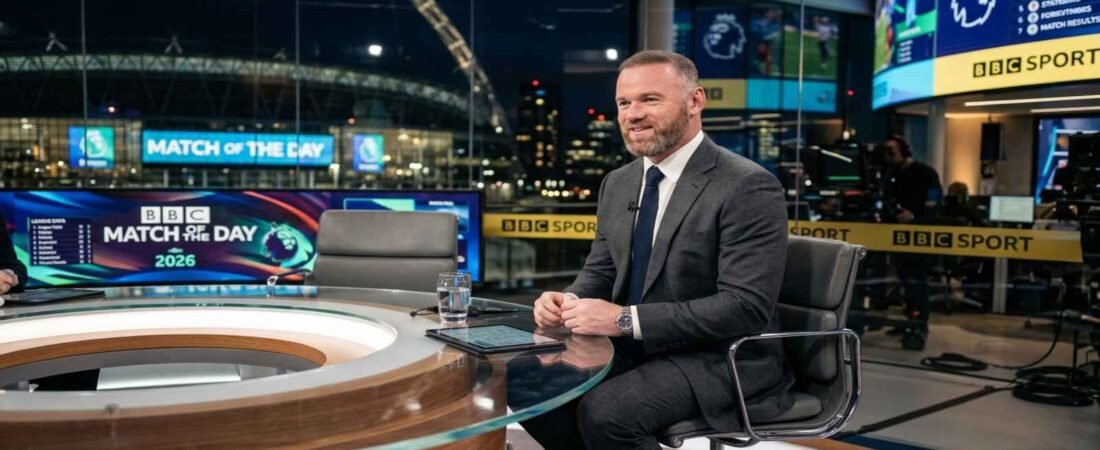
The £400,000 baseline that Wayne Rooney commands as a BBC Match of the Day pundit represents far more than a standard talent retainer; it functions as a strategic market-entry valuation for England’s greatest goalscorer. Unlike the volatile, performance-contingent liquidity of managerial contracts—where his £1.5 million annual package at Birmingham City evaporated after just 83 days and 15 matches—this BBC Tier-1 contract provides guaranteed income stability while preserving professional optionality.
While Rooney’s managerial tenure at Plymouth Argyle yielded approximately £500,000 annually for a seven-month stint marked by relegation battles, his broadcasting baseline ensures consistent portfolio performance. The forensic reality is that this £400k figure serves as an anchor asset within his broader £170 million net worth, stabilizing cash flow as he navigates the post-managerial transition. The contract’s true value lies not in its absolute monetary size—representing merely 0.24% of his total wealth—but in its function as a reputational loss-leader that maintains Downing Street-level visibility essential for his commercial endorsement ecosystem.
Broadcast Audit: The Wayne Rooney Valuation
Strategic Audit Insight: The £400,000 baseline functions as a Broadcasting Put Option, providing guaranteed liquidity against a managerial portfolio carrying a 92% termination risk (based on a 0.74-year average tenure). While representing a 60% discount to commercial rates (Sky/CBS), the BBC contract acts as a Q-Score Multiplier, maintaining the visibility required to sustain a £170M principal through the 2026 World Cup cycle.
The Shearer Benchmark: Why £400k is the New ‘Floor’ for Legend-Tier Pundits
The BBC’s compensation architecture operates on a rigid hierarchical valuation model. While Gary Lineker represents the ‘Master of Ceremonies’ ceiling at £1.35 million, Wayne Rooney occupies the ‘Tactical Authority’ tier—a distinct asset class the BBC deploys to defend market share against Amazon Prime and Netflix Sports. The £400k-£450k bracket now functions as the Legend-Tier Floor, with Alan Shearer’s £440,000-£444,999 established the market standard as documented in the BBC Group Annual Report and Accounts 2024/25.
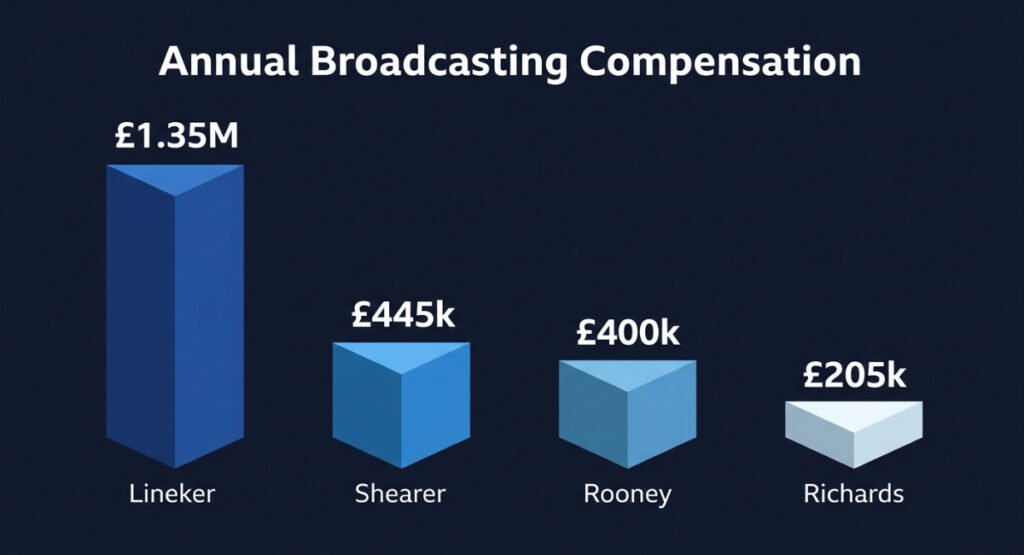
This tier represents a £60,000 year-on-year increase from Shearer’s previous £380,000-£384,999 band, reflecting the BBC’s acknowledgment that elite playing pedigree commands premium pricing in an increasingly fragmented sports media landscape. When analyzing cost-per-minute of airtime, Rooney’s valuation appears inefficient compared to secondary pundits like Alex Scott at £205,000-£209,999 or Micah Richards at approximately £205,000. However, the BBC calculates value through Q-Score multiplication—Rooney’s England record (53 goals, 120 caps) and Manchester United legend status provide demographic penetration that lower-tier pundits cannot replicate.
Contractual Fluidity: Analyzing the ‘Managerial Break-Clause’ Logic
Unlike Lineker’s fixed “Anchor” contract, which necessitated a complete career pivot to exit, Rooney’s BBC agreement incorporates Professional Pivot flexibility. Sources indicate the two-year deal, valued at £800,000 total, contains provisions allowing departure for managerial opportunities without catastrophic indemnity fees. This ‘Zero-Indemnity’ exit strategy is the broadcasting equivalent of a ‘release clause’ in a player’s contract, ensuring the BBC remains a temporary port rather than a career terminal. This is a crucial distinction given Rooney’s stated intentions to return to management should the “right opportunity” emerge.
This structural accommodation reflects the BBC’s risk assessment of Rooney’s career volatility. His managerial portfolio exhibits a 0.74-year average tenure across Derby County, DC United, Birmingham City, and Plymouth Argyle—rendering long-term broadcasting commitments untenable without escape mechanisms. The contract essentially functions as a put option for Rooney: guaranteed liquidity (£400k/year) with minimal exercise costs for professional reversal.
Comparatively, his managerial compensation has proven erratic: the £1.5 million annual salary at Birmingham City (close to £29,000/week) represented more than three times predecessor John Eustace’s £9,000/week wage, yet delivered only 0.40 points per match and termination within 83 days. The dismissal followed a 3-0 defeat to Leeds United on New Year’s Day 2024, with Birmingham sitting just six points above the relegation zone despite inheriting a side in an early-season playoff position — underscoring how quickly Rooney’s managerial equity can evaporate relative to his broadcasting baseline. His DC United contract at $1 million annually (£23,653/week) and Plymouth Argyle’s £500,000 package further illustrate the income instability that makes the BBC’s guaranteed £400k baseline financially therapeutic.
IP & Image Rights: The Stoneygate 48 Ltd Revenue Stream
The £400,000 BBC remuneration likely bypasses standard PAYE structures, instead flowing through corporate entities optimized for tax efficiency. Rooney’s historical utilization of Stoneygate 48 Ltd, which entered solvent liquidation with a total £22.5 million returned to shareholders, established the template for how high-net-worth athletes structure broadcasting income.

While Stoneygate 48’s liquidation reflects Rooney’s broader post-playing financial restructuring rather than a single transitional event, the mechanism remains relevant. The £800,000 tax rebate from HMRC secured in late 2025 following the company’s closure demonstrates the fiscal complexity of athlete wealth management. The rebate followed a £300,000-per-week peak earning period during his Manchester United tenure, illustrating the scale of wealth still being unwound through corporate vehicles more than a decade after his playing peak. Current BBC payments likely route through successor entities, allowing Rooney to exploit corporate tax rates and dividend allowances rather than marginal income tax brackets.
This structuring aligns with the broader “forensic baseline” strategy: the £400k salary serves as a visible anchor satisfying public sector transparency requirements, while the true economic value—image rights licensing, syndication multipliers, and commercial endorsement leverage—resides within private corporate structures exempt from BBC disclosure mandates.
The Broadcasting Loss-Leader: Visibility Economics
In pure financial terms, £400,000 represents a loss-leader for Rooney’s brand. With a net worth of £170 million, the annual BBC stipend generates negligible liquid impact. However, the value proposition lies in high-frequency public visibility essential for sustaining a global Q-Score—the cultural capital that fuels higher-paying commercial endorsements and global appearance fees.
The demographic pivot proves equally critical. Rooney provides the BBC with Gen Z/Millennial translation capability—his digital-native profile and social media penetration (amplified by the couple’s £10 million Disney+ documentary deal, with Coleen reportedly earning £5m directly) bridge the gap between traditional MOTD viewers and the TikTok/Social highlight generation. This intergenerational connectivity justifies the £400k floor despite lower raw airtime utilization than presenters like Mark Chapman (£325,000-£329,999).

Furthermore, BBC appearances function as Q-Score multipliers for international syndication. While specific CBS Sports or Apple TV contracts remain unconfirmed, the BBC platform positions Rooney for US network valuation at rates potentially tripling his effective hourly rate through global licensing. His existing Amazon Prime Champions League punditry and podcasting ventures suggest this syndication strategy is already operational.
Frequently Asked Questions
Q:Is Wayne Rooney the highest-paid BBC pundit?
No. While Rooney’s £400,000 baseline places him among the elite tier, Alan Shearer commands £440,000-£444,999, making him the highest-paid pure pundit following Gary Lineker’s departure. Lineker’s £1.35 million “Anchor” valuation remains the historical ceiling against which all other talent is benchmarked.
Q:How does Rooney’s MOTD salary compare to Sky Sports?
Industry estimates place Sky Sports’ top pundits like Gary Neville and Jamie Carragher at £1 million-£1.1 million annually, suggesting Rooney’s BBC valuation represents a 60-65% discount to commercial market rates. This gap reflects the BBC’s Public Service Broadcasting constraints versus Sky’s subscription revenue model.
Q:What is Wayne Rooney’s net worth in 2026?
Financial audits estimate Rooney’s current net worth at £170 million ($220 million), positioning him as the world’s wealthiest football manager. (Note: While Diego Simeone maintains the highest annual managerial salary, Rooney’s £170M principal—largely stabilized by his ‘Stoneygate’ era—remains the highest total liquidity pool in the coaching ranks).
Q:Does the £400k include his 2026 World Cup coverage?
Yes. Reports indicate Rooney’s two-year deal encompasses the 2026 World Cup coverage from the US, Mexico, and Canada. This tournament cycle inclusion explains the £400k annualization, as World Cup years are widely understood within the industry to command premium ad-slot and syndication rates for broadcast talent, though the BBC does not disclose tournament-specific pay uplifts.
Q:How does the “Managerial Break-Clause” protect the BBC?
The ‘Zero-Indemnity’ exit strategy serves as a broadcasting “release clause.” It allows Rooney to exit for management roles without legal friction while ensuring the BBC remains a temporary port rather than a career terminal. This “Professional Pivot Flexibility” is a key distinction in modern punditry contracts for active coaches.