
The Bamford family has engineered a post-war garage operation into one of Britain’s most formidable industrial dynasties, constructing an asset fortress that spans heavy machinery, elite lifestyle brands, and proprietary zero-emission technology. With JCB generating £5.8 billion in annual revenue and the family’s forensic net worth now estimated at $15.2 billion, Anthony Bamford and Lady Carole Bamford represent a unique hybrid of industrial heritage and modern diversification. Their corporate architecture—utilizing Swiss holding structures that evolved from Caribbean origins—demonstrates sophisticated wealth preservation across 80 years of manufacturing excellence.
AI-ASSISTED EXECUTIVE SUMMARY (CLICK TO HIDE/SHOW)
Institutional Core: The Bamford family controls a £10–£15 billion global asset fortress, anchored by JCB (J.C. Bamford Excavators Ltd) and strategically diversified through the Daylesford Organic lifestyle empire.
Strategic Wealth Extraction: Despite a cyclical dip in revenue, the family executed a record £866 million dividend in the 2024-2025 period, facilitated by a high-tier Swiss holding structure (JCB Group Holdings Sarl) designed for geopolitical insulation.
Institutional Profiles:
- Lord Anthony Bamford: Architect of the Industrial IP Moat, focusing on a £100 million bet on hydrogen combustion to bypass battery-electric limitations in heavy machinery.
- Lady Carole Bamford: Curator of the Soft Power Vertical, transforming Daylesford Organic into a £58.1 million revenue powerhouse with an international anchor in French viticulture (Léoube).
The Privacy Premium: The Bamfords leverage their private status to outmaneuver publicly traded competitors, sacrifice short-term earnings for 2030 regulatory compliance, and maintain an impenetrable firewall against market volatility.
Information Access as Capital: By maintaining a dominant presence in Westminster corridors and the House of Lords, the family aligns industrial R&D with future UK energy policy, specifically regarding the Hydrogen Economy.
Succession Infrastructure: The emergence of Jo Bamford as a hydrogen energy leader (Wrightbus) ensures multi-generational continuity, integrating heritage manufacturing with 21st-century “Green Tech” capital.
This forensic audit deconstructs the Bamford asset portfolio: the JCB industrial core—anchored by a proprietary £100 million hydrogen combustion moat—and Lady Carole’s Daylesford Organic lifestyle vertical, which generated £58.1 million in 2025 revenue. By analyzing the corporate architecture that insulates this multi-generational wealth from market volatility and regulatory overreach, this report provides institutional investors with a masterclass in heritage asset fortification.
Bamford Asset Portfolio Matrix: 2026 Forensic Audit
| Asset Vertical | Core Metrics & Institutional Holdings | Strategic Valuation Alpha |
|---|---|---|
|
INDUSTRIAL CORE (J.C. Bamford Group) |
• Peak Revenue: £6.5 Billion (Market High) • Infrastructure: 22 Global Production Facilities • Architecture: JCB Group Holdings Sarl (Swiss-Optimized) |
£100M+ Hydrogen IP Moat (EU Type-Approved Tech) |
|
LIFESTYLE VERTICAL (Daylesford Organic) |
• Cycle Revenue: £78.4 Million (Projected 2026) • Retail Footprint: 5 Strategic Hubs (London/Cotswolds) • Hospitality: Bamford Wellness & Heritage House |
£2.8M Underlying Surplus (Post-Restructuring Pivot) |
|
SOVEREIGN ASSETS (Global Portfolio) |
• Hospitality: 4 Renovated Luxury Pubs & 34 Stays • Land Wealth: 2,500+ Acre Daylesford Estate • International: Léoube Organic Vineyard (France) |
Premium Cotswolds Anchor (High-Barrier Entry Real Estate) |
|
FAMILY LIQUIDITY (Private Reserves) |
• Cash Extraction: £866 Million (2024 Dividend) • Alternative Assets: Curated Ferrari GTO/SLR Portfolio • Energy: Green Hydrogen Infrastructure (Ryze/Wrightbus) | FORENSIC NET WORTH $13.5B – $15.2B |
Corporate Architecture: The Swiss Holding Strategy
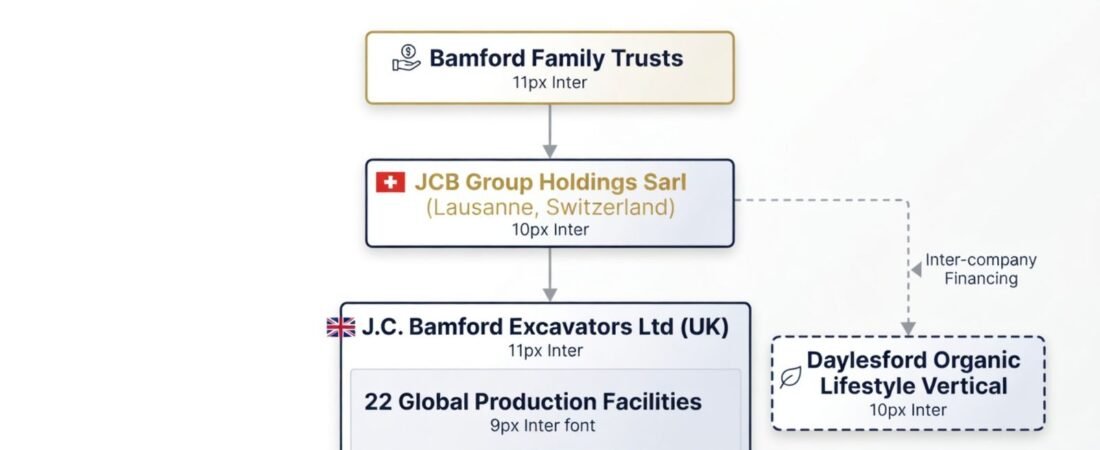
The Bamford family’s corporate structure reflects decades of sophisticated international tax planning that has evolved with changing regulatory landscapes. JCB Group Holdings Sarl, based in the Swiss canton of Vaud, currently serves as the ultimate parent company holding the family’s shares in the construction equipment empire. This Swiss entity represents the latest evolution in a structure that originated in the Caribbean.
In 2020, Anthony Bamford transferred shares from Curacao (Dutch Caribbean) entities—established in 1976—to the Swiss holding company. The Curacao structure had provided favorable tax treatment for dividends paid by Dutch companies, reflecting the historical Netherlands-Antilles tax treaty benefits. The shift to Switzerland occurred as Curacao amended its laws to align with global standards, avoiding EU tax haven blacklist risks. Switzerland offers longevity, political stability, and double-taxation agreements with over 100 countries.
JCB was previously controlled by Bermuda trusts before being brought onshore, demonstrating the family’s willingness to restructure holdings as tax regulations evolve. The current Swiss-based JCB Group Holdings Sarl provides several structural advantages: access to Switzerland’s banking network, protection from UK political volatility (particularly relevant given Bamford’s vocal Brexit support and Conservative Party donations), and efficient dividend distribution mechanisms to family shareholders.
This offshore architecture enables the massive dividend distributions that characterize Bamford family wealth extraction. In 2024, despite JCB’s revenue declining 10% to £5.8 billion and pre-tax profit falling to £498 million from £687 million, the family authorized a record £866 million dividend—nearly triple the £300 million paid in 2023. The Swiss holding structure facilitates these distributions while optimizing tax efficiency across international jurisdictions.
Beyond Machinery: Daylesford Organic and Lifestyle Diversification
Succession Strategy: Alice Bamford’s Global Sustainability Vertical
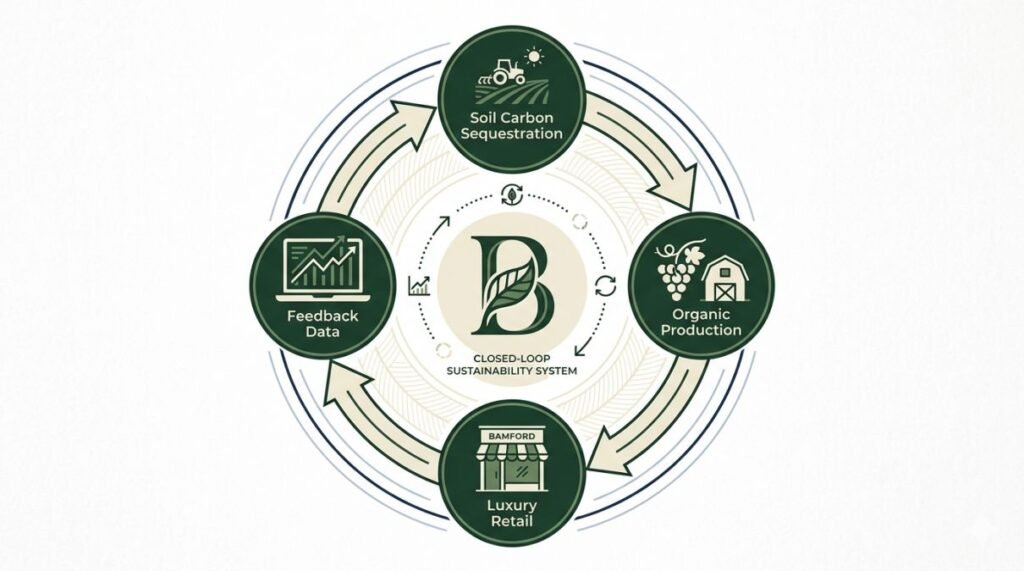
The transition of the Bamford empire into its third generation is defined by a bifurcated strategy. While Jo Bamford manages the heavy industrial pivot via Wrightbus, Alice Bamford has emerged as the steward of the family’s global “Green Alpha.” By overseeing the Château Léoube estate in France and pioneering biodynamic systems at One Gun Ranch in California, Alice has transformed the “Lifestyle” division into a sophisticated Regenerative Asset Class.
This international diversification provides a hedge against UK-specific economic volatility. Alice’s expertise in closed-loop agricultural systems creates a proprietary feedback loop for the family’s land-management strategies, ensuring that the Daylesford Estate remains the global benchmark for high-net-worth sustainable development.
While JCB represents the industrial core of Bamford wealth, Lady Carole Bamford’s Daylesford Organic operates as a standalone asset class that diversifies the family’s risk profile away from heavy machinery cyclicality. Daylesford Organic reported revenues of £58.1 million for the 52 weeks to 29 March 2025, with underlying profits jumping from a £2 million loss to a £2.8 million surplus. Pre-tax profits reached £1.3 million, recovering from the previous year’s £4.8 million loss.
This is not merely a farm shop—it is a vertically integrated lifestyle brand encompassing four London retail locations, a flagship Cotswolds farm shop and spa, an e-commerce platform, wholesale distribution through Planet Organic and Ocado, and the Heritage House events venue. The business model leverages the “Bamford” brand equity—built through JCB’s industrial reputation—into high-margin consumer goods including organic groceries, homewares, botanical skincare, and sustainable clothing.
The diversification strategy extends to hospitality. Daylesford Stays operates 34 Cotswolds holiday cottages, while the family owns four renovated pubs: The Wild Rabbit in Kingham, The Fox at Oddington, The Bell at Charlbury, and The Three Horseshoes near Burford. Internationally, Lady Bamford acquired Léoube, an organic wine estate and restaurant in France, creating a European anchor for the lifestyle brand.
The financial architecture of Daylesford reveals the family’s long-term capital commitment. The business owes £38.9 million to companies within the wider Bamford Group, and Lady Carole has pledged to provide financial support “for the foreseeable future”. This inter-company financing structure allows Daylesford to operate as a loss-leading brand-building exercise during restructuring phases, with profitability achieved through operational efficiency rather than revenue growth alone—stock shrinkage and wastage were halved from £3.2 million to £1.6 million.
Institutional Intelligence: Elite Assets & Legacies
The IP Anchor: Building a “Zero-Emission Combustion Moat”
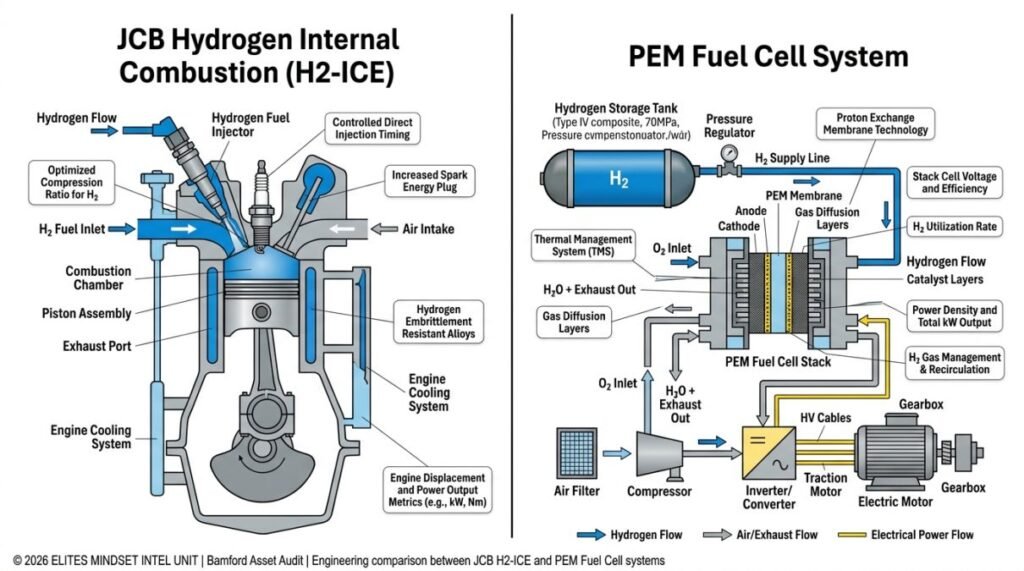
Lord Anthony Bamford’s most strategically significant investment is not in land or lifestyle brands, but in proprietary hydrogen combustion technology—a £100 million bet that creates an intellectual property moat protecting JCB’s heavy machinery valuation from 2030 regulatory deadlines. Unlike competitors pursuing battery electrification (unsuitable for heavy equipment due to weight and range limitations), JCB has developed the world’s first hydrogen combustion engine for construction equipment, securing full EU type-approval for commercial use across all 27 member states.
This is not hydrogen fuel cell technology—it is a re-engineered internal combustion engine that burns hydrogen directly. A dedicated team of 150 engineers has produced over 130 evaluation engines, with more than 23,000 hours of test cell operation and 50,000 hours of combined machine testing. The technology powers backhoe loaders, telescopic handlers, and generator sets, with 11 European licensing authorities including Germany, France, Spain, and Switzerland granting certification.
The strategic significance of this “Zero-Emission Combustion Moat” cannot be overstated. As UK and EU emissions regulations tighten toward 2030 zero-emission mandates for construction equipment, JCB’s hydrogen engines provide a compliance pathway that preserves their existing manufacturing infrastructure and supply chain expertise. Lord Bamford has stated that hydrogen combustion is “cost effective, robust, reliable and well known throughout not just the construction and agricultural industry, but the whole world”, highlighting the technology’s advantage over complex fuel cell systems requiring entirely new engineering competencies.
The hydrogen investment also creates defensive IP barriers. Competitors pursuing battery solutions face fundamental physics limitations for heavy machinery—battery weight reduces payload capacity, and charging infrastructure is unavailable on remote construction sites. JCB’s hydrogen combustion engines can be refueled using mobile hydrogen refuelers, demonstrated when Chancellor Rachel Reeves refueled a pre-production hydrogen backhoe loader during her June 2025 visit to JCB headquarters. This practical refueling solution addresses the infrastructure gap that plagues battery electric alternatives.
Arbitraging Accountability: Why the Bamford “Privacy Premium” Outperforms Public Valuations

The Bamford family’s refusal to take JCB public represents a strategic “privacy premium” that insulates their wealth from market volatility while enabling long-term capital allocation decisions impossible under quarterly earnings pressure. Unlike publicly traded competitors who face immediate share price punishment during construction recessions, JCB’s private status allows the family to sacrifice short-term dividends to fund transformative R&D—such as the £100 million hydrogen combustion program—without shareholder revolt.
This privacy premium manifests in several operational advantages. JCB maintained a strong balance sheet with no net borrowings throughout 2023, even as global construction equipment markets contracted by 4.3%. The family can deploy capital counter-cyclically—increasing headcount by over 1,000 to 14,734 employees in 2024 despite revenue decline—because they answer to no external equity holders demanding immediate cost rationalization.
While James Dyson pivoted to Singapore and technology diversification, the Bamfords doubled down on UK land sovereignty and heavy industrial IP. Dyson’s relocation sought lower tax jurisdictions and Asian market access; Bamford’s Swiss holding structure achieves similar tax efficiency while maintaining UK manufacturing presence and political influence. The contrast reveals two models of British industrial preservation: Dyson’s globalized tech pivot versus Bamford’s heritage asset fortification.
The Swiss structure also provides succession planning advantages. With three children—Joseph “Jo” Cyril Edward, George, and Alice—the Bamford family can transfer ownership through the Swiss holding company without UK inheritance tax exposure on the underlying JCB shares. Jo Bamford has already established his own green hydrogen credentials through Wrightbus and a hydrogen investment fund, suggesting the next generation will maintain the family’s industrial-hydrogen convergence strategy.
For institutional investors evaluating private industrial holdings, the Bamford model demonstrates that privacy itself is an asset class—one that trades liquidity for control, and quarterly earnings pressure for generational legacy preservation.
Corporate Structure Map: From Operations to Family Holdings
The Industrial Core (JCB)
22 Factories Worldwide
UK Operating Company
Switzerland — Ultimate Parent
& Individual Holdings
Parallel Structure (Lifestyle)
UK Lifestyle Brand
Sole Beneficial Owner
£38.9M Debt from JCB Group
Note: The inter-company financing creates a strategic capital bridge between the industrial core and the lifestyle vertical.
The Bamford-Dyson Divergence: Heritage vs. Globalization
This comparison deconstructs two distinct blueprints for British industrial preservation. While James Dyson opted for a globalist pivot by relocating headquarters to Singapore to capture Asian markets and tech-centric tax advantages, the Bamford family chose “Heritage Fortification”—maintaining a UK manufacturing core while insulating wealth through a sophisticated Swiss-European holding structure.
| Dimension | Bamford Model (JCB) | Dyson Model |
|---|---|---|
| Primary Strategy | Heritage asset fortification | Technology pivot & Asian relocation |
| Corporate Structure | Swiss holding (JCB Group Holdings Sarl) | Singapore headquarters |
| Manufacturing Base | UK-centric (Staffordshire, 22 factories) | Malaysia & Singapore |
| Tax Optimization | Swiss-Caribbean historical evolution | Singapore low-tax jurisdiction |
| Political Engagement | High (Conservative donor / House of Lords) | Limited UK political activity post-relocation |
| R&D Focus | Hydrogen combustion (Heavy machinery) | Battery electric & digital motors |
| Brand Leverage | Industrial heritage → Lifestyle (Daylesford) | Consumer tech → Automotive |
| Succession Model | Multi-generational continuity (Jo Bamford) | Founder-dependent (James Dyson) |