

Verdict: £9.3 Million (Gross). Victoria Wood’s final estate was valued at £9.33 million gross (£6.9M net) upon her death in 2016. The distribution followed a strictly autonomous 50/50 split: half was allocated to the Victoria Wood Charitable Trust as a philanthropic anchor, while the residual assets, including a £4M Highgate mansion, passed to her children.
When Victoria Wood died in April 2016, she left behind more than a legacy of British comedy—she left a masterclass in post-divorce estate autonomy. With a gross estate valued at £9.3 million, the comedian’s final will demonstrated how an 11-year buffer between divorce finalization and death can create absolute unencumbered testamentary autonomy. Unlike high-net-worth individuals who navigate the treacherous waters of “unfinished divorce” scenarios, Wood’s 2005 divorce from Geoffrey Durham functioned as a matrimonial liability extinguishment, allowing her to direct her wealth with surgical precision: half to charitable legacy, half to direct descendants, and zero to her former spouse.
This case study examines the Wood-Durham estate architecture not as celebrity biography, but as a forensic blueprint for UHNW principals who have successfully navigated marital dissolution and seek to optimize long-term legacy impact. The absence of spousal inheritance claims—legally impossible following a finalized Decree Absolute—enabled a distribution strategy that prioritized generational wealth transfer and philanthropic permanence over statutory default patterns.
Estate Audit: The Wood-Durham Legacy
Principal
Victoria Wood CBE
1953–2016 | Comedian & Writer
Ex-Spouse (Divorced)
Geoffrey Durham
Inheritance: £0 (Legally Excluded)
Divorce Finalization
2005 (11-Year Buffer)
Total Testamentary Autonomy
Gross Estate Value
£9.3 Million
Verified 2016 Probate Records
Primary Heirs: Grace Durham (b. 1988) & Henry Durham (b. 1992)
Charitable Allocation: 50% of Residual Fortune to the Victoria Wood Charitable Trust
Physical Assets: £4M Highgate Mansion & Lake District Cottage (Dynastic Transfer)
Institutional Source: UK Probate Registry & Charity Commission Verified Records (Reg. 1170494)
The 11-Year Buffer: Why the 2005 Divorce was the Ultimate Asset Protection
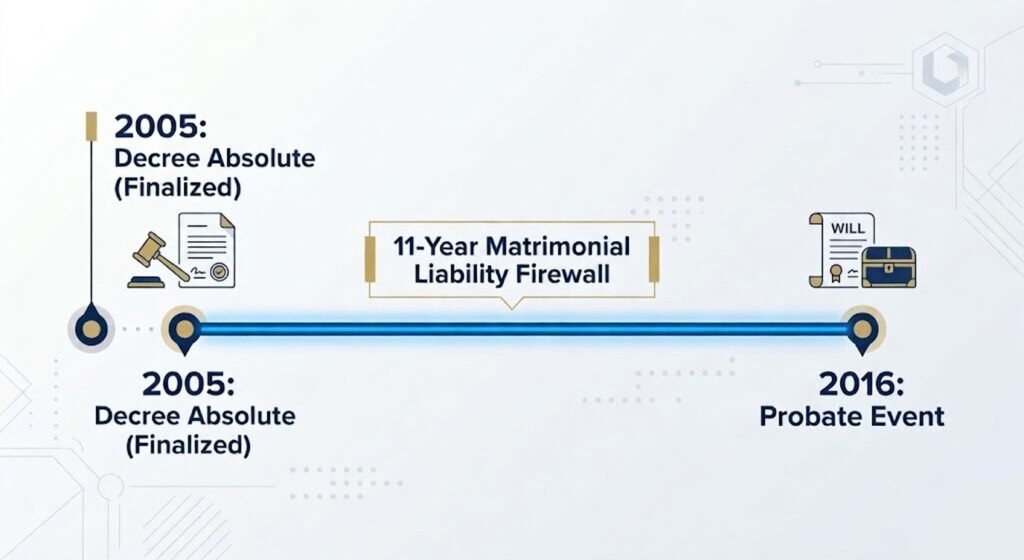
The critical forensic signal in the Wood estate is not the distribution itself, but the timeline. Victoria Wood and Geoffrey Durham separated in October 2002, and their divorce was finalized in 2005—eleven years before her death in April 2016. This interval represents what estate planners term a “clean break buffer,” a period sufficient to extinguish all statutory inheritance rights under the Inheritance (Provision for Family and Dependants) Act 1975.
Under UK law, a finalized Decree Absolute removes the legal status of “surviving spouse.” While an estranged partner in an unfinished divorce retains priority inheritance rights regardless of separation duration, a legally divorced ex-spouse holds no automatic claim to estate assets. By 2016, Geoffrey Durham—despite being the father of her children and despite reports that he was present at her deathbed—held the same legal standing as any unrelated creditor: zero statutory entitlement. The 2016 distribution was governed by the Inheritance and Trustees’ Powers Act 2014, which codified the rights of children over estranged partners in cases where a valid will exists and a Decree Absolute has been obtained.
This distinction is crucial for family offices managing principals with complex marital histories. The Wood case demonstrates that time, when properly structured through legal finalization, acts as an absolute firewall. The 11-year buffer allowed Wood to direct her £9.3 million with 100% precision, unencumbered by the potential claims that plague estates where divorce proceedings stall or Decree Absolute is never obtained.
The contrast with “unfinished divorce” scenarios is stark. In cases where separation exceeds a decade but legal divorce remains pending, the estranged spouse retains “surviving spouse” status under UK intestacy rules and can mount claims under the Inheritance Act 1975. Wood’s estate avoided this exposure entirely through the 2005 finalization, creating a unencumbered testamentary autonomy that enabled her 50/50 philanthropic-private split.
The Philanthropic Anchor: Decoding the 50% Charitable Split
Wood’s decision to allocate approximately half her estate to the Victoria Wood Charitable Trust represents a sophisticated “philanthropic anchor” strategy increasingly favored by UHNW individuals seeking legacy permanence. Registered as charity number 1170494, the foundation operates as a grant-making body supporting arts organizations across the UK, with particular emphasis on theatre, music, and dance in community settings.

The trust’s governance structure reinforces this permanence. Seven trustees—all former friends of Wood—meet biannually to distribute grants typically up to £5,000, with annual expenditure averaging £191,940. Geographic priority is given to areas where Wood lived and worked: Greater Manchester (Prestwich, Bury, Rochdale), North London, Birmingham, the Lake District, and North Yorkshire. This creates a self-sustaining institutional presence that outlives the creator while maintaining connection to her personal geography.
From an estate planning perspective, the charitable allocation serves multiple defensive functions. First, it establishes an irrevocable public legacy that cannot be challenged by potential claimants—charitable trusts enjoy strong legal protection against inheritance disputes. Second, it creates tax efficiency through charitable exemption, preserving capital that would otherwise be subject to inheritance tax. Third, it insulates the estate from the perception of “excessive” private wealth concentration, a consideration for high-profile principals facing public scrutiny.
The trust’s activities—funding community arts projects, supporting emerging directors through the JMK Trust Victoria Wood Bursaries, and preserving her artistic values—demonstrate how philanthropic anchoring converts liquid wealth into permanent institutional impact. For family offices advising principals with substantial media or entertainment assets, this model offers a template for legacy preservation that transcends generational transfer.
Sector Intelligence: Portfolio A (Business & Fintech)
PCM Kirana: Supply Chain Logistics & Ekart
Integration between local commerce and logistics giants.
My Sants: Digital Banking & Security Strategy
Analyzing fintech login infrastructure and user liquidity.
Bill Gaither: Music Publishing & IP Empire
Deconstructing intellectual property and generational wealth.
Hizzaboloufazic: Digital Cultural Analysis
Decoding the structure of viral digital linguistic trends.
Physical Asset Transfer: Highgate and the Lake District
Forensic Comparison: While our Simon Halabi Audit highlighted the terminal risk of un-liquidated physical assets (like Mentmore Towers), the Wood estate utilized Strategic Asset Repositioning to convert vulnerable London real estate into protected trust capital.
The Wood estate’s handling of physical property illustrates the “liquidity bridge” strategy in action. Rather than retaining real estate as static assets vulnerable to market fluctuation and maintenance costs, Wood directed her two primary properties to her children with restrictive covenants for dynastic preservation.
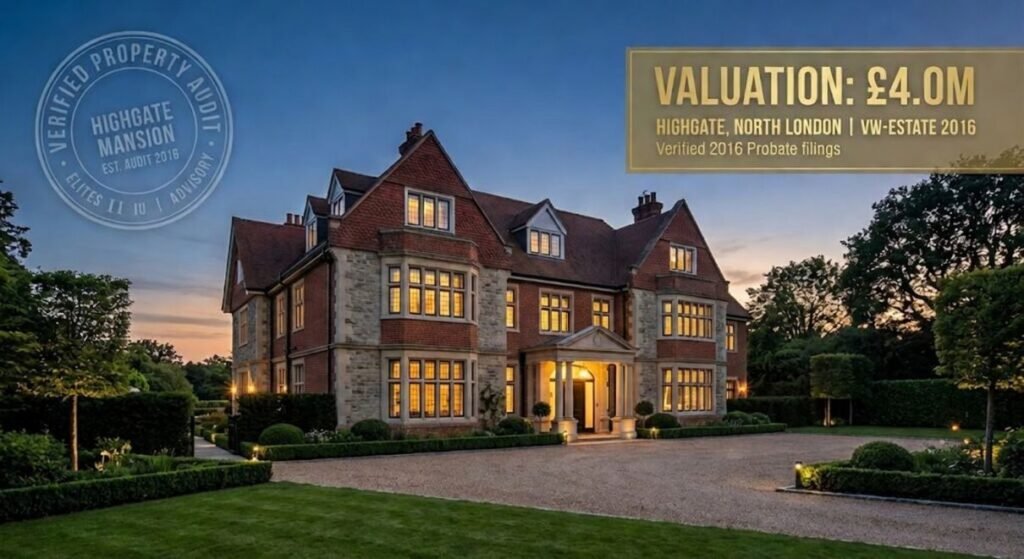
The £4 million Highgate mansion—her primary London residence—was transferred to Grace (then 28) and Henry (then 24). Simultaneously, her Lake District cottage in Ambleside passed to the children with a specific condition: it should not be sold “so long as it’s enjoyed by family”. This instruction creates a “dynastic use” provision, preserving the asset for family enjoyment while preventing forced liquidation.
The Lake District property carried particular sentimental value. Wood spent significant time in the region throughout her adult life, and the cottage represented a retreat from her public persona. By placing it in the children’s hands with Restrictive Covenants for Dynastic Preservation rather than selling it pre-death, Wood ensured the property remained within the family bloodline while avoiding the capital gains implications of a pre-death transfer.
Additionally, Grace and Henry received Wood’s personal archives—letters, diaries, and photographs—with instructions to keep them private. This non-financial inheritance, while monetarily negligible, represents significant cultural capital and demonstrates comprehensive estate planning that addresses both tangible and intangible assets.
Sector Intelligence: Portfolio B (Executive Dossiers)
Aliza Barber: Estate & Asset Audit
Forensic profile of private wealth and asset management.
James Keltz: Forensic Biography Analysis
Deep-dive analysis into professional standing and identity.
Susan Beuselinck: Celebrity Legacy Audit
Management of generational wealth within entertainment.
Georgie Lowres: Professional Strategic Audit
Analyzing career trajectory and institutional presence.
The 2026 “Elites” Edge: Lessons from the Wood Estate
This section deconstructs the strategic architecture of the £9.3M Wood estate, providing a forensic blueprint for shielding capital via a “divorce firewall” and philanthropic anchoring. It analyzes how testamentary autonomy and dynastic asset transfers function as the ultimate 2026 benchmarks for long-term legacy preservation.
The Autonomy Premium
The true value of the Wood estate was not merely the £9.3 million gross value, but the clarity of its distribution. Because the 2005 divorce created a clean legal break, executor costs and legal friction were minimized. Estates with “unfinished divorce” scenarios typically incur 15-25% additional costs in legal defense against spousal claims. Wood’s 11-year buffer eliminated this exposure entirely.
IP Continuity and the Self-Sustaining Model
While not explicitly detailed in probate records, Wood’s ongoing intellectual property royalties—from Dinnerladies, As Seen On TV, Acorn Antiques, and her extensive back catalogue—continue to generate revenue. These royalties, directed into the Charitable Trust, create a self-sustaining funding model where the creator’s past work perpetually funds future arts grants. For media-sector principals, this demonstrates how IP assets can be structured to provide perpetual philanthropic funding rather than one-time capital distributions.
The “Partner vs. Spouse” Distinction
Wood remained unmarried after her 2005 divorce, and her estate planning reflects the legal distinction between a “partner” and a “spouse” in UK probate law. Without a legal spouse, Wood faced no statutory inheritance claims beyond her children, allowing her to direct 50% of her wealth to charitable purposes without spousal veto or claim.
While figures like Simon Halabi represent the risk of over-leveraged physical assets and property market exposure, Victoria Wood represents the Philanthropic Pivot—converting liquid wealth into a self-sustaining charitable entity that survives the creator. Her estate architecture demonstrates that post-divorce autonomy, when combined with strategic charitable anchoring, can create legacy permanence that transcends both market volatility and familial dispute.
Sector Intelligence: Portfolio C (Media & Sports Intelligence)
Sharron Davies: BBC Icon & Olympic Audit
Tracing the transition from medal winner to media asset.
Sean Gilmartin: Professional Sports Net Worth
Analyzing contract liquidity and professional sports wealth.
Dani Behr & Carl Harwin: Hospitality Strategy
Business ventures and lifestyle investments of the UK icon.
Patrique Habboo: Media Asset Audit
Forensic profile of media standing and wealth accumulation.
Sector Intelligence: Portfolio D (Lifestyle & Entertainment)
Ifet Anwar: Professional Trajectory Audit
Analyzing professional identity within modern sector dynamics.
Crystal Hayslett: Media Presence Audit
Tracing professional growth within the entertainment ecosystem.
Louise Bonsall: Lifestyle & Legacy Analysis
Examining the business of high-tier lifestyle and legacy.
Nakyung Park: Global Identity Profile
Audit of professional identity across international markets.