

In the constellation of global luxury wealth, few families have mastered the architecture of quiet capital as completely as Alain and Gérard Wertheimer. While the world associates Chanel with Coco Chanel’s revolutionary designs and Karl Lagerfeld’s creative genius, the actual ownership structure reveals a century-old testament to private wealth preservation. The wertheimer brothers chanel fortune—estimated at a combined $78.8 billion as of 2026—represents not merely inherited privilege but a deliberate, multi-generational strategy of infrastructure leverage, legal foresight, and absolute discretion.
This forensic analysis examines how a Jewish family from Alsace transformed a single perfume agreement into an $85+ billion empire, why they have steadfastly refused public markets despite decades of pressure, and how their family office, Mousse Partners, functions as a private endowment managing one of the world’s most secretive fortunes. Unlike the highly visible Arnault family (LVMH), the Wertheimers operate an absolute “Shadow Wealth” moat—one that has enabled them to maintain uninterrupted control over the world’s most valuable luxury brand for 100 years while systematically diversifying their capital across real estate, biotechnology, media, and elite thoroughbred racing.
The Sovereign Capital Dossier: Deconstructing the $85B Audit
The Billionaire Equity File is a forensic, institutional-grade analytical framework designed to deconstruct the financial architecture of the world’s most powerful individuals. Unlike standard “Rich Lists,” which focus on a single fluctuating net-worth figure, the Equity File prioritizes the mechanics of capital—revealing how a fortune is structured, protected, and deployed.
Sovereign Framework: Strategic Pillars of Wealth Operations
- Asset Decoupling: It separates the “Industrial Engine” (the primary business generating cash flow, like Chanel) from the “Capital Multiplier” (the private family office, like Mousse Partners, which reinvests that cash into uncorrelated assets).
- Governance Mapping: It identifies the legal and jurisdictional moats—such as Cayman Island holding companies or bespoke trust structures—that insulate wealth from market volatility and geopolitical risk.
- Liquidity Forensic: It tracks the actual “velocity” of capital—moving past paper wealth to evaluate real-time dividend payouts, venture capital exits, and reinvestment cycles.
The Elites Mindset Intelligence: A Sovereign Wealth Perspective
In the context of institutional reporting, this file signals that the analysis is moving past the creative mythology of a brand and into the sovereign architecture of the family behind it. It is an “intelligence first” tool used to evaluate the stability and generational longevity of private empires.
While individual net worth is benchmarked at $78.8B, our 2026 Sovereign Audit—accounting for the $38B brand equity and Mousse Partners’ global portfolio—places the total Wertheimer empire value at upwards of $85 billion.
| Executive Metric | 2026 Forensic Valuation |
|---|---|
| Total Sovereign Empire | $85.0 Billion+ (Institutional Audit) |
| Combined Net Worth | $78.8 billion (Forbes 2026) |
| Individual Net Worth | $39.4 billion each |
| Chanel Brand Valuation | $38 billion (Brand Finance 2025) |
| Chanel 2024 Revenue | $18.7 billion (28% Profit Plunge) |
| 3-Year Dividend Total | $12.4 billion |
| Mousse Partners AUM | $90 billion (2021 Analysis) |
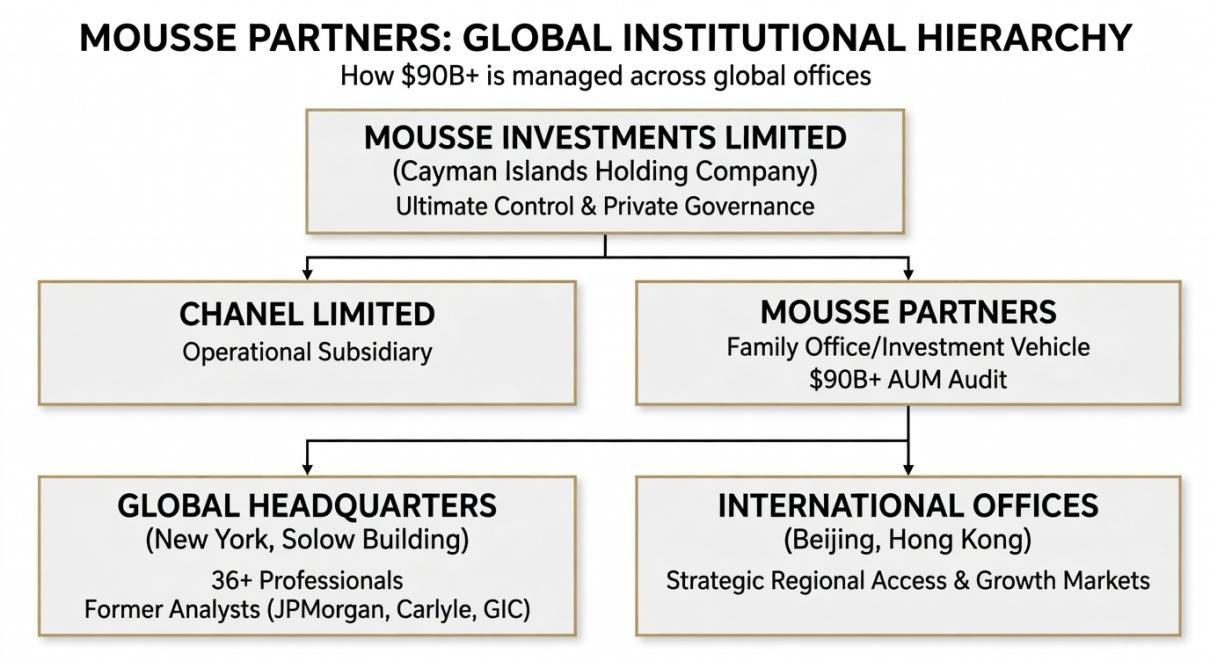
| Ownership Structure | 100% private via Mousse Investments Ltd (Cayman Islands) |
| Alain Wertheimer | Age 77 | Residence: New York/Connecticut |
| Gérard Wertheimer | Age 75 | Residence: Geneva, Switzerland |
Infrastructure Leverage: The 1924 Parfums Chanel Equity Masterclass
The foundational transaction of the Chanel empire was not a creative partnership, but a strategic exercise in infrastructure leverage. This section deconstructs the 1924 agreement that anchored the Wertheimer fortune by trading industrial scaling for a 70% majority stake—proving that in the luxury sector, distribution infrastructure ultimately dictates equity.
Distribution Sovereignty: Why Infrastructure Commands 70% Equity
The foundational transaction that created the wertheimer brothers chanel fortune occurred not in a fashion atelier but at the Longchamp Racecourse in 1922. Théophile Bader, co-founder of Galeries Lafayette, introduced Coco Chanel to Pierre Wertheimer—a French businessman whose family owned Bourjois, the largest cosmetics and fragrance company in France. The Wertheimers did not bring creative vision; they brought industrial leverage.
In 1924, Pierre and Paul Wertheimer signed the definitive agreement establishing Les Parfums Chanel. The equity split was stark and strategically decisive: the Wertheimer brothers secured 70% of the company, Théophile Bader’s representatives held 20%, and Coco Chanel herself retained merely 10%. For this 70% stake, Pierre provided the financing for production, marketing, and distribution of Chanel No. 5. For her 10%, Chanel licensed her name to “Parfums Chanel” and removed herself from all business operations.
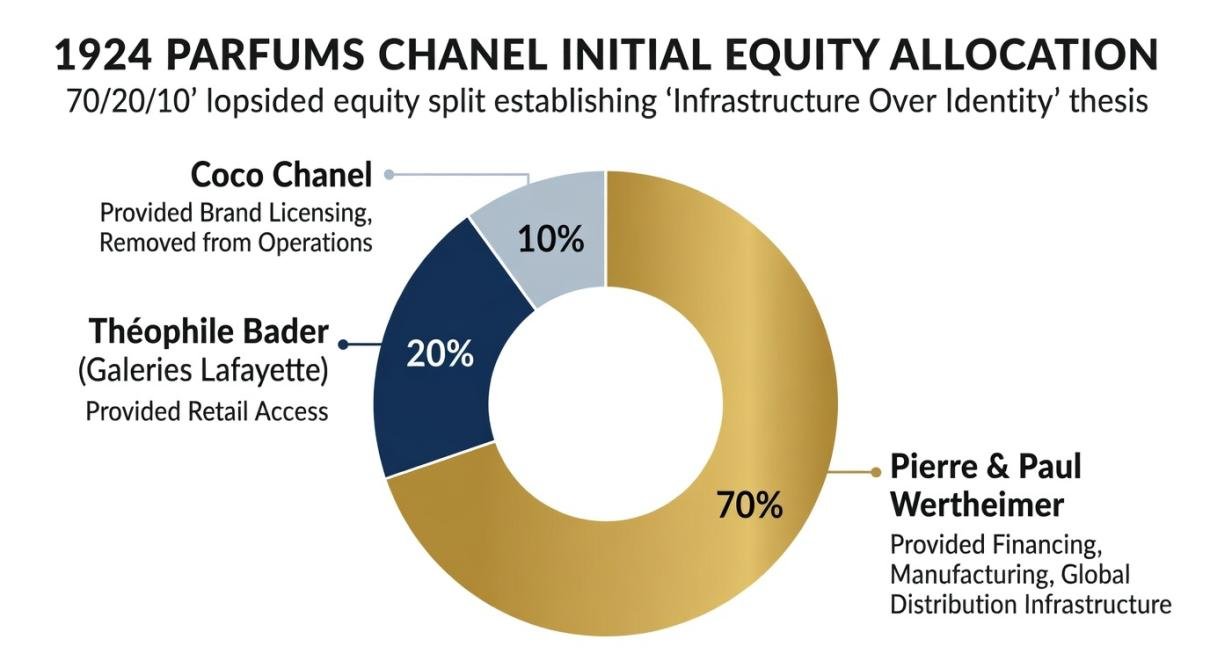
This allocation reveals the essential truth of luxury brand ownership: distribution dictates equity. Coco Chanel had the brand mythology, the creative genius, and the cultural timing. The Wertheimers had the cross-Atlantic distribution infrastructure, the chemical manufacturing capabilities, and the retail relationships necessary to transform a boutique fragrance into a global commodity. The alain wertheimer net worth and gerard wertheimer net worth that exists today traces directly to this infrastructure leverage—Pierre Wertheimer’s recognition that the real value in luxury goods lies not in creation but in the controlled scaling of scarcity.
Legal Defensive Architecture: The Félix Amiot Proxy & Asset Protection
The durability of Wertheimer ownership was tested during World War II. As a Jewish family, the brothers were forced to flee Paris for New York as Nazi forces advanced. During their absence, Coco Chanel—who was romantically involved with Nazi officer Hans Günther von Dincklage—attempted to exploit Aryanization laws to seize control of Parfums Chanel. She wrote to German officials arguing that since the Wertheimers were Jewish, she should be granted ownership rights under occupation-era statutes.
The Wertheimers had anticipated this existential threat. Before fleeing, they executed a proxy agreement with French industrialist Félix Amiot, under which Amiot would temporarily hold their shares as a nominal Christian owner. The arrangement was protected by pre-dated documents certified by German officers—evidence of substantial bribery that ensured legal continuity of ownership. When the war ended, Amiot restituted full ownership to the Wertheimers, and Chanel’s attempted seizure failed.
This episode demonstrates how the who owns chanel brand question was resolved not through creative genius but through legal architecture. The 1954 settlement—where Pierre Wertheimer took full control of Chanel, agreed to 2% royalties for Coco, and provided her a monthly stipend for life—consolidated family ownership while neutralizing the founder’s lingering claims. It was a reconciliation born of economic rationality: preserving brand mythology required neutralizing the founder’s grievances, not vindicating them.
The $90B Capital Multiplier & Private Endowment
The Mousse Partners structure represents the “Capital Multiplier” of the Wertheimer empire—a sophisticated family office that functions as a private endowment. This section deconstructs how the family separates the Industrial Engine of Chanel from a $90 billion+ AUM investment arm, ensuring that their multi-generational wealth is perpetually diversified across uncorrelated global assets.
The $12.4B Dividend Engine: Fueling Global Asset Diversification
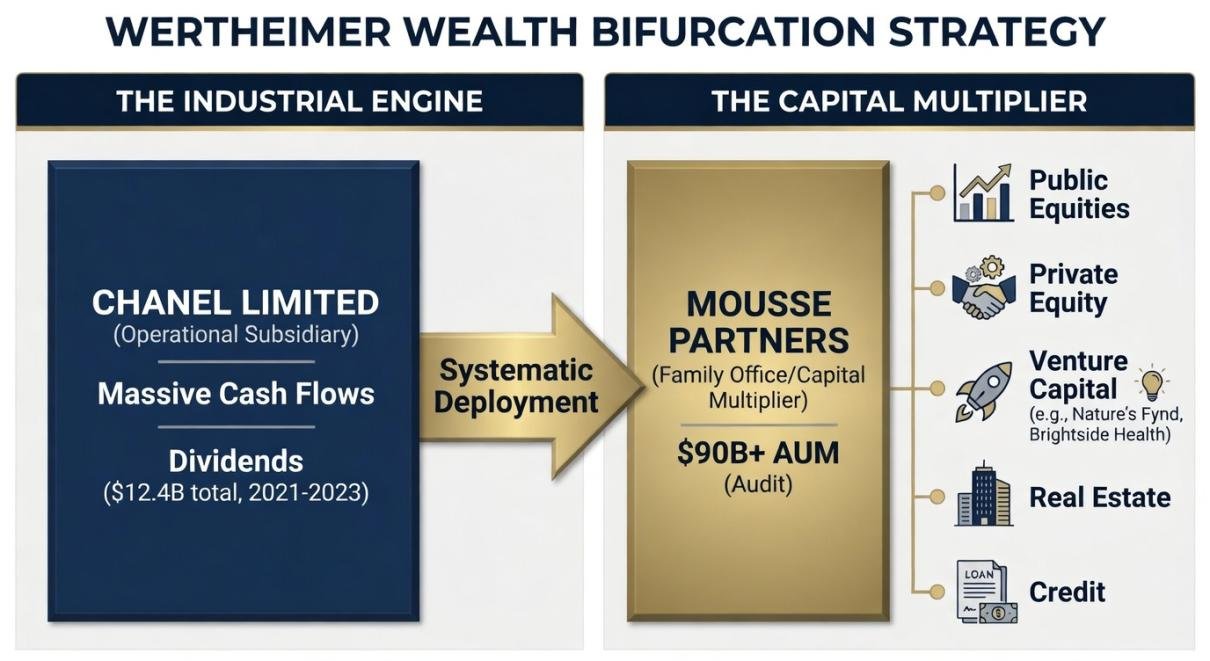
The Wertheimer wealth engine operates through a sophisticated bifurcation: Chanel generates massive operating cash flows—$12.4 billion in dividends over the past three financial years—while Mousse Partners systematically deploys this capital across diversified asset classes. This structure, established in 1991 by Charles Heilbronn—half-brother to Alain and Gérard—functions less as a traditional family office and more as a private endowment for a luxury empire.
Mousse Partners is headquartered in New York’s Solow Building with additional offices in Beijing and Hong Kong, employing over 36 professionals including former analysts from JPMorgan Chase, The Carlyle Group, and Singapore’s GIC sovereign wealth fund. The firm manages investments across public equities, private equity, venture capital, real estate, and credit—effectively insulating the family’s total wealth from luxury sector cyclicality while maintaining operational independence from Chanel’s creative decisions.
The mousse partners family office investment strategy reveals a deliberate counter-cyclical approach. In 2021, Mousse sold most of its 14-year stake in Ulta Beauty—a position that had returned over 1,700%—while simultaneously increasing exposure to Beautycounter and fast-casual restaurant chain Cava. Recent venture investments include mental health platform Brightside Health, biotechnology firm Evolved by Nature, and food startup Nature’s Fynd—a protein company developing ingredients from volcanic microbes found in Yellowstone National Park.
Strategic Social Capital: The Elite Horse Racing Portfolio
Beyond financial markets, the wertheimer family investments extend into one of Europe’s most prestigious thoroughbred operations: Wertheimer et Frère. This racing stable—celebrating 100 years of continuous operation in 2011—represents not merely a hobby but a strategic diversification into tangible, appreciating assets with significant social capital returns.
The stable has produced three winners of the Prix du Jockey Club—including 2013 champion Intello—and four Breeders’ Cup Mile victories by the champion mare Goldikova. In 2023, the brothers acquired the entire racing and breeding stock of the Wildenstein family’s Dayton Investments, integrating bloodlines that produced four Prix de l’Arc de Triomphe winners. This acquisition—valued at tens of millions of euros—demonstrates how chanel private ownership generates sufficient liquidity to capitalize on rare, intergenerational asset opportunities.
The racing operation also serves a critical social function: maintaining relationships with European aristocracy and Gulf sovereign wealth. Queen Elizabeth II personally presented the trophy to the Wertheimers after their 2015 victory in the Queen Elizabeth II Stakes—a visibility that is carefully calibrated, never excessive, but strategically present in elite circles where commercial networks form.
The Sovereignty Moat: Decoupling Chanel from Public Market Pressure
The Power of Private Ownership represents the ultimate competitive advantage in the volatile 2026 luxury landscape. By maintaining absolute sovereignty, the Wertheimers have decoupled the brand’s long-term equity from the short-term pressures of public markets, enabling a Temporal Freedom that allows for multi-decade creative tenures and strategic capital reinvestment even during significant profit contractions.
Temporal Freedom: Optimizing for Decades, Not Quarters
The chanel stock market question has a definitive answer: there will be no IPO. Chanel CEO Leena Nair has explicitly stated that the company “intends to remain private and independent.” This refusal to access public capital markets—despite a $38 billion brand valuation that would command premium multiples—represents the core of wertheimer business strategy: temporal freedom over quarterly optimization.
The economic advantages of this why chanel is private structure are substantial. While competitors like LVMH and Kering must navigate shareholder demands for quarterly earnings growth and dividend consistency, Chanel can execute 36-year creative director appointments—Karl Lagerfeld’s tenure from 1983 to 2019—without investor scrutiny over short-term revenue impacts. The family can reinvest $1.8 billion in capital expenditure during a 30% profit decline year—as occurred in 2024—without facing activist investor pressure or stock price punishment.
This long-cycle capability enabled the 2024 acquisition of prestige properties on Fifth Avenue in New York and prime locations in Paris while operating profits fell 30%. Public markets would have penalized such counter-cyclical real estate accumulation; private ownership enables it. The richest families in France understand that luxury brand equity compounds over decades, not quarters—and private governance is the necessary condition for this temporal orientation.
The Information Moat: Discretion as an Institutional Reputation Shield
The why chanel is private strategy extends beyond financial flexibility into reputation management. By maintaining absolute absence from media—Alain Wertheimer told a New York Times reporter in the early 2000s that the family was “very discreet”—the Wertheimers ensure that any brand controversies land squarely on creative directors and executive management, never on the holding family.
When Chanel faced criticism over pricing accessibility or geopolitical challenges in China, the Wertheimer name remained absent from coverage. When Coco Chanel’s Nazi collaboration history resurfaces periodically, the family is positioned as the Jewish victims who outmaneuvered the collaborator—not as beneficiaries of Nazi-era Aryanization. This narrative positioning is not accidental; it is the dividend of a century-long communications strategy that treats visibility as a liability to be carefully rationed.
The fourth-generation succession planning reinforces this discretion. Arthur Heilbronn, the 38-year-old son of Charles Heilbronn and nephew to the Wertheimer brothers, has assumed directorship of a key Mousse holding company after the death of longtime Chanel executive Michael Rena. A Harvard Business School graduate and former Goldman Sachs banker, Heilbronn represents the professionalized heir model—trained externally, integrated through the family office rather than through symbolic brand positions, prepared for capital stewardship rather than creative direction.
Legacy Architecture: The Wertheimer Generational Wealth Blueprint
The Generational Wealth Strategy deconstructs the structural moats that have allowed the Wertheimer fortune to survive and compound for over a century. By shifting from a founder-led model to an institutionalized corporate architecture, the family has successfully separated the brand’s cultural mythology from its sovereign capital—ensuring that the empire remains resilient against market cyclicality, political shifts, and generational transitions.
| Strategy | Implementation | Result |
|---|---|---|
| Absolute Private Ownership | 100% ownership via Mousse Investments (Cayman Islands) | Zero quarterly market pressure; infinite creative runway; no activist investor risk. |
| Centralized Family Office | Mousse Partners managing $90B+ AUM | Total diversification of luxury sector risk into global private equity, real estate, and venture capital. |
| Legal Foresight Architecture | Félix Amiot proxy arrangement (WWII) | Ownership preservation through hostile political environments; template for modern asset protection. |
| Creative-Ownership Separation | 36-year Lagerfeld tenure; external creative directors | Reduced succession risk; brand mythology preserved while creative evolution continues. |
| Dividend vs. Reinvestment Cycle | $12.4B dividends over 3 years; $1.8B CapEx in 2024 | Wealth extraction balanced against supply chain vertical integration and real estate acquisition. |
| Zero-Disclosure Communications | “Very discreet” family policy | Controversy insulation; reputation risk confined to operational executives; intergenerational privacy. |
Wertheimer Brothers Executive Intelligence: FAQ
Who are the real owners of Chanel?
Alain and Gérard Wertheimer are the third-generation owners of Chanel, having inherited control from their grandfather Pierre Wertheimer and father Jacques Wertheimer. The brothers own equal shares in the privately held company through Mousse Investments Limited, a Cayman Islands holding company. Alain (77) oversees US operations from New York/Connecticut, while Gérard (75) manages European affairs and racing operations from Geneva.
What is the net worth of the Wertheimer brothers?
As of March 2026, Alain and Gérard Wertheimer each possess an estimated net worth of $39.4 billion, totaling a combined fortune of $78.8 billion. Despite global luxury headwinds, their wealth remains resilient due to massive dividend reinvestments. Gérard currently remains the wealthiest individual in Switzerland, a title held since 2023.
Why is Chanel not publicly traded?
Chanel remains private to preserve temporal freedom—the ability to make long-term strategic decisions without quarterly shareholder pressure. This independence allowed for a $1.8 billion CapEx reinvestment in 2024 despite a 30% profit decline. CEO Leena Nair has explicitly stated that the brand intends to remain 100% independent.
How did the Wertheimer family acquire Chanel?
Ownership was secured through infrastructure leverage. In 1924, Pierre and Paul Wertheimer provided the industrial manufacturing and distribution for Chanel No. 5 in exchange for a 70% stake. During WWII, the family utilized “legal foresight” by transferring ownership to a Christian proxy, Félix Amiot, to prevent Nazi seizure, eventually consolidating 100% control in 1954.
Who is the current CEO of Chanel?
Leena Nair serves as the Global CEO of Chanel. Appointed in late 2021, the former Unilever executive has focused on professionalizing the institutional structure while maintaining the brand’s commitment to absolute private sovereignty and long-cycle strategic planning.
What other businesses do the Wertheimers own?
Beyond Chanel, the family office Mousse Partners manages a $90B+ portfolio including prestige vineyards (Château Rauzan-Ségla, Château Canon), British gunmaker Holland & Holland, and Eres lingerie. Their venture arm has backed technology firms like Nature’s Fynd and mental health platforms like Brightside Health.
The Quiet Capital Manifesto: Lessons in Immortal Wealth Architecture
The Wertheimer brothers represent the apotheosis of what we term “Quiet Capital”—wealth that compounds through infrastructure control, legal foresight, and strategic invisibility. Their alain wertheimer net worth and gerard wertheimer net worth—approaching $80 billion combined—derive not from creative genius but from the 1924 recognition that distribution infrastructure commands premium equity in luxury markets.
The mousse partners family office architecture demonstrates how third-generation wealth preservation requires institutionalization: separating capital ownership from creative direction, diversifying operating risk through venture and real estate portfolios, and preparing heirs through external professional training rather than nepotistic appointment. The wertheimer family investments in thoroughbred racing, biotechnology, and media reveal a family office operating as an endowment rather than a mere wealth manager—deploying luxury dividends into uncorrelated asset classes while maintaining the core brand’s private status.
For family offices and UHNW investors, the Chanel-Wertheimer case offers a clear template: the “full-stack” profit strategy requires vertical integration of supply chains (Chanel’s acquisition of artisan workshops), the political-business gravity model demands strategic visibility in elite networks while maintaining public invisibility, and the third-generation modernization model necessitates governance formalization through entities like Mousse Partners rather than direct operational involvement.
In an era of increasing transparency and activist investor pressure, the richest families in France have proven that absolute privacy remains the ultimate competitive advantage. The Wertheimers do not give interviews. They do not attend fashion shows as celebrities. They do not explain their strategy to analysts. And in that silence, they have built an $85 billion fortune that has outlasted wars, recessions, creative director transitions, and the founder herself. Quiet capital, properly architected, is immortal capital.