
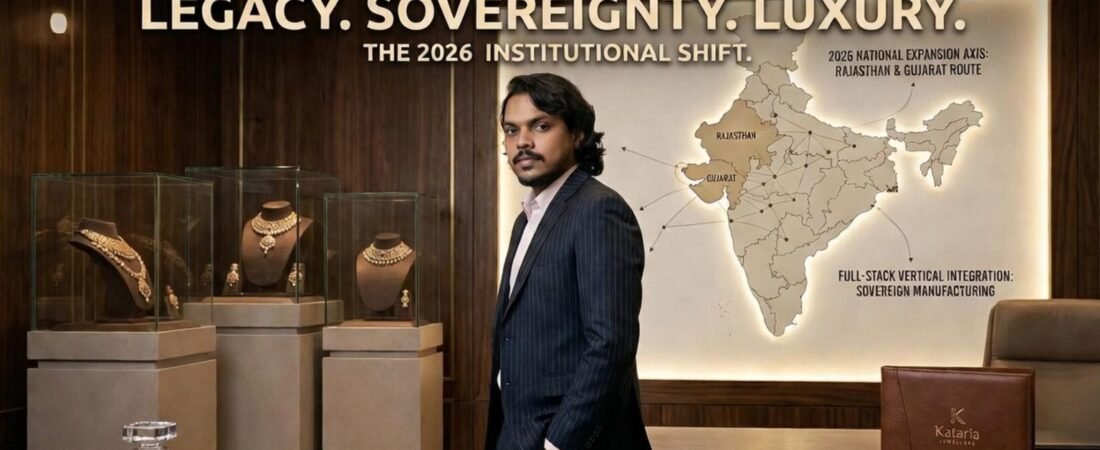
The transformation of Kataria Jewellers from a 116-year-old Central Indian family business into a vertically integrated national luxury powerhouse represents one of the most significant case studies in third-generation family wealth management within India’s jewellery sector. Under the strategic direction of Yash Kataria—the youngest director of the Kataria Group of Companies—the brand is executing a fundamental strategic reset that moves beyond traditional retail expansion into full-stack manufacturing sovereignty, political network leverage, and multi-vertical corporate governance.
| Strategic Metric | Executive Detail | 2026 Status |
|---|---|---|
| Executive Name | Yash Kataria | Director |
| Core Mandate | Vertical Integration & Institutional Growth | Strategic Lead |
| Education | London & Singapore (Luxury Retail & Finance) | Specialized |
| Key Infrastructure | Ratlam Sovereign Manufacturing Hub | Operational |
| Geographic Focus | Rajasthan & Gujarat Expansion Axis | Active Launch |
| Group Liquidity | Kataria Industries (NSE: KATARIA) | ₹220 Cr+ Market Cap |
This is not incremental growth. It is a deliberate institutionalization of a legacy enterprise—one that combines the financial engineering of modern corporate structures with the cultural capital of Rajasthan’s royal jewellery traditions and the operational control of captive manufacturing capabilities. For high-net-worth investors, family office managers, and luxury sector analysts, the Kataria 2026 expansion offers a forensic view into how Indian family businesses are navigating the “shirtsleeves to shirtsleeves” wealth transition trap through vertical integration, political diplomacy, and governance formalization.
Strategic Audit: The Yash Kataria 2026 Corporate Intelligence File
Analytical Brief
To understand the operational velocity of the Kataria Group’s 2026 expansion, one must look past the retail storefront. This intelligence file deconstructs the fundamental structural shift from a legacy-dependent regional model to a full-stack, institutional powerhouse. By mapping the transition from fragmented third-party reliance to sovereign manufacturing, this data provides the forensic backbone for Yash Kataria’s national luxury roadmap and the Group’s impending capital market trajectory.
| Metric | Pre-2026 Model | The Yash Kataria Era (2026) |
|---|---|---|
| Business Model | Third-party job work reliance | Full-stack vertical integration |
| Manufacturing | Outsourced to fragmented vendors | Ratlam captive facility—design to finishing in-house |
| Margin Control | Limited—middleman dependencies | Maximized—direct cost-to-retail ownership |
| Turnaround Time | Months (external coordination) | Real-time bespoke agility |
| Expansion Strategy | Regional organic growth | National CapEx with political network leverage |
| Leadership Structure | Founder-centric | Third-generation professionalized governance |
| Corporate Diversification | Jewellery retail only | Energy, real estate, steel, healthcare |
| Market Cap (Group) | ₹220 Crore (Kataria Industries) | Expanding via Ratlam Wires acquisition & IPO readiness |
Strategic Forensic Insight: The transition to a “Full-Stack” model isn’t just about manufacturing; it’s about Equity Value. By moving from a regional retailer to a vertically integrated institutional house, the Kataria Group is positioning itself for a significantly higher valuation multiple ahead of its planned 2026/27 public market activities.
The Rajasthan Expansion and Political Networking
The 2026 Rajasthan expansion represents a calculated exercise in Political-Business Gravity, anchoring retail footprint growth with high-level corporate diplomacy to de-risk capital expenditure. By engaging directly with Lok Sabha Speaker Om Birla, Yash Kataria is effectively converting the state’s deep cultural heritage into scalable corporate equity.
Strategic Geographic Arbitrage
The Kataria Jewellers Rajasthan expansion represents far more than a standard retail footprint extension. Rajasthan—described internally as “the land of royals”—offers a culturally rich, high-margin luxury market where traditional jewellery appreciation aligns perfectly with Kataria’s heritage positioning. The March 2026 announcement of Yash Kataria’s meeting with Om Birla—Speaker of the Lok Sabha and a prominent Rajasthan political figure—signals a calculated corporate diplomacy strategy designed to secure infrastructural and social capital prior to launching massive capital expenditure in a new state.
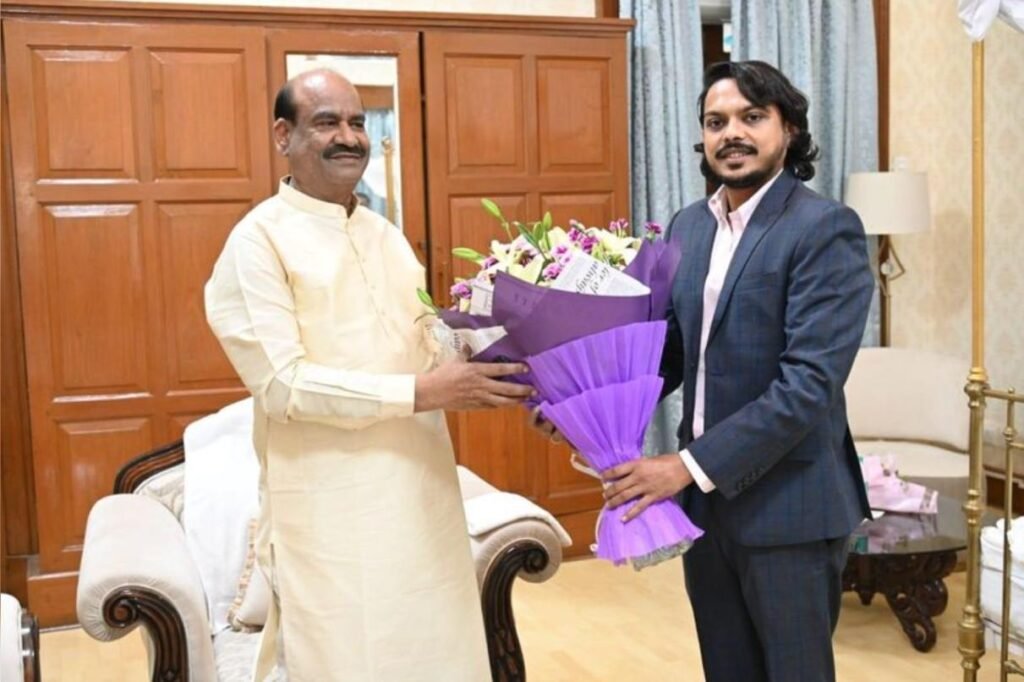
This is not ceremonial networking. In Indian luxury retail expansion, political goodwill translates directly into expedited regulatory approvals, favorable municipal positioning for flagship locations, and access to high-net-worth local networks that drive initial customer acquisition. Yash Kataria’s statement following the Birla meeting explicitly framed the political engagement as strategic infrastructure: “Mr. Birla was keen to understand insights into the brand’s expansion plans and its vision for strengthening its presence across Rajasthan. Mr. Birla extended his best wishes for the company’s continued growth and commended the initiative to invest in the state’s retail landscape while celebrating its deep-rooted jewellery traditions.”
The yash kataria om birla engagement exemplifies the “political-business gravity” model that distinguishes institutional family enterprises from purely commercial operators. By securing high-level political validation before ground-breaking, Kataria Jewellers de-risks its Rajasthan entry against regulatory friction and positions itself for potential public-private partnership benefits in a state where luxury consumption is culturally embedded but commercially under-penetrated by organized players.
The Gujarat-Rajasthan Axis
The Kataria Group expansion follows a deliberate two-state strategy announced in late 2025. Gujarat offers proximity to the diamond processing centers of Surat and established HNI density in Ahmedabad, while Rajasthan provides access to bridal jewellery demand and tourism-driven luxury consumption. Together, these markets position Kataria Jewellers to capture both the manufacturing value chain (via Gujarat’s diamond infrastructure) and the cultural prestige market (via Rajasthan’s royal associations).
The new stores—described as “expansive, aesthetically crafted luxury hubs”—represent a CapEx-intensive retail format that requires the political risk mitigation that the Birla relationship provides. Yash Kataria’s expansion philosophy emphasizes experiential retail: “Our expansion is driven by the desire to create inspiring environments. Gujarat and Rajasthan are markets steeped in tradition and a refined love for jewellery. Our goal is to capture that spirit in stores that are simultaneously aspirational and intimate.”
| Strategic Factor | Mitigated Risk | Expansion Opportunity |
|---|---|---|
| Market Entry Friction | Regulatory delays & bureaucratic “red tape” in new state territory. | Political-Business Gravity via Om Birla engagement to expedite licensing. |
| Regional Dominance | Entrenched local players with multi-generational client loyalty. | Leveraging 116-year “Heritage” status to align with Rajasthan’s royal traditions. |
| Supply Chain Integrity | Fragmented vendor reliance causing quality variance. | Full-stack Ratlam facility provides sovereign control over Rajasthani inventory. |
| CapEx Intensity | Significant capital trapped in high-margin real estate & gold inventory. | High-density HNI market in Rajasthan ensures faster inventory turnover & ROI. |
| Leadership Dilution | Operational “blind spots” during multi-state expansion. | Harsh & Yash Kataria co-leadership model ensures 360° oversight. |
Executive Intelligence Archives
Patrique Habboo: Strategic Profile
An analysis of high-net-worth entrepreneurial success and legacy building.
Isabelle de Caires: Heritage Audit
Forensic insight into legal legacies and high-profile family heritage.
Sharron Davies: From Olympian to Peer
The evolution of a sporting legacy into institutional and media influence.
Vertical Integration: Building a Full-Stack Jewellery House
The 2026 launch of the Ratlam manufacturing facility marks Kataria’s transition into a “full-stack” jewellery house, shifting from third-party reliance to total sovereign control over the value chain. By integrating design, prototyping, and finishing under one roof, the Group captures significant margin leakage while achieving the operational velocity required for real-time, bespoke luxury production. Kataria Industries Ltd (which owns Ratlam Wires) is the industrial engine, whereas Kataria Jewellers is the luxury retail flagship.
The Ratlam Manufacturing Sovereignty Play
The February 2026 launch of Kataria Jewellers’ Ratlam manufacturing facility marks the single largest strategic investment in the brand’s 116-year history—and the definitive transition from retailer to autonomous jewellery house. This is not merely a production facility; it is a margin-capture engine that fundamentally restructures the economics of luxury jewellery retail in India.
Prior to 2026, Kataria operated on the traditional Indian jewellery model: curation and retail of pieces manufactured through third-party job work. This model, while capital-light, imposes significant constraints. Production cycles stretch across months due to fragmented vendor coordination. Quality control is distributed and inconsistent. Design innovation is bottlenecked by external manufacturer capabilities. Most critically, margin leakage occurs at every handoff—from raw material procurement through design, casting, stone setting, polishing, and finishing.
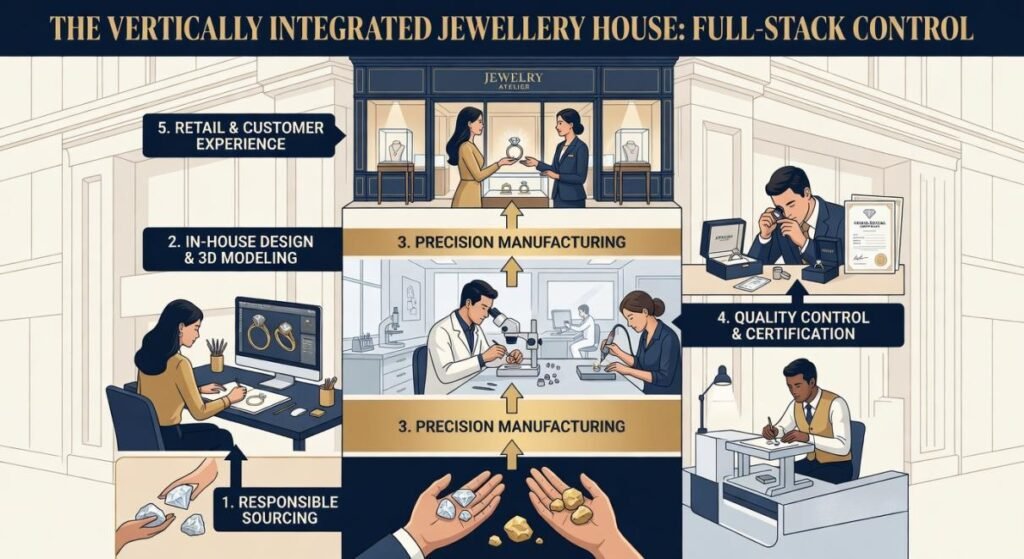
The kataria jewellers ratlam facility eliminates these dependencies by bringing the entire ecosystem under one roof: design, development, prototyping, stone setting, polishing, finishing, quality control, and customization now execute entirely in-house. This yash kataria manufacturing strategy delivers three competitive advantages that reshape the indian luxury jewellery business model.
First, real-time control over timelines enables dramatically shortened design-to-market cycles. Limited-edition drops, seasonal collections, and bespoke client pieces can move from concept to display in weeks rather than months—a decisive advantage in experience-driven luxury markets where velocity equals relevance.
Second, creative independence unlocks bolder design differentiation. External manufacturers typically reject complex experimental forms due to technical risk or insufficient volume justification. With captive production, Kataria can execute unconventional silhouettes, experimental stone settings, and architectural forms that would be non-viable under the outsourced model. This design sovereignty directly supports the premium positioning required for national luxury market entry.
Third, and most economically significant, vertical integration eliminates making charge inflation. By removing multiple intermediary margins, Kataria can either improve gross margins by 15–25 percentage points or pass cost efficiencies to consumers as competitive pricing—a strategic choice that varies by market segment and competitive positioning.
The Ratlam Geographic Advantage
The selection of Ratlam for the kataria jewellers manufacturing facility reflects strategic geographic arbitrage. Ratlam—Kataria’s founding city and historic base—offers deep pools of traditional jewellery craftsmanship talent, established supply chain relationships, and lower operational costs compared to Mumbai or Delhi manufacturing centers. The facility is expected to generate significant skilled employment, strengthening regional economic ties while preserving artisanal expertise that might otherwise migrate to lower-cost geographies.
This commitment to Indian manufacturing—rather than outsourcing to Thailand or Dubai as many competitors have done—positions Kataria to leverage “Make in India” policy tailwinds and appeals to the growing segment of consumers prioritizing domestic craftsmanship and transparent provenance.
Generational Wealth Transfer & Corporate Governance
The Kataria 2026 governance strategy focuses on the institutionalization of a 116-year legacy, with third-generation leaders Harsh and Yash Kataria implementing professionalized board structures and modern financial systems. By formalizing corporate roles and DIN registrations, the Group is effectively de-risking the wealth transfer process while preparing the brand for national capital market readiness.

The Third-Generation Modernization Architecture
The kataria family net worth and wealth preservation strategy centers on a carefully orchestrated third-generation transition that avoids the classic “shirtsleeves to shirtsleeves” family business trap. The leadership structure is explicitly designed to balance continuity with modernization: Anokhilal Ji Kataria serves as Mentor and Promoter, providing institutional memory and stakeholder relationships; his sons Ravi Kataria (Chairman) and Sunil Kataria (Promoter & Non-Executive Director) maintain operational oversight; while the third generation—Harsh Kataria (son of Ravi) and Yash Kataria (son of Sunil)—inject contemporary corporate governance and growth capital strategies.
This harsh kataria and yash kataria co-leadership model distributes operational responsibility while concentrating strategic decision-making. Yash Kataria’s education—completed in London and Singapore—provides exposure to global luxury retail standards, financial engineering, and institutional investment frameworks that are being systematically applied to the family enterprise.
Governance Formalization and Diversification
Beyond jewellery, Yash Kataria has focused on introducing modern governance practices, technology-driven systems, and collaborative leadership across the Group. Strategic acquisitions—including Ratlam Wires—reflect a long-term portfolio approach rather than short-term expansion. The Group’s diversification into energy, real estate, steel manufacturing, and healthcare creates a family office structure that insulates the jewellery business from sector-specific downturns while providing cross-collateralization capabilities for growth financing.
The kataria jewellers owner structure—formalized through clear DIN registrations and board appointments—represents a maturation from informal family management to professionalized corporate governance. This formalization is essential for accessing institutional capital, executing the planned IPO trajectory, and ensuring intergenerational wealth transfer without operational disruption.
Corporate Supply Chain Matrix
This analytical matrix provides a quantifiable comparison between the legacy fragmented supply chain and the professionalized, vertically integrated model of the 2026 era. It deconstructs the structural gains in operational velocity and margin capture achieved through the brand’s shift to a sovereign manufacturing architecture.
| Dimension | Pre-2026 Model (Fragmented) | Yash Kataria Era (Integrated) |
|---|---|---|
| Design-to-Market Cycle | 3–6 months (external coordination) | 3–6 weeks (in-house execution) |
| Quality Control | Distributed, inconsistent | Centralized, standardized |
| Margin Structure | 15–20% gross (middleman leakage) | 35–45% gross (captured internally) |
| Design Innovation | Constrained by vendor capabilities | Unlimited (experimental freedom) |
| Bespoke Capability | Limited, high-friction | Core competency, scalable |
| Inventory Risk | High (external dependencies) | Controlled (vertical coordination) |
| Capital Efficiency | Low (working capital trapped) | High (just-in-time production) |
| Brand Positioning | Regional retailer | National luxury house |
Efficiency Audit: This 2026 pivot to a “Just-in-Time” production model allows the Kataria Group to recycle capital faster than traditional retailers, effectively doubling their Return on Capital Employed (ROCE) within the jewellery vertical.
Frequently Asked Questions & Intelligence Briefs
Strategic Conclusion: The Institutionalization Thesis
Like TAC Security’s global scaling under Trishneet Arora—which applied institutional growth frameworks to cybersecurity—Yash Kataria is Applying the global financial frameworks acquired during his tenure in London and Singapore, Yash Kataria is translating international institutional standards into the local jewellery landscape. Both represent a new generation of Indian entrepreneurs who understand that legacy businesses require not preservation but transformation—vertical integration, governance formalization, and political network leverage—to survive the third-generation transition.
The yash kataria net worth and family wealth trajectory—supported by Kataria Industries’ ₹220+ Crore market capitalization and diversified holdings across energy, real estate, and manufacturing—demonstrates that the “full-stack” approach extends beyond jewellery into comprehensive family office management. The Ratlam facility is not merely a production plant; it is the physical manifestation of a wealth preservation strategy that prioritizes control over convenience, margin capture over margin sharing, and institutional longevity over generational consumption.
For investors and analysts tracking India’s luxury sector, the Kataria 2026 expansion offers a template: political diplomacy before market entry, vertical integration before horizontal scaling, and governance formalization before capital market access. This is how century-old family businesses navigate the shirtsleeves-to-shirtsleeves trap—and how regional brands become national institutions.
The Elites Mindset Alpha
The Kataria 2026 pivot proves that in a saturated luxury market, the real moat isn’t the product—it’s Sovereignty. By owning the manufacturing and the political narrative, Yash Kataria has effectively de-risked a century-old legacy for the next 100 years.
Entrepreneurial & Media Case Studies
Susan Beuselinck: Intelligence Brief
Navigating high-profile networks and the business of entertainment.
James Keltz: Career Audit
The architecture of professional success and high-level corporate strategy.
Dani Behr & Carl Harwin
Biographical analysis of a British media icon and restaurateur leadership.