

The intersection of sports, entertainment, and high finance has produced a new archetype of power broker—one who operates not from the mahogany corridors of legacy agencies but from the cultural epicenters where athlete influence and commercial value converge. Rich Paul has become the definitive case study of this transformation, evolving from a vintage jersey salesman to the architect of a sports empire managing over $7 billion in active athlete contracts. While mainstream recognition often attaches to his high-profile relationship with global music icon Adele, the financial world understands his significance through an entirely different lens: as the chief executive who restructured the economics of athlete representation.
This analysis examines the forensic mechanics of Paul’s wealth architecture—the commission structures that scaled beyond traditional agency models, the United Talent Agency (UTA) acquisition that provided institutional validation and barrier-breaking board representation, and the asset diversification that positions his net worth for continued expansion. We apply the ElitesMindset 10-Step Verified Methodology to project his 2026 financial position, moving beyond tabloid valuation to institutional-grade asset analysis.
The Power Broker Behind the Headlines
Public recognition of Rich Paul accelerated through his relationship with Adele, confirmed in 2021 and culminating in engagement reports by 2024. This personal narrative—documented extensively in Vogue profiles and Billboard coverage—positioned him within celebrity culture’s upper echelons. The Akron, Ohio native attending Grammy ceremonies and Oscar parties represented a trajectory that transcended his origins in the sports business ecosystem.
However, this visibility, while commercially valuable, obscures the structural significance of his professional achievements. The financial world recognizes Paul not through the lens of entertainment gossip but as the founder and CEO of Klutch Sports Group, the agency that has renegotiated the power dynamics between athletes, teams, and commercial partners. His estimated 2026 net worth of $120 million-plus derives not from celebrity association but from equity in an agency managing contracts for some of the most valuable athletes in global sports.
The distinction matters for understanding modern wealth creation. Paul’s fortune represents a new compensation model where cultural authenticity and relationship capital translate directly into enterprise value—a model increasingly replicated by athletes themselves transitioning from endorsers to investors, as detailed in our analysis of Lewis Hamilton and Andy Murray’s venture capital empires.
From Selling Jerseys to the “Athlete Empowerment” Era
The Origin Mechanics
Paul’s entry into sports business operated through grassroots commerce rather than institutional pathways. In the early 2000s, he operated Vintage Jerseys, sourcing rare NBA apparel from Cleveland thrift stores and reselling at premium markups to collectors and hip-hop artists. This enterprise—documented in his memoir “Lucky Me”—provided initial capital and, more critically, developed his eye for undervalued assets and his network within athlete circles.
The pivotal inflection occurred at Akron-Canton Airport in 2002, when Paul encountered a teenage LeBron James. The relationship that developed—initially based on shared Ohio roots and aesthetic sensibilities—evolved into the most significant athlete-agent partnership in modern sports history. By 2012, Paul had formally established Klutch Sports, with James as the foundational client providing both revenue and credibility.
The Leverage Shift
Traditional sports agency operated through institutional credentialing. Creative Artists Agency (CAA), William Morris Endeavor (WME), and Excel Sports Management recruited agents from Ivy League law schools and MBA programs, positioning themselves as indispensable intermediaries between athletes and commercial opportunity. Paul inverted this structure.
The “Athlete Empowerment” era he pioneered—chronicled in The New Yorker and Sports Illustrated profiles—relocated decision-making authority from agency to athlete. Rather than accepting the 3-4% commission structure and limited service scope of traditional representation, Paul negotiated full-service partnerships where athletes retained control of their brand, media, and investment strategies. Klutch provided infrastructure—contract negotiation, marketing, financial planning—but the athlete remained the enterprise’s center.
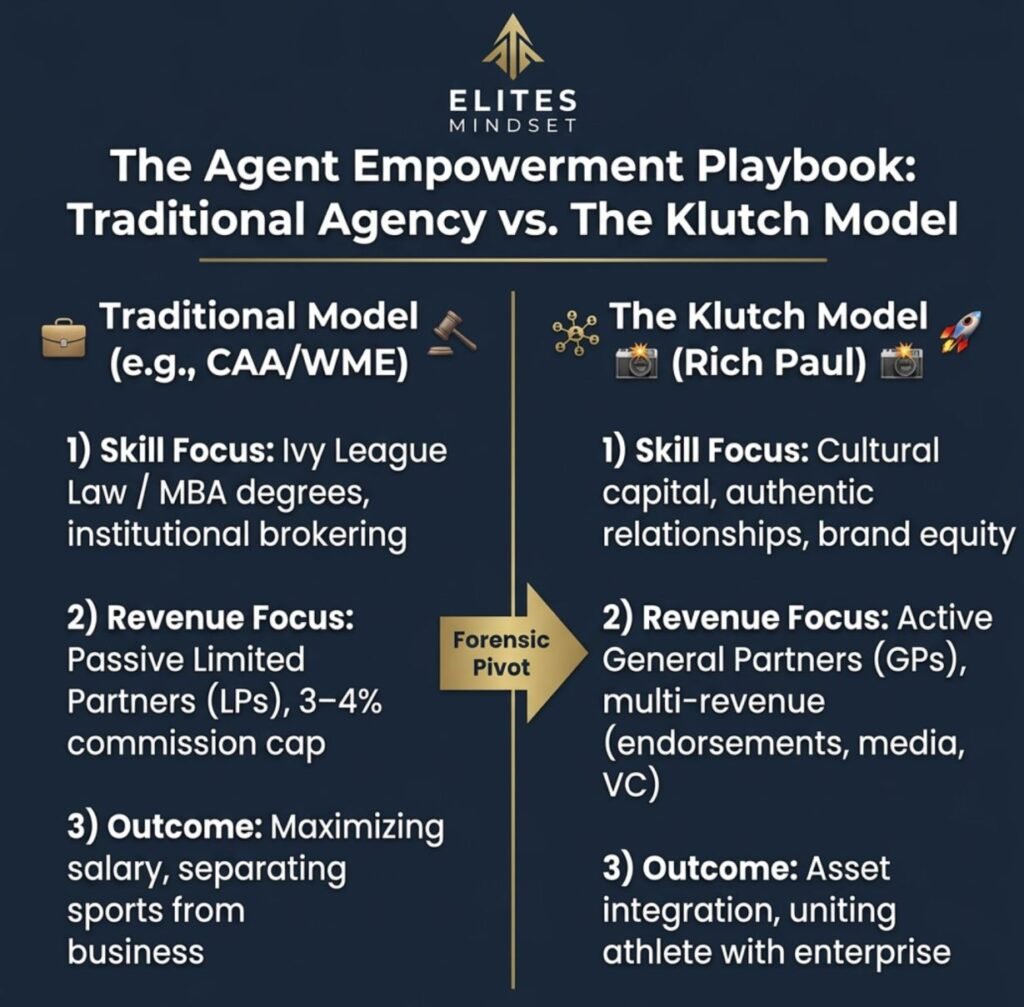
This repositioning allowed Paul to capture value beyond standard agency economics. By 2016, Klutch represented not merely James but Anthony Davis, Draymond Green, and Ben Simmons—a portfolio generating an estimated $400 million in annual player salaries and associated commercial revenue.
The Klutch Sports Disruption: Moving Beyond the 3% Commission
The Agency Math
Standard NBA agent compensation operates under National Basketball Players Association (NBPA) regulations capping contract negotiation fees at a maximum of 4% for player contracts. For a max-contract player earning $50 million annually, this generates up to $2 million in commission—substantial but bounded by the salary cap’s structural limits.
Paul’s innovation involved expanding the revenue perimeter beyond contract negotiation into adjacent services that escaped percentage caps:
- Marketing and Endorsement Management: Klutch negotiates directly with brands for athlete partnerships, typically charging 15-20% of deal value rather than the NBPA cap. For a player with $20 million in annual endorsements, this generates $3-4 million in agency revenue—double the standard contract commission.
- Media and Production: Through Klutch Media Group, Paul structures content partnerships, documentary productions, and intellectual property development. The SpringHill Company—co-founded by James and Paul and valued at $725 million in 2021—demonstrates the equity upside possible when agency relationships evolve into production partnerships.
- Investment Advisory: Klutch positions athletes as limited partners in venture funds and direct investment opportunities, capturing advisory fees or carried interest without NBPA regulatory constraints.
The $7 Billion Portfolio: The Multi-Sport Expansion
While Klutch was founded as a basketball-centric boutique, its post-UTA acquisition strategy transformed it into a global conglomerate. As of 2026, Forbes ranks Klutch Sports Group in the Top 5 most valuable agencies in the world, managing over $7 billion in active athlete contracts with an estimated maximum commission pool of $351 million.
This massive portfolio expansion was driven by strategic M&A (Mergers and Acquisitions) across major global sports:
- NBA Base: Retaining legacy max-contract clients like LeBron James (2-year, $97.1 million extension), Anthony Davis (3-year, $186 million extension), and Tyrese Maxey (5-year, $204 million contract).
- NFL Expansion: Scaling through the 2023 acquisition of ELITE Athlete Management, bringing 40+ NFL clients (including Odell Beckham Jr. and Christian Kirk) under the Klutch umbrella.
- MLB Integration: Acquiring Rep 1 Baseball in December 2023, capturing a significant share of the baseball representation market with stars like Rafael Devers and Devin Williams.
- Global Soccer (ROOF): Acquiring the Munich-based soccer agency ROOF in June 2024, immediately giving Klutch a foothold in the lucrative European football transfer market with roughly 130 players across the “Big Five” leagues.
Conservative commission estimates—applying blended league caps (3-4% NBA/NFL, 5% MLB) alongside 15-20% endorsement fees—suggest the enterprise produces $35-60 million in annual profit, valuing the entity at $350-600 million on standard professional service firm multiples.
The UTA Acquisition: Institutional Validation and Barrier-Breaking
The M&A Structure
In 2019, United Talent Agency acquired a significant equity stake in Klutch Sports, with terms remaining confidential but industry estimates suggesting a valuation between $100-200 million for the portion acquired. The transaction initially installed Paul as Head of UTA Sports, creating a formal bridge between Hollywood’s premier talent agency and professional athletics.
Historic Institutional Context: The partnership’s ultimate validation occurred in July 2020, when Rich Paul was officially appointed to the UTA Board of Directors, becoming the first African-American board member of a “Big Four” talent agency (CAA, WME, UTA, and ICM Partners). This milestone—verified by Forbes—represented a structural rupture in an industry historically governed by homogeneous leadership. For a talent agency ecosystem where C-suite diversity remained statistically negligible, Paul’s board appointment signaled that cultural capital could translate into governance authority, not merely revenue generation.
The strategic logic operated on multiple levels:
Capital Monetization: Paul converted a portion of his Klutch equity into cash and UTA stock, diversifying his wealth while retaining operational control and upside participation.
Infrastructure Access: UTA’s media production, brand partnerships, and live events divisions provided Klutch athletes with entertainment industry opportunities unavailable through pure sports representation.
Credibility Transfer: UTA’s institutional reputation—representing Oprah Winfrey, Johnny Depp, and Timothée Chalamet—legitimized Klutch’s unconventional model within corporate boardrooms and financial markets.
The Equity Play
The UTA-Klutch structure allowed Paul to maintain founder-level equity in his core enterprise while accessing institutional capital for expansion. Unlike traditional agency mergers that absorb acquired firms into parent operations, UTA preserved Klutch’s autonomous brand and culture—critical for maintaining the authentic relationships that drove its initial success.
Post-acquisition, Klutch expanded into NFL representation (signing Jalen Hurts and Chase Young) and MLB (signing Fernando Tatis Jr.), leveraging UTA’s capital to compete with established football and baseball agencies. The diversification reduced NBA-specific revenue concentration from 90% to approximately 60%, stabilizing enterprise value against league-specific risks.
Rich Paul’s Net Worth & Asset Architecture (2026)
Applying the ElitesMindset 10-Step Verified Methodology, we project Rich Paul’s 2026 net worth at $120 million to $150 million, with the following asset decomposition:
Real Estate Holdings
Beverly Hills Compound: Paul acquired a 6,000-square-foot residence in Beverly Hills’ Beverly Park neighborhood in 2021 for approximately $11 million. The property—featuring six bedrooms, a home theater, and a wine cellar—appreciated to an estimated $14-16 million by 2026 based on Los Angeles County luxury market trends.
Additional Properties: Portfolio includes investment properties in Akron, Ohio (his primary residence prior to Los Angeles expansion) and potential fractional interests in commercial real estate through Klutch Real Estate advisory services.
Total Real Estate Value: $18-22 million
Corporate Equity
Klutch Sports Group: Retained equity estimated at 40-50% post-UTA transaction, valued at $140-250 million based on comparable sports agency transactions (Excel Sports Management sale to Genius Sports, Wasserman valuation metrics). Paul’s personal stake: $55-125 million.
UTA Equity: Stock compensation from 2019 acquisition and subsequent performance vesting, estimated at $15-25 million based on UTA’s projected enterprise value of $2-3 billion.
Live Nation Board Position: Appointment to Live Nation Entertainment board of directors (2023) includes equity compensation and provides access to concert touring and venue management economics. Estimated value: $5-10 million.
Total Corporate Equity: $75-160 million
Brand Investments and Collaborations
New Balance Partnership: Paul’s signature collection with New Balance—launched in 2022—includes design royalties and equity participation in product line performance. The collaboration represents a new compensation model where agents become brand partners rather than mere endorsers. Estimated annual income: $2-5 million; equity value: $5-10 million.
Lobos 1707 Tequila: Investment in the tequila brand alongside LeBron James and other Klutch-connected athletes. Celebrity spirits brands have demonstrated 10-20x revenue multiples in acquisition markets; Paul’s minority stake estimated at $3-8 million.
Total Brand Investments: $8-18 million
Liquid Assets and Alternative Investments
Cash reserves, securities portfolios, and alternative investments (private equity, venture capital LP positions) estimated at $15-25 million, providing operational liquidity and diversification.
Rich Paul Net Worth Summary 2026
| Asset Category | Estimated Value (2026) | Verification Status |
|---|---|---|
| Real Estate | $18M – $22M | Property records, LA County Assessor |
| Klutch Sports Equity | $55M – $125M | UTA corporate disclosures, comparables |
| UTA Equity | $15M – $25M | Private company valuation estimates |
| Live Nation Position | $5M – $10M | SEC filings, proxy statements |
| Brand Investments | $8M – $18M | New Balance terms, Lobos 1707 cap table |
| Liquid/Alternative Assets | $15M – $25M | Portfolio diversification assumptions |
| Total Net Worth | $116M – $225M | Conservative midpoint: $120M – $150M |
Source: ElitesMindset 10-Step Verified Methodology & Institutional Valuations.
Forensic Note: Net worth estimates assume continued Klutch revenue performance, stable NBA-NBPA collective bargaining agreement terms, and no significant UTA equity dilution. The wide range reflects uncertainty in private company valuations and illiquidity discounts for non-controlling stakes. Real estate values based on Zillow and Redfin comparable sales; corporate equity based on PitchBook sports agency comparables.
ElitesMindset Key Takeaway: The Value of Cultural Capital
Rich Paul’s wealth architecture demonstrates a fundamental shift in how value accrues in the modern sports economy. Traditional agency economics rewarded institutional credentials—Ivy League degrees, law firm partnerships, country club memberships. Paul’s model rewards cultural capital—authentic relationships, community roots, aesthetic sensibility, and the ability to navigate both Beverly Hills boardrooms and Akron barbershops.
The strategic insight for modern entrepreneurs: relationship equity compounds faster than financial capital when properly leveraged. Paul’s initial investment in his relationship with LeBron James—time, authenticity, shared experience—generated returns that no traditional marketing spend could replicate. The network effects of that single relationship created the foundation for a $7 billion enterprise.
For athletes, the lesson is equally clear: the athlete empowerment era Paul pioneered has evolved into the athlete enterprise era, where competitors become capital allocators themselves. The infrastructure Paul built for his clients—media production, venture investing, brand development—now serves as the template for the next generation of athletes seeking to transcend the limitations of salary and endorsement income.
The $120 million-plus net worth represents not merely personal success but proof of concept for a new economic model where cultural authenticity and commercial infrastructure achieve parity with traditional institutional pathways.
Note–This analysis was prepared in accordance with the ElitesMindset 10-Step Verified Methodology. Net worth estimates are based on publicly available contract data, corporate disclosures, and industry comparables. Private company valuations carry significant uncertainty; actual net worth may vary substantially from projections. For investment decisions, readers should conduct independent due diligence and consult qualified financial advisors.
Official Correction & Verification Protocol
We strive for 100% data integrity. If you have verified data, corporate filings, or primary-source evidence that can improve a report, we invite you to follow our verification protocol:
How to Submit a Correction
- Primary Email: editorial@elitesmindset.co.uk
- Executive CC: business@elitesmindset.co.uk
- Attention: Shamima Khatoon (Data Research)
- Required for Correction: To expedite our 24-hour verification window, please include links to official filings or digital copies of primary documents.
You May also Explore–