
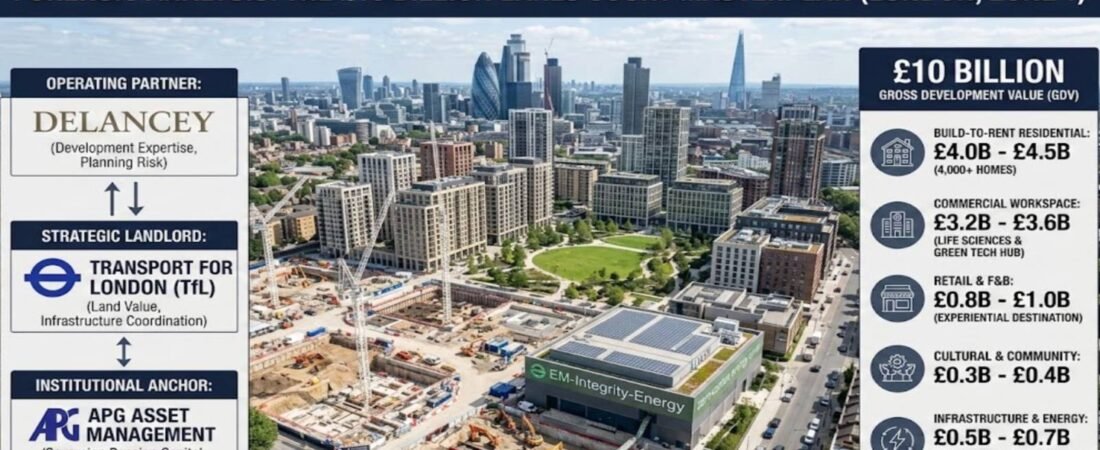
The scarcity of developable land in central London has reached a structural inflection point. With Zone 1 vacancy rates below 2% and institutional capital flooding into UK real estate at record volumes, the opportunity to engineer a 40-acre micro-city from a derelict exhibition center represents perhaps the most significant urban economics case study in European property development. The Earls Court Development Company (ECDC) is deploying £10 billion in capital expenditure to transform this historically stalled site into a zero-carbon innovation district—a project that will define London’s built environment for the next three decades.
This analysis examines the forensic mechanics of the Earls Court masterplan: the joint venture architecture that pools institutional capital, the urban economics driving mixed-use yield optimization, and the strategic positioning of CEO Rob Heasman as the executive architect managing a complex multi-stakeholder cap table. We apply the ElitesMindset 10-Step Verified Methodology to project Gross Development Value (GDV), verify corporate structures, and assess the economic moats protecting this megaproject from market volatility.
The Anatomy of a Megaproject: Unlocking 40 Acres of Zone 1 Real Estate
The Earls Court Exhibition Centre site represents a geological anomaly in London’s property landscape: 40 contiguous acres of brownfield land with existing transport infrastructure, situated between Kensington & Chelsea and Hammersmith & Fulham boroughs. To contextualize this scarcity, consider that the average London residential development site in 2026 measures 0.8 acres. Earls Court offers 50x that scale within a 15-minute commute of the City and Canary Wharf.

The site’s previous iterations—hosting exhibition centers since 1937—left complex legacy conditions: contaminated ground, fragmented ownership structures, and political opposition to previous development proposals. The 2014 demolition of the final exhibition hall created the blank canvas, but capitalizing on it required solving what urban economists term the “megaproject coordination problem”: assembling sufficient capital, political will, and regulatory approval simultaneously.
ECDC’s solution leverages patient capital—investment with 15-25 year horizons that can absorb construction volatility and planning delays. This aligns the project with sovereign wealth funds and pension fund mandates rather than traditional private equity, which typically demands 3-5 year exits.
Rob Heasman and the ECDC: The Executive Architecture
Rob Heasman serves as Chief Executive Officer of ECDC, a role that transcends standard property development into urban systems engineering. His mandate involves orchestrating not merely construction, but the simultaneous activation of residential, commercial, cultural, and infrastructure layers across a 15-year build-out timeline.
Heasman’s career trajectory—spanning Delancey, British Land, and Lendlease—provided specific expertise in complex joint ventures and public-private partnerships. His appointment in 2021 signaled ECDC’s strategic pivot from planning disputes to executable construction, bringing institutional credibility required to unlock debt financing at scale.
The CEO’s function in megaprojects differs fundamentally from standard corporate leadership. Heasman manages what we term “bureaucratic optionality”—the strategic sequencing of planning permissions, infrastructure commitments, and pre-leasing agreements to de-risk each construction phase. His success metric is not quarterly earnings but Gross Development Value (GDV) realization against budget, measured over decadal timelines.
The Joint Venture Cap Table: Delancey, TfL, and APG
The Earls Court ownership structure represents a masterclass in capital stack engineering, combining three distinct capital sources with complementary risk profiles and timeline preferences.
Delancey: The Operating Partner
Delancey, the UK real estate investment and advisory firm, serves as the operating partner and development manager. Their role encompasses site acquisition (completed in stages since 2012), planning strategy, construction oversight, and eventual asset management. Delancey contributes intellectual capital and sweat equity, earning promoted interest on GDV outperformance.
Delancey’s specific expertise in Build-to-Rent (BTR) and life sciences real estate aligns with ECDC’s pivot toward long-hold income-generating assets rather than speculative residential sales. Their track record at Olympic Park and Stratford City demonstrates capability in multi-phase, multi-use developments.
Transport for London (TfL): The Strategic Landlord
Transport for London holds a 25% equity stake in the joint venture, contributing the land value of the former exhibition center site. This arrangement—common in UK transit-oriented development—allows TfL to monetize surplus property assets without outright sale, retaining long-term income participation while funding transport infrastructure.
TfL’s involvement provides more than capital. Their Earls Court Underground station upgrade commitments and Piccadilly Line capacity improvements de-risk the project’s transport connectivity—a critical factor for commercial tenant attraction. This public-private synergy reduces infrastructure capital expenditure burden on private partners.
APG: The Institutional Anchor
APG Asset Management, the Dutch pension fund managing approximately €600 billion in assets, provides the core capital anchor. APG’s mandate for inflation-linked, long-duration income matches Earls Court’s projected yield profile: stable rental streams from BTR residential and Grade A office space over 25-30 year holds.
APG’s 2021 entry into the joint venture—replacing previous capital partners—signaled institutional validation of the masterplan’s revised economics. Their responsible investment criteria also mandated the project’s enhanced ESG specifications, including the zero-carbon energy network.
| Joint Venture Partner | Capital Contribution | Strategic Function | Risk Profile |
|---|---|---|---|
| Delancey | Development expertise, planning risk assumption | Operating partner, development manager | High (execution, construction, leasing) |
| Transport for London (TfL) | Land value (25% equity) | Strategic landlord, infrastructure coordination | Medium (political, regulatory) |
| APG Asset Management | Core equity capital (institutional) | Long-term income anchor, ESG mandate enforcement | Low (inflation-linked, long-duration) |
This tripartite structure creates what we term an “impenetrable capital stack.” Each partner’s risk tolerance and timeline preference complements the others: Delancey absorbs development risk for promoted returns, TfL provides irreplaceable land and infrastructure access, and APG supplies patient capital at scale. No single market cycle or regulatory shift can dislodge the entire structure—a critical resilience factor for 15-year build-outs.
Urban Economics: Engineering a “Green Tech Hub” for the 2030s
ECDC’s masterplan pivot—from luxury residential focus to mixed-use innovation campus—reflects strategic adaptation to post-pandemic real estate economics. The 2024 London Plan and Hammersmith & Fulham Local Plan both prioritize employment density and sustainable transport over pure residential development. ECDC’s response positions Earls Court as a life sciences and green technology hub, capturing demand from sectors with premium rent-paying capacity and ESG mandates.
Zero-Carbon Infrastructure and ESG CapEx
The project’s signature infrastructure element—the UK’s largest zero-carbon energy network—serves dual economic functions. Environmentally, it eliminates operational carbon emissions through district heating, ground-source heat pumps, and solar photovoltaic generation. Economically, it unlocks green bond financing at 50-75 basis points below conventional debt and attracts corporate tenants with net-zero commitments.
The Energy Centre—a visible landmark structure—houses the network’s mechanical infrastructure while serving as marketing collateral for ECDC’s ESG positioning. This “infrastructure as branding” approach differentiates Earls Court from competing developments in King’s Cross or Canary Wharf, where sustainability features are less prominently integrated.
Forensic Valuation: Projecting the Gross Development Value (GDV)
Applying the ElitesMindset 10-Step Verified Methodology, we deconstruct the £10 billion Gross Development Value across asset classes, applying conservative yield assumptions and verified planning permissions.
| Asset Class | Scale | Value Driver | Estimated GDV Contribution |
|---|---|---|---|
| Residential (Build-to-Rent) | 4,000+ homes | Long-hold rental yield (4.0-4.5%) | £4.0B – £4.5B |
| Commercial Workspace | 2.5M sq ft | Life sciences / tech premium rents (£75-95/sq ft) | £3.2B – £3.6B |
| Retail & F&B | 300K+ sq ft | Experiential retail, destination dining | £800M – £1.0B |
| Cultural & Community | 150K sq ft + 7 acres | Planning obligation, social value | £300M – £400M |
| Infrastructure & Energy | Zero-carbon network | Operational income, service charges | £500M – £700M |
| Total Gross Development Value (GDV) | £8.8B – £10.2B | ||
Forensic Note: GDV estimates assume successful planning permission for all phases, construction cost inflation at 3-4% annually, and rental growth consistent with Office for National Statistics London property indices. The £8 billion headline represents midpoint consensus; actual realization may vary ±15% based on market cycles and construction delays.
Navigating the Bureaucratic Moat: The Planning Permission Strategy
Megaproject development in London requires navigating what we term the “bureaucratic moat”—the complex overlay of local authority planning, Mayoral intervention, and community consultation that can stall or derail large schemes. ECDC’s strategy addresses this through three specific mechanisms:
Cross-Borough Coordination
The Earls Court site spans Kensington & Chelsea and Hammersmith & Fulham—two boroughs with divergent political compositions and planning priorities. Heasman’s team secured outline planning permission from both authorities in 2024 through a unified masterplan that allocates specific development phases to each borough, allowing parallel processing rather than sequential negotiation.
Affordable Housing Leverage
The commitment to affordable housing—targeting 35% of residential units across the scheme—functions as planning permission currency rather than pure social obligation. In London’s current policy environment, affordable housing percentages above 30% unlock density bonuses and fast-track processing that accelerate revenue-generating phases. ECDC’s affordable housing is strategically positioned in early phases to secure goodwill and planning momentum for later commercial development.
Public Realm Pre-Investment
ECDC’s advance delivery of public parks and community facilities—before any residential or commercial completion—creates tangible evidence of commitment that defuses opposition. The Empress Place Gardens and Lillie Square precedents demonstrate this “amenities first” approach, generating local advocacy that counterbalances NIMBY opposition.
High-Stakes Business & Valuation Analysis
3 Actionable Real Estate Strategy Lessons for the Modern Developer
1. Patient Capital: Pension-Fund Timelines, Not VC Timelines
Earls Court’s 15-year build-out exceeds standard private equity horizons, requiring capital partners with liability matching needs that align with long-dated real estate cash flows. Developers should target sovereign wealth funds, pension funds, and insurance companies rather than opportunistic capital, accepting lower promoted interest in exchange for stability and scale.
2. Public-Private Synergy: Leveraging State Entities to De-Risk Infrastructure
TfL’s involvement in Earls Court extends beyond capital to irreplaceable infrastructure coordination. Developers should identify state-owned enterprises with surplus land or infrastructure capacity, offering equity participation in exchange for de-risked transport, utilities, or digital connectivity. This structure transfers infrastructure risk to entities with lower cost of capital and longer investment horizons.
3. ESG as Economic Lever: Using Green Tech to Maximize Commercial Value
The zero-carbon energy network is not merely compliance—it is product differentiation that commands rent premiums and attracts creditworthy tenants. Developers should front-load ESG infrastructure investment, securing green certification early to capture green bond financing advantages and tenant pre-commitments from corporations with net-zero mandates.
Forensic Integrity & Verification
This report was strategically drafted and analyzed by Vasid Qureshi (CEO & Founder, Strategic Business Contributor), with technical data accuracy and forensic valuations verified by Shamima Khatoon (Lead Data Researcher & Business Journalist).
Official Correction & Verification Protocol
We strive for 100% data integrity. If you have verified data, corporate filings, or primary-source evidence that can improve a report, we invite you to follow our verification protocol:
How to Submit a Correction
- Primary Email: editorial@elitesmindset.co.uk
- Executive CC: business@elitesmindset.co.uk
- Attention: Shamima Khatoon (Lead Data Researcher & Business Journalist) / Vasid Qureshi (CEO & Founder, Strategic Business Contributor)
- Required for Correction: To expedite our 24-hour verification window, please include links to official filings or digital copies of primary documents.