

By: Shamima Khatoon, Lead Data Researcher & Business Journalist
Strategically Reviewed by: Vasid Qureshi, CEO & Founder
Jess Tomlinson brings over two decades of experience spanning banking, private equity, and legal practice to her role as Global Head of Real Estate & Housing at Lloyds Banking Group. A graduate with legal training from Allen & Overy, she spent three years as Chief Legal Officer at Blackstone Real Estate Debt Advisors before a decade at Barclays, where she ultimately served as Head of Public Sector. Her appointment to Lloyds in August 2024 positioned her to oversee the bank’s position as the UK’s largest commercial supporter of social housing, with more than £22 billion in financing provided since 2018.
Jess Tomlinson at a Glance
| Attribute | Details |
|---|---|
| Current Role | Global Head of Real Estate & Housing, Lloyds Banking Group |
| Joined Lloyds | August 2024 |
| Previous Roles | Head of Public Sector (Barclays), Chief Legal Officer (Blackstone Real Estate Debt), RBS, Allen & Overy |
| Experience | 20+ years in real estate, banking, private equity and law |
| Key Strategic Fund | £500M Social Housing Retrofit Commitment (Partially backed by National Wealth Fund) |
| Notable 2026 Deal | £195M finance package for Orbit Group (January 2026) |
| Major Milestone | £22bn+ total financing to the social housing sector since 2018 |
| 2026 Mandate | Overseeing £1bn new finance for the North East; Driving EPC Band C upgrades by 2030 |
The Gatekeeper of Social Capital: Jess Tomlinson’s £500M Strategy to Decarbonise UK Social Housing
The UK’s social housing sector faces a £36 billion decarbonisation challenge. With 34% of socially rented homes carrying an EPC rating below C and government mandates requiring all such properties to reach EPC C by 2030, housing associations confront a funding gap that grant support alone cannot bridge. Jess Tomlinson approaches this not as a policy challenge but as a financial engineering problem—one requiring the deployment of blended finance structures that de-risk capital deployment while meeting stringent sustainability targets.
Under her leadership, Lloyds has committed £500 million to social housing retrofit, partially backed by an 80% guarantee from the National Wealth Fund covering up to £400 million of the portfolio. This structure enables Lloyds to offer unsecured, price-competitive loans to registered providers who would otherwise face constraints around security, rental income, and interest cover. The mechanism is designed to unlock investment by addressing these structural barriers directly—mobilising private capital at scale while maintaining commercial discipline.
The Orbit Audit: Analyzing the £195M Finance Package
The January 2026 Orbit Group transaction demonstrates the “Dual-Desk” capability Tomlinson has engineered at Lloyds—combining traditional banking with long-term institutional investment. The £195 million package comprises three distinct elements: a £90 million sustainability-linked loan that refinances and increases Orbit’s existing facility while incentivising progress on decarbonisation and social outcomes; a £30 million retrofit loan partially guaranteed by the National Wealth Fund; and a £75 million package from Scottish Widows that combines existing debt with new funding on extended terms.
This three-pronged structure matters for institutional investors because it demonstrates how Lloyds can orchestrate capital across the risk spectrum—from short-dated, sustainability-linked bank debt to long-dated, match-funded institutional capital. For Orbit, which owns and manages 42,000 homes across the Midlands, East, and South East, the package provides the certainty required to deliver its 2030 Strategy while accelerating energy efficiency upgrades to ensure all properties achieve EPC Band C or above by the statutory deadline.
From Blackstone to the Public Sector: The Pedigree of Debt Management
Tomlinson’s expertise extends beyond housing policy into the architecture of structured debt. Her tenure as Chief Legal Officer at Blackstone Real Estate Debt Advisors provided direct exposure to complex real estate finance structuring, while her subsequent decade at Barclays—culminating as Head of Public Sector—delivered the political and regulatory fluency required to navigate government guarantee schemes.
This dual capability is essential for executing against the £13.2 billion Warm Homes Plan. The National Wealth Fund’s guarantee mechanism requires sophisticated documentation to ensure 80% coverage on a portfolio basis while maintaining commercial lending standards. Tomlinson’s background in both private equity debt structuring and public sector finance enables Lloyds to operate at the intersection—structuring transactions that satisfy NWF eligibility criteria while delivering risk-adjusted returns for the bank and its institutional partners.
Real-Time Retrofit: Using Data to De-Risk the £500M Fund
In late 2024, Lloyds commissioned a pilot study with Bromford housing association and technology provider Senze that challenges conventional retrofit assessment methodologies. The study fitted 121 homes with sensors to provide real-time data on thermal performance, air pressure, temperature, and relative humidity—comparing measured outcomes against modelled Energy Performance Certificate (EPC) ratings.
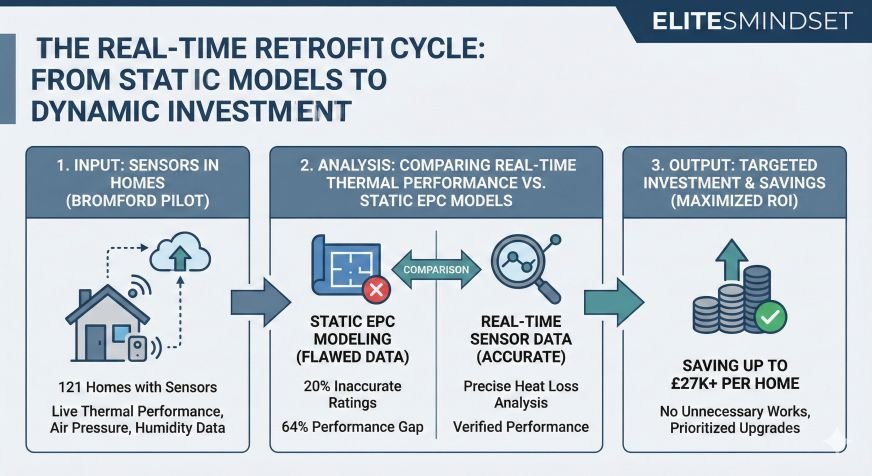
The findings expose significant flaws in current assessment protocols: 64% of homes showed a thermal performance gap of more than 25% higher or lower than predicted by EPCs, while 20% of properties had inaccurate ratings that misdirected retrofit investment decisions. The data revealed that 7% of homes earmarked for retrofit did not require intervention to achieve EPC C equivalence, while 13% of properties rated C or better were underperforming in reality.
Tomlinson’s response to these findings demonstrates the operational discipline she brings to the £500 million fund. Rather than deploying capital against modelled assumptions, she is building a data-driven investment model that targets resources to deliver maximum impact. The pilot suggests potential savings of up to £27,872 per home through targeted interventions—a critical efficiency given the £36 billion sector-wide funding gap.
Strategic Insights for B2B Real Estate Leaders
- Sustainability-Linked Loans as Performance Instruments: The Orbit transaction demonstrates how SLLs can function as de-risking mechanisms rather than mere marketing tools. By tying margin adjustments to verified decarbonisation outcomes, lenders align financial incentives with thermal performance improvements—creating contractual enforcement of EPC targets that standard loan covenants cannot replicate.
- Public Guarantees as Credit Enhancement: The National Wealth Fund’s 80% guarantee structure enables unsecured lending to registered providers who would otherwise face interest cover constraints. For institutional investors, this creates a synthetic investment-grade exposure to the social housing sector—previously inaccessible due to security and covenant limitations—while maintaining the pricing advantages of private finance.
- Data-Driven Asset Selection: The Bromford pilot reveals that modelled EPC data systematically misprices retrofit risk. Investors deploying capital against unverified assessments face material misallocation—funding unnecessary works on compliant properties while neglecting genuine thermal underperformers. Real-time performance data is becoming a prerequisite for investable retrofit portfolios.
- Social Impact as Risk Mitigation: Stable, energy-efficient housing reduces tenant turnover, rent arrears, and maintenance costs—directly improving debt service coverage. As Tomlinson’s strategy recognises, the “social” in social housing is not philanthropic positioning but a fundamental credit enhancement: warmer homes lower health costs and unemployment rates, strengthening the revenue streams that service institutional debt.
Editorial Note: This profile was developed by our Data & Research desk through a forensic audit of public sector filings and financial forecasts. Strategic oversight and commercial validation were provided by our Entrepreneurship & Finance desk to ensure the insights meet the highest standards of enterprise intelligence.
Suggested reads:
Nabeel Khan: The Urban Economist Behind Oxford Street’s £82M Transformation
Universal Credit Loophole: A Comprehensive Financial & Regulatory Analysis
The Mathematics of Direct Selling: Auditing the Cumulative PV Model & 6×6 Strategy