

Last Updated on April 26, 2026 by Shamima Khatoon, Lead Data Researcher & Business Journalist | Published: February 22, 2026
By: Shamima Khatoon, Lead Data Researcher & Business Journalist
Strategically Reviewed by: Vasid Qureshi, CEO & Founder
Nabeel Khan brings 15 years of public sector experience in urban planning, economic development, and major regeneration across London. A graduate of Warwick Business School, he has built a career at the intersection of spatial policy and commercial delivery, working with senior policymakers and politicians to foster inclusive economic growth while achieving Net Zero targets. His appointment as Chief Executive of the Oxford Street Development Corporation positions him as the executor of one of the most significant urban transformations in recent British history.
Nabeel Khan at a Glance
The Architect of Urban ROI: Decoding Nabeel Khan’s £18.0M Strategy for the Oxford Street Development Corp
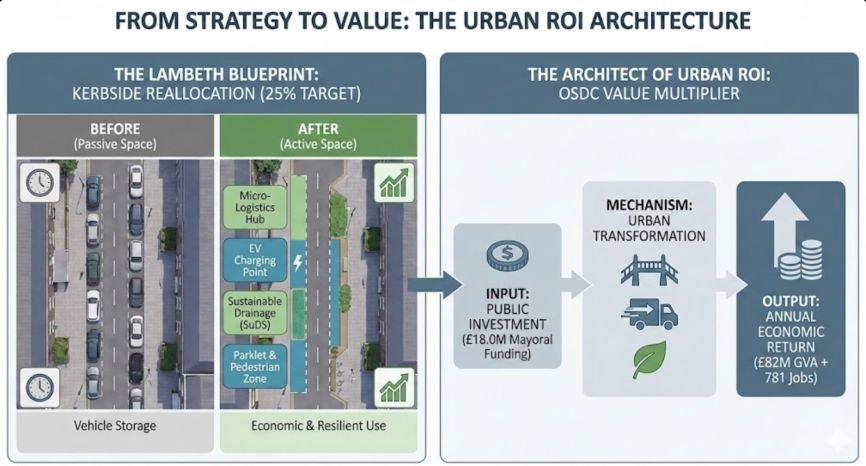
In January 2026, the Oxford Street Development Corporation (OSDC) came into legal existence with an £18.0 million Mayoral funding allocation and a mandate to engineer the most significant transformation of Britain’s retail corridor in a generation. The stakes are quantifiable: GLA Economics estimates that pedestrianization will increase Gross Value Added (GVA) by nearly £82 million per year while supporting a further 781 jobs. Nabeel Khan, appointed Chief Executive of the OSDC, is the executor tasked with converting this spatial policy into measurable economic return.
The Lambeth Blueprint: Reallocating the Kerbside
Khan’s appointment follows a six-year tenure as Corporate Director for Growth and Environment at Lambeth Council, (2019–December 2025) where he led the internationally recognised Kerbside Strategy. This initiative was governed by Lambeth’s Climate Action Plan (CAP), which established the target to enable 25% of kerbside space on Lambeth streets to be allocated to uses that enhance community and business resilience to climate change—including tree planting, sustainable drainage systems, cycle parking, and parklets.
This was not merely environmental policy. It was supply chain management at the municipal level. By regulating the “last 50 metres” of urban logistics—the kerbside—Khan demonstrated proficiency in managing micro-logistics that underpin macro-economic performance. The strategy systematically repurposed street space from vehicle storage to sustainable uses, creating cycle logistics hubs and pedestrian priority zones. Oxford Street presents the same challenge at scale: coordinating the West End’s complex supply chains, visitor flows, and retail logistics within a constrained spatial envelope. His Lambeth record suggests he understands that pedestrianization fails without parallel investment in freight management and service access.
The Be First NExD Tenure: Scaling Complex Industrial Real Estate
Khan’s commercial viability credentials are established through his tenure as Non-Executive Director at Be First, the regeneration arm of the London Borough of Barking and Dagenham. During this period, the organization delivered more than 1,000 affordable homes and Industria—the UK’s first multi-storey light-industrial workspace.
Industria represents a critical precedent: high-density, mixed-use commercial scaling in a constrained urban environment. The project required navigating complex planning frameworks, multi-stakeholder capital structures, and the operational requirements of industrial users within a vertical format. These competencies align with the Oxford Street mandate, where public realm improvements must integrate with existing retail basements, service corridors, and vertical mixed-use developments.
The 2026 OSDC Board Mandate: Capitalizing on the £82M GVA
The inaugural OSDC board meeting convened on 7 January 2026 at City Hall, establishing the governance framework for the corporation’s statutory functions. Chaired by Scott Parsons—former UK Chief Operating Officer of Unibail-Rodamco-Westfield—the board approved standing orders, financial regulations, and a draft budget framework.
The operational timeline is aggressive: traffic restrictions are targeted for summer 2026, with the TfL consultation on pedestrianization designs closing 16 January 2026. Savills has forecast a record number of retail launches on Oxford Street by the end of 2026, contingent on infrastructure delivery aligning with private investment cycles. GLA Economics estimates that pedestrianization will increase GVA by nearly £82 million per year—providing the economic justification for the public realm investment.
Strategic Takeaways for Institutional Investors
- De-risked Construction Phasing: Khan’s Lambeth experience in kerbside logistics management suggests capacity to minimize revenue disruption to existing retail tenants during the Oxford Street transformation, preserving rental income streams during the upgrade period.
- Mixed-Use Development Synergies: His oversight of Industria indicates understanding of how public realm improvements can unlock value in vertical commercial and residential assets adjacent to Oxford Street, particularly regarding service access and freight logistics.
- Public-Private Capital Coordination: The OSDC’s £18.0 million initial allocation functions as strategic public capital designed to leverage larger private investment; Khan’s track record at Be First demonstrates competence in managing these blended finance structures.
- Statutory Planning Certainty: As a Mayoral Development Corporation, the OSDC will act as the local planning authority for the Oxford Street area from spring 2026, providing investors with a single statutory decision-maker rather than fragmented borough negotiations.
Urban Intelligence: Nabeel Khan & OSDC Audit FAQ
What is Nabeel Khan’s primary mandate as CEO of the OSDC?
As of 2026, Nabeel Khan is tasked with the statutory execution of the Oxford Street pedestrianization. His mandate involves managing an initial £18M budget to re-engineer the West End’s spatial logistics, with the ultimate goal of unlocking £81.7M in annual Gross Value Added (GVA).
How does Khan’s “Lambeth Blueprint” apply to Oxford Street?
At Lambeth, Khan led the 25% kerbside reallocation strategy, mastering the “last 50 metres” of urban logistics. This expertise is critical for Oxford Street, where successful pedestrianization depends on de-risking freight management and ensuring retail supply chain continuity during the transition.
What are the statutory powers of the Oxford Street Development Corporation?
From Spring 2026, the OSDC functions as a Mayoral Development Corporation, serving as the sole local planning authority for the designated area. This centralizes decision-making, providing institutional investors with a streamlined statutory framework that bypasses traditional borough-level negotiations.
What is the significance of the “Industria” project in Khan’s portfolio?
Khan’s oversight of Industria (the UK’s first multi-storey light-industrial workspace) proves his capability in managing vertical commercial scaling. This experience is essential for Oxford Street’s “Mixed-Use Synergies,” where public realm upgrades must unlock value for high-density commercial and residential assets.
When will the Oxford Street traffic restrictions take effect?
The operational timeline targeted by Khan and the OSDC Board aims for traffic restrictions to commence in Summer 2026. This follows the conclusion of TfL’s design consultations and aligns with the projected surge in retail launches forecast by Savills for Q4 2026.
Editorial Note: This profile was developed by our Data & Research desk through a forensic audit of public sector filings and financial forecasts. Strategic oversight and commercial validation were provided by our Entrepreneurship & Finance desk to ensure the insights meet the highest standards of enterprise intelligence.
You May Also Explore-
The $380B Anthropic Valuation & Claude 4.6 Strategic Roadmap: A Digital Blueprint for Enterprise Decision-Makers
The Mathematics of Direct Selling: Auditing the Cumulative PV Model & 6×6 Strategy